aka_pseudonym
Members
-
Joined
-
Last visited
Everything posted by aka_pseudonym
-
Great. Vacuous post then. So how many wheel rotations are required to trigger the system? Is it the same for on and off? Is it front wheels only being monitored? What angle does the inclinometer look for when descending and levelling? I run 16" M+S's all year round due to my location so I'll need to do some calculations before I start re-landscaping my stopping spot. Thanks, be great to know that.
-
Thanks J.R. Thanks Llanigraham. I've been testing. I think I may have worked out what happens and how it's programmed to react! I've decided the hill descent switches off after the car has gone a certain distance on the flat. Likewise it switches on after it's gone a certain distance down a hill. The distance seems to be about a car's length or a little more but it's probably a fixed number revolutions of the wheels. And specifically the front wheels. So if you go forwards down a hill and onto the flat the front wheels will go at least the length of the car while the back wheels are still dropping down. If you go down in reverse it's the back wheels that'll run onto the flat while the front wheels will only reach the level area at the last moment - so not enough revolutions to trigger it to turn off. I hope I've explained that coherently! There's a sort of logic in that it waits until it has moved a fixed distance either down or along before it reacts. There's a bit of video on the BBC website at the moment of the effects of the melting of the permafrost in Siberia. If a Yeti drove across it (apt place for a Yeti after all) with the hill descent constantly turning on and off it'd be ridiculous. https://www.bbc.co.uk/news/av/world-54195656
-
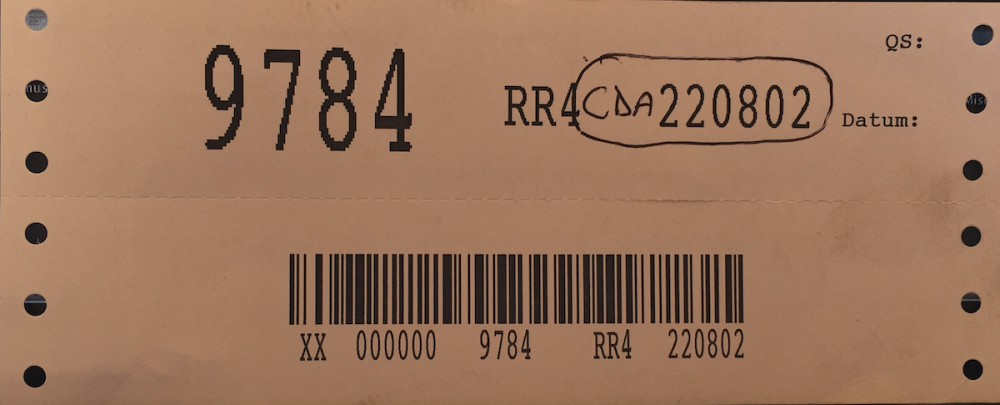
It will be. This is the tag which was attached to my engine when it was supplied. Same other than the numbers. The engine number - for the sake of the DVLA in the UK - becomes "CDA" followed by the six numbers. So your engine was made on 26th May 2017 at 3:11pm!
-
I'd certainly follow up widdershins post above this. I had something similar although I must admit it was sort of opposite as it came on when I applied power and went away when I backed off. It was discovered when it went for its MOT by the excellent old school mechanic at the garage I use. They are a poor components he said and fail on lots of VAG cars with four wheel drive. Expensive part for what it is - nearly £200 as I recall. Certainly worth a look. Looks like this.
-
The fact it works in reverse is one of the best things about it I think. I once went up the track in the snow in a Subaru Justy 4x4 and it lost traction almost at the top and started sliding down backwards. No ABS on it so wheels just locked. It was probably going at 25mph before I managed to stick it in a snow drift to stop it. But it felt like 100mph. One of the most frightening car things I've ever experienced! Now I can go upwards in the Yeti with the hill descent switched on knowing that if traction is lost it'll work the ABS all by itself to get me down slowly again and it won't care what gear it's in. I'll test it in forward motion next time. I know it doesn't release the pressure over time - tried to push it a little a while ago a couple of days after it was parked and the wheels were still locked. However when the ignition is turned on it seems to reset itself during its startup procedures even if the engine itself isn't running.
-
Very true. There you go! It's as though there's a trigger to release the pressure which I haven't found. It might be moving a certain distance on a flat surface. Or just a sensor recognising it's on a flat surface - which literally doesn't happen until the last 3ft or so. Or something else. Anyone know please?
-
I'm off road by about 3.5 miles. The last 250 yds or so is quite steep (more than 20º in places) and involves about 200yds forwards, a change of direction at a hairpin, and then 50yds reversing. All downhill. It only flattens out at the very end. So I turn on the hill descent (I enjoy looking at the view while the car goes about its business) and a few minutes later I'm parked. But at that point the hill descent hasn't released the pressure it has built up in the hydraulic system to do its job. I can turn off the hill descent. I can switch off the engine. The handbrake is immaterial - it's a good old fashioned manual cable on my car. So I'm guessing something triggers the hill descent system to open a relief valve somewhere so the pads are no longer pressed against the discs especially at the back it seems (but that might just be because the last stage is in reverse). I know the pads are free enough - I've had them out recently, cleaned and coated the ends with copper grease. It's as though there's a trigger to release the pressure which I haven't found. It might be moving a certain distance on a flat surface. Or just a sensor recognising it's on a flat surface - which literally doesn't happen until the last 3ft or so. Or something else. Anyone know please? It's not an issue, I usually just turn off the hill descent before or during the final reversing bit, it's just a niggle. If I knew what actually turns it off I might be able to trick it just at the right moment. (Hate cars that think they are cleverer than I am!)
-
I think you're worrying unnecessarily! If your car was made in 2012 it most likely had the revised engine anyway when it was made. As I recall the original engines - like mine - had an engine number starting CDA, revised ones started CDB. It'll be in the service book. I'm not sure if that's right but it's in this forum somewhere if you search. The early ones self destructed because the piston/oil rings design was rubbish, the chain tensioner was oil pressure driven, that didn't work so the chain skipped cogs, the timing went, the pistons hit the valves and its life ceased. But your original engine never had that problem - it probably had a cracked block or head from what you said. And even if it had a CDA engine originally, the one installed in 2017 would certainly have had the redesigned pistons, oil rings, con rods, chain tensioner etc fitted when it was reconditioned. VAG probably replaced tens of thousands of the original engines, in Audis, Skodas, VWs and Seats. They certainly wouldn't have replaced them with something which could fail again. Worry not!
-
Sounds good. If your car's original engine was changed "due to some missfires and coolant leak" that sounds more like a crack somewhere or a warped head rather than just a head gasket gone. Possibly easier for the dealer just to replace the engine and not bother trying to find out where the problem is. Anyway you've got an eight year old car with a three year old engine, I've got a ten year old car with a two year old engine, so we've both done well! I expect both engines will outlive the cars they are in.
-
I'm no expert but from what I learnt when mine was being swapped was it'd be much more than just the block. I understood a base engine would have been a complete assembly of a reconditioned block, head, camshafts etc all built up at the factory. They changed the specs for the timing/chain/tensioner components from the early 1.8TSI's as they were the weak link (pun) so they would have been new components to be fitted. What I also got "extra" as Skoda supplied a "complete engine" was the auxiliaries and bolt on bits - oil pump, water pump, sump and so on and so on. But as I say I'm no expert. You might do better to start a brand new topic in the Superb section "What is included in a base engine?". There are Skoda mechanics who contribute to this forum - they'll know.