Nirrain
Finding my way
-
Joined
-
Last visited
-
Thanks for all the input! My "less smart" 2013 Citigo had it original battery last for 9 years with more or less the same usage as the 2018 Octavia with infrequent use, except the citigo was used more for the very short trips. That is why I suspect the newer car being too smart for its own (or at least its battery) good. It was the authorized Skoda mechanic that programmed the new battery when the first battery died after 3 years on the Octavia so I am inclined to believe it was done correctly, though your comment regarding missing the 0 in 70 does raise some suspicion I have considered it, but from the very thorough analysis done by @RicardoM in Charging diagnostics my understanding is that the start-stop connector should not affect anything else and to me it seems that the car simply does not charge the battery sufficiently for good health but the start-stop system works as it should as long as the battery is fully charged (when done manually with a corded charger) I have not bought VCDS yet but trying to gauge if this issue would be another argument for getting one - I would also like to change the high beam assist to work at a lower speed but find it hard to pay the price just for that convenience That is a very good point, but as I understand the 2018 Octavia does not have regenerative charging and even if the target was 90% shouldn't the BMS still protect the battery from overcharging?
-
Would it be possible to configure the BMS to target a higher State of Charge for the battery using HEX-V2 and VCDS? e.g. target 90% SOC instead of 80% Related to below topics regarding frequent low state of charge and fast degrading batteries on a 2018 Octavia Battery issues Charging diagnostics Thank you!
-
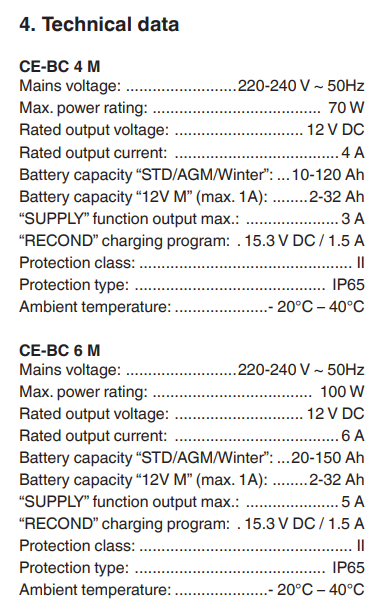
My understanding is that the upper limit it is more of a "convenience" to avoid too long charge time and that the lower current charger will all else equal be better for the battery no matter the size. For comparison the higher amp chargers have the same low limit capacity for maintenance mode, though they do have a RECOND mode that could have been relevant. At the moment I am leaning towards the battery no longer having its full capacity but still with significant life left and the main problem is that the BMS only charges towards 80% (or less) which is not ideal when the car is not driving every day. I wonder if a HEX-V2 and VCDS would enable me to increase the charging target to 90 or 95%. But otherwise the extended charging sessions while the car is parked may just be a necessary hassle to keep the battery healthy which only used occasionally.
-
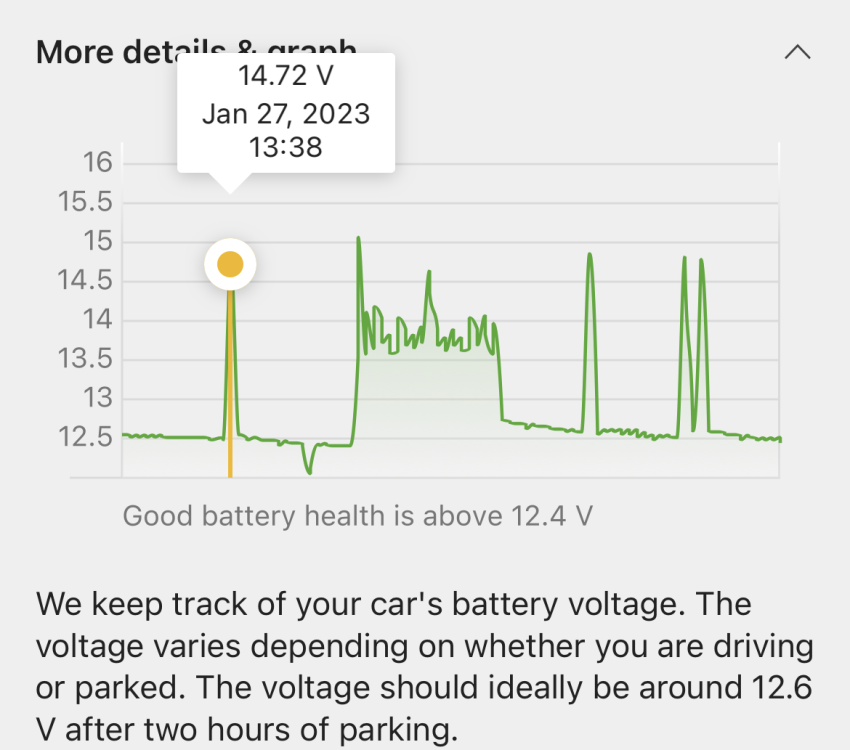
The charger has protection against overcharge and goes into trickle charge mode once full, I have, however, not been able to find out if that is the same as the explicit "maintenance mode" so I have manually changed it to maintenance mode once the normal (or winter mode when below 5C) charge reported the battery as full. From the SkodaConnect app the voltage fluctuates while in maintenance mode, see attached image showing 1 week measurements where the middle part was the long maintenance mode charge and the other peaks have been while driving. It is about 0-5C currently in Denmark, but I would prefer to keep the battery in situ rather than taking it indoors - our infrequent use of the car is not always planned ahead. The voltage readings have been from my multimeter as well as the "SkodaConnect" dongle that seem to be in agreement as long as the car is forced to be fully asleep (e.g. doors and bonnet hatch activated) I do not have access to a battery tester, but considered testing the capacity by a real load like turning on the headlights (or full beam lights) for a set amount of time and then based on the OC voltage and time until the charger reports to battery as full estimate the capacity - I do need to somehow find the headlight wattage though.
-
First of all thank you @varooom, @nta16 and @BigEjit for all your detailed suggestions tailored to my specific situation, I really appreciate it. ad 3. I recall that the battery had about 12.5V open circuit when I received it and that the manufacturing date code was about 3 months prior to the date I received it. ad 4. I drive the car for approx 7000 km/year where most of the trips are 40 min mostly highway, but also occasionally short trips. The car frequently stands still for 5 days at a time but it is rare that it exceeds a week. ad 5. I have not put an amp meter directly in circuit as my multimeter is rated only for 200mA and from other posts I understand that the sleep current may fluctuate (e.g. when the 4G SkodaConnect dongle wakes) so I have only measured the current draw indirectly by measuring voltage across the fuses and kept track of the battery voltage over time while parked. The latter being a poor indicator if the total capacity of the battery is nowhere near 70Ah anymore ad 6. Since I left the charger on for 48 hours in maintenance mode even though the charger reported the battery as already full, the battery seems to be in better health. After 3 hours parked the voltage is 12.59V and when parked for 24 hours it is now 12.52V. So much better than previously, but still either the current draw is high or the capacity of the battery is low as the energy loss from 12.59 to 12.52V is about 5Ah if the battery capacity is 70Ah when full which would suggest a current drain of about 215mA while parked.
-
That is a very good point, I am just a bit overwhelmed. Also heard some that recommends Carly https://www.mycarly.com/plan/?c=DK&b=vag&n=Volkswagen but the very different pricing models (VIN#, subscription, "per click credit" etc.) make is it difficult to identify what makes sense for my limited need - I do not think I am ready to take over servicing my two cars at this time so will have normal interval service at the mechanics regularly. I am located in Denmark so I doubt there are many local members around
-
Really appreciate your help! It is a 2018 Octavia Mk3 Combi, trim level "Style" with a 1.0 TSI engine and Manual 6 transmission gearbox The charger is an Einhell CE-BC 2 M 'smart charger' where I connect the + on the charger to + on the battery and - on the charger to the "ground point" of the engine mentioned in the manual. I then connect the charger to mains and have set it to "winter mode" for normal charging and "maintenance mode" for the long 48 charge while the car was shut down (e.g. all doors locked and the bonnet clamp activated with a screwdriver as mentioned in a different post regarding "correct way to measure battery drain" on briskoda. What should I be doing differently? When doing the trick with the ignition, brake pedal and headlights is the ECU using some internal battery to be able to register that it is being done?
-
What I meant was if there is a cheaper solution than the 3/10 VIN Hex-V2 from RossTech https://store.ross-tech.com/shop/vchv2_ent/ as that sounds more "pro" than my mechanic skills justify 😀 I have read the manual in particular regarding batteries and fuses, but the way the BMS really works is still a mystery to me. The next step I plan to take is to do a long maintenance charge on the old battery and then somehow check the capacity if I can find a suitable 12V consumer to see if that battery may still be of use while I monitor the behavior of the new battery in the car to see if the BMS just lets it unload gradually or actually keeps it in decent shape from here.
-
I do not, but have considered it. What would be the minimum required hardware and software purchases to be able to check it?
-
The first battery was an 69Ah Varta EFB OEM battery, the second was a Varta Blue Dynamic 70Ah EFB battery for cars with start-stop. I asked the shop to register the new battery with the computer as I installed it myself but have not (yet) dived into VCDS etc. Is that what you mean by adapt the battery or is that something else?
-
I'd appreciate more details, thanks! In my case the rough timeline is the following 1. My 2018 Octavia was not driven much during the first Covid lockdown in 2020 and when driven (short and long trips) the start-stop function did not engage 2. At one point the car reported low battery but could still crank, but on that trip it suddenly went into "safe mode" and the mechanic said it was a broken spark plug. They said it was not related to the low battery, but I am inclined to think it is related. 3. Since then the start-stop was only rarely engaged even when I charged the battery with a smart charger so I concluded that the low battery situation had damaged the battery so I replaced it in dec 2021 and everything worked fine for a while 4. In the summer of 2022 I noticed the start-stop again did not engage and I suspected the "Skoda Connect" dongle that Skoda installed to be leaking power so started monitoring the battery and charging whenever it went to 12.3 or below - resulting in external charge 1-2 times a week. 5. I measured voltage across all fuses while the car was tricked to sleep mode, but could not find any leaks 6. Then I noticed that even after a 45 min drive the battery quickly went from 12.6 to 12.2V while parked for 2 days and that the 2Amp charger only took an hour before reporting the battery as full 7. Then I tried to leave the charger on maintenance mode for 48 hours and since then the voltage dropped from 12.6 to 12.5 after 3 days parked As I understand the BMS does not only use voltage to gauge the SoC of the battery, so if the battery is charged to full while bypassing the BMS I would fear that the BMS thinks the battery is only at 80% or so and end up overcharging the battery?
-
Thank you! My car came with a Varta EFB 59Ah which lasted only 3 years and the replacement Varta 70Ah Blue Dynamic started giving me problems after 1 year, so I have a different experience. That said if the long session trickle charge after the battery is full will restore the second battery I am left pondering if the first battery could have lasted longer if I had done the same back then.
-
Interesting point, can you elaborate? I presume the BMS has registered the battery as full since it does not charge the battery further even on a long 45+min drive. But if I do not bypass the BMS while doing a long trickle charge session in-situ my thought process is that if I charge the battery in-situ to full then I expect the BMS to consider the battery full afterwards (even if it also registered it as full prior) and all should be well? Or am I mistaken?
-
For what it is worth I have been going through a similar experience: Rare start/stop and very quickly degrading battery voltage while parked (12.6 to 12.2 in the span of a few days), albeit with an EFB battery. My 2Amp 'smart charger' reports the battery as full after a few hours of charging despite 12.2->12.6 should be 60%->100% SoC so should take many hours on a 2Amp charger. After gathering input on reddit for this issue I tried to leave the charger on the battery in maintenance mode (13.5-14V current limited charge mode) for 48 hours even though it was already "full" which seems to work. My working theses is therefore that the surface charge (possibly due to Stratification, though that should not be so relevant for AGM batteries) causes the charger and onboard BMS to think the battery is full when it is not, and even though the battery does not accept much current in this state, it does still accept a little and is therefore gradually being filled closer to true capacity instead of just surface charge.