BigJakk
Members
-
Joined
-
Last visited
Everything posted by BigJakk
-
Quoted out of context (maybe i should become a journalist?) but that would be my overall advice! I kick myself a bit as I've never previously owned a car with a sunroof as any kind as i personally find them a bit redundant nowadays when A/C is pretty much universally standard. Likewise cabriolets have never been of any interest to me. I would certainly never spec one on a new car, it just happened to be that this car came up and happened to have one. I will certainly NEVER be buying another car with one. Its only once you dive into it you realize just how many potential flaws and problems there can be with these things and the maintenance requirements and the costs should repair become necessary -- when mine started leaking a few days after purchase i seriously worried it was going to be a case of getting rid of the car. Since having it repaired I will be watching it like a hawk and in my gut i cant help feel that this car wont be around long term once it has been paid off.
-
For me, whilst the interior trim is a lot better put together and the car 'feels' a lot more premium than my previous Octavia's, when you actually sit in them a white and start to look at them there are some noticeable backwards steps compared to my 14 year old MkII. The door plastics are noticeably harder and the door cards are basically a slab of plastic where on the old car they were a cushioned p-leather type material. The sports seats are much nicer looking than on the older cars however the fabric inner sections arent much to write home about and don't look as if they will be as durable as the fabric/foam weave thing on the older cars. Don't get me wrong, a lot of the stuff in front of you as a driver is very nice - i love the sports steering wheel in particular - but look closer and there are bits that have clearly not moved forwards or even gotten worse likely in the name of cost. I always find the throttle response on VAG cars to be a bit mushy at the start of the pedal travel - i know this is partly drive by wire throttles but i drive loads of different makes and models and it is particularly noticeable on VAG cars, especially when double de-clutching. The newer car is better for this than my MkII was but its a shame that the missus Fiesta still has a better throttle response. On a daft and purely subjective note, the engine - the TDI VRS is fine around the doors for most of your daily driving needs and is a wonderfully economical thing, but properly quick it is not im afraid. I read a comment on here before i got mine that the diesel VRS is just a family car with a sporty body kit rather than actually being sporty and in terms of power I have to agree - it does handle very well though - it makes me wonder why the engine wasn't refreshed at some stage as with an extra 200-210bhp it would probably be ideal. And on another personal note... the panoramic roof... never again 😨
-
Lubrication/Treatment of Sunroof Seals In my initial research into my leaky roof i kept coming across a lot of VW EOS Convertible owners boards - it appears that the EOS is basically a collander! One of the solutions VW have offered to fix the problem was treating the various rubber seals on the convertible roof using a special lubricant oil. This lubricant is called 'Krytox' manufactured by DuPont and is an expensive, super high specification PFPE lubricant. It seems that it has the effect of rejuvenating seals causing them to swell and remain water tight - it is also extremely durable and does not react to the elements and contaminants. VW sell this stuff under three part numbers: G 052 141 A1 - Oil based G 052 141 A2 - Paste based G 052 141 A3 - Aerosol based It can also be bought direct from DuPonts UK distributor GBRTech.co.uk who quoted me £30.30 for the 30ml of the oil (Krytox GPL-105) and £38.90 for 2oz of the paste (Krytox GPL-205), not including VAT and £13 fedex delivery. A lot of chat on the forums suggests it can go a considerable time before needing reapplying and that a little goes a very long way, however the oil based version apparently contains a lower quantity of the actual lubricant compared to the paste. There are several alternative PFPE type lubricants that can be found cheaper on ebay etc. including Zarox, Fluorofluid and Whiteline bicycle lubricants - however anecdotal evidence is that these, despite being cheaper are still fairly expensive and are not as good as the Krytox and this a bit of a false economy. Interestingly the Golf and Leon workshop manuals refer to applying the Krytox paste to the seals, however there is no mention of it in the Octavia manual. As such i was a bit reluctant to spend £50 quid on something that may or may not be necessary. In my research i found a lot of references to 'Gummipflege', particularly among owners of MB and BMW cabriolets. This stuff is a rubber conditioner which also appears to rejuvenate the condition of seals (unlike normal rubber dressings which simply make it look shinier) although the reports are that it is nowhere near as durable as the Krytox stuff as it isn't really meant for external use. There are several brands of Gummiplege - Sonax, Liqui-Moly, BMW and Nextzett. The Nextzett stuff seems to be the best rated and i got a 100ml tube from MicksGarage for about £6 delivered so thought it was worth a whirl. It comes in one of those Kiwi-Shoe Polish type applicators with a foam pad on the end. Having wiped the seals down with a damp cloth and dillute washing up liquid and water mix which i allowed to dry, i applied it to all of the rubber seals around the inside and outside of the roof panel as well as all my door and boot seals. There's still loads left in the bottle which i can see lasting sometime. I will see how it goes, but even if i feel the need to reapply every couple of months or so at this stage I dont feel as if im losing anything by trying this first as an alternative to the Krytox. Hope this has all been of use to you folks
-
Drainage Tubes - Continued: While not specific to the Octavia - the Leon Workshop Manual pretty much shows the layout of the drain tubes as they are on the Octavia in quite a lot of details as well as the cleaning procedure: http://www.seatia.com/secon-887.html
-
Lubrication of Roof Mechanism and Rails All workshop manuals for the Octavia, Golf and Leon refer to this as being a maintenance/service procedure however the only information i can find for the service interval comes from a Golf website where every 4 years or 40k miles is given. The three procedures seem to vary quite a bit, with the Octavia one appearing the most simple. I personally think that the sunroofs may be different for each model (as there are two different procedures for the Leon depending on body shape) however cant confirm this. Links to the procedures below : Octavia: See Page 115 in the pdf (https://www.dropbox.com/sh/6mvh3pqryshv3rp/AAAYSoCsp-vVWz-h4ko4QoAha?dl=0&preview=Maintenance.pdf) Leon: http://www.seatia.com/secon-1242.html (Procedure differs from hatch/couple and the ST) Golf: https://www.vwroc.com/forums/topic/26804-sunroof-maintenance/ The lubricant itself in all manuals is listed as VW solid lubricating paste (G 060 751 A2) - I managed to get a 160g mastic gun type tube for £40 from TPS, you can get it on Ebay for slightly more. That quantity looks like it will last beyond my lifetime. Im not sure what exactly the stuff is in terms of identifying a cheaper alternative - it a graphite grey type colour, thicker consistency than lithium spray grease, quite sticky. In terms of the procedure itself, i tired using a shop vac to hoover any debris out of the rail area - however the nozzle was too big to really be effective. Likewise i had a spray can of air that i tried to use to blow out the thick, however this didn't really do much - i can imagine though that a proper decently powered air compressor may assist here. All i ended up doing was using a clean microfibre cloth and making sure i gently worked well into the rails and nooks. As the existing lubricant was still quite sticky this managed to pick up a lot of the loose old lubricant and the dirt embedded within. In terms or applying fresh, a little went a LONG way. I tried applying it to the rails using a small artists brush bent at an angle however I am far too clumsy for this and access is quite tricky (a small step ladder may assist with this from the outside, from the inside you'll have to climb onto the seat base). In the end i used cotton buds, bent at an angle and smeared in the grease and ran them along the rails. This probably ended up going on a bit thick but i cleared up the excess with another clean microfibre cloth. I then ran the roof open and closed a few times. The Leon workshop guide details a specific attachment to the mastic tube which looks to apply it precisely where it needs to do - i googled this - VAS 6621 'Grease Stone' however couldn't find anywhere selling or a price. As per my original post, i cant quite work out which final section of runner the Octavia manual is referring to?!? After re-greasing, the panoramic roof's opening and closing doesn't feel or sound any different, no smoother and no less smooth - with that said the old lubricant i removed did seem to have picked up quite a bit of grit and dirt - always an issue with greases and given the potential damage this could cause with metal on metal contact i feel it was worth doing. The service interval seems a bit long to me, maybe something you just check on each spring time?
-
Where to being with this, I recently bought my Mk3 VRS used (but new to me) from a good friend. The car has a pano-roof, which i wasn't massively fussed about and on the basis of my experiences so far I will never buy a car with again. Long story short within a few days of buying the car i found the roof was leaking. The issued appears to have been fixed now by my local VW independent specialist who had to remove the roof, fit a new seal, re-bond the roof to the plastic frame and then refit. As a result of my issues I've done a LOT of research into these roofs the last few weeks so prepare for a long winded response. The roofs themselves appear to be manufactured by Webasto however the VAG appear to have a particularly poor track record in terms of leaks and drainage issues when compared to other marques. Clearing Drainage Tubes The most common issues are the sunroof drains themselves becoming clogged and flooding. The way to test this is to carefully run some water into the sunroof tray (i used a squeezy mineral water bottle) and see if it drains effectively - the drain points are at the front and rear wheel arches. Even if still draining okay i would suggest this should be a yearly job. My front drains were nowhere near as efficient as the rear drains. With the roof open, the drainage points can be found in the four corners of the plastic sunroof tray, however the two rears ones are not readily visible and are hidden by the mechanisms. The two front ones are easily identifiable and are circular holes a few millimetres in diameter. These drain points are bonded to drain tubes - I've seen other people have these bonds fail and leak or become disconnected and they have had to drop the headliner and re-bond the pipes to the roof. The front drainage tubes run down the A-Pillar and exit at the bulkhead in the engine bay. The drain tubes themselves are just push fit into a rubber boot at the bulkhead and again in mu opinion there is the potential for this to work loose and leak. The procedure i used to clear the front drains was firstly to open the bonnet and remove the rubber stripping from the plenum chamber cover - it will just pull off. From there you will see there are several metal clips which secure the plenum cover, again these will pull out and you should be able to lift both corners of the plastic plenum chamber cover. The workshop manual suggests the windscreen wipers need removing, but even with my shovel hands i was able to reach in under the plenum chamber cover and feel towards the base of the A-Pillar where you will feel a rubber nipple. You need to manipulate this and you should feel an amount of gunk work clear from the nipples, this in itself should improve the efficiency of the drainage tubes markedly. To clear the tubes themselves some recommend blowing compressed air from the drain point in the roof tray, however VW seem to advise against this and the workshop manuals refer to using a bowden cable or similar as a drain snake. Personally i wouldn't use anything metal or too rigid as the drain pipes themselves aren't especially heavy duty and i could see the potential to cause damage. I purchased some plastic garden strimmer line for a couple of quid from the DIY shop - 2mm diameter, in reality i could probably have done with using the same stuff but a bit thicker as this was a bit too malleable and not strong enough. As such i doubled it up and taped it at several points to double its thickness and make it a bit stronger. It was then a case of gently feeding it down the two drainage pipes - if you hit any snags its probably a bit of blockage, working the cable back an forth it should push through and i was eventually able to get my cable to appear out of the bulkhead nipple and then basically 'flossed' the drainage tube. I repeated this several times and quite a bit of gunk was loosened. I then repeated this on the other side front drain. Finally i used a large syringe containing hot (but not too hot) water and washing up liquid and injected this directly into the drain point just to try and degrease and clean any final bits out. As discussed the rear drainage tubes cant be easily accessed from the top by my eyes. The workshop manual suggests these exit by the rear wheel arch and that access to clear the drain point nipple can only be gained by removing the rear bumper - which looks a right ball ache. I have seen some suggests that taking off the wheel and arch liner should also get you access. You could also clear the tube from within the car - removing it from the rubber boot where it enters the drainage nipple and exits the car, but this would mean removing a lot of the boot trim. This was all a bit involved for me as my rear drains seemed okay, however i will keep an eye on this. My research suggests that the way to clean these drains is again using your improvised drain snake - however this time from the bottom up, feeding it from the wheel arch nipple up towards the roof where it should emerge. I will stick another post on shortly re: the lubrication of the mechanism and seals
-
Darkside Developments posted an interesting analysis of several Diesel Tuning boxes onto their Youtube channel a month or so ago, included the likes of DTUK and TDI-Tuning as well as some from overseas. Interestingly they all only made around 210-220bhp despite claims of 240+ and according to the folk at Darkside the methods by which this extra power was being produced may not be the cleverest for the health of the car. I know there's an element of Darkside being a competitor to these companies but the analysis was pretty detailed (as is most of the stuff they seem to put out - a lot of it is well over my head) and interestingly the tuning company i have used up here in the past also poured scorn on the idea of getting more than 210-220 out of the 184 TDI at Stage 1, even more so if the transmission has had a harsh paper round. All in all, it was enough to put me off the idea of tuning boxes. EDIT - Just seen Gary's link - same video i am referring to above
-
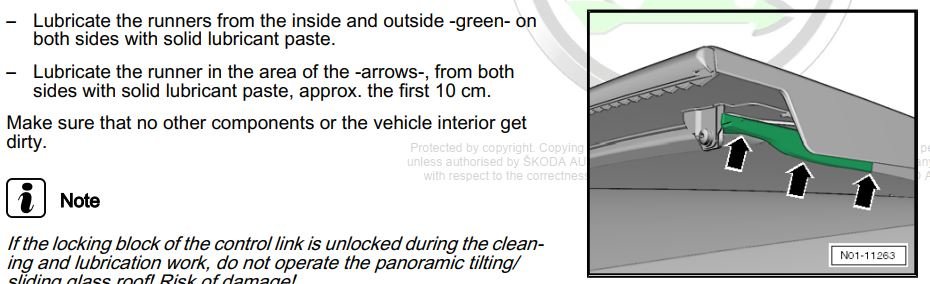
Hello guys, After my recent experience with my leaking panoramic roof on my new (to me) VRS - fingers crossed foxed now - i have decided to very much keep on top of the maintenance for the roof. I have cleared the various drain points and applied gummi-pflege to all of the rubber seals (I know VW recommends krytox for this job but the stuff is very expensive - from my reading it seems the gummipflege isn't as durable but i figure that gives me a reason to reapply it and re-check the roof more regularly). I have invested in some of VW's lubricant paste which is referred to in the workshop manuals (again this must be made of unicorn tears given the price of it). Having checked the Skoda workshop manual the greasing procedure seems much simpler than the process listed in the Mk7 Golf and Leon workshop manuals and refers only to greasing the rails and a short length of runner. I have greased the rails this afternoon, but cant work out where this runner is that is referred to. I have attached a clipping from the workshop manual showing this but wondered if anyone had done this procedure may be able to direct me to it with photos of the area as it looks in the real world? Thanks again
-
Hello Folks, After my recent adventures with a leaking panoramic roof which is now *touch wood* fixed, i am quite determined to keep on top of maintaining it. I am aware that VW specify two particular specialist lubricants for the job - an oil based one for the actual rubber seals and then a paste based one for the actual metal runners and rails of the roof. From my research it seems that VW's specific lubricants are in fact Krytox GPL-105 (the oil) and Krytox GPL-205 (the paste) - both of which are fairly expensive. My understanding is that they are both chemically the same however the oil is less concentrated and 'watered down' into liquid form. As such, to save myself a bit of money i was thinking of trying to source some of the Krytox GPL-205 paste and use it for both the rubber seals and the metal to metal components, i was just wondering if anyone had any experience of using it on the rubber seals and whether it was just as suited to the job as the oil -- it just seems a bit silly to buy two expensive lots of what im informed is chemically the same stuff? Thanks guys
-
Unfortunately not - i had a look at the printout they had of the TPI but im afriaid didn't make a note of any of the details. I will ask if i can have a copy when i go back to the garage to collect the car - 'for my records' and all that, i will report back As an aside, my independent have been really good with this so far, they were quite happy to keep my car inside over the weekend to prevent any further water ingress and to try and get it aired out for me over the weekend too. In contrast i contacted the next nearest local Skoda dealership to me, just out of interest to query whether they were aware of the issue - the first person i spoke to didn't even know what a TPI was, i was then told that they were unaware of any such issue on the Octavia😦
-
Yes, despite having owned Skoda's for 10 years I've only ever had one other direct dealing with dealers. I wasn't exactly bowled over by them. I think I'll keep this in the hands of my independent for as long as possible. Fingers crossed this will be the fix but I'm not holding my breath. 😔
-
So, this morning went to pick the car up from my independent. They explained that since I last spoke with them they had made some enquiries with their contacts and there IS in fact a TPI against my cars chassis number relating to panoramic roof leaks. Interesting considering Skoda said there was nothing on their system! 🤨 They showed me the print out which relates to the seal between the metal roof and the sunroof structure. There is a water ingress issue at the seal which can leads to corrosion which then becomes a bodyshop issue too They advised there initial investigation shows no evidence of corrosion to the metal so it may just need the updated seal. They have ordered the parts and when they arrive on Monday the roof will be coming out. They've agreed to keep the car indoors and out of the rain over the weekend, so hopefully the damp issue shouldn't get any worse. Just thought the fact there is a TPI may be of interest to anyone else with problems
-
More disheartening news. My VW independent had a look and confirmed that there are no issues with the drains, water is coming in through the frame. They're hesitant to go any further as their next step will be panoramic roof off and they admit this isn't a familiar issue to them. They suggested a call to Skoda to see if there are by recalls or repair/service kits for the issue. They've kindly offered to keep the car indoors overnight as it looks like it's going to lash it down. Local Skoda dealership says no recalls or technical bulletins, they said they have loads of issues with Yeti roof's but haven't had any problems with Octavia's. All they could suggest was book it in with them for (another) diagnostic - wouldn't be drawn on likely cost of repair but said worst case I'm looking at a new roof. It's safe to say I feel sick at the moment.
-
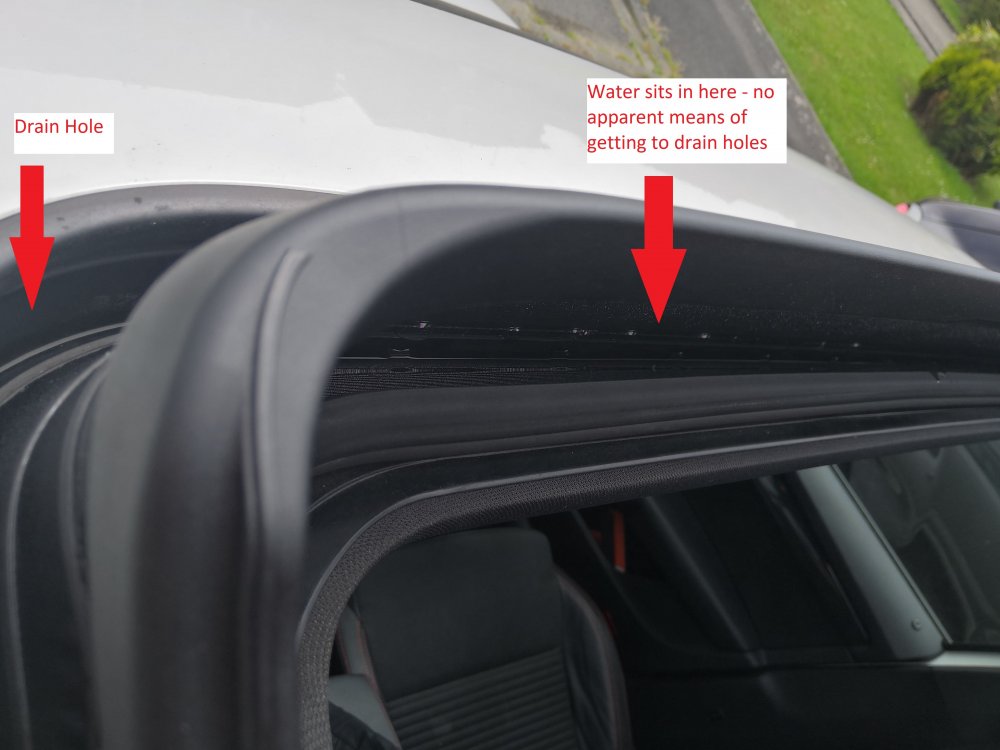
I think that's an excellent idea, it also gives the advantage that as its reversible i can still pop them off at this point for future cleaning.. I've wasted another morning really, however out of interest i stripped down the A pillar on the drivers side and found that the green drain tube on that side is similarly just pushed fit into the black sidewall grommet. It all seems a bit haphazard to me so as per the above suggestion i have nipped the join up a touch with a cable tie on each side. They would both need a good yank to come away now. I also took the opportunity to floss the drivers side drains with my improvised nylon drain snake and flushed through both sides with with lukewarm soapy water until both ran pretty clear. I've only managed to wet vac about 100-150ml of water out from the carpets this morning, so the carpet is obviously drying in the warm weather - I've also taken delivery of a water resistant roof cover for the inevitable monsoon that will no doubt arrive soon When testing for leaks, the car has been pointed with the nose on a downward angle - however i notice that panoramic roof tray seems to have an outer where the drain holes are and an inner tray behind the concertina fabric noise canceler. I notice that this inner try also seems to fill with water but there doesn't seem to be anywhere for that water to then go and reach the drain, so it is just sitting there. Unfortunately the big kick in the slats is that water is till persisting it down from the headliner on the passenger side whenever i test the drains. I really cant get any more access from the head liner so its off to the VW specialist around the corer in the morning however when booking it in i got the ominous 'we would usually just point you to a body shop for panoramic roof issues'. Ive had the car four days and im already contemplating how to get rid of it 😩 As an aside, for anyone who should stumble across this and is suffering draining issues this excellent link pretty much gives everything you need to know about the drainage tubes and how they are routed: http://www.seatia.com/secon-887.html
-
Thanks folks, I've got the tech diagrams for the drain pipes and found a how to for removing the sun visor on a Golf R forum... Unfortunately it looks like a set of nifty and expensive pliers are needed to do so 🤨 (why can't things just be screwed on these days) so I've hit a stumbling block there. I definitely think that join needs sealing as it is ridiculously loose fitting, would a polyurethane sealant like 'pu flex' be more suitable? I've used that to seal metal before but not on rubber/plastic. Thanks again guys
-
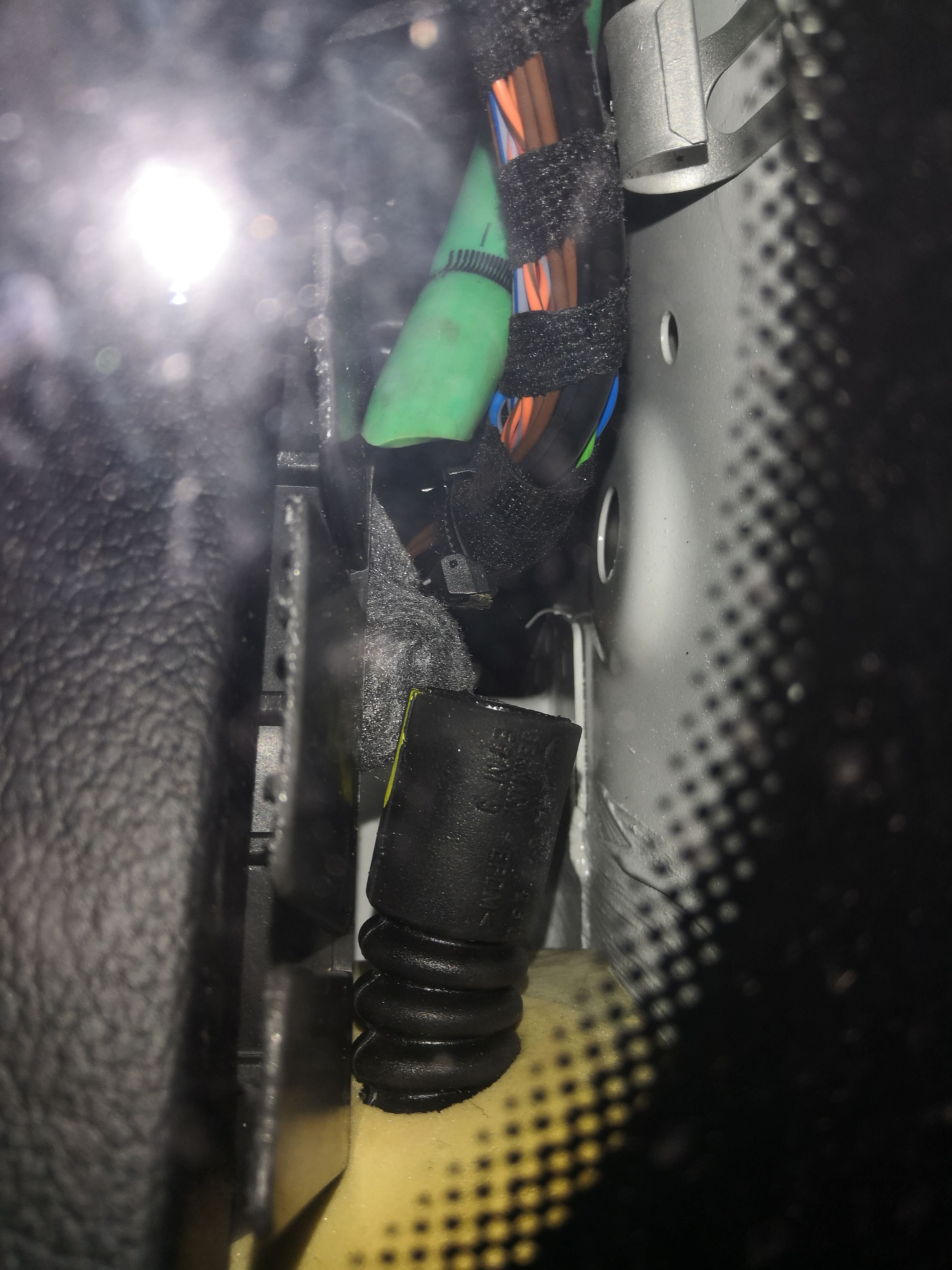
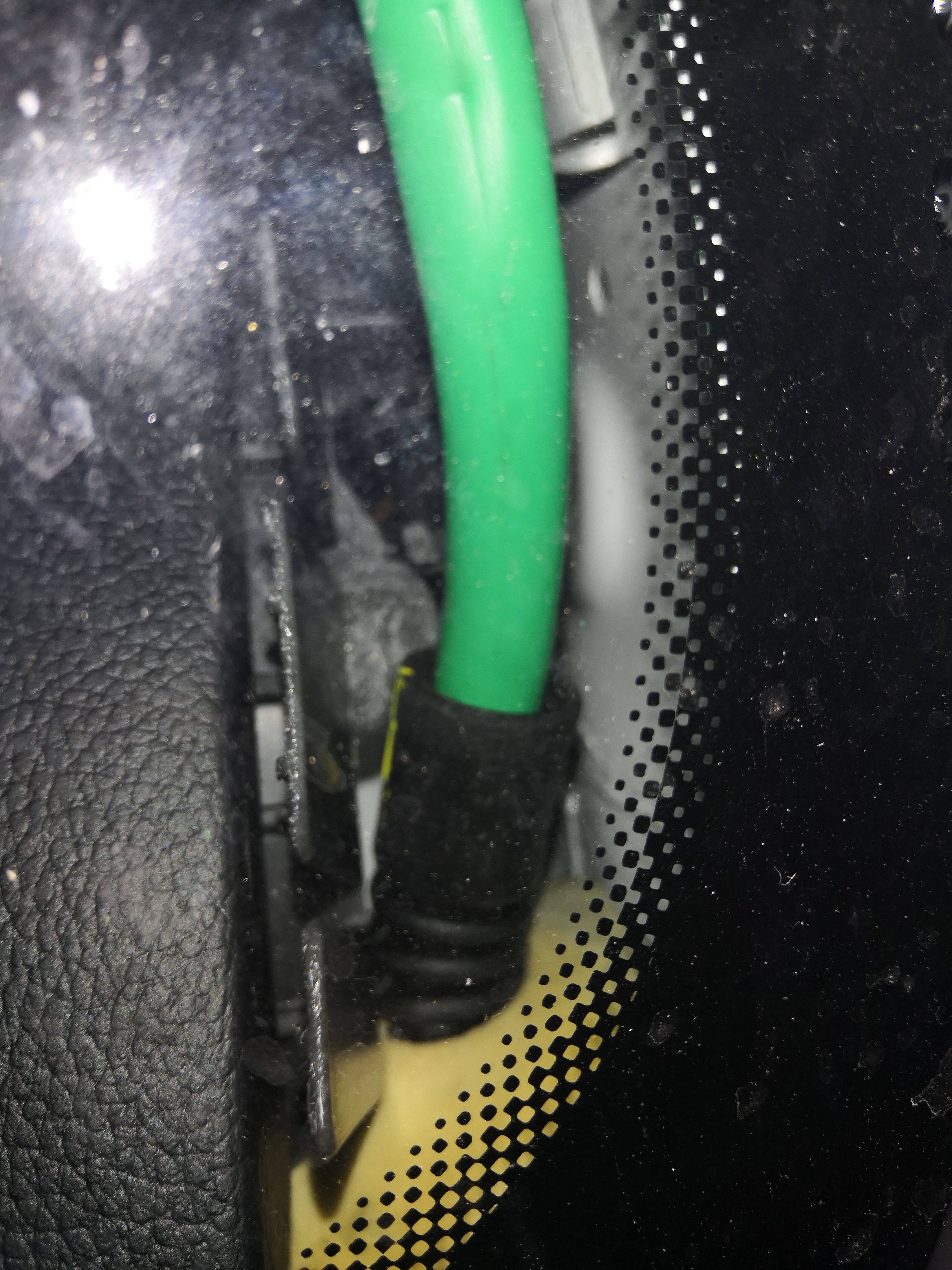
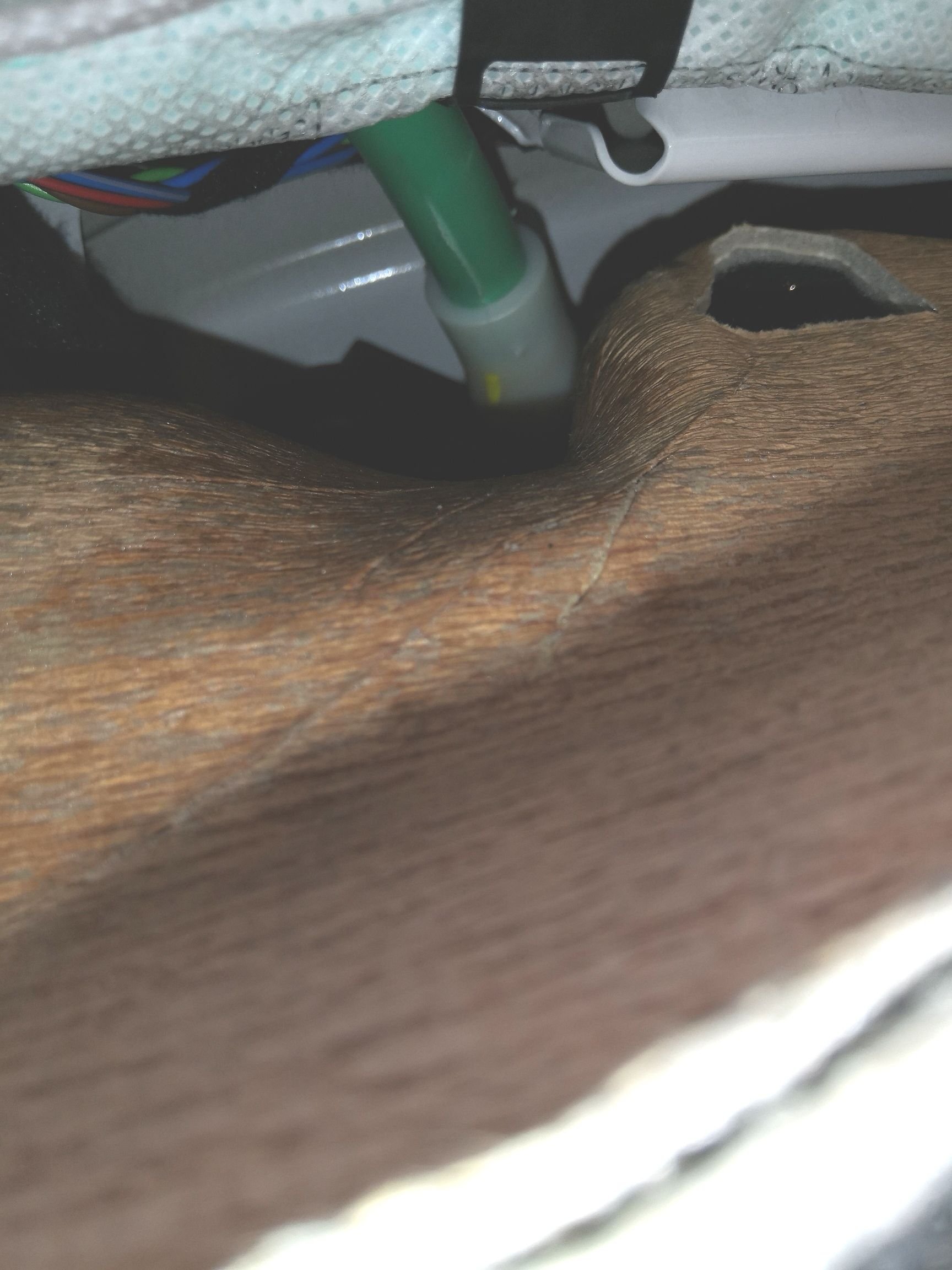
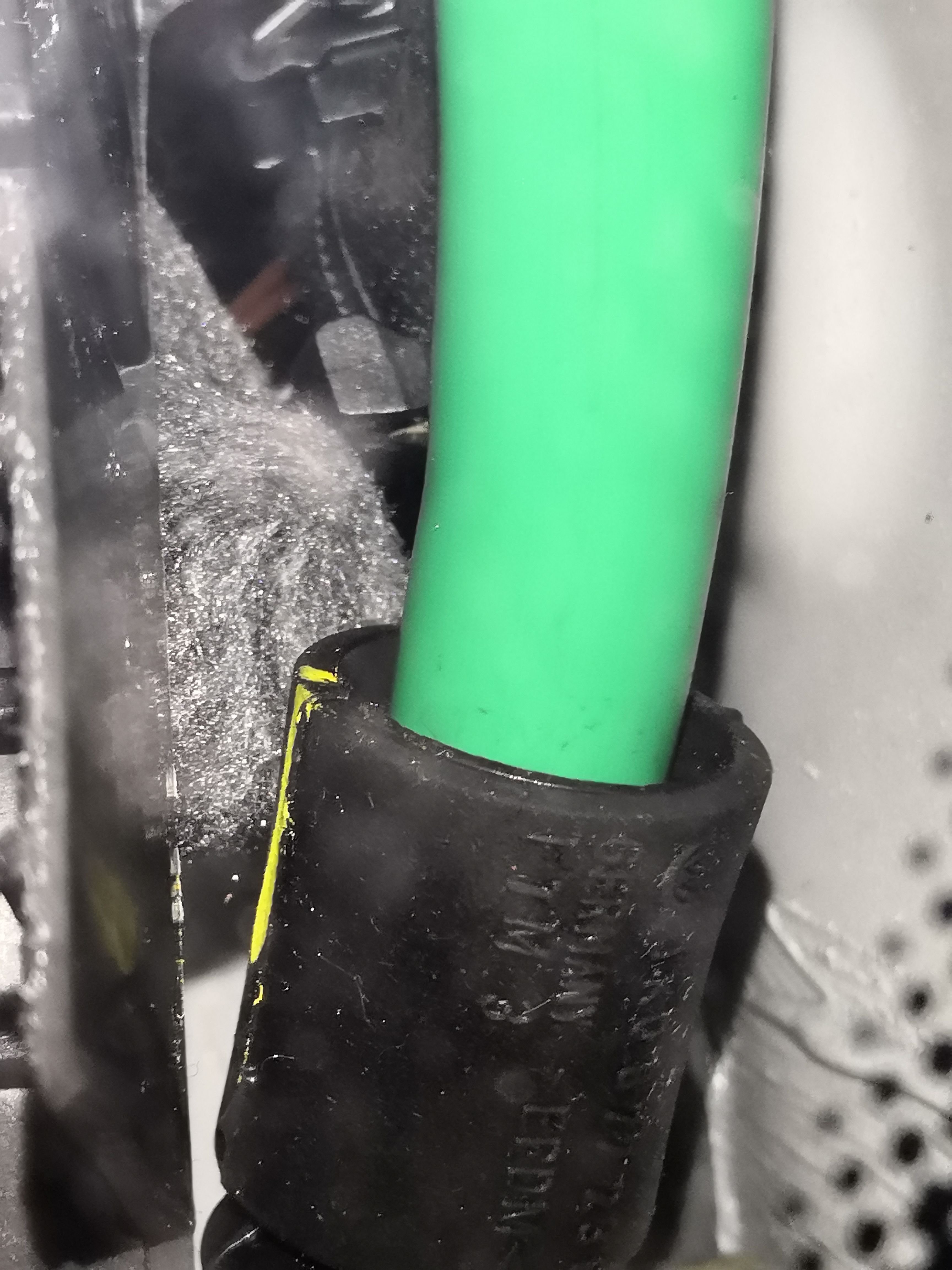
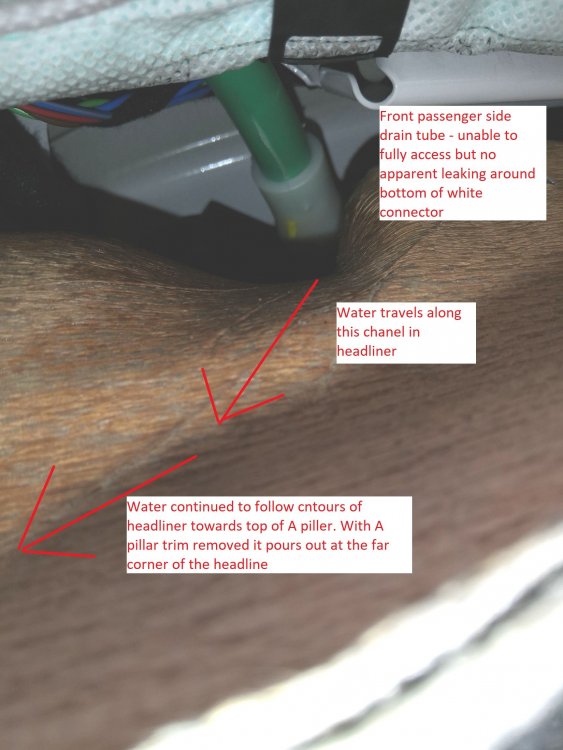
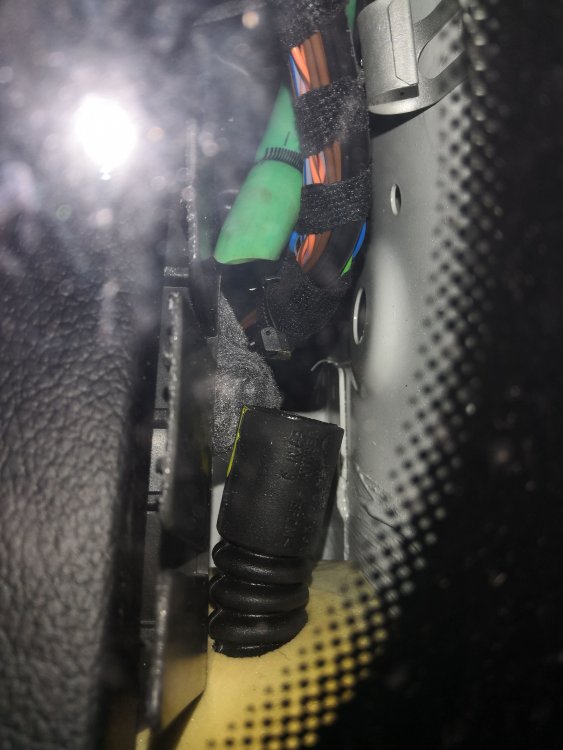
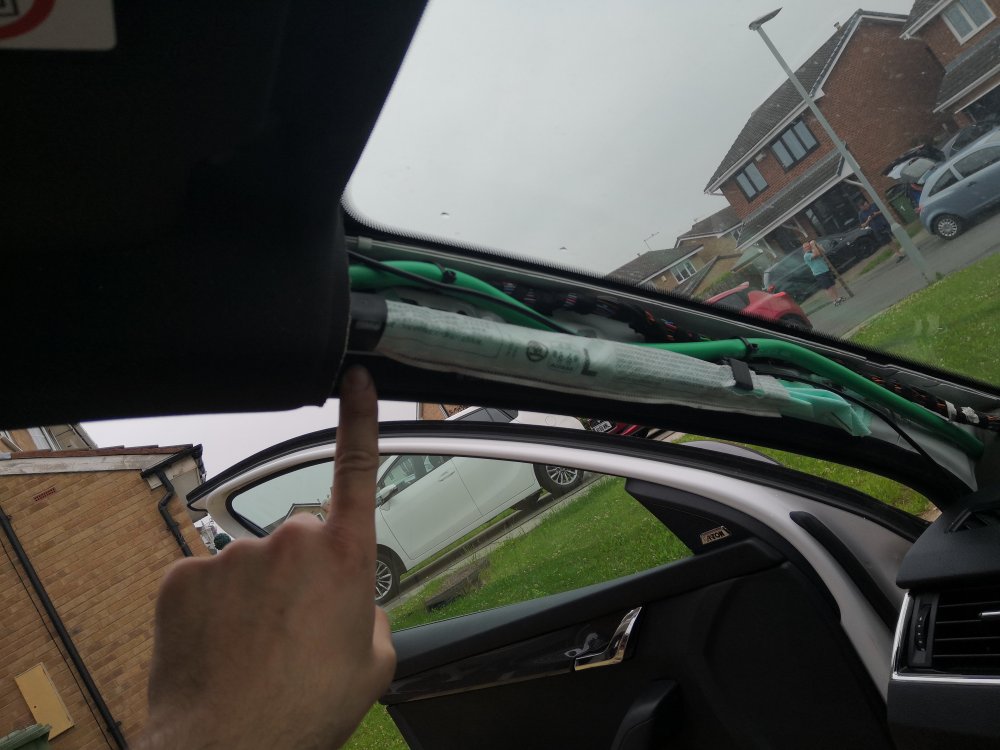
So, todays investigation of the nearside/passenger side drain tubes have got me so far Having removed the A pillar trim, soaking the sunroof tray with the roof open, water was immediately piddling out from the corner of the headliner and also at the bonnet release handle in the footwell. I've pulled through the full length of the drain with strimmer wire as suggested, I've also discovered that the drain tube at the bottom of the A pillar is extremely loosely connected to the tube/grommet leading through the firewall. Having firmly reinserted the drain tube, the leak at the bonnet release seems to have gone. It doesn't look like there is any means of securing this connection with clips etc as the two tubes would just compress, it looks as if the connection has just warped and grown loose. At this stage I am considering sealing the join with silicone sealant. I've attached some pics for reference. Whatever I have done, the water is now no longer immediately pouring out from the headliner, however as soon as you drive the car it starts pouring out from the same location. Unfortunately i can't get the sun visor off to roll the headliner further back, however following the water trail it seems to originate from the drain point on the roof try so wondering if the connection has grown 'baggy' up there also. At this stage the two things; whether anyone has has any joy sealaing the drain tube joints and if so what sort of sealant would be best to use How to remove the sun visor so I can get a better view into the headliner. Thanks folks 👊
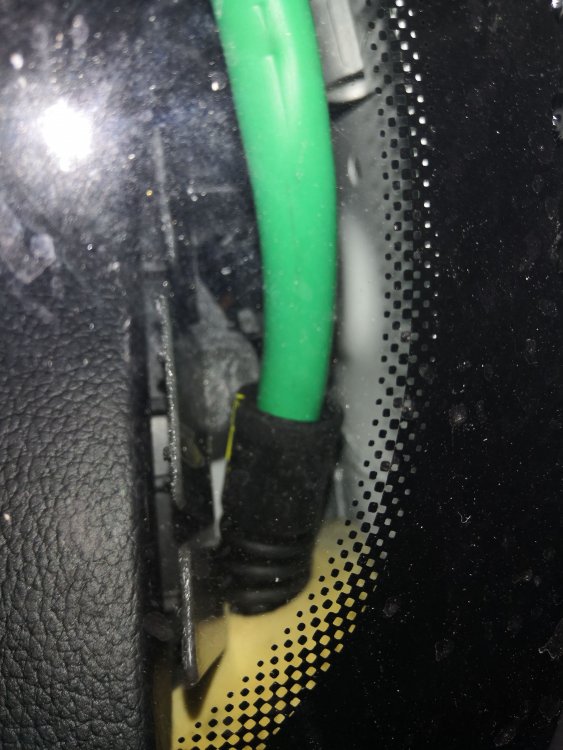
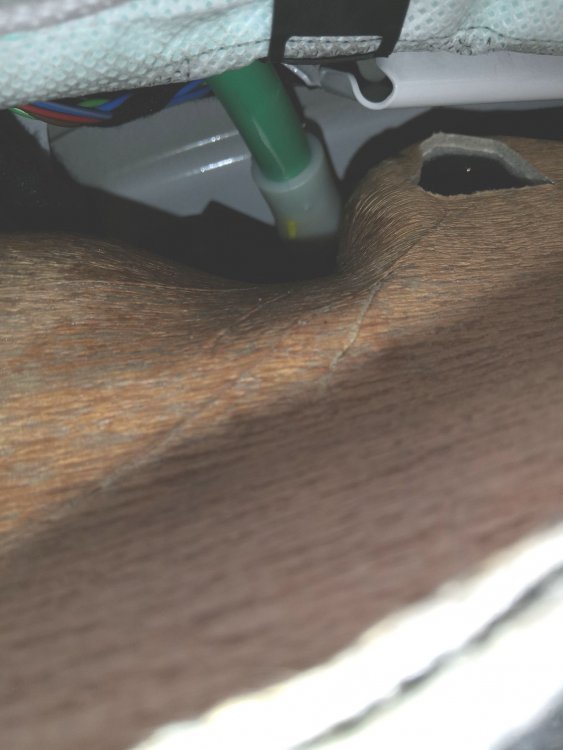
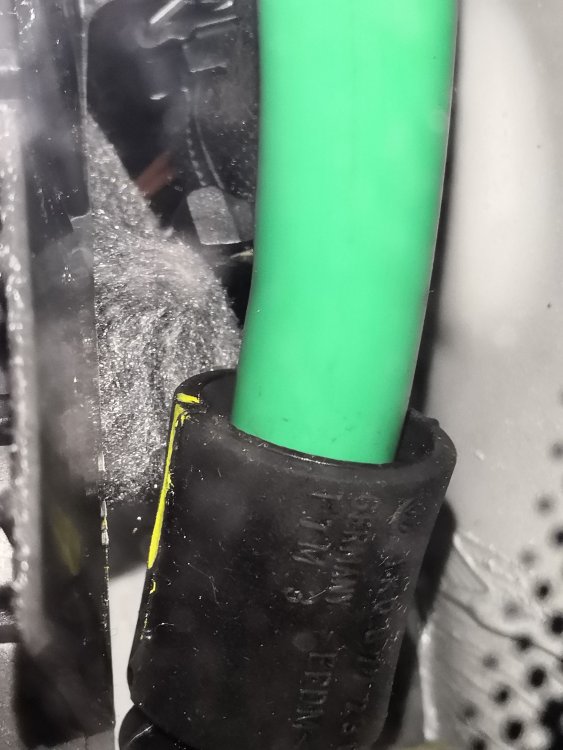
-
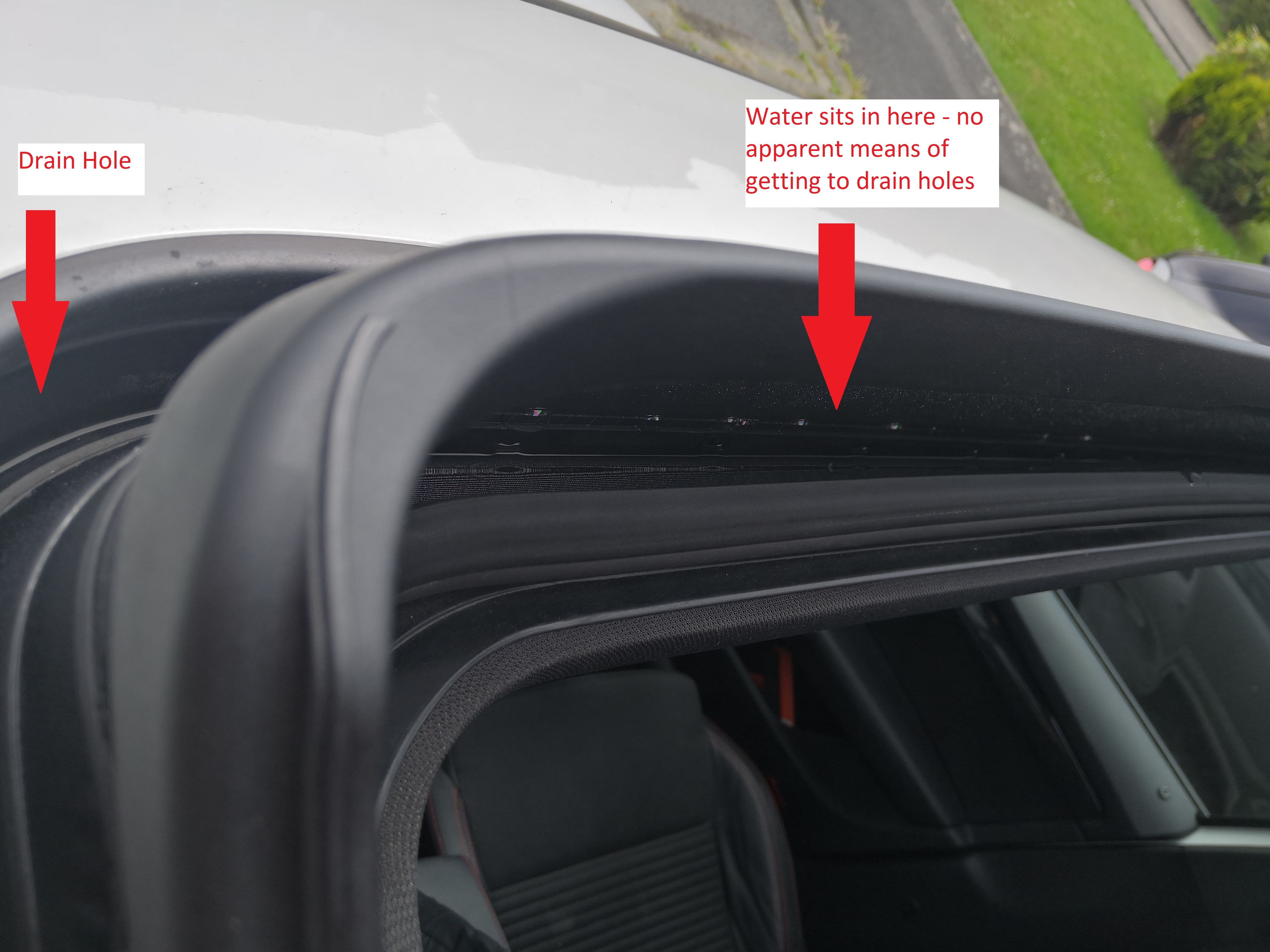
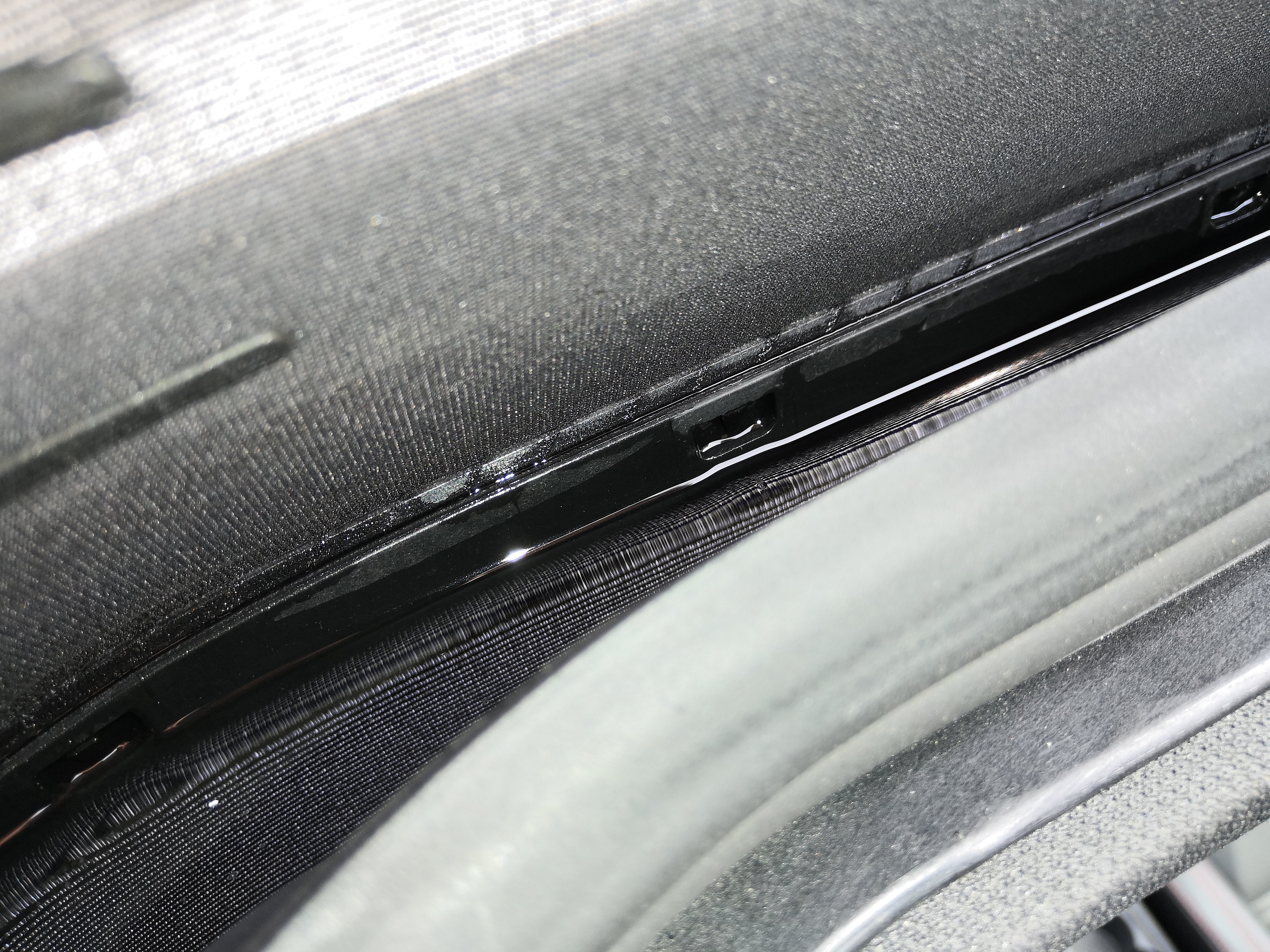
Further to the above, interestingly there is the water being retained in the area between the concertina webbing at the front of the sunroof - it doesn't seem to be draining off anywhere of its own accord and is just sitting there. I've attached an image for reference, I would have thought this area Should drain off somewhere too? Thanks again guys
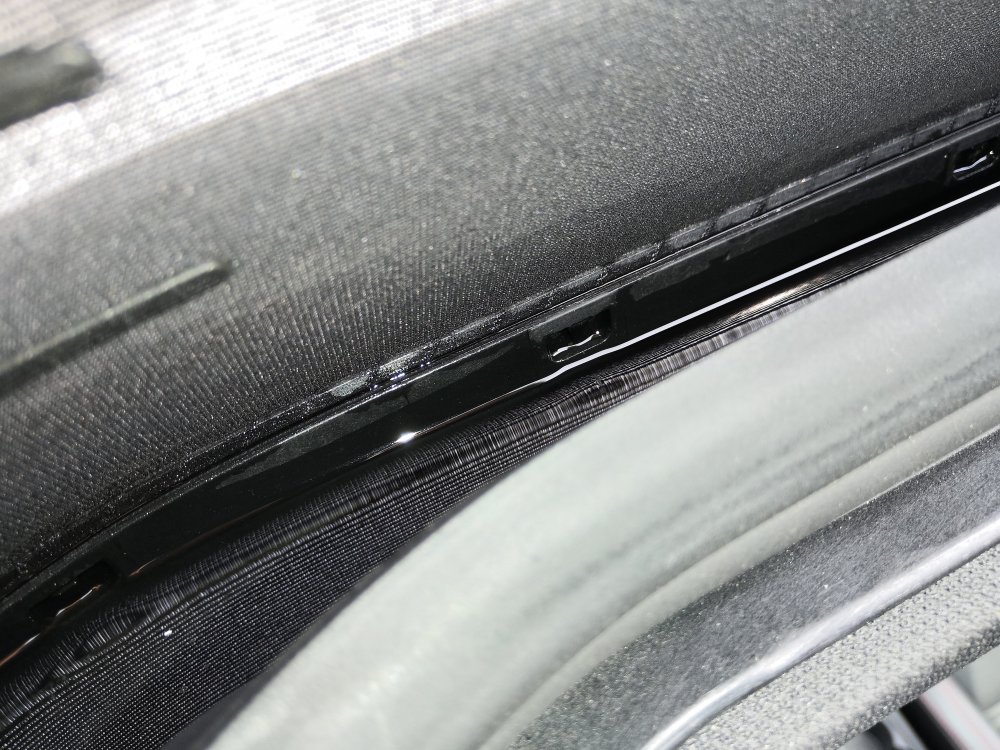
-
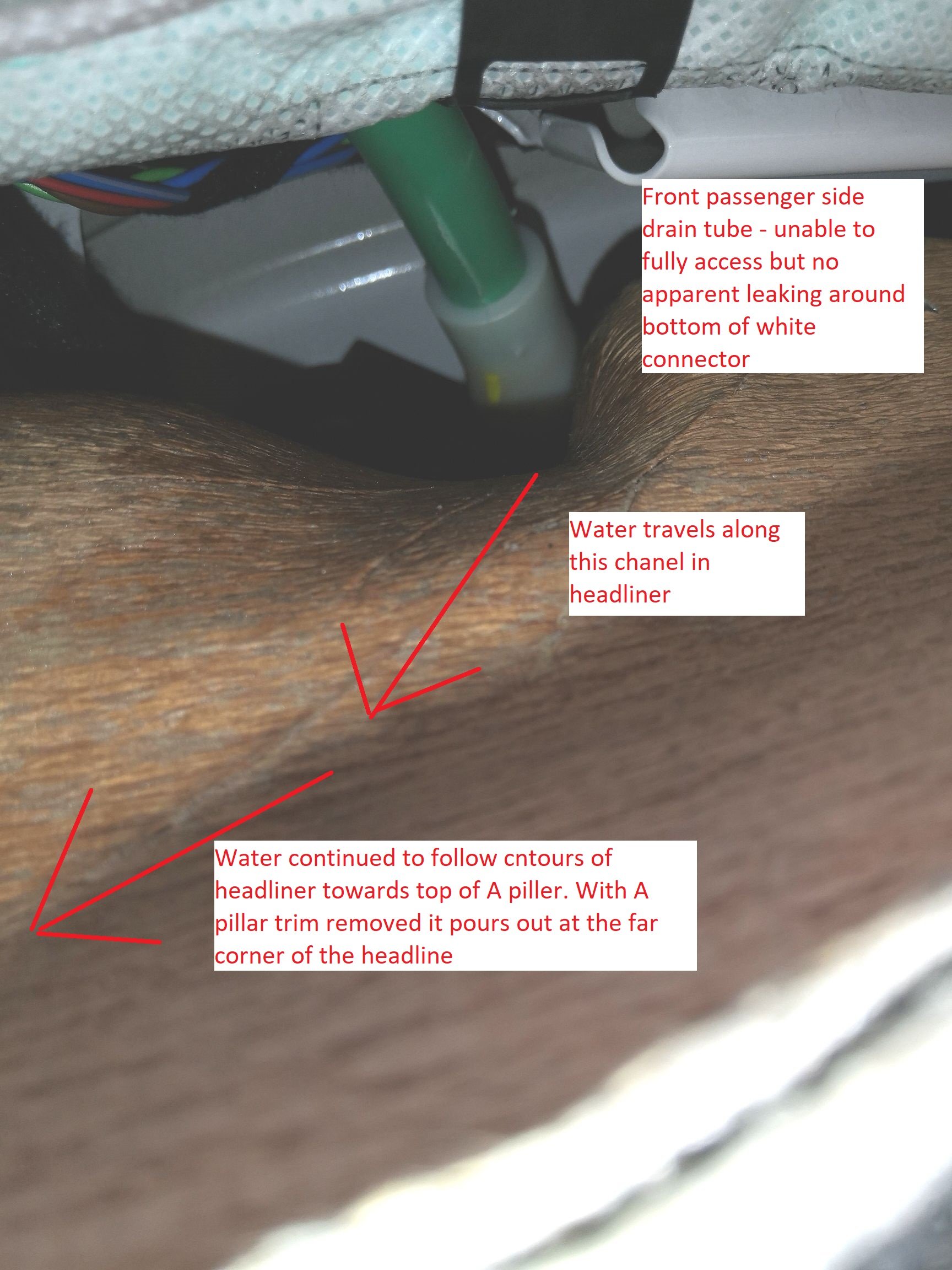
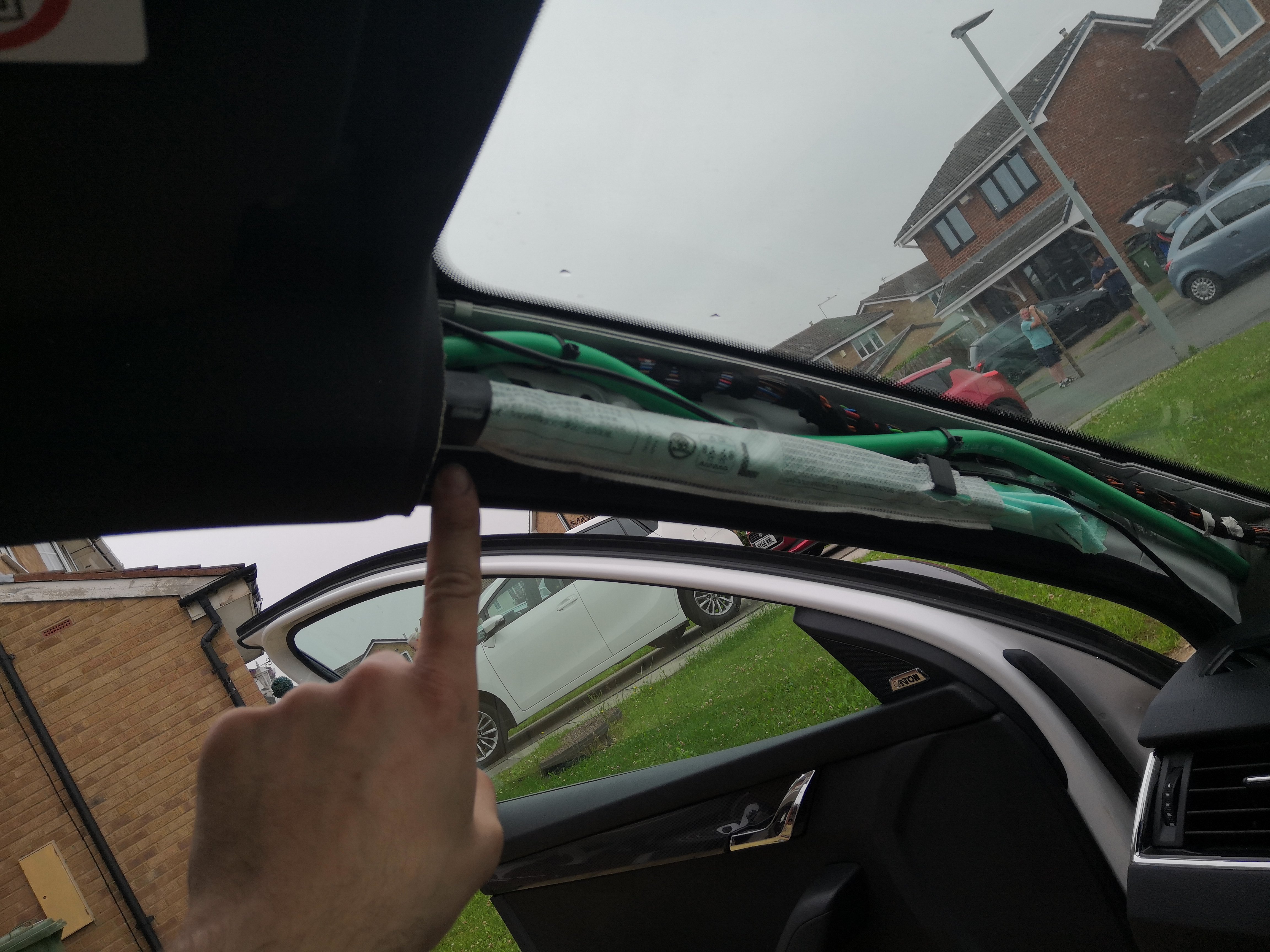
Got some strimmer wire and have fed it through the drains - didnt come out too dirty, however when pouring water around the sunroof tray it is draining a lot quicker. On the face of things, the leak appeared to have stopped - however as soon as you drive away water starts pouring out from the top of the A pillar again I've reached a point where i can't really unfurl the headliner anymore because I can't get the sun visor removed. i can just about see where the green drain tube meets the white plug. The water seems to be coming from somewhere in that rough vicinity as it is following a channel in the headliner down to the top of the A pillar where it is then spilling out. Unfortunately though there's nothing I can clearly pinpoint as the source. It looks like the drain tube has been off in the past though as there's a mark someone has made on the drain and the plug and they aren't quite lined up any longer. I fear this is going to end up being a bend over and go to a dealership job 😖
-
It's definitely coming from the roof, having just poured a cup of water into the front nearside roof drain, with the nearside a pillar trim off water has just run down the headliner towards the a pillar and just given me a nice shower. In regard to clearing the drain tubes, can anyone advise what to use, I don't want to poke wire down there as fear tearing the pipe and making my life even more miserable 😭
-
So got up early this morning to tackle this. Having removed the FNS A pillar, the drain hose looked okay however there was a small amount of water on one of the rubber seals (see picture below). I then went on to sacrifice the skin on my forearms to the mechanical gods, clearing the two front drains under the scuttle which were full of crud and dirt. They are now both clear and flowing freely. A couple of goes with a small coke bottle full of water and everything looked good, however as I returned to he car I found fresh water in the frontvpassenger footwell trickling down from where the headlining meets the top of the A pillar trim. I'm now on tearing the headliner a part as I can only think now that there is a leak where the drain tube meets the roof. When I find said leak, can anyone recommend what sort of product I should be using to seal? Also, does anyone know where the drains exit at the rear as judging by the front the rears could do with clearing too. Cheers guys
-
Hello Folks, Bought myself a 64 plate Octavia VRS MK3 two days ago, it has a panoramic roof. I bought the car from a very good friend who I have known for donkeys years through thick and thin. He looks after his cars and I am certain had no prior knowledge of what I have discovered tonight, when I've told him about it he was genuinely gutted. The car has pretty much sat on my drive over the weekend, during which time it did of course lash it down with rain. Tonight the missus and I decided to take the new car to visit my daughter who has been in intensive care In hospital the last few weeks (2020 can go away already). On getting into the car there was a musty smell with SWMBO complaining that it was coming from her side of the car. With the AC on and blowing fresh air the smell was fairly quickly dispelled, however when we returned to the car after visiting hours the smell was back. Checking under the mats the whole nearside floor was damp, particularly the rear. Upon returning home I wet vacced a ton of water out from the nearside floor. The driver's side of the vehicle appeared dry. Given the effective operation of the AC and the fact the service history shows the cabin filter was recently changed my first thought was a possible issue with the cars panoramic roof. With darkness drawing in I opened the roof and poured water into the channel around the glass panels. I started at the rear and found the water drained away quickly and could be seen draining from the rear wheel arch area onto the ground. I then poured towards the front of the car and the water seemed to take a while to drain out of the channel and I couldn't determine where it drained away to, as there was no evidence of any water fall on the ground at the front of the car. I then checked the interior and found the driver's side to be dry, however when checking the passenger side there was a fair bit of water trickling out of from the bonnet release area. I poked around a bit more and couldn't find any evidence of damp around the headliner. I also found that the passenger side carpet is dry around the upright section which goes up the back of the firewall, suggesting that the water is coming in fairly low down. I also culdnt find any moisture around the glovebox so I don't think it's a cabin filter/plenum chamber issue. Unfortunately it then started to get a bit too dark outside to investigate any further. I was hoping someone may be able to point me in the direction of a possible fix or even suggest where I should start to look first? Thanks guys