



Skip to content

gallaghermartinpaul

Finding my way
  • Joined

  • Last visited

Everything posted by gallaghermartinpaul

  1. Only consolation being that we hired a brand new 3 cylinder Fabia last year and the effect was even more pronounced.
  2. Hi, Absolutely, sounds much like a modern diesel. And yes, it also has an odd spot at relatively low revs (c1200) where even if the pedal is held in place-by a torch, length of wood, etc-the RPM will fluctuate in 2-3 second cycles by around 200 RPM. No air leaks, new MAP sensor, sparkling throttle body and a clean manifold; no problems shown on my hand-held scanner or at the VW garage locally. Runs fine and will maintain constant revs at tickover or at higher RPM. A mystery...
  3. Yep, turns out that that's exactly what it was. Dropped the car off yesterday and spoke with a guy in the workshop who assured me that both cams and the crank are locked in place by their Skoda special tool, that it was impossible for it to be fitted wrongly and that it was likely a fuel injector. etc, etc. Got a call back just now to say yes, they had actually fitted it a tooth out and wasn't it all rather embarrassing. This, as I'm sure I've said, from the main VW/Audi/Skoda dealer here in Berlin. Now in the process of getting an admission of the error in writing so there might at least be some recourse if the motor blows in the near future. In conversation with a Skoda mechanic in the UK, he suggested 1 tooth out shouldn't have affected the valves, etc; not sure what the obviously elevated cylinder temperatures will have done to the piston and rings. In any case, thanks for your advice guys. As you said Wino, sometimes the most obvious answers are the right ones, no matter how implausible it seems that such an amateurish error could have been made.
  4. Pictures. Of the position of the fanbelt pulley relative to the timing cover marks. First one with inlet valve camshaft locked to TDC. The second slightly fuzzy one is with the locking pin for the exhaust camshaft inserted. The third one shows the empty lug where the pin should insert into the head to lock the exhaust camshaft but can't, the inlet valve cam being locked at TDC. The final shows from above if you what happens if you rotate the engine to the point shown in the second image: the pin won't enter the lug behind the inlet valve camshaft, thus it sticks out beyond the fully inserted one in the exhaust cam. If this is what it seems, this is a major error by a dealer, right?
  5. *should read 'into the small wheel for the exhaust cam', i.e; it's passed through the toothed wheel and into the lug in the head. Locked at TDC.
  6. No, just routine. However...having just looked I've found something strange. Driver side wheel and wheelarch liner off to expose the fanbelt pulley, I've removed the plugs and turned the motor to align the mark on it between the two plastic notches on the timing case labelled '0' and '2'. Then trying to use the pulley locker to lock the cambelts together that I used to change the belts last time I've found it won't fit. You can remove the two pins from the tool's spacer plate and insert one into the camshaft governing the inlet valves. When you do that, it and the crankshaft (meaning the fanbelt pulley/timing case marks) are in alignment. But then you can't get the second pin into the wheel for the exhaust camshaft under any circumstances; looking in from above with a torch it's apparent that its top edge is only just on the lower lip of the lug in the head it's meant to slot into. If you then remove the first pin from the outer wheel (inlet valve cam) and turn the motor so that the exhaust cam pin will go in then the first one won't. More seriously, by the point the pin is onto the small wheel for the exhaust cam, the timing mark on the fanbelt pulley has moved good 15-20 degrees past the marks on the timing cover. I recall from doing them last time that it was fiddly to get both cams and the crank aligned but it was doable with patience. This is different. When the light fades a bit I'll take some pics and post them in case I've been at all unclear. What I'm not sure on is how this would cause the effects I'm seeing. Inlet valve timing would be normal (obvs) but exhaust out by a tooth, presumably? How serious is this and how come it's only causing probs when warm? I appreciate until then it's running fully fuelled and the ignition timing will probably be advanced or retarded to optimise starting etc. How would the valve timing being out cause intermittent rough idling (if revved it runs normally for 5 seconds or so, then goes back to spasms of shuddering every 5 to 10 seconds) is the ECU attempting to compensate for what it senses but only able to do so much before a misfire occurs? Apologies if I've got a lot of questions but I need to take it back to the garage and be very clear about what I think is wrong and what effects it is having. My German is OK but naturally imperfect, so when you tell people stuff they don't want to hear they've a tendency just to try to talk right over you. The motor trade (and I worked for recovery services for years, I might add): seems some things are the same wherever you go...
  7. Seemingly not. I guess I need to check the same functions on the downstream one. Now second guessing myself for too long, there can be no way an incorrectly fitted cambelt could account for this? If that were the case a misfire would be constant, it wouldn't drop in and out as it does?
  8. The latter high reading is probably a function of the multimeter. I've never had one that self-ranges before and, once the earth clamp is attached to the battery, it just sits there showing random voltages on the screen until its positive lead is connected. To check it wasn't bust I tested the battery voltage and got a steady 12.5, engine off.
  9. Think you are probably right. Resistance between 3 and 5= 2.6 ohms ambient temp, permanent feed ignition on (but fuel pump shut off having run for a few seconds to charge the system) from red/blue 11.8v. I tried to get a reading from the other terminals on the harness plug but they were odd: either very low, below 1 volt or, in the case of the terminal that would join no.1 on the lambda sensor plug that I think is blanked off (as your diagram also suggests), extremely high:107 volts.
  10. Lost a post, apologies if I'm repeating myself. Yeah, 11.8 volts from blue/red wire with ignition on (fuel pump had shut off by this point, however). 2.6 ohms resistance 3-5 at ambient temp. Ordered some sharp little probe ends so I can test at the back of the plug for a reading when its running.
  11. Thanks very much. So test for 12 v (ish) supply to sensor from the brown wire at the harness terminal. Then test for resistance across 3 and 5?
  12. A bit too technical for me, I have noticed that if the throttle is held down to a fast idle, say 1500 rpm, that oscillations of around 200 rpm occur. This is on a 2-3 second cycle and completely regular. No sign of obvious heater leads on the sensor, they're all the same gauge wire.
  13. Thanks guys, Yeah, it's well into the 30's here. I have, however already tried what you suggest once the plug finally clicked into place: no luck. As everything's now a bit more accessible I thought about taking the (first) Lambda out and cleaning it. Is this likely to yield results, in your opinion(s)? I know from the almost-obsessively detailed service record that the car's first owner kept that neither have been changed. So at around 110,000 miles they're past the recommended interval. Much as I'm loath to start chucking parts at it randomly, having a dealer do something fairly similar will lead to a bill greater than the car's value in fairly short order. I'm assuming they're best done as a pair, the one just below the manifold and the other one downstream, beneath the car? Thanks for your input thus far, Martin.
  14. Hi, In Germany, alas. Front Lambda removed there is, as you suggested, 5 wires: no. 6 black, no. 5: blue/black, no. 4: grey, no.3: yellow, no. 2 white. no. 1: blanked off. The plug at the end of the sensor's cable came apart with a gritty sound and was fairly grubby inside. Cleaned up, it now doesn't want to clip back together, the two halves join but there's a lot of resistance at the point you'd expect to hear it 'click' back together. There is also another smaller clip on the back of the main one (see pic). Oddly enough, running it in that state, i.e, sensor unplugged but me thinking it was connected, actually resulted in it running normally to operating temp. Thinking I'd sorted it, it was only walking round the back of the car that the smell of petrol alerted me to the fact that I hadn't. No dash warning light shown, but a code did come up when checked.
  15. Hi all, Having found and retrieved relevant grommet from where it was carelessly discarded in the wing, there's unfortunately no change. Regarding temp sensor discussed yesterday, I assume it's working as unplugging it whilst running raises the rev range to c1000rpm and throws up a fault code. Disconnecting the solenoid for the purge line for the fuel vapours (which has an 11.7 volts feed) makes no difference and also generates a code. Removing fuse 7 which controls power steering and, in Haynes, 'engine electronics' makes no difference but no code thrown up. I'm waiting 'til it cools down a bit and then thinking I'll check the first O2 sensor in the manifold and its connections. It has 4 wires going in, any idea off the top of your heads what the voltage should be? Also, whilst I remember, I noticed a couple of times that I couldn't get a good earth for the multimeter on the big earth points on the inner wings and had to go direct to the battery. Though there's no sign of other electrical problems, a clean surely can't harm them; would it affect the throttle body settings by cutting the power to them though? Thanks, Martin.
  16. Thanks, it did kinda leap out at me when I spotted it today; mainly as it's the only tangible difference between now and when it went to the workshop. So it's allowing, what...too much unmetered air to the manifold? Weakening the mixture and raising the temp in the pots? Does that account for the funny colour? As I said, they've never looked like that before and I've had them out at least once a year since I owned it. Yep. Other end is tight, sealed with an identical grommet.
  17. That's annoying, no more uploads. The yellow circled end goes into the (standing looking over the engine) rear left-hand side of the engine cover/air filter box. From there it runs down a pipe internal to the box to emerge near the throttle plate. Apparently.
  18. Hi, Thanks for the timely reply. I can only upload a couple of pics at a time it seems. These 2 should give an idea of where the pipe from the air filter box (the circled yellow end) runs to the manifold beneath the throttle body. As regards the rest: nope, coolant temp sensor was in place 5 years ago when I did the cambelts and not been touched since; the gauge sits dead on 90 and works quickly, coolant temp readings on a scanner are steady if about 5 degrees below what is shown on the gauge. Oil is a 10-30 I recall, I'd used a 5 but it seemed to burn a little bit so I switched it. That was over 5 years ago, mind. Quality wise, I use a Liqui-Moly which here (in Germany) is probably akin to the Halfords hi-end stuff, not the best but far from bargain-basement stuff. Thanks, Martin.
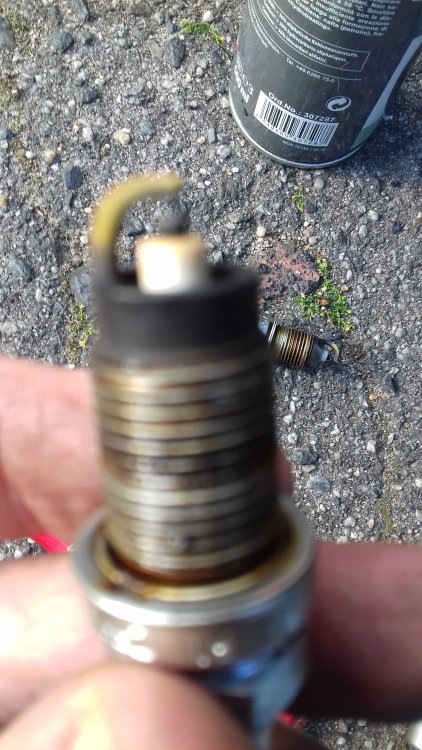
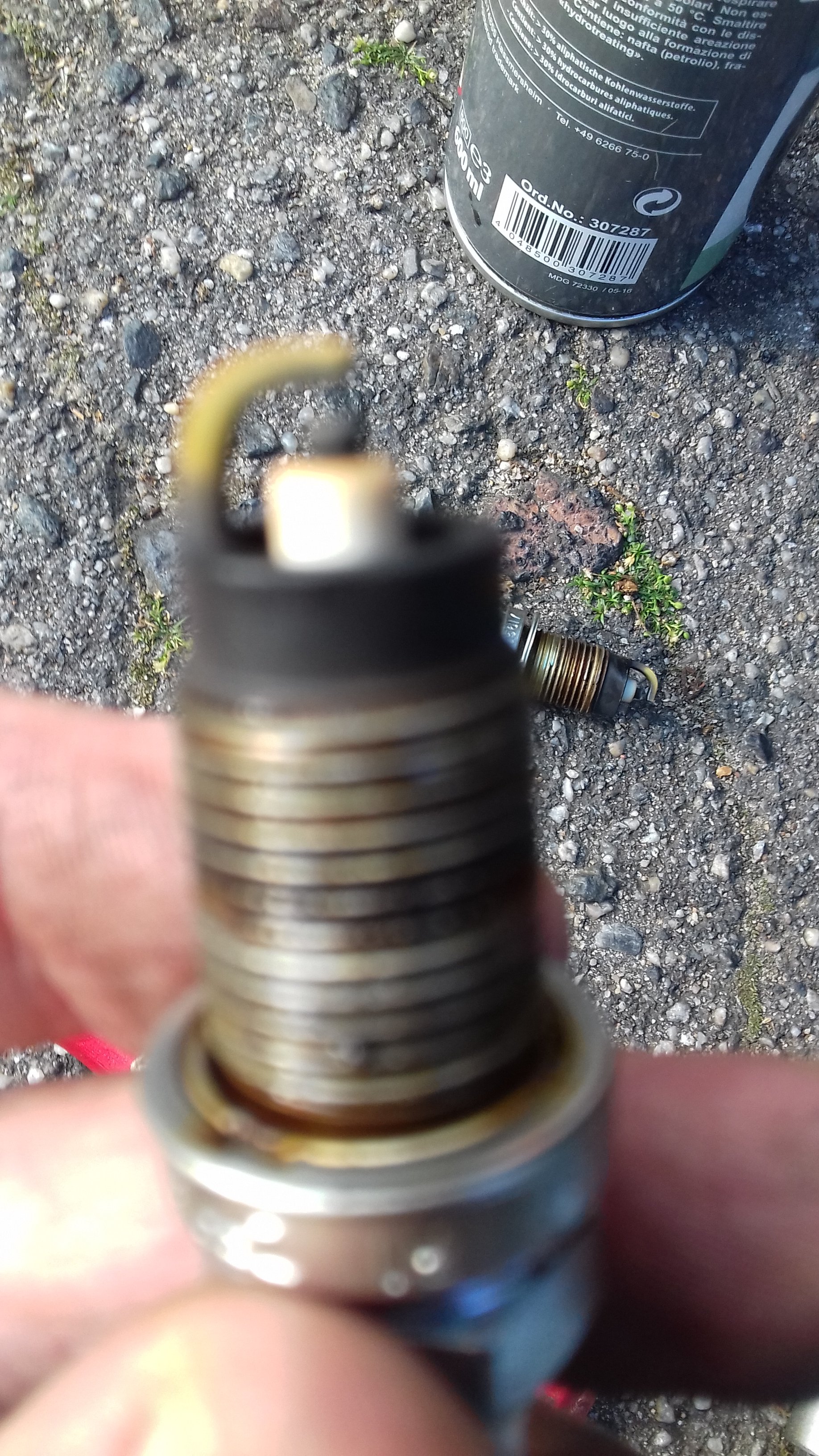
  19. Hi all, After being in a workshop, the motor referred to above has developed a rough idle once warmed up. I drove it to the dealer and on to the ramp. Once finished (cambelts), they test drove it and, surprised by the rough idle claimed to have run a diagnostic but found nothing. A Diagnostic check with a hand held scanner also shows no faults but the plugs look very different to normal, instead of the usual beige deposits I always see, the electrodes are coated with orange powder, the insulators completely white and the end of the plug body above the threads protruding into the cylinder itself a burnt black. The effect is identical on all four plugs. No fuel additives used. Driven on 95 octane petrol, occasionally 98. Fuel injectors all have c14.5 ohms resistance. An auto box and thus never driven hard. c110, 000 miles but consumes almost no oil. Oil changed 6 monthly but smelling quite strongly of petrol despite being changed in March. Once above 1000 rpm the unevenness smooths out and driving at speed is fine. No visible splits in any pipework around the engine bay and spraying brake cleaner round the engine (without effect) suggests that I'm not missing any. The dealer's staff have lost the rubber grommet that goes on the end of the pipe running from air filter to join the pipe from the brake servo to the manifold beneath the throttle body, however. The joint's obviously no longer airtight but I'm not sure how important that is, I assumed it's just intended to draw fresh filtered air in to the manifold at the point crankcase gases are introduced below the throttle body? That I've removed and there's no oil or carbon inside the manifold. I'm not able to see an EGR valve where there ought to be one but there's a PCV valve on the back of the block. No idea how that works. Coil packs were replaced as a group last year; ditto plugs. Lambda readings, though I'm not entirely conversant with their meaning, seemed low at idle: 0.97 something. Since I've owned it, fault codes for the manifold air pressure sensor have cropped up periodically describing an implausible reading though no change in performance correlates to them: they're cleared and don't appear for another 6 months or whatever. Apologies for the quality of the pictures. All suggestions received gratefully. Martin.
Important Information

Welcome to BRISKODA. Please note the following important links Terms of Use. We have a comprehensive Privacy Policy. We have placed cookies on your device to help make this website better. You can adjust your cookie settings, otherwise we'll assume you're okay to continue.

Account

Navigation

Configure browser push notifications

Chrome (Android)
  1. Tap the lock icon next to the address bar.
  2. Tap Permissions → Notifications.
  3. Adjust your preference.
Chrome (Desktop)
  1. Click the padlock icon in the address bar.
  2. Select Site settings.
  3. Find Notifications and adjust your preference.