FrozenFiremint
New here
-
Joined
-
Last visited
Everything posted by FrozenFiremint
-
Dear RR-Vliet, thank you for the quick reply and update, without your inital post, this project would not have happened! Swapping to a shorter gearset is a very good idea and the long 5th and 6th gears also bother me. I am very excited about your upcoming dyno results - if you encounter any hardware specific problems, please share them here so others (like me :) ) can use them for their remapping. I will also definitely share my results once the car is remapped again around start of august. A downpipe is also next on my to do list, but the ege german legal ones are like 1600 Euros...if you have a cheaper source, please let us know. To your 230 hp question: Assuming a volumetric effiency of 0.9 and around 50 mbar pressure loss through throttle&intercooler, the turbo needs to support a MAF of 23 to 25 lb/min to achieve 230 hp. Also, we would need to push around 2.1 bar relative to achieve this target. From the compressor wheel side of things, the kia stinger 3.3TT is known to achieve 1.75 bar remapped, however the engine bank swallows much more air with 1.6 L per bank. The closest turbo i could find in terms of spec is the Garrett G25-550 48mm, based on the compressor map, it supports a pressure ratio of ~3.5 at 24 lb/min with similar full blade design -> Doable From the turbine wheel side of things, i doubt we can push 25-26 lb/min (air+fuel) of exhaust mass flow through the tiny turbine (no matter 8 or 11 blade), EGT and EMAP will be sky high. The Garrett G25-550 with the lowest A/R housing (0.49) can flow a max of 16 lb/min at our target pressure ratio of 3.1 -> Doubt Realistically - purely based on my opinion, so take it with a grain of salt - the turbo can support around 190-200 hp. Probably the following changes are necessary to increase that value: -Higher A/R turbine housing with clipped or further enlarged turbine -Better HPFP with 1.4 150 hp injectors -Upgraded conrods, to achieve 230 hp at the flywheel at lets say 7 krpm, the engine needs to put out 230 NM. At 4 krpm, over 400 NM! -Downpipe to lower EMAP (as you already did) -Lower compression, 10.5 is reaaaally high for 2.1 bar relative boost You can log wg dutycycle (87 % is basically fully open, 100-140% is only applied to force it shut during low rpm acceleration), EGT and IAT to see if there is room left for more power. I will also do that once the remap is complete and share the data logs here. Stay safe
-
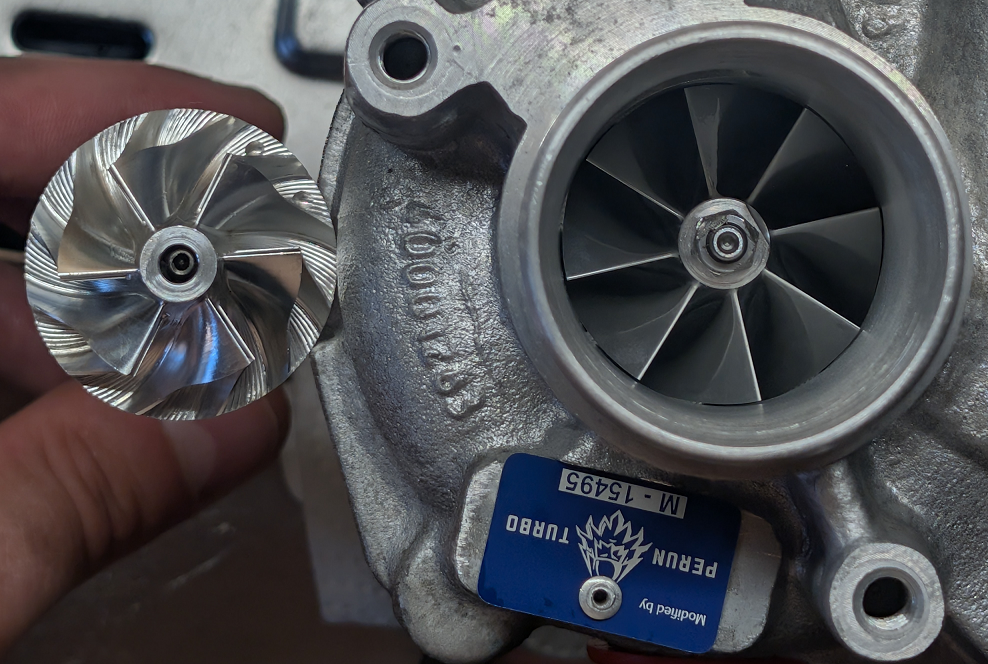
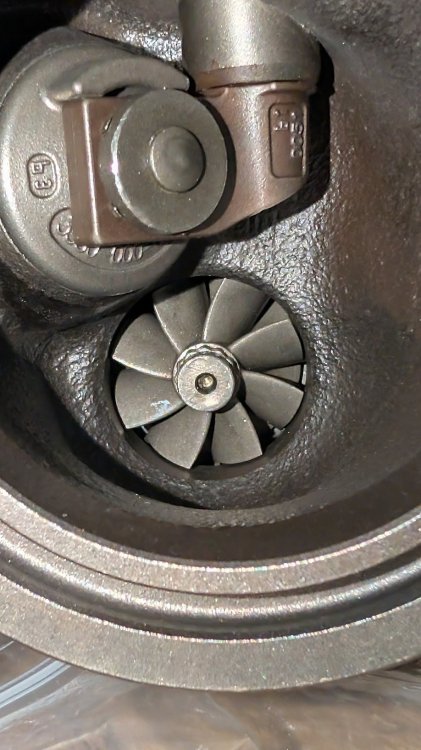
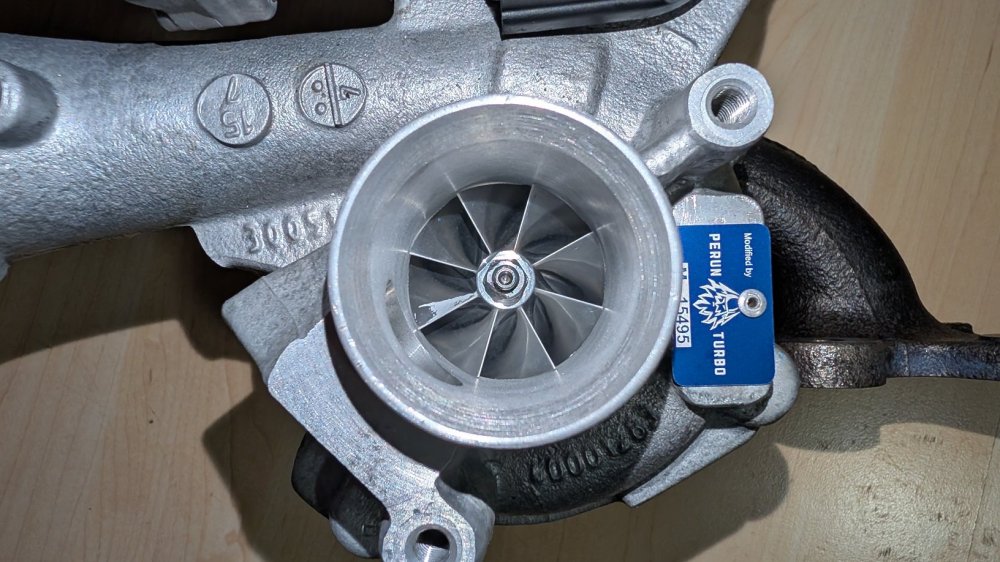
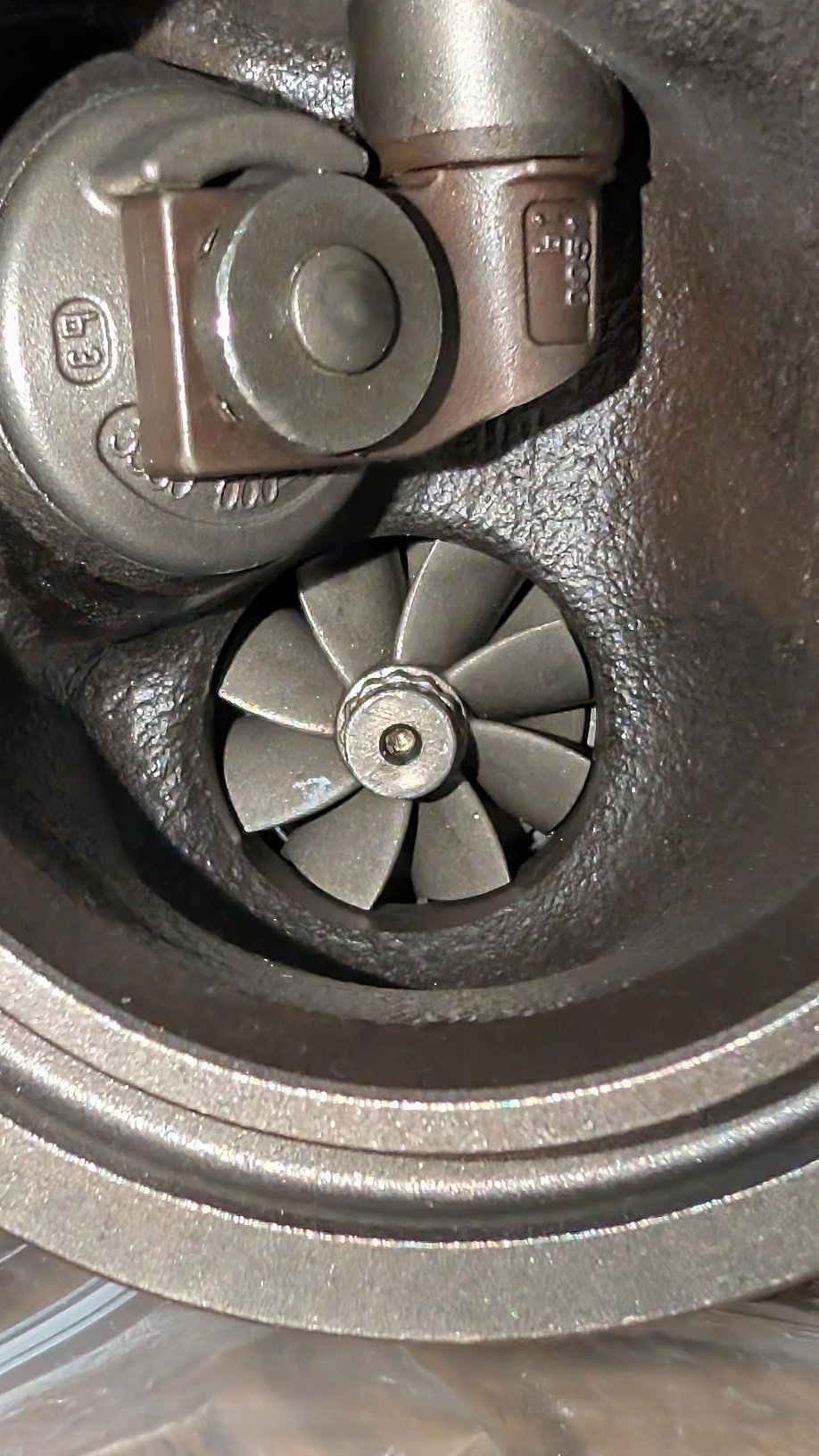
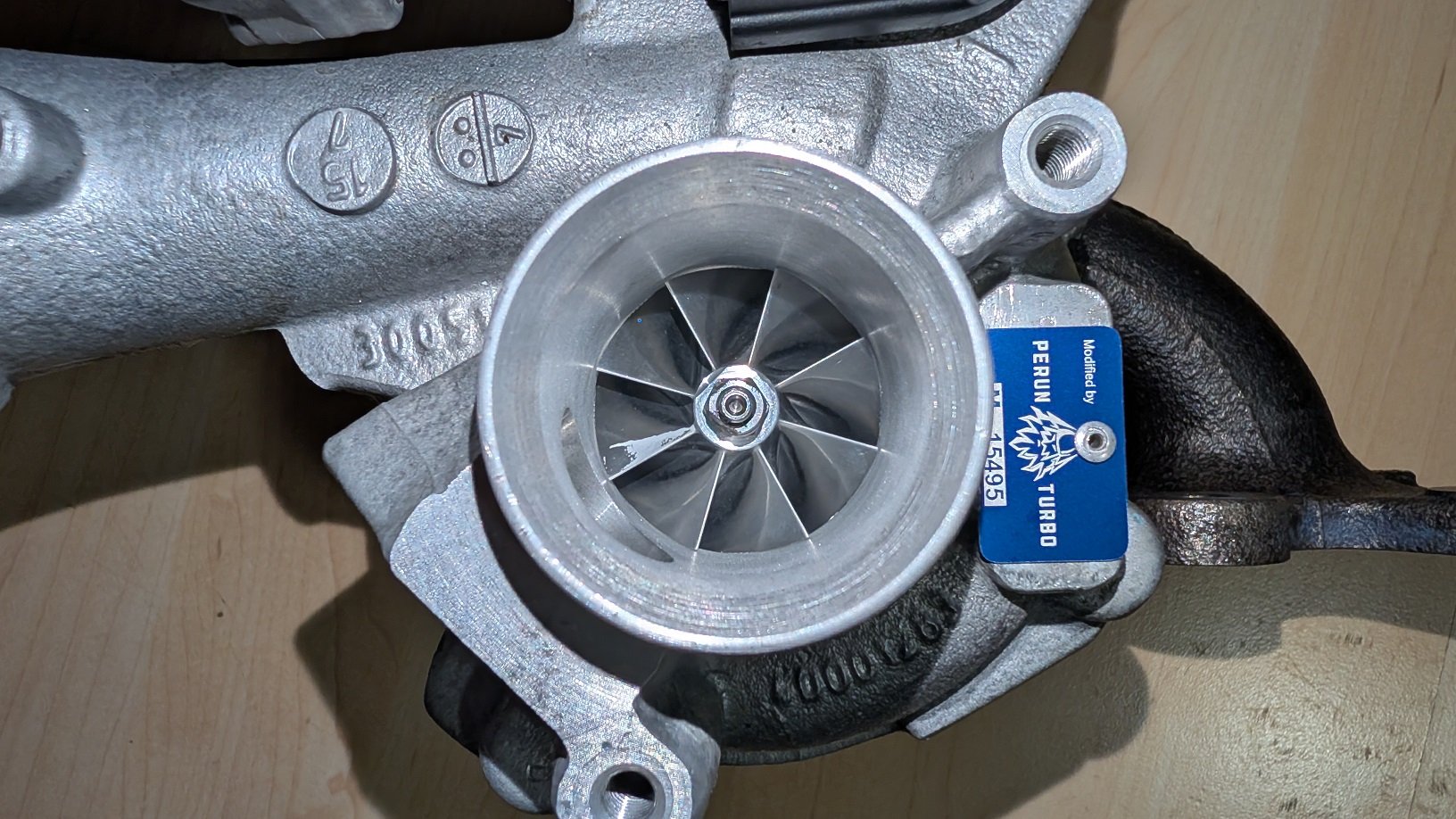
Hello from germany, adding a datapoint for the people planning to go the hybrid route. I started from the original 1.2 TSI turbocharger, OEM number 04E145713Q, the CYVB engine hardware is stock, 205 kkm. I was heavily inspired by the post from RR-Vliet (October 2025). I decided to directly contact the company who modified RR-Vliets turbo: Perun Turbo in poland (ul. Kwietniowa 8, 05-090 Wypędy). Very pleasant experience, sent my turbo via mail from Germany, they modified it and sent it back. Took about one month from first contact to turbo in my hands and about 560 Euro including shipping. Axial and radial bushings were replaced, they even sent the old parts and balancing protocol. Main reasons for me to favour the hybrid turbo over a stock 1.4 TSI turbo: The turbine housing, wastegate diameter and actuator stays stock -> The smaller A/R compared to 1.4 TSI turbine casings retains exhaust gas velocity and makes boost control easier from a mapping point of view (dutycycle, exhaust mass flow tables, etc.). Technical details: Compressor wheel Stock Upgraded turbo Wheel type 6+6 Splitter 8 Full blade Inducer diameter 27 mm 36 mm Exducer diameter 36 mm 47 mm The compressor wheel is from a Kia Stinger 3.3TT (3.2 V6 twinturbo, designed for 1.6 L of displacement for each turbo), type Honeywell resp. Garrett 844076-8. Turbine wheel Stock Upgraded turbo Wheel type 10 Blade, radial flow 8 Blade, mixed flow Inducer diameter 31 mm 39.2 mm Exducer diameter 27 mm 27 mm The turbine wheel is from a VAG 1.4 TSI 140/150 hp model. The turbocharger now carries the designation “M-15495” in case anyone wants a similar mod from Perun Turbo. Based on flow estimations and wheel rpm, the new turbo is good for about 1.6 bar - 1.7 bar. However, there are some key differences to the “M-14042” model from RR-Vliet: · 8 Blade turbine instead of 11 Blade turbine: Better exhaust flow due to mixed flow turbine with less turbine blades (same blade angle), does not choke easily at high rpm · Full blade compressor wheel, which helps to close the large turbo lag compared to a splitter blade design. In terms of compressor wheel upgrades, the step from 36 mm to 47 mm is huge - the compressor wheel is now larger than a OEM IHI IS12 turbo used in VAG 1.8 TSI engines. This induces tons of lag due to the polar moment of inertia. Some word about the various turbine sizes and designs used in the VAG EA211 1.2 and 1.4 turbos, this helps to easily identify them in e.g. online listings and such: · 1.2 TSI (90/105/110 HP): 10 Blade turbine wheel, radial flow · 1.4 TSI 122 HP: 11 Blade turbine wheel, radial flow · 1.4 TSI 140/150 HP: 8 Blade turbine wheel, mixed flow With the help of a friend, we fitted the turbo in ca. 2 h of time. Some tips and OEM part numbers: · Gasket set: 04E253039D · Oil return line (generally can be used again but replace gaskets, included in 04E253039D): 04E145735C · Oil feed line (absolutely replace): 04E145140AS (buy the AS-variant, this one keeps the oil line further away from hot engine parts compared to previous revisions) · Clean the exhaust port on the block with some fine grit sanding paper so the metal gasket has a clean surface to sit on · Remove two bolts on the catalytic converter so it can be pushed to the side and makes mounting the exhaust clamp much easier · Even when you drain the oil, there will still be about 100 ml in the feed and return line. Be prepared to clean the engine block with some brake cleaner afterwards as it makes quite some mess. Top off the coolant with some G13 afterwards. · Better use a pit or lift, your back will thank you · Fill the oil port with fresh oil or better some MoS2 turbo additive and spin the compressor wheel a few times, saves the radial bushings upon “dry” startup We did not calibrate the wastegate actuator via VCDS and the engine seemed fine without, no error codes or limp mode. This probably only works if the turbo wg is properly adjusted beforehand. Some impressions from the first drive: · Typical “big turbo setup”-feeling: Engine feels n/a below 2800 rpm, above the turbo pulls like a freight train all the way to the redline. As a side effect, this helped me to safe fuel on my commute as there is barely any time spent on boost. · Driving off boost is enhanced to better exhaust flow with increased throttle response · IAT is lower, as the compressor is now much more efficiently, as a side note: The wg is pushed open further compared to stock, lowering EMAP and EGT. · Remap is planned in 1 month, but as RR-Vliet already mentioned: Be careful, the big compressor wheel saves you from a quick boost buildup, but take it slow and cap boost pressure below 3 krpm. Otherwise, the turbo surges anyway as the small 1.2 cannot ingest the air mass (Surge line of this hybrid is at ca. 6-7 lb/min in efficiency island), the risk of LSPI increases exponentially and the conrods may see some sunshine. There are currently no x or h-shaft conrods for this engine ☹ Stay safe