wyx087
Resident Member
-
Joined
-
Last visited
Everything posted by wyx087
-
When I put down my deposit, they only had LR available. They then raised LR price, was during mad chip shortage mid 2022. A few week before collection, they made SR available. SR was £2000 cheaper than my order while LR was £4000 more expensive. In all honesty, SR would have been more than enough for my needs. I've only ever used full range (100% down to 8%) once on a day trip, having a short top-up break wouldn't have changed anything. There's DC rapid charger everywhere down south. My point is, UK is not exactly a big island. Civilisation is everywhere. It's not like people on this island regularly drive 1000+ miles American road trip, or really need that 600+ miles range because they are in the Australia outback. Especially up to Manchester, trunk roads DC rapid charging infrastructure has now been built up at incredible speed. City EV or LR EV doesn't matter, all can do long distance drive. Difference is a few more stops for car isn't designed for it. A few more comfort breaks for less suitable cars wouldn't hurt. Just as people driving CityGo wouldn't drive 200+ miles daily commute.
-
Nice of you to put words in other people's mouth. All I'm doing is educating, especially on complex topics. For example, believing Google's 11 kW charge rate, or a random summary article about solar FIT. In your instance, Google isn't wrong, the max on-board AC-DC charger is 11 KW. But DC charging rate can be faster. Able to do multiply and division does not mean able to calculate a complex system..... If you want to use rule of thumb by lowering average travel speed from 70 mph down to 50 mph. It makes EV driving much more feasible because as speed decreases, time between charging increases beyond human capability. Let's do an proper comparable example with the Mini. https://abetterrouteplanner.com/?plan_uuid=2f36d593-2cfb-4f2c-a41a-74ba84eb5d5f 6 hr 50min driving; 2 hr 45min charging. Compared to using MY LR: 6 hr 48min driving; 43min charging. City EV can do long distance, just like early Nissan Leaf have been driven JoG to LE. City EV's need more stops to top up, roughly every hour for the Mini it seems. There's so many charging hubs along trunk road these days it's really non issue. Newer ICE cars are different and don't connect to the internet?
-
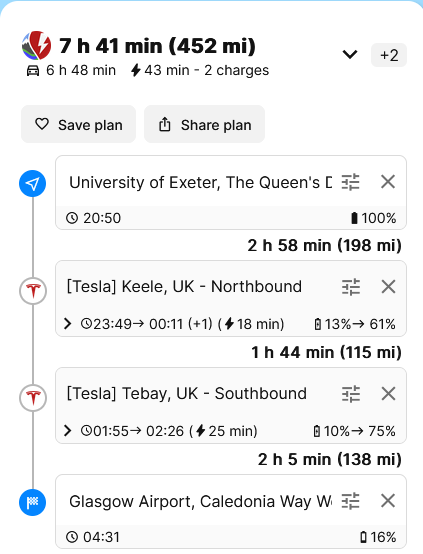
Great to see you finally get why EV's are so convenient in day-to-day use. Unfortunately you've started dribbling nonsense here when you tried to calculate EV long distance travel times using a 11 kW charger. First, I'd love to see anyone driving a diesel car for 9.25 hours "almost non stop". Does diesel driver run to the toilet so that they stop less than 5min? Or does this come as standard? 😛 Second, remember EV's are capable of 200+ kW charging speed. ~20min top up while you stretch and eat. This is a typical long drive, a pit stop every ~2 hour for ~20min. Wouldn't be much longer than driving a diesel and also doing comfort stops. Ah okay. Sorry. I got confused by the word "latch". I thought that's the bit you are holding. Prey, do tell, why do UK not have the locking pin whereas some other countries do have this locking pin? Why do you think it's okay to circumvent this restriction?

-
https://www.hse.gov.uk/pubns/indg216.htm Also:
-
Last time I refuelled, about 2 years ago, I don't remember UK allows petrol nozzles to lock. How do you walk around your car if you must hold the petrol nozzle?
-
UK is only 1100 odd miles furthest top to bottom. 5-6 ~30min stops is more than reasonable for 16 hour drive. Let's be honest, UK is a small island with roads that are getting clogged up by the day. I can imagine the same view of UK from mainland Europe/China/India/America/Australia. Why wouldn't population on this modest sized island drive EV's?
-
Indeed there's 2 elements to FIT payment: generation and export. But don't always assume what you read is 100% correct, because websites like those usually take shortcuts to describe a complex system. All people on FIT start off with deemed export because it predates smart meters, older non-smart meter cannot measure export. Deemed export means for each kWh generated, they deem 50% export regardless of how much is self-consumed. Meaning use as much as possible without consequence for people on FIT. For example, my statement for gloomy autumn/winter days. Effectively it's ~20p/kWh based on generation for me regardless of how much I use, since V2H install, I consistently self-consume over 95%. Then there's higher paying SEG (smart export guarantee). People on FIT can move the export part to SEG (one way) to get better rates such as 15p from Octopus, currently. FIT still pays generation part whereas newer installs only get paid SEG. But today's solar PV installs are much cheaper and generate more. So overall ROI is said to be similar. My neighbour also installed 10 panels, but got 4 kWp system (my is 2.9 kWp) installed for just £4000. Coming back to your view that there's associated cost, it's only true for newer installs as you rightly pointed out. But for FIT, it depends, usually it is completely free.

-
Ah yes, if not on EV tariff, self consuming net a saving of 5-15p currently, depend on tariffs. If charging without solar over night: 20p cost. But off-set by -15p solar export payment = 5p net cost for charging EV up to solar generation amount. If charging via solar divert method: -5p cost (net saving) because you wouldn't need to pay that 5p/kWh. So instead of my 7.5p saving for EV tariff + FIT solar. You are saving 5p/kWh using solar divert.
-
With public EV charge points double every dozen of months, people think sometime in 2025 we will see 1000 rapid charging hubs around UK. https://www.speakev.com/threads/when-will-we-see-1000-ev-rapid-charging-hubs-in-uk.184481/ According to this crowd sourced maps, we've already got over 500 rapid charging hubs (need 5 or more charger to count): https://www.google.com/maps/d/u/0/viewer?mid=1DOswN-GODssM2XmKV4oQ9r-mkGcbGno&ll=52.183213135981326%2C-0.863469044656453&z=8 The golden age of EV travelling might be upon us, with general public slowing down adoption whilst hub building is full steam ahead. I think this is the right way to do it, build it and they will come.
-
But if your import is 7.5p/kWh overnight on EV tariffs?
-
Let me explain again, FIT is based on generation. Self-consuming has no associated cost. If you want to deliberately base your understanding on snippets of truth, it's your choice. But you are completely wrong here with regard to FIT.
-
Without FIT (~2016 or earlier installs, based on generation), you'd be on SEG (smart export guarantee, based on your export). You should be getting 10-15p/kWh? It would make more financial sense to export as much as possible and charge up your battery/EV at as cheap rate as possible. Provided export pays more than cheapest import. For example, Intelligent Octopus Go is 7.5p/kWh import overnight and 15p/kWh SEG. So doesn't make financial sense to self consume because each kWh you self-consume is effectively 15p. Here are the best EV tariff and SEG tariff from different suppliers: https://www.speakev.com/threads/list-of-ev-tariff-for-2-5p-mile-motoring.179786/ Also got to remember unlike my V2H bi-dir charger, where it basically behaves like a home battery, you will need to generate consistently more than 1.4 kW in excess to charge EV using solar divert feature in "standard" EV charge points. That is due to charging standards. https://myenergi.info/minimum-charge-current-need-to-allow-user-to-set-t-t5646.html For my 2.9 kWp E-W install, EV charge point's solar divert feature doesn't make sense. I have this capability in my other "standard" charge point but it doesn't work due to low amount of excess. I managed to get around the 6 A limitation by using Tesla API, when Leaf isn't at home: https://www.speakev.com/threads/charging-off-excess-solar-using-dumb-charger-and-home-assistant.177813/#post-3441721
-
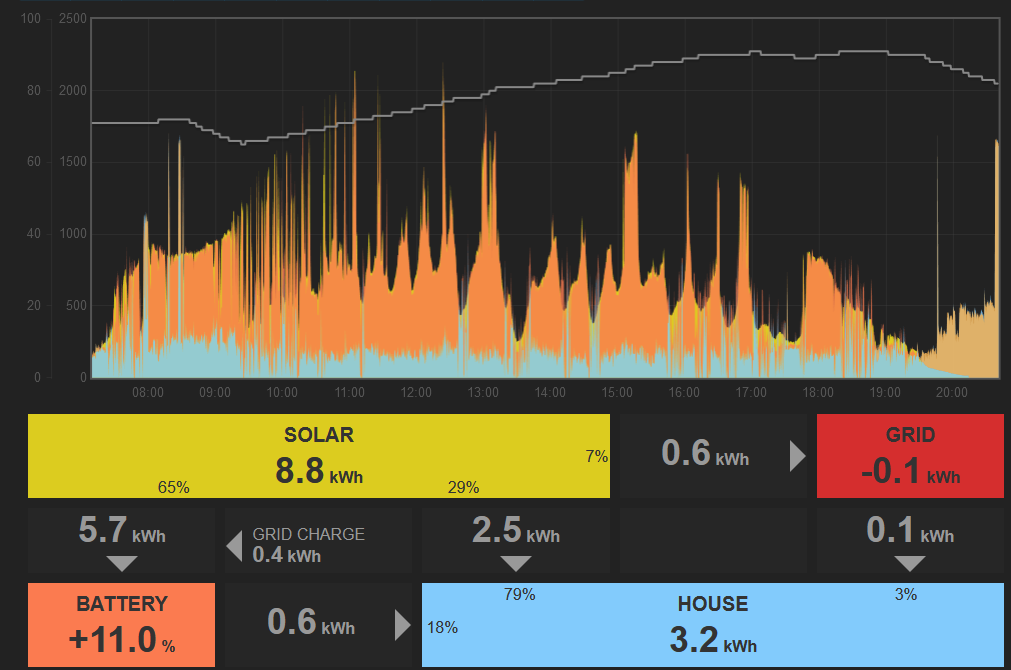
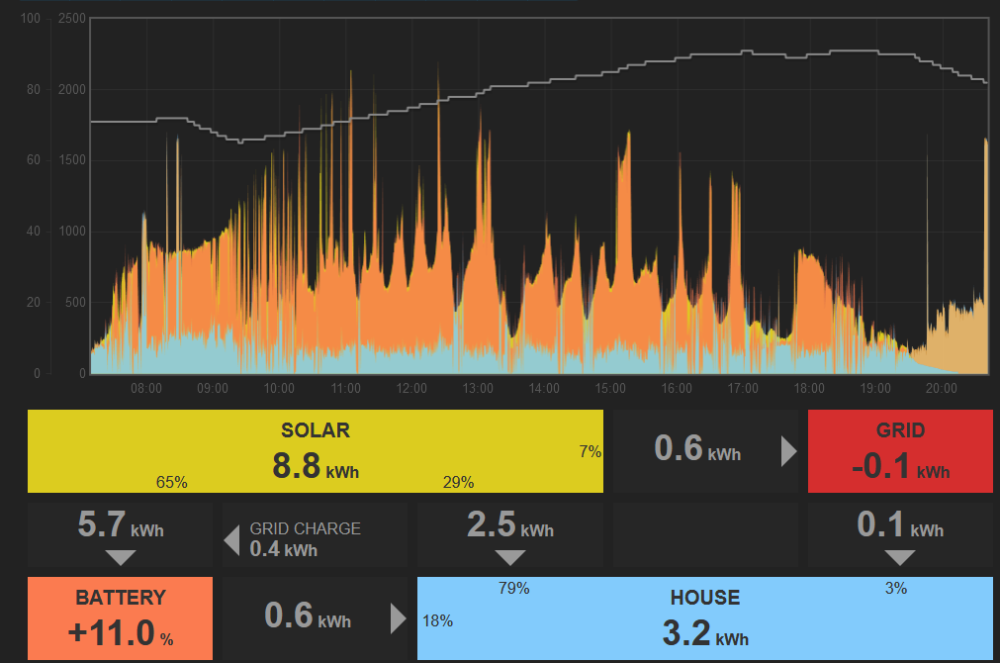
You are telling me this isn't charging for free from solar array? edit: for info: the line is battery charge level, the filled lines are solar generation and where it went. Cost of solar: £7000 about 9 years ago. Return on investment: about 10 years mark, accounting for inflation. Effective cost of solar from after ROI: free. Feed in tariff is based on generation, not export. So self-consumed as much as possible. Charge car or don't charge, it doesn't make any difference to the payment.
-
https://electrek.co/2024/04/19/kias-15000-ev2-caught-in-wild-most-affordable-ev-video/ Kia EV2, $15k BEV, spotted in the wild.
-
I'm surprised the Taycan hasn't burst into flames according to the stuff people say on the internet 🤪
-
But why are 240 kW capable Korean 800v cars not able to charge at full speed on 250 kW Tesla 400v chargers? Why are 250 kW capable Tesla cars not able to charge at full speed on 350 kW ultra-rapid? What about 400v AC, which EV onboard charge is able to charge from that? As usual, devil is in the detail. for rapid charger it is amp limited and car voltage dependent to deliver maximum power in kW. If only the public is willing to learn about this new tech, how different speed is individually useful in different situations. At very least learn how to best operate their own machines.
-
Then what's the point of the video? Highlight how not to charge EV's, but present it as a problem. Destination charging at hotels would solve all problem for tourists. Public infrastructure should always be the fallback. 7 kW charge points are never designed to get people from A to B, it is designed for people to use whilst parked up at B. For example, my 600 miles drive to Portree, I would not have to worry about charging. Tesla software takes care of everything, Tesla superchargers all the way. But around Isle of Skye, I'll need a top up charge. If I were able to charge at the B&B for just 1 night, I wouldn't have any worry for the duration of my stay on the isle. Scotland council installed rapid charger is the last resort fallback. I'll be travelling in May bank holiday as well as kids' half term. One of busiest week for tourists. I'm not at all worried about potential queueing.
-
Tesla is not known to book people in for anything software related, they prefer to solve remotely by pushing a new OTA update, failing that it's "ranger" to your door, service centre is last resort. So might needed a new charge port or onboard charger? Not sure what's the problem with Kia..... again, doesn't sound like software related. Sounds like dealer or Kia UK doesn't know what's wrong with the car.
-
Out of interest, what sort of problems? Is it Tesla/Apple's "my way or the highway" or something that is serious and makes the car undriveable?
-
Only if vehicle built-in self diagnostic cannot make sense of what went wrong. With simple machines, the error code should get you 90% there: https://www.tesla.com/ownersmanual/model3/en_us/GUID-9A3F0F72-71F4-433D-B68B-0A472A9359DF.html The customer can also check and self diagnose: https://teslatap.com/articles/service-mode/
-
Car parts assembly company and mechanical parts replacement technician don't have a handle on electronics, who would have thought! FWIW, all the OTA updates I've done on my Tesla were problem free. I've read story of Tesla not able to be driven due to wrong drivetrain software received via OTA update. It was sorted within 2 hours of phoning them up.
-
There are around 32 million cars on the road in 2017. https://www.statista.com/statistics/299972/average-age-of-cars-on-the-road-in-the-united-kingdom/ Let's say 100 thousand li-on cars by 2017, more than double from your data in 2015. That is just 0.31% out of total cars. More than 1000 cars were involved in the 2017 fire, let's say 1500. So statistically, there will only be 4 li-on equipped cars. How much damage could 4 small li-on battery contribute, in comparison to fuel in over 1000 fuel tanks? Are the building material and structure design similar between the Liverpool car park and Luton airport car park? Otherwise making this comparison is rather misleading.
-
The dancing guess-o-meter is expected. It's completely worthless because it works out car's range from previous few miles of driving. 2013 or earlier Leaf doesn't have the battery % reading. Late 2013 or newer will have much more reliable battery % reading. Always use a metric that directly reports battery energy remaining, same as the fuel gauge. 60 miles to completely empty is pretty good going for 9 health bar Leaf. The video skipped the an important explanation. Nissan cheated, 1st bar is lost at 85%, not 11/12 = 91%. Subsequent bars are lost at ~6.5%. Hence at 9 bars SoH is at 70%. I'd trust my car to go ~50 miles with comfort buffer built in. My 9.5 years old is at 11 health bars, soon to loose 11th. Although it's been at 79% for the last year. As mentioned, 30 battery seems to degrade faster, many 6 years old cars are also at 80% SoH. The slowest degrading battery for first-gen Leaf seems to be the one I have, the 24 pack after 2013.
-
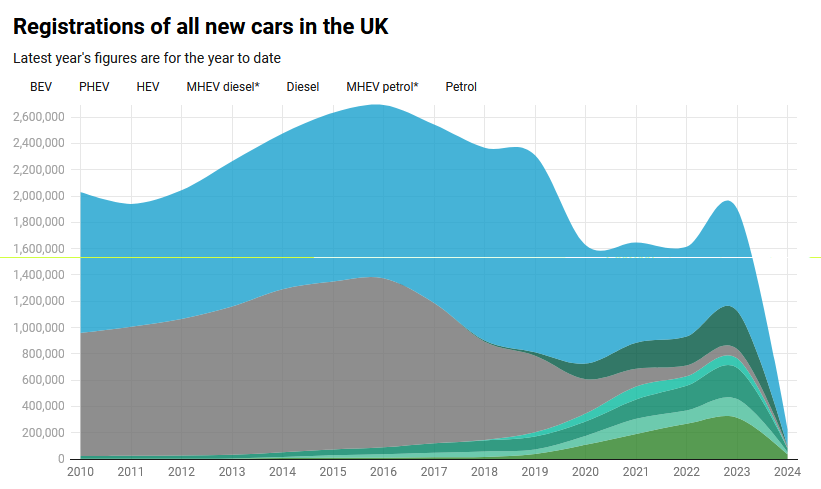
And neither have we seen ideal lithium burning condition. How sure are you that during the very unlikely event known as battery thermal runaway, it will burn much hotter than petrol/diesel fire? I also don't see any reason why battery are brought into the equation, when the likelihood of "contributing" is miniscule. As percentage, in 2017, li-on battery vehicle are less than a few % on the UK roads. Statically the 2017 burnt down car park is more likely to not have contained any Li-on battery vehicle (PHEV, BEV).
-
Other fuel sources burn just as ferocious and has similar temperature to destroy supporting structure. https://en.wikipedia.org/wiki/Adiabatic_flame_temperature#Common_flame_temperatures Gasoline: 2,138c Lithium: 2,438c Difference is putting them out and problem of re-combustion with lithium batteries.