
wyx087
Resident Member
-
Joined
-
Last visited
Everything posted by wyx087
-
As expected, most of the cost is in depreciation. Every other cost (excluding insurance) is minuscule. Same experience for me. End of the day, people need to stop think with separate costs: purchase/lease cost and running cost. It's all money spent on motoring, save on 1 side allows more spend on the other.
-
Hopefully it's clear why controversial EV contents are being made by the dozens, a lot of the time by non-EV or even non-car channels. End of the day, it's all about the attention economy. Feed the algorithm, feed the entrenched ideals.
-
The extra cheap slots had been very reliably made available for me so far. I agree in the future more emphasis may be placed on making sure there is sufficient renewable excess. So it may require longer time plugged in (eg, instead of 8pm to 9am all cheap, may require 7pm to 10am with gaps in the middle as wind drops) This is why the longer you keep it plugged in, the more flexibility it offers to the suppliers, so I have been advocating idea of simply plugging in whenever possible (eg. parked at home). With more and more unpredictable renewables on the grid, I cannot see any reason why cheap rate slots being withdrawn. Even if taxation gets introduced, it would still be hugely beneficial for everyone to utilise the excess generation. The way I can see taxation works is in tiers according to how much load is put on the grid and how flexible you are: V2G don't get taxed, smart charging gets taxed a low amount, dumb charging gets taxed a moderate amount, finally charging during high demand period (4-7pm) and rapid charging gets taxed a high amount.
-
Indeed. https://en.wikipedia.org/wiki/Hanlon's_razor
-
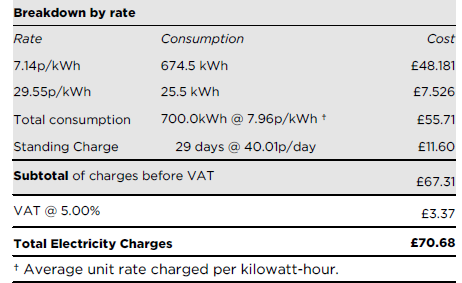
It is unlikely people will drive 250+ miles 2 days in a roll. So 7.5p/kWh for 6 hours is typically more than enough. It would charge just over 50% for a ~78 kWh car (GV60 or MYLR). That translates to around 130 miles. Gotta stop thinking with empty-to-full mentality. It is possible to "smart" charge fully overnight by utilising extra cheap slots offered by Octopus intelligent: https://octopus.energy/smart/intelligent-octopus-go/ Regarding day time premium, just get a way to time-shift to cheap energy. 1 month figures: Before you say home storage it's expensive, my V2H + brand new home charger (I sold my old Podpoint that was installed in 2017) costed me £2200. 10p/mile saving + 20p/kWh home use saving means less than 1 year ROI. 3 phase is not needed. I'm charging 2 EV's at combined 14 kW, ~60 amps. I try to move washing machine and dishwasher away from Leaf's brief 2hr charging, but even with those it would not exceed the 100 amp incoming. I guess the reason 600 miles was quoted because it lines up with 50% public charging cost estimate for a 600 miles trip. 300 miles from home, 300 miles public charging.
-
Sure, the black smoke couldn't possibly be diesel..... 🤞
-
Definitely not an EV 😛 https://www.speakev.com/threads/fossil-fuel-ambulance-catches-fire.184189/ Great comments:
-
Also worth adding, all Model Y's come with matrix headlight hardware. With latest 2024.8 update, all cars now have adaptive matrix headlight feature like Audi's.
-
Real world experience of public charging on the bank holiday: https://www.speakev.com/threads/bank-holiday-charging-chaos-not-really.184100/ In short, only Rugby service had a queue, but no queue nearby after a very simple quick look on the map. Zero queue just turn up and charge for everywhere else from Aberdeen to Hampshire and back. One can always find queues if one goes to busiest locations for "contents". Climate control isn't one of the required physical control......
-
now if only there was a nation wide network of electric distribution network , oh I don't know, lets say national grid. You know, something that would deliver your energy in the same way for everything else. Even better , wouldn't it be nice if your EV could be plugged in everywhere it is parked. Then it could even help the grid by soak up excess renewable and charge much cheaper. How many EV owners have solar panels installed at their property so they don't even have to buy fuel? Answering your last question, I don't feel having an up front cost to save in the long run is wrong/bad. Grants exist to help but it shouldn't remove the up front cost completely when there's saving to be made for the individual.
-
There are many people have got the boiler upgrade scheme (BUS) grant and spent less than direct boiler replacement. How much is a gas boiler replacement? £3000 for combi? £2600 for direct system boiler replacement last year my parents done it, absolutely nothing else changed, straight boiler swap and added a magnetic thing. https://www.speakev.com/threads/journey-to-electric-only-complete.183843/#replies £1000 for ASHP https://www.speakev.com/threads/paid-£500-to-start-the-heat-pump-journey.183984/post-3587553 £390, later on someone else said £800 quoted, the OP's quote is £2900 in page 2. https://www.speakev.com/threads/new-vaillant-heat-pump-install-ne-england.183484/post-3574971 Cost parity with oil heater replacement I agree direct combi boiler replacement isn't realistically feasible at the moment. This is my biggest issue as I no longer have the space for a hot water tank. (also wife wouldn't let go of the gas hob) Regarding the cross-pavement cost. £650 is will be paid back from overnight charging savings in ~6500 miles. (3p/mile vs 13p/mile public charging or petrol/diesel)
-
Best to stop relying on the council's token gestures. 😅 Braintree have an "electric forecourt" https://gridserve.com/electric-vehicle-charging/electric-forecourt/braintree/ Luton, Cambridge, Ipswich, Newmarket and Thetford all now have Tesla open-to-all https://www.tesla.com/findus?v=2&bounds=52.89387333088001%2C1.839886066015457%2C51.13615500484255%2C-1.670245769922043&zoom=9&filters=party But as always, best to charge at home and get this grant for on-street parking if at all possible: https://find-government-grants.service.gov.uk/grants/electric-vehicle-chargepoint-grant-for-households-with-on-street-parking-1
-
I read those ones will work with the same as Tesla superchargers for Tesla vehicles: So their backend is most likely still managed by Tesla. Good from reliability point of view as evident from supercharger, but some people may not like the association.
-
(not seeing what you are referencing) All charge points should communicate with the car in the correct way, letting the car know its limits and doing most basic safety checks. Otherwise they wouldn't function and no one would buy them. The goal is to match demand with cheap abundant renewables. When this happens, everyone get cheaper energy. But it is unrealistic to expect people to put the kettle on only when the sun shines. So storage capabilities are needed. There will always be points in time where demand is lower than supply capability, batteries can then soak up those cheap electricity. The view that cheap overnight will disappear will only be true if we continue to rely on supply that we can control. For example current majority mix of gas plants. As I always said, key is to keeping the car plugged in. Stop thinking with petrol station, start thinking EV as wasted resource when not plugged in, batteries as assets with flexibility to soak up cheap energy whenever needed.
-
Comms for charge point is as laid out in the podpoint explainer. This is optional. Comms for vehicle is to ensure vehicle doesn't pull more than what can be provided. Charge point gives a PWM signal to tell charge point maximum charge current. The cable gives a resistive value to say how much it can safely handle. Comms for vehicle are compulsory, this is why wall charge point and granny charger exist, you can't just wire up live and neutral to a type 2 plug. Charge point will tell the car a different story compared to granny charger, and only then the car will draw more power. If you don't want it, then just buy a dumb charge point or a smart one and don't connect to internet. https://www.boxt.co.uk/ev-chargers/guides/tethered-vs-untethered-ev-chargers-whats-the-difference-which-is-best
-
Smart charge points after ~2019 all able to cut down charging rate when it detects high load close to house fuse limit. This is done by changing pulse modulation in one of the signal to the car. The charger is in the car, the charger reads those safety signals to ensure it doesn't pull more than what cable and charge point can provide. The cable also has resistor inside it to tell charger its current rating. You don't need comms, as I mentioned regarding if internet is lost, you can always unplug and disable internet features for a dumb charge point that always dispenses when you plug in. But it's still wise to put in the ethernet cable from charge point location back to main fuse. It can be used for CT clamp, comms or any other signal that is needed in the future. 4222 times my Leaf had been plugged in on the slower Type 1 charge port. Over 3000 would have been done by us with the "home" cable. That cable was bought second hand for £50 and sold for £35. The old podpoint had Type 1 and Type 2 cable swapped every other day for 1 year, no problem despite being 5 years old at the time. Those EV connectors are incredibly robust. (I'll be on holiday next week, won't be checking forums)
-
I do have untethered charge point for maximum compatibility (Leaf type 1 and MY type 2). But I keep the Type 2 cable always connected as "home" cable, plugging in takes <2s. In the car there's another cable for charging when away. People buy tethered for ease of use, but I feel "home" cable achieves exact same thing. With added benefit that changing cable is a doddle, for more suitable length due to change of car or when cable get damaged. Untethered also has wider compatibility for older cars.
-
Something like this: https://www.voltaev.co.uk/products/bg-syncev-cable-holster-type-2 You put the plug in there to store it. Put the holster very close to vehicle charge ports. That way you never need to re-arrange the cable, just park up and plug in, 1-2 second job, makes life much easier. Hopefully this explains UK smart charge point regulations, what is communicated in smart functions: https://pod-point.com/guides/smart-charge-point-regulations The communication between car and charge point requires some simple comms (resistive value and PWM signals). You can't just install a Type 2 socket directly to the mains, the required signals wouldn't be present. If you are installing yourself, best to get the cable plumbed in and get EV charge point professionally installed later on. Price should be cheaper and you get more feature-rich smarter charge point, may be even V2H capable. The cable need to contain ethernet such as using EVUltra cable or standard 3 core with added ethernet alongside it. Behaviour when internet fails depends heavily on the charge point. But it should not prevent people from charging. . My old podpoint would revert to completely dumb charge point. Plug in and it dispenses. My new Indra would stick to previously set schedule, that is downloaded and saved locally. There is also an override button on the unit to start charging immediately.
-
Unfortunately no convention for charging point location. Front centre, front side fender and rear sides have all been used. Only way to plan ahead is to install a charge point with untethered Type 2 socket. Then buy a suitable length "home" cable for your EV so there's no excess cable to deal with. I would highly recommend adding a plug holster as close as possible to socket on your EV after you get your EV, the location of charge point then becomes irrelevant and it would save a lot of time not needing to handle the cable. Charging can be done from any plug with the right adaptor. I'm not familiar with French standards. In UK, Earthing is connected to neutral and bound to pipework. So if grid has fault on neutral line, you touching your car would be dangerous. I think that is called TN standard. You want either open-PEN protection on TN standard (most UK sold wall installed charge points have this built in) or convert to TT standard by installing an earthing rod. The dedicated installed charge units communicate using your internet connection or mobile data in UK. Again, not familiar with France, In UK there is no way to communicate over power line. Smart meter all use mobile data network. All latest EV use Type 2 connector. This is the universal connection in Europe. Only a few early EV use Type 1 (Leaf). If you want greatest compatibility, get a charge point with untethered Type 2 socket, then buy a "home" cable for any EV you end up with.
-
Missing most important mention whether this 450k MS is still using original battery and motor. No attempt at SoH read out. I do hope their later videos improve in their EV knowledge base. I look forward to follow up videos with more info on the car.
-
What spec would you say mini EV is comparable? https://www.mini.co.uk/en_GB/home/range/mini-3-door-hatch/mini-3-door-hatch-tech-spec.html Cooper petrol is 1610 kg, and goes up to 1710 kg for JCW. Electric is 1775 kg, but I can't figure out which version is it on your table...... Mini electric is 10% heavier whilst built on compromised ICE platform. Or only 3.8% heavier compared to heaviest petrol version. Today's cars are heavier, not just EV's.
-
Tesla are known to do end of quarter pushes. Just like dealerships where car manufacturer price is obscured from buyer and dealership make end of month/quarter/year sales. But sometimes these price increases are rumours (might be circulated by mothership itself) to induce demand. So far, I've only seen Tesla say they plan to raise price in US. As for vehicle weight, we have to compare like-for-like. Average petrol/diesel includes older simpler vehicles without all the latest safety gear. Also another factor is the ham-fisted approach by some manufacturers. BMW i4 for example is up to 2300 kg for a car without much space inside (4 series). This is due to use of ICE platform rather than building on a dedicated BEV platform. Compare same era dedicated EV to same era ICE with similar vehicle size, safety gear and performance. I've posted this previously: Tesla Model Y LR: 1986 kg, 378 bhp, 854 l boot. Tesla Model Y SUV Long Range AWD 5dr Auto specs & dimensions | Parkers Volvo XC60 polestar engineered PHEV: 2145 kg, comparable 399 bhp, 598 l boot. Volvo XC60 SUV Polestar Engineered T8 Twin Engine AWD auto 5d specs & dimensions | Parkers Audi SQ5 sportback diesel: 2010 kg, 336 bhp, 500 l boot. Audi Q5 Sportback SQ5 TDI Quattro 5dr Tiptronic specs & dimensions | Parkers VW Touareg R-line tech petrol: 1945 kg 335 bhp, comparable 810 l boot Volkswagen Touareg SUV R-Line Tech 3.0 V6 TSI 340PS 4Motion Tiptronic auto 5d specs & dimensions | Parkers
-
It is growing pains with rapid roll out of the rapid charging network. Charge point operators need capital to grow, the return is not clear. Investors need to see the return before investing more, so prices get pushed up. Tesla is in an unique position where they can easily push through any lack of returns for charging in their car sales. At same time, their hardware and backend is cheaper due to good engineering and bigger production scale. The only way I can see for price reduction by non-Tesla charge point operators is government support, in the growth period. I think this is the area government should now focus on. The call by manufacturers for subsidies should be ignored, the product itself is already more than good enough and price competitive. It's the usage experience that needs improving.
-
It's astonishing some of the rises in standing charge, over 60p. Luckily, in greater London or south east is still at 40-odd pence. I agree cost of infrastructure upgrades should be built into per-kWh of electricity, not standing charge. Down here should be a noticeably more expensive than where renewables are located, up there. This makes so much sense. Why let the work van parked not doing anything? When it could be charging or even assisting the grid. Need to start thinking with the mentality that parked cars = wasted resource; plugged in cars = useful resource.
-
Government push out a half thought out policy, who would have thought! Undoubtedly there would be more arguments over parking spots. Not saying it's a good idea, just reporting on this news that might help alleviate the issue...... whilst worsen another issue.