wyx087
Resident Member
-
Joined
-
Last visited
Everything posted by wyx087
-
For car integration with supplier, you wouldn't need to do anything with the app if your ready-by time never changes. Simply plug in and they take care of everything. Make sure to leave charge point in dumb "charge any time" mode. IOG (or EOn) will poll the car and work out it has plugged in, stop the charge and create a schedule. I have a thread that I keep up to date on SpeakEV for all the lowest EV specific tariffs if it's of any use List of EV Tariff for 2.5p/mile motoring | Speak EV - Electric Car Forums
-
This is exactly how it works. I'm on IOG. From what I've read, EOn are using Octopus' Kraken backend, so it is highly likely it will work similar to Intelligent Octopus Go (IOG). E.ON Next and Kraken partner to lower energy bills for customers | E.ON News You set how much % you want to add if it's charge point connecting to supplier; you set target % SoC if car is connected. You set ready by time Plug in if not already plugged in Supplier sets charging schedule. You can change settings at any time for re-roll. It will never override car charge limit. For example, if your car limit is set to 80%, only really need 50% replenished, but tell supplier you want 100%. Supplier will schedule as such, giving more cheaper electricity during late evening. But car will prevent it from charging further once car hits 80%. However, supplier will know because it checks charge point logs to ensure charging has started, and it is against T&C (at least for IOG). I have Home Assistant set up to relay how much % Tesla needs to IOG. So that every time I only need to plug in. But I think as long as it's in the ballpark should be fine. Or simply leave it on something like 70% should be roughtly there, you'll rarely arrive home at 0%.
-
What Evo and Stone said. WRT not maintain speed up a really long hill, if there is a fault with cooling system, yes power may be reduced causing problem maintaining speed. Power will also be reduced without any fault when very low SoC. Almost all EV will have available power (both drive and regen) indication. gen 1 Leaf is the bubbles, Tesla is the dotted lines. Due to ultra efficient nature of EV's, during normal driving and normal AC charging, excess heat isn't the problem. I have driven our gen1 Leaf like I stole it in 35c and never see thermal throttle, only went up to 6 bars. Generally EV battery cooling are designed for rapid charging or track use. Day to day, the coolant only circulates to ensure even temeprature across the cells. So you'll need a really really long hill or be driving like on a track to really need the battery thermal management. The ONLY case where I think there may be a cause for concern is during rapid charging. Let's say if there is a coolant leak in the radiators, Tesla pre-heats the battery to over 50c using motors as resistive heater, then during rapid charging coolant leaks out when going through the radiator. But I believe the car/BMS would be smart enough to detect the fault and shut off rapid charging, thus instantly stop adding energy into the system.
-
What exactly are you seeking? There is no video of the fire. Burning is seen from the thumbnail but no giant explosion in such a distructive way as the previous video. How sure are you that the previous video was Li-on related?
-
That's a really strange article, almost seems like AI written it: no references to sources, half truths written confidently. On this part: " It's important to manage battery heat during use and ensure it stays within these ranges. When temperatures climb to high levels, typically between 158°F and 212°F, there's a risk of thermal runaway—a dangerous chain reaction that can lead to battery pack destruction. " It completely ignores that BMS will manage the charge and discharge rates to prevent overheating. There's a lot more control over battery temperature than the mandatory oil and coolant required by ICE. Put it simply, BMS controlled charge/discharge a giant battery at very slow rate rate would not raise its temperature. Basic physics: energy = work over time. Increase time and decrease work will reduce heat energy generation.
-
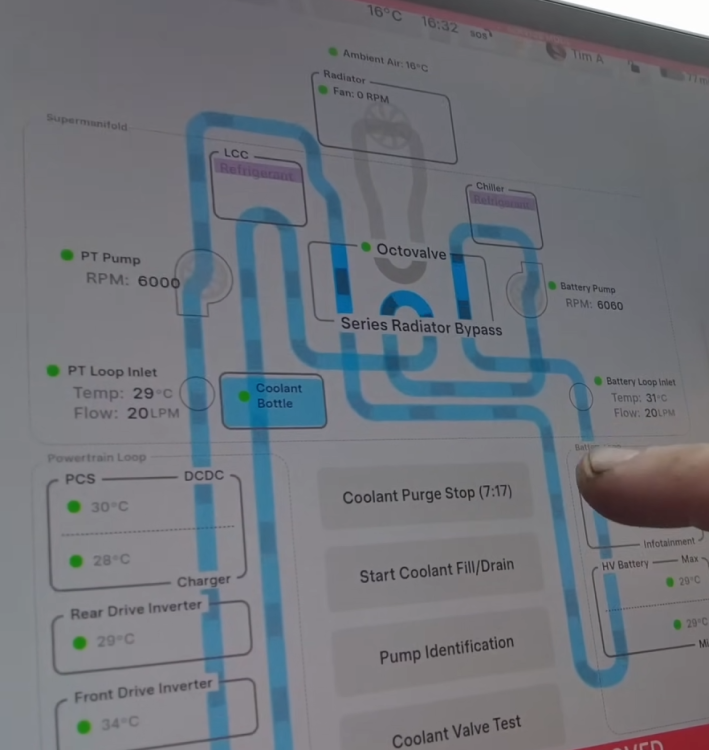
Where is your source of info for EV's have 2 cooling systems? All EV I've seen only have 1 coolant tank. There may be systems that seem complicated (tear down of Ford Mach-e looks full of pipes) but underlaying principle is quite simple. Early Nissan Leaf only have 1 coolant loop for the motor, doesn't even have intercooler for cabin, just radiator + motor stack (I'm unsure if inverter gets any coolant, as it's built like an engine sitting on top of the motor) in this loop. Cabin has independent AC system and PTC heater. Battery doesn't get anything. Tesla have "Octovalve". It handles liquid distribution and all the components can be accessible once taken the frunk off. Below is a video of swapping in a new heat pump compressor. Everything is 1 loop with Octovalve managing the flow. There's a customer service menu allowing customer to do any work they desire. Detailed first-party workshop service manual freely available online: https://service.tesla.com/docs/Model3/ServiceManual/en-us/GUID-50BD94A1-A00B-40DC-8241-4E75CF0B702B.html Which other manufacturer publishes those, with detailed photo+video for to work on their cars? JalopnikThe Tesla Model Y's Octovalve And Cooling System Manifold...Automotive benchmarking company Munro & Associates has been tearing into a Tesla Model Y for a number of weeks now, and perhaps the company’s most intriguing discovery is the amazing cooling system... All seems much simpler than coolant system + turbo intercooler + emission control systems in ICE vehicles.
-
Whatever testing method, at least EV will never have this problem because there is no exhaust. Sky NewsDieselgate: Five carmakers go on trial in UKThe class action beginning at the High Court today could yet be expanded to include 1.8 million customers of 14 car brands, one law firm involved in the case says.
-
Hang on, I thought you said li-on battery fires are fierce flames. They don't really explode. Someone else on SpeakEV actually thinks for themselves, I'll just c+p here: " Interesting somehow an explosive atmosphere was created inside the garage. There are 3 possible atmospheres. Hydrogen / oxygen from 12v battery charging. Petrol vapour + atmospheric oxygen and assuming the house uses gas a natural gas leak from a domestic supply and atmospheric oxygen. Hydrogen / oxygen from 12v, difficult to get enough volume for a big bang petrol / air needs a lot of energy to kick it off. My money would be on the gas leak explosion, there are about 30 per year in the UK alone, if that's the case the car is an innocent bystander. " https://www.speakev.com/threads/peugeot-phev-explodes-with-a-shockwave.193765/?post_id=3836985#post-3836985 Funny how that particular youtube channel chooses to point the blame at li-on batteries despite absolutely no evidence. Hum...... makes one wonder their biases....
-
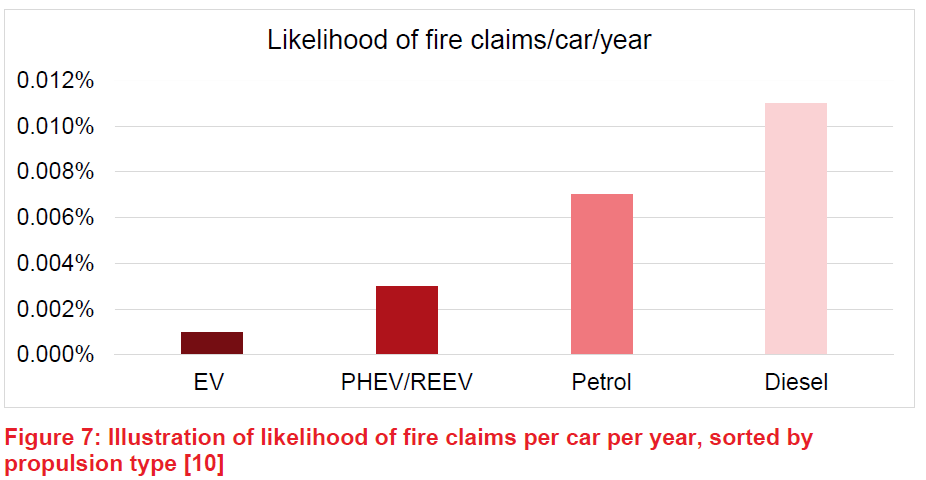
Let's refresh memories, "covered car park fire safety guidance for EV" was the report: https://www.briskoda.net/forums/topic/517208-car-park-fires-transporters-ships-any-fires-any-evs-involved-or-not-thread-were-they-the-cause-just-there-and-so-made-fighting-the-fire-harder/page/6/#findComment-5804476 The data on page 21 came from Thatcham Research and MIAFTR. " Thatcham Research, the UK motor insurers’ research centre, used the data from the Motor Insurance Anti-Fraud and Theft Register (MIAFTR) and their own data to categorise fire claims by vehicle fuel type, excluding claims relating to theft as they could be due to arson. " First, this number did not come from fire departments. Second, previously you talked about Thatcham Research, where it supported your views, you claimed they were very reputable. The number that kept being quoted is because that's the only stat available. Until you've got more reputable stats, casting doubt on reputable figures seems to have arterial motive.
-
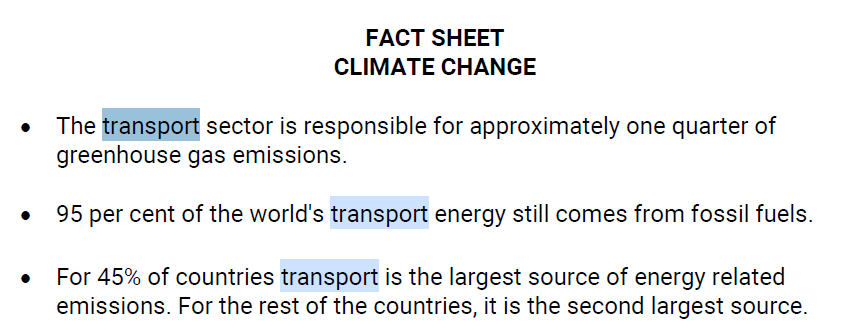
Well, is it true or not that fossil fuel powered transport contributes a significant amount to climate change? https://www.un.org/sites/un2.un.org/files/media_gstc/FACT_SHEET_Climate_Change.pdf and Restricting power would not increase range, the bigger the battery the easier it is to draw more power from it. Because it decreases C rating. Range is never an issue as I'm sure many people actually driving EV can attest. As previously mentioned, MEB cars are on the heavy side compared to American/French EV's, not sure about Chinese, they are not really focused on efficiency. Similarly, Skoda MQB cars are on the lighter side. By the way, seeing Kodiaq is 7 seat capable, I'd class Enryaq/ID4 one size below. As with all things, there's variation. Until an average is calculated across the market for different "classes", I don't think it is fair to continue the old thinking that EV are heavier, often repeated by poorly researched articles. As I've shown back in 2023, there's lighter BEV and heavier ICE vehicles. Just as you can cherry pick your car to claim otherwise.

-
Well done, you've put in good effort. Now add a few more metrics, how many BHP does your car have? How much does it weigh if you change the engine to over 300 bph? Why does it have to be your or anyone's vehicle? Is this because of chip on your shoulder? I've previously posted, many ICE vehicles do weigh more and often smaller load capacity: The higher the vehicle, the poor visibility of lower road users (including more vulnerable ones), as you've rightly pointed out. There's many ICE powered vehicles that are just as heavy as the 2 EV examples you've picked. See my 2023 post. No need to say that. Remember, the less mileage ICE is being used in its lifetime, the better. So it's never too late to scrap it 🥰 If weight based, and if it is based on GVW rather than kerb weight, yes, absolutely. On kerb weight, as shown by yourself, Tesla and Renault are on the same "grade", and will very likely be cheaper than many of those I posted in 2023. Indeed. I can only relate this bit to lol's final statement regarding Kei cars.
-
Indeed, both are very true. Is it fair for smaller lighter cars to be hit with same tax/parking as heavier ones that does more damage to the roads and take up more road space? Is it possible to rent said larger vehicle for those once a month trips? Is it possible to drive a smaller vehicle for times when the big car isn't needed? (you've already answered them, I'm just putting out food for thought, if you like) There's indeed different uses and needs by different people, for example farmers seems to swear by their Land Rover or Toyota's. But at the same time, tragic death at that Wimbledon school could be avoidable if such monstrocity isn't on the road. It's all relative. Unfortunately around suburban London, most large passenger vehicles (typically Range Rover or biggest SUV by a German brand) I see are not serving its intended purpose are sparkly clean, only 1 or 2 in the car, and are definitely for one's ego.
-
Those have a function to serve. They are likely to be on a different tax bracket. Does heavy passenger cars have any additional function to serve compared to lighter cars? Of course, other than to inflate driver's ego. Bigger sized human can still fit in smaller lighter vehicles, Hyundai Inster is a good example. Lots of Kei cars are light weight and tiny on the outside but giant on the inside.
-
The survivability of any meat bag outside of vehicles are not affected by crumple zones. However, they are affected by vehicle inertia and body shape. Former is weight and speed, latter is lower car vs SUV. My argument is that weight based taxation system to disincentivise heavier vehicles make sense on more levels than it doesn't. Manufacturers can cut corners or they can offer more smaller lighter vehicles that are less lethal to the other party. Remember, vehicles exist in a shared space, crumple zones only aims to protect against similar masses.
-
Put yourself, without a metal box, on the other end of accident. Which would you rather be collided with? A lighter vehicle or a heavier vehicle? This kind of comment only focusing on vehicle crumble zone screams "me me me".
-
The point is, once again you are not understanding the issue and blaming other people for your errors. The article pulled numbers in without checking, comparing GVW against kerb weight. Just like how you are defending the article you posted without checking its facts. Yes you have. But what has that got anything to do with Model 3 and BMW 3 series both have GVW 2200 kg? How does that has anything to do with weight of vehicle? How does that have anything to do with:
-
Yes, MEB cars seems to be on the heavy side across the board. Especially compared to Skoda MQB cars. It is also worth pointing out smaller EV are heavier than comparable small ICE vehicles. I'm not saying ICE cars require special consideration. I'm not saying EV require special consideration either. I'm saying using shared or evolved platform as basis for comparison will make EV seem heavier due to the design have legacy parts that are no longer necessary. Legacy ICE manufacturer also tend to buy battery packs to bolt in, rather than start with EV skateboard platform as basis. For example, EV can make the battery a structural part of the vehicle, meaning removing redundant stiffening parts that must be required for ICE vehicle. Platform like this should be EV's starting point: https://www.reuters.com/business/autos-transportation/chinas-catl-launches-ev-platform-flagging-safety-top-selling-point-2024-12-24/ The article did talk about Range Rover weight in kerb weight. It never specified whether the weight given was GVW or kerb weight. Are you saying people should assume and accept your articles in order to confirms your biases? What were you saying about thinking for one self and question things? I question everything, I don't only question things from government. But social media and random webpages require double effort.
-
Point taken. 2200 kg is indeed GVW rather than minimum kerb weight from wikipedia. I still think it is a badly written article rehasing outdated ideas for people to confirm their biases: In the article, it points out Range Rover are heavier, they used kerb weight (follow the link) rather than loaded GVW: " For example, New Range Rovers usually weigh upwards of 2400 kg, which is heavier than many EVs. " 2400 kg is min kerb weight. When to Model 3 at 2200 kg as given in the article makes the EV sound like it is very heavy. In reality, a BMW 3 series permissible gross weight is also 2200 kg. https://www.bmwhk.com/en/all-models/m-series/bmw-3-series-m-models/bmw-m3-sedan-technical-data.html/bmw-m3-competition-sedan-with-m-xdrive.bmw
-
No, any modular platform that has any involvement with ICE will mean it is a compromised platform. Jack of all trade, master of none type of situation. Similar situations are: Stellantis EV's. BMW i4. early Mercedes EQA, EQC. First-gen Nissan Leaf is similar, they say they are built on new EV platform, but it's just re-designed B platform. https://en.wikipedia.org/wiki/Renault-Nissan_B_platform#Nissan_EV_platform This article is the reason I'm banging the drum that EV's used to be considered heavier. The article compares Corsa against ICE counter parts, built on a modular ICE based platform. It is the topic of discussion, why EV are only heavier when built on compromised platform. The article also has flat out lies. Model 3 weights 1600-1800 kg, not 2200 kg. https://en.wikipedia.org/wiki/Tesla_Model_3 You are so lazy in your reply, you just copy and pasted a link from Google, including auto-highlights. Didn't even read the article.
-
What has BMW 5 series got anything to do with Mini? Electric or not. Similarly, what are you trying to compare Model X or Spectre against? Both are EV but you haven't provided a point of reference. But need to remember the weight of special doors on the MX. By the way, Spectre is not a grounds up EV: https://en.wikipedia.org/wiki/Rolls-Royce_Spectre "It is Rolls-Royce's first electric vehicle (EV) and rides on the same platform as the Phantom and Cullinan." I'm not saying EV are special, in fact, I'm saying they are not special in the weight sense as people make out. Yes, I agree ICE cars come in difference size, shape and weights. EV is the same and they are designed to fulfil all kind of different roles. People choose petrol/diesel based on a number of factors, not many choose petrol/diesel based on lifestyle choice. EV is the same, it's another way to power the vehicle and not special in any way as a vehicle. The only possible way EV are special is their role to play in combating climate change. It has nothing to do with lifestyle, size, shape, weight or class of vehicle. It's a powertrain that can be entirely powered by renewable with ultra high efficiency. Its battery is part of answer to mass adoption of renewables. But as a vehicle, it's not special at all, quite boring actually. Only you are treating EV special, as though some sort of satan's creation.
-
Who knew, well designed EV's are not that heavy. But badly designed EV on ICE platform weighs more, i4 for example: up to 2740 kg GVW. https://carstan.info/weight/bmw/i4 Early view that EV's weigh more are due to EV's built on ICE platform compared against ICE cars. That view is no longer true for ground-up EV. MY LW AWD V5 says 2600 kg but car itself weighs 1980 kg. So could load 5 100+ kg adults will have capacity to spare.
-
Riiiiiiight....... so what could this post about age and disability mean, after I uttered the word "walking"? "C40 Cities is a global network of mayors taking urgent action to confront the climate crisis and create a future where everyone can thrive." What's not to like? I sense there's a "car is king" attitude. Just earlier, I saw a local petition going around opposing extension of bus stop by removing 1 parking space. So I've written to my local council parking consolation in support of the proposal, suggesting providing more bus routes to increase shop footfall.
-
Totally agree. It's only a zero sum game, if you deliberately make that way. 15min city is the same, it's not either or. Which is quicker at moving lots of people? Lift or stairs? Similarly, which allows more people to do more things? 15min walking for majority removing lots of cars, option to drive for those who need it? Or everyone has to drive to amenities?
-
Hum, so are you suggesting having the option to walk to amenities within 15min is not a good thing? Because everything must cater to the minority that require a car? Installing lifts or ramps are good, but not if that involves removal of stairs and reduce throughput capacity for the majority. Same principle with 15min cities, give the majority option of walking to amenities. Interesting theory. I hadn't thought of that, thanks for pointing it out. Unfortunately tyre particulate emissions research seems to be in early stages, quick search didn't turn up anything researching this particular variable.
-
Is 15 min cities plans to ban car driving within the local area? Or plans to reduce the need for cars by locating amenities closer to neighbourhoods? You are thinking the former. I'd always thought bigger contact patch = more particulate filter.