Avocet
Members
-
Joined
-
Last visited
Everything posted by Avocet
-
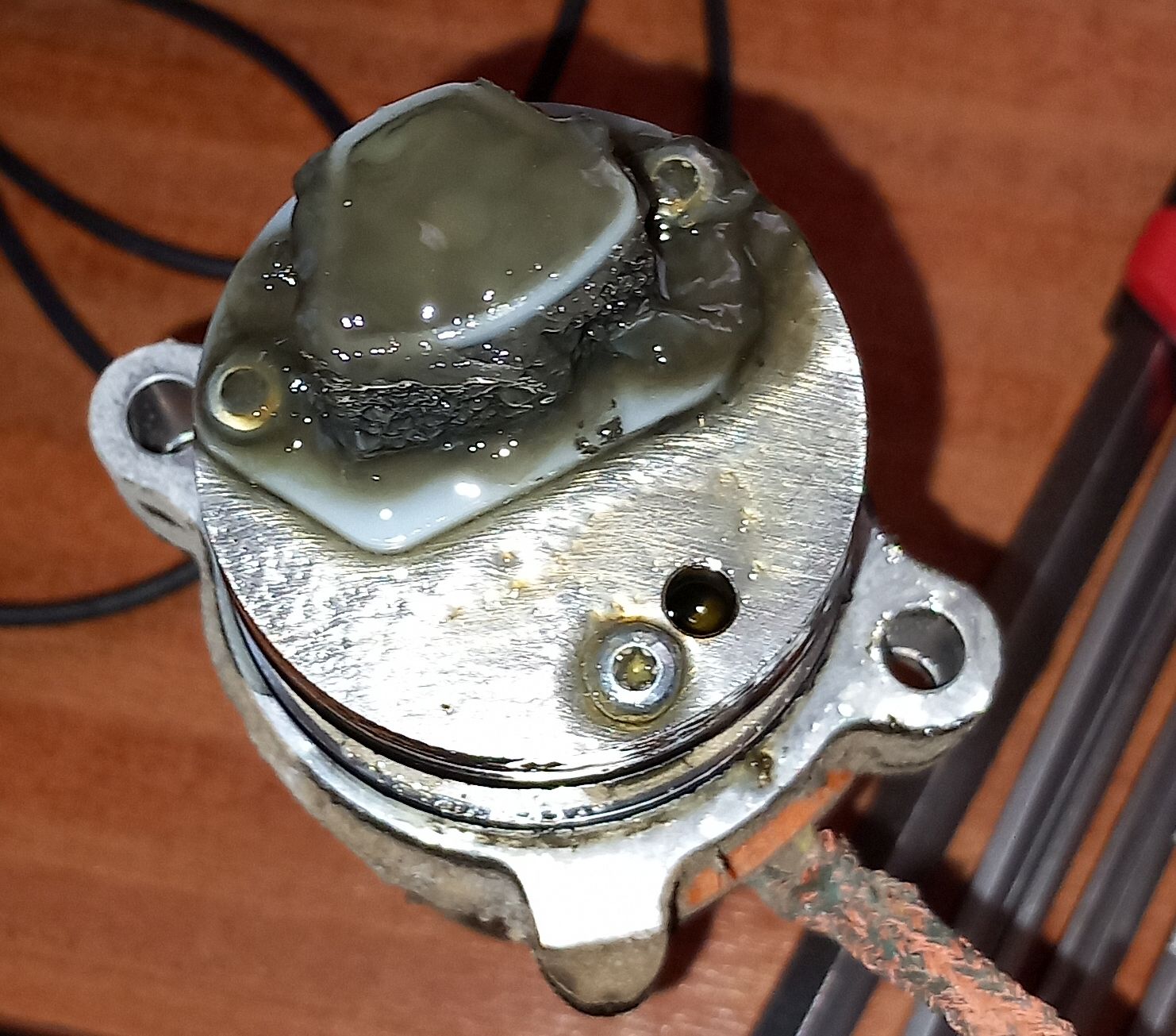
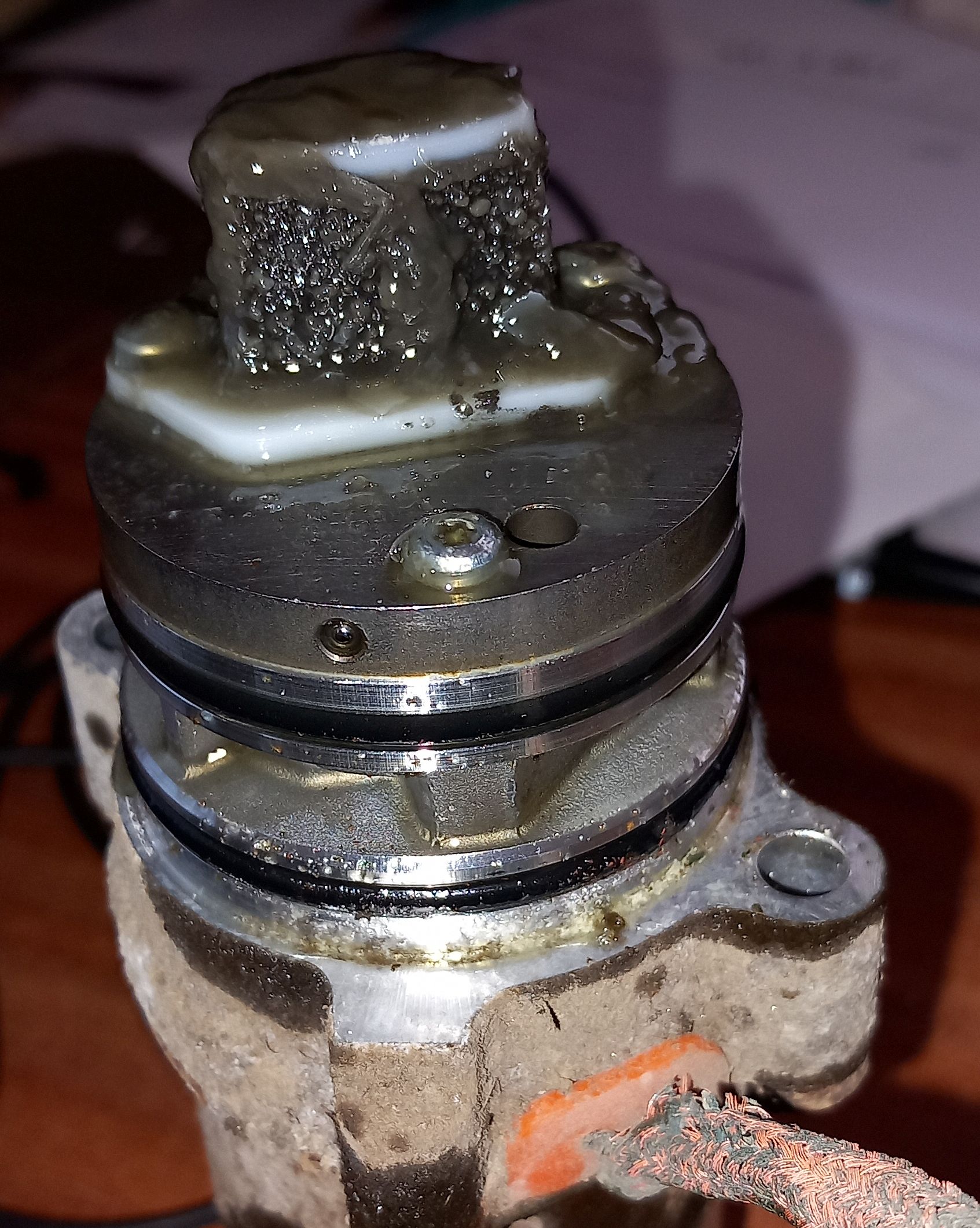
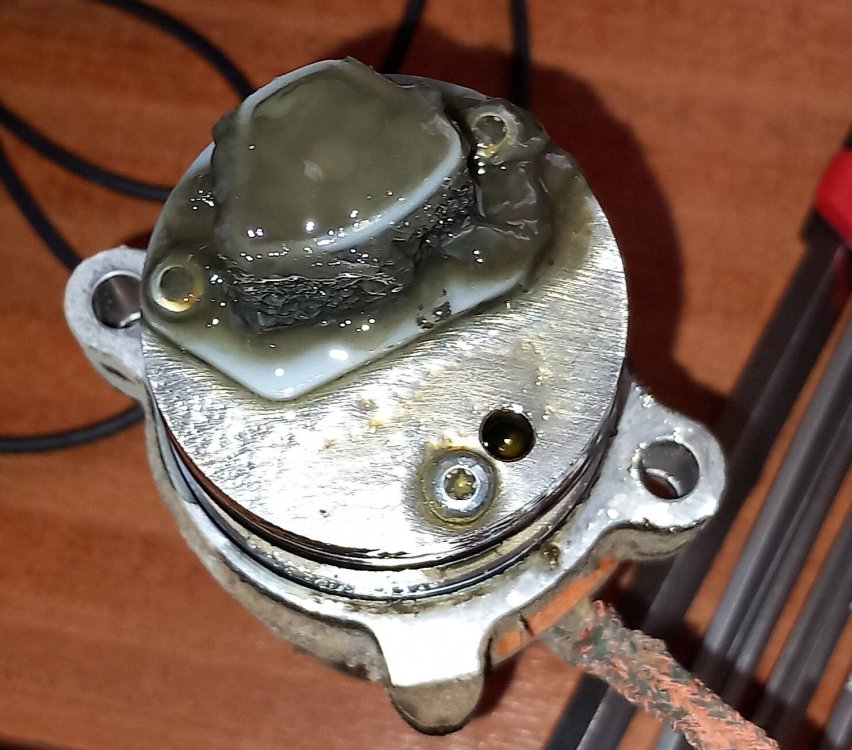
Thanks, I'll try to get some photos, but the cracks look far too irregular to be deliberate, I think! I can practically pull the annulus off with my bare hands! (Not that I've tried too hard, until I can source a replacement)!
-
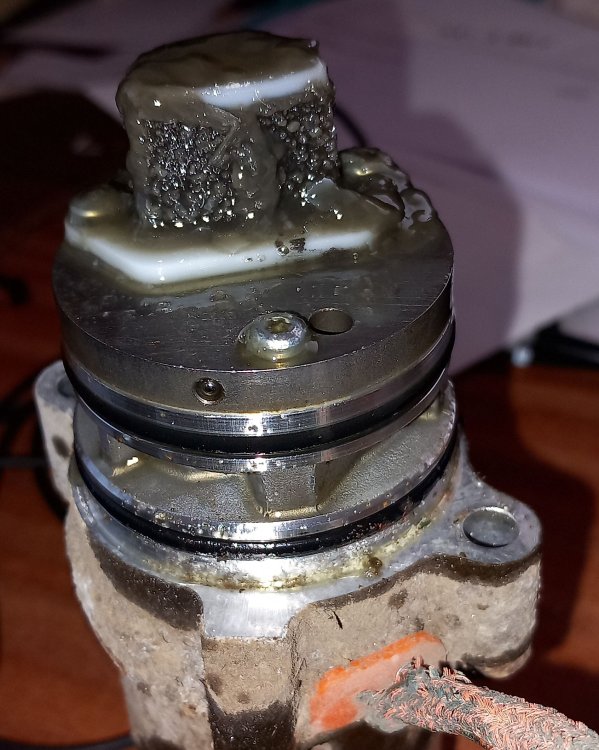
Hi All, When I was doing the Haldex oil change the other week, I noticed that there was a large ring on the end of the propshaft, near the nose of the rear diff. It was bonded to a rubber insert (or at least, it was originally)! The rubber had seriously deteriorated. I'm guessing this is some sort of torsion damper? Do all 4x4 Kodias have them, or just the DSG ones? Bit surprised that the car has only done 44,000 mies and this is all but dead. Does anyone have a part number, please? (Or a source for them)?
-
2017 car with only 44,000 "light" miles on it. Haldex oil previously changed by main stealers. This is the first time I've done it myself. The oil was also pretty manky, with "bits" in it.
-
Well, I finally got round to it this afternoon. Bloody glad I did! Always worth paying that bit extra for a full, main dealer service history...😒
-
OK, thanks. Just thought I'd better check!
-
Sorry, yes, fair point. I do, of course, mean the Haldex oil!
-
Thanks for that. Do you know if a 2017 Kodiaq would be "Generation 5", as in that link, please? It doesn't seem to be on the list in the link. Also, I don't have VCDS. (Although I do have an OBDeleven dongle). I'll have to see if that can do the pump re-learn. Would I be right in thinking that the pump is continuously learning anyway, so if I don't do the re-learn, it will just do it after some driving in any case? (But just take longer).
-
Hi All, Last time this was done by a dealer, they didn't clean the gauze strainer. I'm keen to do it myself, this time, so that I can give it a proper clean. Any tips or recommended "how-to" videos, please? I've been slightly unnerved by one suggestion that I'll need to do a "pump re-learn"? (Seems a bit extreme after an oil change)?! 2017 150 DSG 4x4.
-
Yes, that's possible. My wife's car did this. The most likely explanation, is that there's a bit of pad material deposited on one or both discs. This can happen when the discs get very hot and you come to a stop and leave your foot on the pedal (or hill-hold on). Each time that bit of disc passes between the pads, it "grabs" very slightly giving the illusion of a "warped" disc. The remedy, (I'm told) is to do a few very hard stops, to get the discs stinking hot, (which re-distributes the pad material more evenly round the disc) and then drive around for about 5 minutes (ideally without braking) to allow the discs to cool back down. (Or brake gently to a halt WITHOUT hill-hold on and without leaving your foot on the brakes as the car stops - i.e. coast the last few feet). I never tried it though, because my wife's car's discs needed changing anyway.
-
Thanks ever so much! I really appreciate the trouble you've gone to, with such a detailed answer. I'll pass that one on.
-
Hi All, I normally hang out on the Kodiaq board but a friend has a question about a 1.4 TSI Octavia auto, with about 110,000 on it, 2010 model. He's had it diagnosed by a dealer as having a stretched timing chain. It rattles a bit on startup, (say, for about 2 seconds). The change from 1st to 2nd isn't particularly smooth. Other than that, it drives fine. He has to go on a long trip, abroad on Tuesday, for about 3 weeks, so no time to get anyone to do the timing chain. They anticipate doing about 2500 miles before they get back here. I realise this is a bit of a "how long is a piece of string?" question, but could I ask what the general feeling is, on this matter? Are these prone to sudden, catastrophic failure, or will they happily just gradually get a bit more rattly, but not do anything nasty for a long time? Can they get to a point where the engine won't run properly because the cam timing is as far out? Or go into some kind of limp mode because the engine management system sees a sensor out of range? (Basically, he's just wanting to know whether he should risk it or not...) Would, for example, something like a quick oil change for some thicker oil, help? Thanks!
-
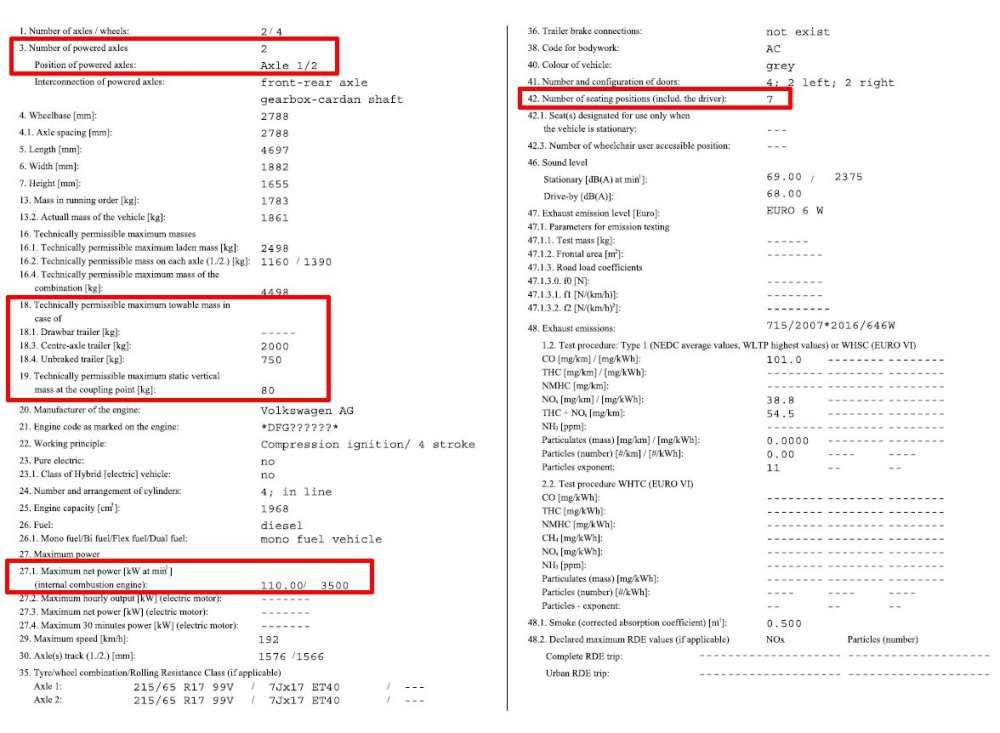
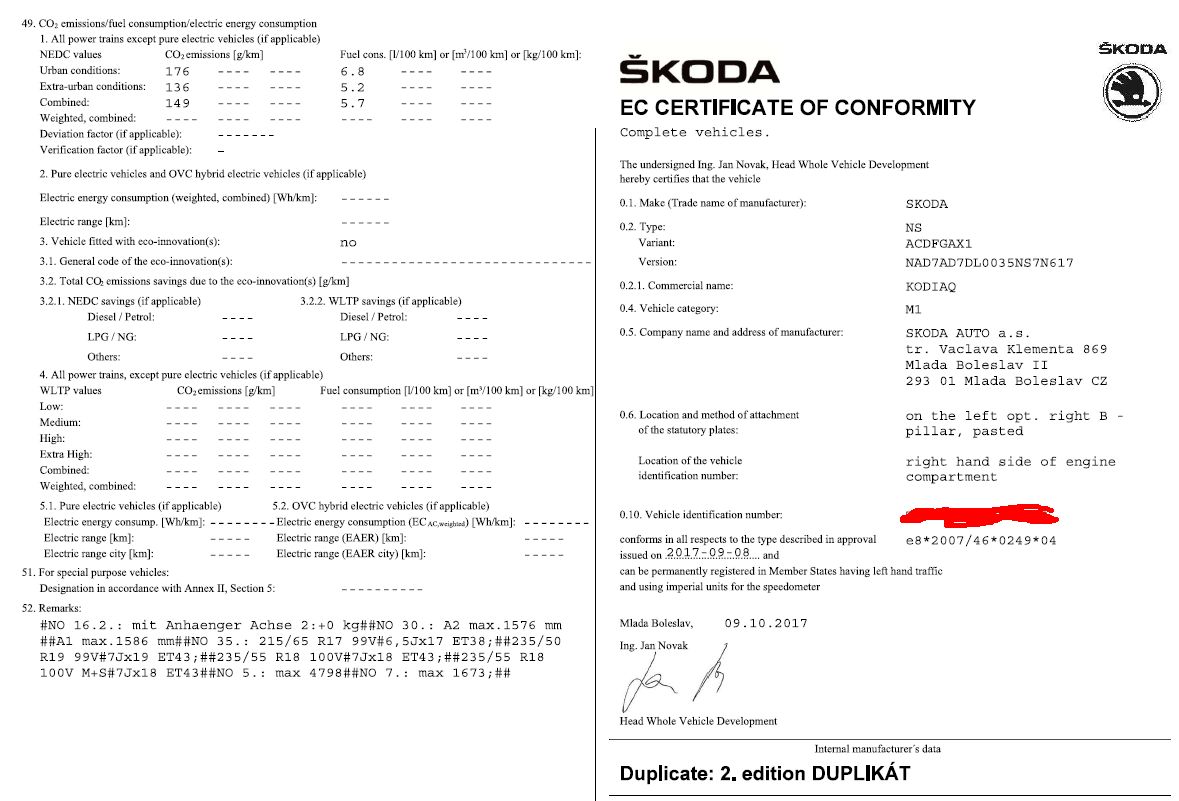
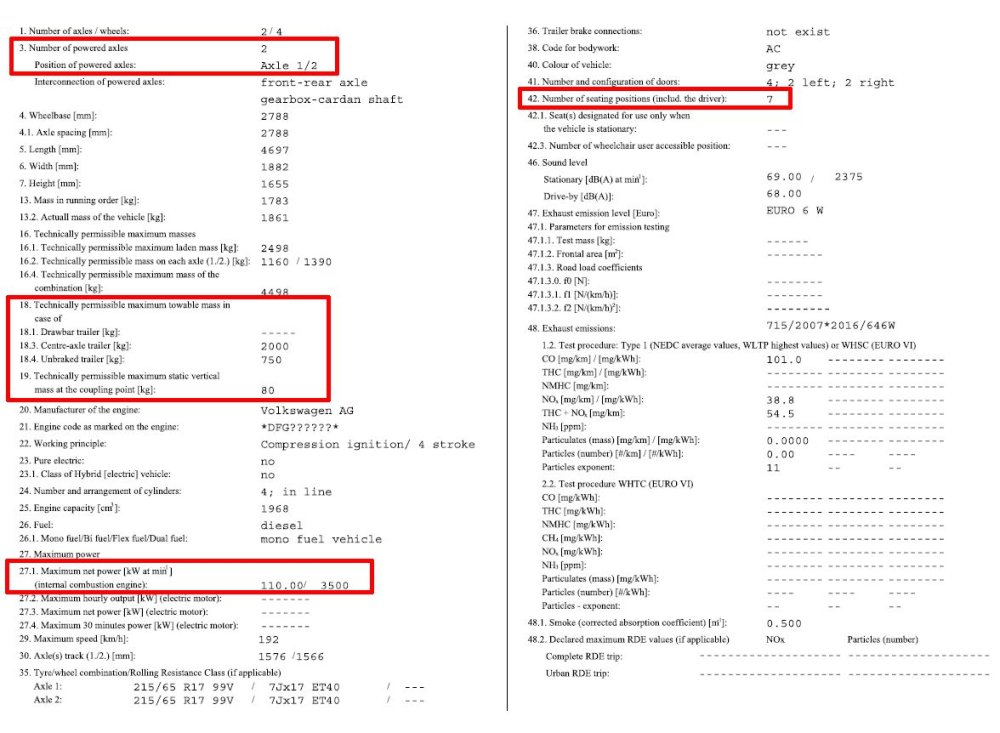
You could try asking Skoda UK for a "specimen" Certificate of Conformity. They MIGHT e-mail you one. The actual "proper" Certificate of Conformity is a very unassuming bit of A4, printed on both sides, but is actually the definitive legal document that nobody can argue with. It is unique to your particular vehicle and will quote what it can and can't tow, braked and unbraked. The manufacturer is obliged to issue ONE original, free of charge, to the first owner, but if the first owner has lost it, they can charge for a duplicate. The "specimen", however, is just a scan of it, and has no legal standing, but does actually give you the data you need.
-
You won't find a law that says you "can't" fit one, because laws are not written that way. They usually tell you what you MUST do, and then if you're not doing those things, you're breaking the law. You will, however, find the Construction and Use regulation on braking, which will say something along the lines of the vehicle "having to comply with the relevant provisions of ECE Regulation 13 or 13H or..." (it will give various alternatives, depending on when the vehicle was type approved). If the vehicle was never homologated for towing in the first place, then as soon as you attach a trailer to it, you will be in breach of the relevant C&U regulation (because you will not be able to provide evidence that the vehicle satisfied the requirements of those regulations with a trailer attached). In a serious enough accident to get the Plod involved and go to court, that's what the prosecuting expert witness would pull out of the hat. Of course, none of this means that the vehicle wouldn't meet the requirements (it probably would, with most trailers), but what you wouldn't have, is firm evidence of compliance to show a court.
-
Keep it safe, some manufacturers can charge well into 3 figures for a duplicate!
-
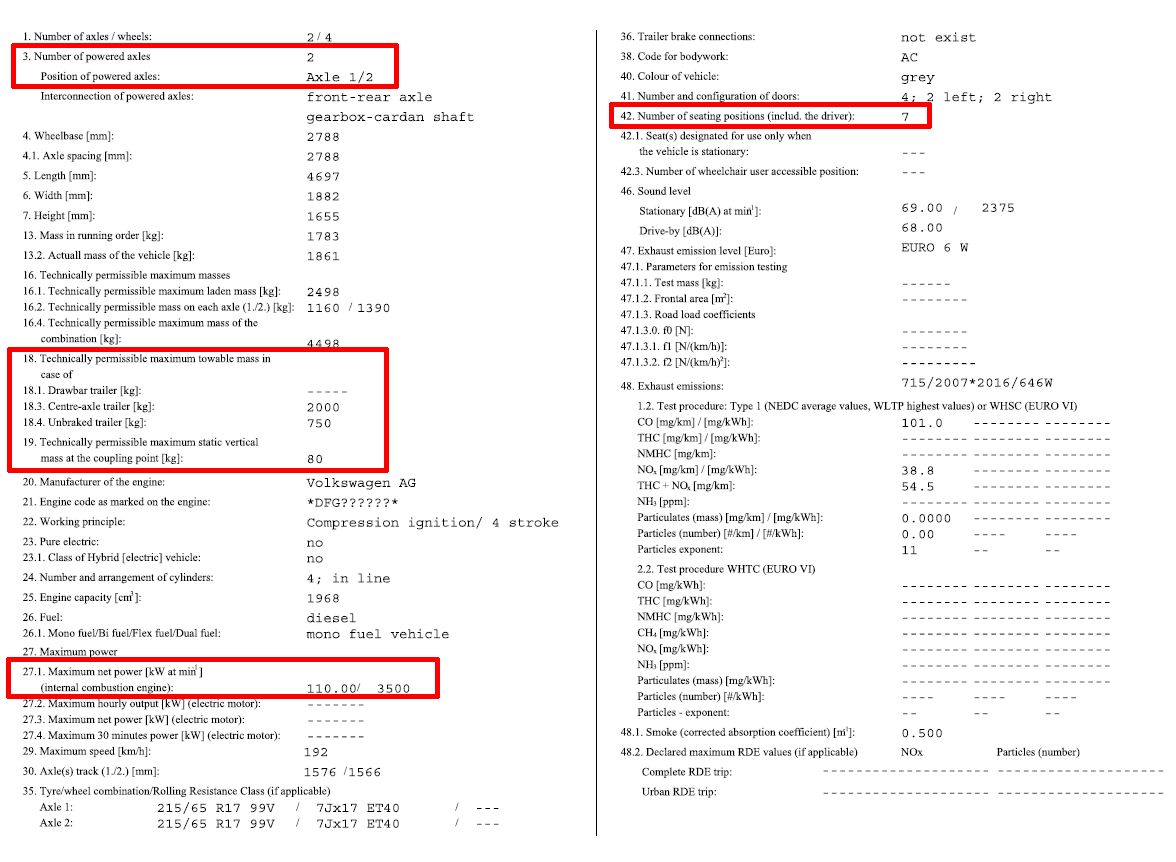
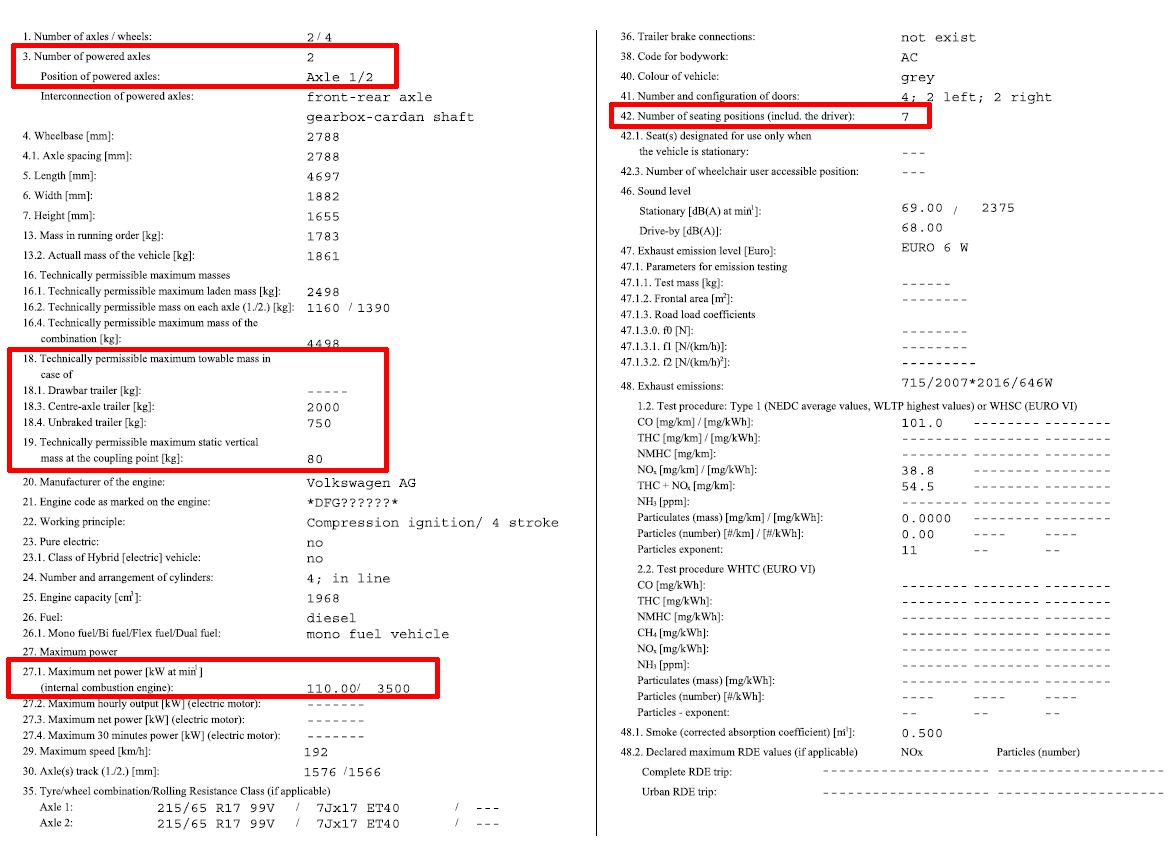
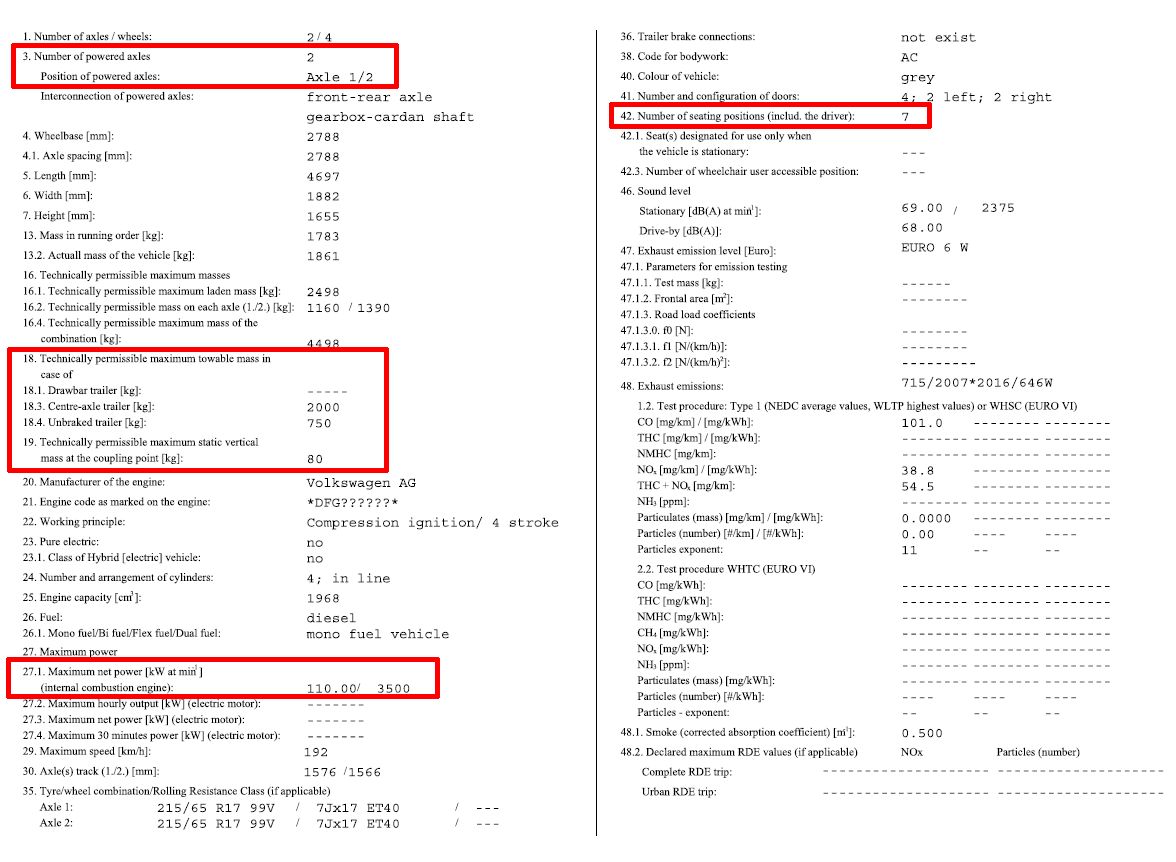
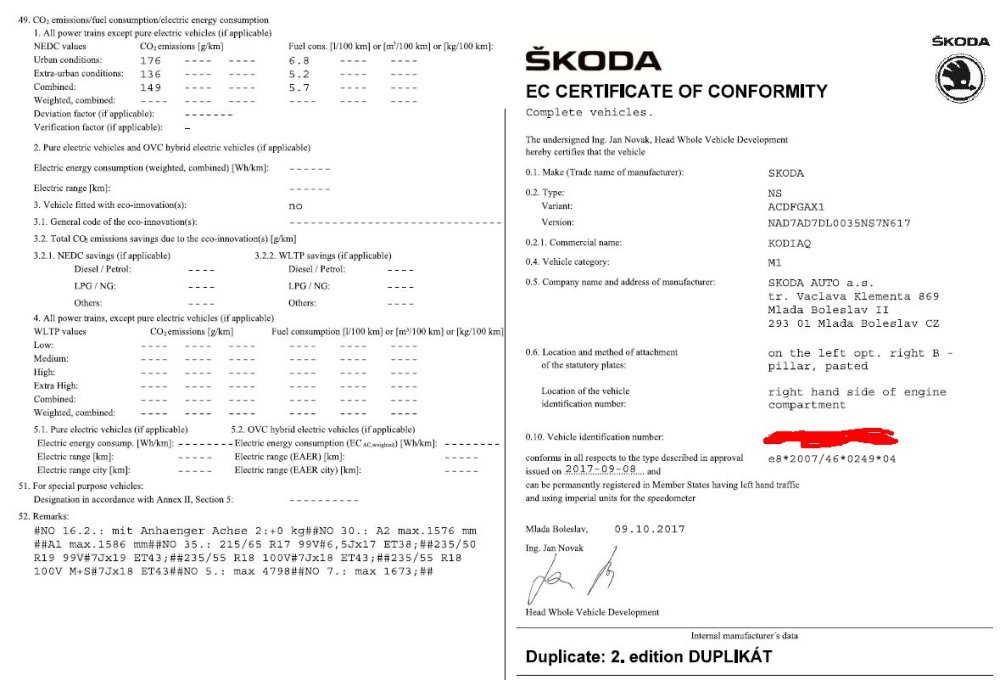
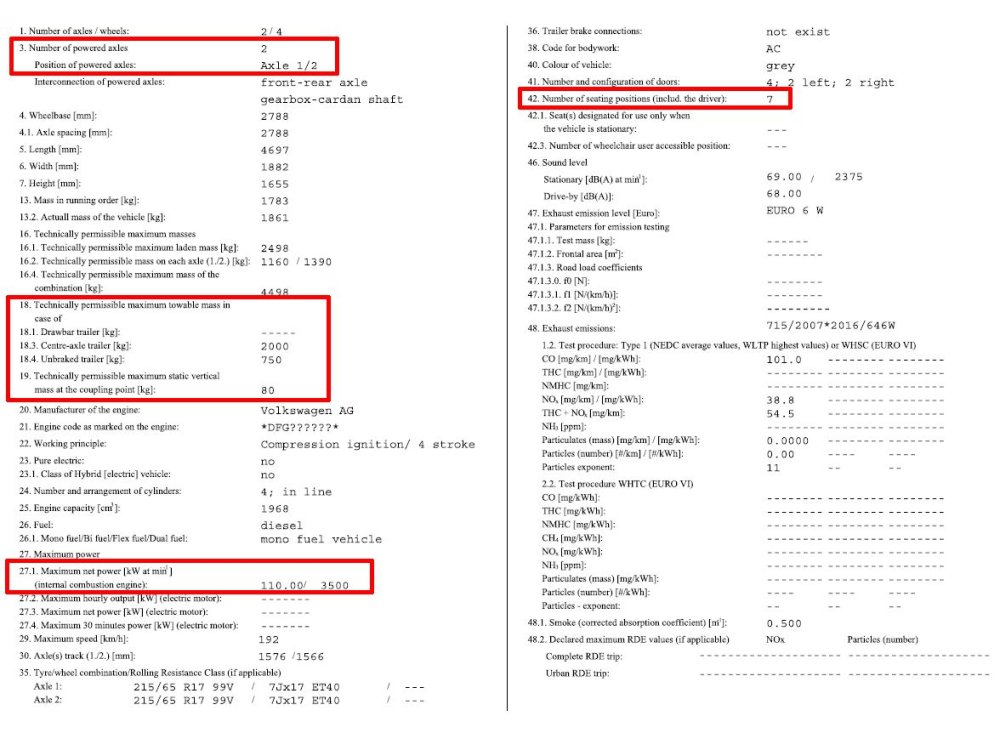
In my experience, getting technical information out of a salesperson, is a hiding to nothing. Get on to Skoda Customer Services and ask for a "Certificate of Conformity" for your car. You're entitled to a free, paper one, but if one has already been issued for your car, they're allowed to charge for a duplicate, so make sure you haven't already got one. It's a single sheet of A4, with loads of technical and regulatory data on it. (See attached). Fields 18 and 19 will give you the type approval information for your actual car (the VIN will be on the front of the certificate). This is the definitive legal document. Nothing else matters. Forget what you hear on internet fora, from owners or salespeople!
-
I think you're right to be concerned. Frankly, it's utterly ridiculous that a manufacturer should produce a vehicle of this type and NOT expect people to want to tow with it! Ours has had an aftermarket towbar fitted (and actually seems to be a very good tow car), but was out of warranty when it was fitted.
-
Yes, there's no legal problem with getting a third party towbar fitted. Demand an EU "Certificate of Conformity" with the car. That will give you a load of type approval data, specific to your car, including what it can and can't tow, braked and unbraked. You might, however, run into warranty problems if anything goes wrong.
-
Yes, that's the thing. "Encouraged" by Euro NCAP, but not a legal requirement in the UK. It'll be interesting to see how that works out, post-Brexit, as for the type approval tests, there is a catalogue of various EU speed limit signs that the systems HAVE to recognise. DfT is (I think) secretly hoping that the fact that Northern Ireland has the same signs as us, means we might be able to piggyback off that, because NI has to stay in regulatory alignment with the EU.
-
You'd need deep pockets to win that one, I think! My guess, is that it WILL work, "most" of the time. good luck proving that it sometimes doesn't!
-
No, not a EuroNCAP or insurance company requirement, and no, the traffic sign recognition system doesn't have to recognise British signs, because our government has decided not to adopt it. However, it does have to recognise Northern Irish signs (which are, of course, the same as ours, so the system will "probably" work OK here, but the manufacturers have no legal obligation to make it do so. I think we'll get a sort of "Poundshop" version of it as an option - and those of us wanting it, will have to pay extra, whereas they'll start getting the "full fat" version of it in the EU, whether they like it or not. https://www.daviddjward.com/the-brexit-slow-puncture-deflating-our-vehicle-safety-standards/
-
I wonder if "Travel Assist" is the Skoda marketing department name for a raft of measures that are going to become legal requirements in the EU from next July? One of them is "Intelligent Speed Assist" which uses cameras with traffic sign recognition software and a GPS database, to determine the speed limit and try to keep the car within it. Another requirement being rolled out, is "Driver Distraction and Attention Warning" (which in some forms, I think, will use a torque sensor on the steering column to look for regular driver inputs and try to wake the driver up in some way, if it stops detecting them). GB hasn't adopted those regulations, post-Brexit, so I guess the manufacturer will have had no reason to tune the software to recognise GB road signs in particular. Obviously, they do look similar to many EU speed limit signs, but I know the systems can sometimes get confused by the variable speed limit signs on gantries, because of the frequency with which the lights in those will pulse, and that varies between manufacturers. It could be that Skoda are charging us extra for features that will be a legal requirement on cars sold in the EU soon.
-
One of the rear doors doesn't always lock. I've got another door lock assembly, and was thinking of swapping it this weekend, but was just wondering if there were any particular tips before I start? Are they just "plug-and-play", or do I need to disconnect the battery first (or worse, even "code" the new one)? 2017 car with KESSY, if that makes a difference? (And the door protectors).
-
Personally, I've never really seen the point? Most cars with a "sport" button just alter the throttle response so you get more of it in the first few inches of pedal travel. My sister swears it makes her car go faster, but of course, it doesn't! I've never really found it too much of a chore to push the pedal another inch down the footwell? In fact, I'd go so far as to say I quite like it on really bumpy farm tracks, at low speeds, as it makes for less jerky progress.
-
I'm also having door lock problems! 2017 car, nearside rear door fails to lock, and now sometimes, driver's door won't unlock! Car appears to be receiving the signals from the remote fob OK (tried it with both fobs), and if the fob is close to the car, the same thing happens if you touch the driver's door (the other doors unlock but not the driver's door). Are the lock assemblies in the doors, known for being troublesome?
-
First of all, if you want the definitive figures for your car, ask Skoda for an EU Certificate of Conformity. Legally, they are obliged to issue ONE, free, to the first purchaser of the vehicle. They don't look like much (just a single sheet of A4 with lots of data printed on them), but they're a valuable legal document. They're unique to each vehicle, so there won't be any messing around with weight ranges, it will simply tell you exactly what your car can legally tow, braked or unbraked, including nose weight. Look around Field 18. The certificate will have your car's 17 character VIN on it. Secondly, towbar prep is, as has been said, various cooling system upgrades, plus the necessary interface for the wiring. Lots of people (me included, have NOT had towbar prep and tow things. There is no legal problem with doing so, but there may be warranty problems if you cook your engine whilst towing. Just watch the temperature. Most of the time, in the UK, unless you're towing the maximum weight in the middle of summer, up a steep hill, you'll be fine. Thirdly, we had ours done by PF Jones in Manchester and we're happy with it. Make sure you go for "coded" electrics.