red2
Finding my way
-
Joined
-
Last visited
Everything posted by red2
-
Well just to respond to your specific question, I have never been aware of my fuel pump making noise ( 2.0 TDI ). I have heard ignition-on pre-cranking running fuel pumps on other vehicles I've owned but never on the Yeti.
-
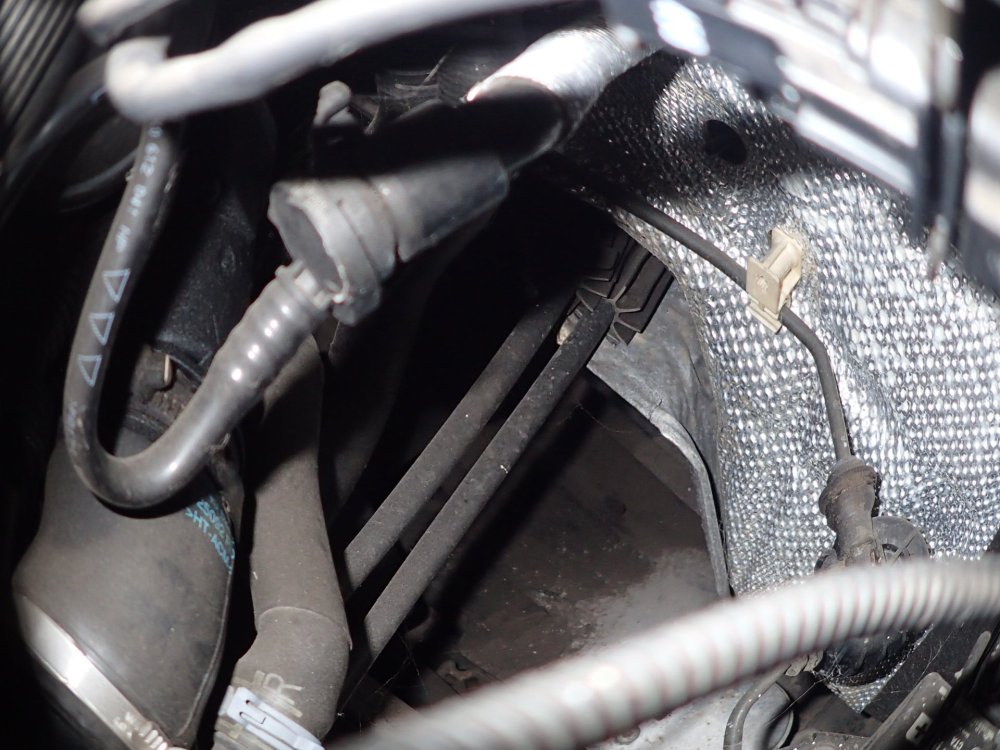
This view is taken with me standing facing the front of the car, bonnet open, looking downwards from the right hand side of the engine bay, past the firewall. You can see there is definitely some insulating material on the firewall itself and down and around into the "transmission tunnel". It is silvered so maybe it is more for heat insulation than for sound. Also it doesn't appear to have any lagging type material associated with it, at least not the material you can see edge on, that disappears into the "transmission tunnel", so again perhaps it's main role is not sound insulation. And just for info., my brother's 2.0 TDI Yeti, despite similar km's, is noticeably quieter than mine. At idle and in the lower gears, I can clearly hear some "diesel clatter" whereas his car is virtually silent.
-
I had the same sort of grinding noise on brake application but only after the car had stood a long time and surface rust had formed on the discs. Have you checked the brake disc itself for possible rust or other surface issues ? ( I don't know about the pad glazing. )
-
Did the Googling and learned about the zinc inclusion problems, mostly in lower door areas it seems. Also the other rust problems that afflict some Yetis generally seem to NOT be the rust-through ( perforation of body panels ) problems of many cars of say the 70's. I guess the galvanised steel and zinc solution body dipping and 12 year anti-corrosion ( perforation ) warranty is far superior to what the older cars had. I remember years ago seeing companies that used products like Waxoyl ( spelling ? ) to "rust-proof" older cars and seeing that they seem to be no longer around is evidence of how much better modern cars are in this respect. And only inferred that some may keep their precious Yeti's off salted roads because everyone here seems to rave about the Yeti 🙂. ( I do too. ) Thanks Rooted.
-
Entirely for my interest and as I've noticed a lot of forum members are based in the U.K., may I ask do you guys use your Skodas frequently on roads that have been salted, and if so, how do these modern vehicles stand up long term to that ?
-
When I partially drained and re-filled my cooling system, after changing a water pump, I was originally going to just top up and "burp" the system by squeezing radiator hoses, etc. running the engine with the radiator cap off ( as per traditional simpler cooling system practice ) but then the complexity of these cooling systems gradually dawned on me and I wasn't then comfortable with this method. I eventually bought a Draper vacuum filling system and did it that way. Under vacuum, I was able to get in an extra litre and a half of coolant if I remember correctly (compared to first running the car up to temperature with the cap off). Many of the manufacturers now seem to recommend vacuum filling. I didn't do any VCDS procedures but will probably look up and see what this entails since it has been mentioned above.
-
I had a vague idea that the standard procedure would be to clear all codes and then see what comes up subsequently and it's nice to have that confirmed. Also it's eye-opening ( to me ) that a service workshop would not routinely scan for any codes on a "modern" car as part of a service but I guess if the owner doesn't report a operating fault and there is no dash light, it's time and money to them to do so. Thanks everyone !
-
When I did a "Auto Scan" recently on my Yeti, I was surprised at the number of fault codes showing in the report e.g. 5 fault codes under "Engine" and numerous others in various other systems. All up, there might be dozens ( I didn't count them but there's many...) Many of the fault codes had accompanying dates from long ago e.g. 2016. The car is new to me ( only 600 km driven by myself ) but has 127 000 km on it by the previous owner. I have a complete service history, all being done by a well-known franchised repair workshop ( but non-Skoda specialist ). Am I right in assuming these old codes are showing because no one ( the workshop ) has ever cleared them ? They surely must have checked for DTC's at each service so why would they not clear them ? Thanks for any input to what probably appears to others as an extremely simple question.
-
I did not try to resurrect the battery once I saw 1.5 V on the multimeter, based on past experience with highly discharged batteries. If the discharge had been quick ( say like lights left on overnight - maybe these "modern" cars won't let you do that ? ), I might have tried but I am certain this was a slow discharge over many weeks caused by operator error ( me ). I had other things going on and it just escaped my mind, as also the car wasn't running at this stage so that made it easier to forget to keep the battery charged. A quite expensive lesson for me. ( Yes I got those dash lights too after a battery change, but as you guys said, they all disappeared quickly. ) The reason I asked this question about fault codes in the first place was I tried VCDS for the very first time a few days ago and got a ton of fault codes showing on the Auto Scan results. That made me think that maybe the very low battery voltage may have caused mayhem with the various systems (naive as it seems now). But today as I gained more familiarity with VCDS, I looked more closely at the information and saw that pretty much all of the codes had dates from long ago, like 2016. Thanks for the responses.
-
Does anyone know if battery depletion over several months ( as in down to maybe 1.5 V ) will cause fault codes to be logged in the e.c.u. ? And what about battery connection and dis-connection ? Does that cause the same thing ? This is all without the engine being started. Thanks.
-
Thanks everyone. Pretty clear then it's not DSG.
-
-
I have a Yeti 2.0 tdi 4x4 with 6 speed manual gearbox. I have just been looking through my genuine Skoda workshop book to see what service items I need to do. I am a little confused as the book lists changing the oil for "6 speed DSG" and then in a different place for the "6 speed automatic". I thought the "DSG" referred to the automatic and specifically I thought DSG meant the transmission has the dual clutch mechanism ( "direct shift gearbox" ) Does anyone know if my 6 speed manual gearbox is "DSG" ?
-
Also your Haldex clutch services. Seems easy to miss unless your mechanics are Skoda specialists.
-
The next best thing to having one in front of you on your bench ! Now I see where the metal powder comes from and why you have to regularly service these units. It looks like mine has never been done going by service records. ( 130 000 km ). Hope that's not going to be an issue for me...Also I wonder if this "non-rebuildable/ lifetime part" claim is a German car thing. Certainly helps the throwaway car mentality and VW's bottom line.
-
Thanks gumdrop. The whole concept ( Haldex solution to AWD ) is brilliantly simple but the deeper you try to understand how specific components work, the more you realise how much engineering expertise you need. That first video you linked gave me a major breakthrough in understanding how the clutch plates engage and disengage. 👍
-
Thanks JR, So is it correct to say that when the Haldex clutch is fully "locked up" ( i.e. transmitting max. torque to the rear wheels ), there is little oil contamination because the clutch plates are not moving relative to each other ? In my reading, someone likened part of the Haldex clutch to a motorcycle wet clutch and the latter definitely contaminates the oil when the fibre plates and steel plates move relative to each another i.e. slip Also do you know any web-site that explains how the Haldex works ? Surprisingly difficult to find any details on this !
-
Can someone confirm that my basic idea of Haldex clutch operation is correct ? The clutch pack "slips" in normal ( e.g. cruising ) driving. If this is correct, is this the reason that the Haldex clutch needs oil and filter changing or screen cleaning periodically, because the slipping plates in the clutch are continuously generating fine debris off the sliding surfaces ? Have I got this right ? Thanks.
-
Schtum - I should have pointed out my 2012 Yeti is modern compared to the previous cars I have owned 🙂. Thanks for confirming. J.R. - Do you think your experience with less reliable electrical systems on your more recent cars is something that is representative of vehicles in general ? Maybe what will limit the effective lifespan of current and recent vehicles will be the onset of electrical issues that are too complex to cost effectively repair.
-
Still getting used to all the modern stuff and a little confused here. Does my 2012 TDI Yeti use Can-Bus technology ? Thanks !
-
Thanks @Lee. ( Was about to join anyway for greater access to tech help. )
-
Thanks Warrior193. The strange thing is when I click on that 3 dot symbol, I only get "Report" or "Share" options. No sign of "Edit".
-
As I can't see how to edit my post above... The "Service Now !" message is back so it was just a coincidence it disappeared shortly after the oil change. So it seems there is no oil quality sensor and in fact it makes sense that the Variable Servicing interval is monitored by just an algorithm that keeps track of driving conditions. Ill probably get hold of VCDS to reset the service message.
-
Just reporting back on my findings. A previous vehicle I owned had a "Service" reminder message pop up on the dash at a designated mileage and the only way to remove the message was by connecting to the car's ecu. Hence I imagined the same thing would be needed with the Yeti. But......I changed the oil yesterday and noticed after the first drive, the "Service Now ! " message has disappeared by itself ! I have no idea how the car monitors the service interval under "Variable/Flexible Servicing" but it almost seems like it can directly monitor the oil quality !
-
Thanks Ian. I'll give it a go today. Suspect the sump plug is very tight as I briefly tried it before so will probably have to jack it for that. And thanks for that too idleness. I've googled that oil extractor and will definitely consider it for the future, as getting under the car is getting harder... I don't like the idea of taking the car to the garage for an oil change and not having a clue what actual oil they are putting in, when they use vague descriptions like "5W30 full synthetic", with no way of checking whether they are using the correct VW spec. oil.