DerekU
Members
-
Joined
-
Last visited
Everything posted by DerekU
-
My 26 April posting in the forum link below includes photos showing where the 'cabin filter' is located (behind the glove box). https://www.briskoda.net/forums/topic/516188-fusebox-opening-on-mk4-fabia/#comment-5847128 This is on a 2024-built right-hand-drive Fabia, but I expect the filter will also be behind the glove-box of your "Style" Fabia. Plenty of manufacturers (eg. Bosch) will offer a suitable replacement filter, or you could obtain an 'original equipment' filter from a Skoda dealership.
-
"Impressive" - Hmmm! I'd use the words "irrational", infuriating" and "incomprehensible".
-
As your car has cosmetic plastic 'caps' on the heads of the wheel-bolts and a Skoda-badge insert in its centre, I assume it did not come with 'aero' wheel trims. It would be worth you checking that you have the cap removal 'tweezers'. https://shop.wingsskoda.co.uk/products/skoda-removal-tool-for-original-caps My 2009 Roomster's alloy wheels have a centre Skoda badge and bolt caps, and the Skoda spare-wheel kit provided with the car when bought new included the 'tweezers'. Conversely, my 2024 Fabia has aero trims and its (optional) Skoda spare-wheel kit DOES NOT include the cap removal 'tweezers'. Both spare-wheel kits include a wire loop/hook thing that (supposedly) can be used to remove wheel-bolt caps https://www.akstuning.co.uk/shop/home/2507-genuine-vag-wheel-bolt-cap-removal-pull-tool-6x0012243.html but my 15-years experience with the Roomster is that the plastic caps can adhere quite firmly to the wheel-bolt heads (especially the cap that covers the head of the anti-theft security bolt). I occasionally wipe a little wax polish on the inside of my Roomster's caps, but a firm pull with the tweezers can still sometimes be needed to remove a stubborn cap. It may be practicable to remove the caps with the wire loop/hook, but it won't be as effective as using the tweezers and may well damage the cap.
-
If your Fabia's wheels won't have the aero trims on them, it should be immediately obvious visually whether or not it has rear disc brakes (which everything points to being the case). You might also wish to check its motor's oil-filler cap (mentioned here) https://www.briskoda.net/forums/topic/525686-wiper-speed-oil-topup-lid/
-
I've looked at the online Owner's Manual for a 2019 Fabia Mk 3 and this contains the following guidance relating to the Amundsen infotainment unit fitted to that model. Although Fabia Mk 3 and Fabia Mk 4 cars can both have Amundsen infotainment units, the units themselves are quite different. There is no equivalent "Assign station logo from an external source" advice in the part of a Fabia Mk 4's online Owner's Manual that refers to the Amundsen unit, so it is reasonable to assume that capability is no longer present for Fabia Mk 4 models.. I understand that assigning a 'custom' radio station logo to a Fabia Mk 3's Amundsen infotainment unit involved transferring the logo from an SD-card into the unit, but the Fabia Mk 4' Amundsen unit has no SD-card slot and - to the best of my knowledge - there is no way to to transfer a logo to that unit by using one of the car's USB-C ports.
-
Your photo is of the AMUNDSEN 9" unit (which is the one I have in my 2024 Fabia SE L car) but - as I said above "I can't find anything in the infotainment unit's options that would allow me to add a logo to a station in the listing that lacks a logo, nor to alter/delete the logo of a station with a logo." The part of the Fabia MK 4 online manual that relates to the Amundsen unit's radio does have references to station logos, but not to what (I think) you want to do.
-
It might help to know which infotainment unit (7", 8", or 9" display-screen) your Fabia has. This BRISKODA discussion relates to radio logos and Mk 4 Octavia models (NOT Mk 4 Fabias) but might still be relevant. https://www.briskoda.net/forums/topic/493466-radio-station-logos/ My Fabia has the 9"-screen (Amundsen) infotainment unit, but I can't find anything in that unit's menu system that permits to load 'custom' radio logos. I can pull up a long listing of DAB radio stations (presumably stored in the car's 'memory'). Many of the stations in the listing have logos, but a lot do not. I can't find anything in the infotainment unit's options that would allow me to add a logo to a station in the listing that lacks a logo, nor to alter/delete the logo of a station with a logo.
-
It may depend on which infotainment system your Monte Carlo has... I think your car will have the 8" display-screen unit ("Bolero") with 2 physical buttons on the front or possibly the 9" display-screen unit ("Amundsen") with 'virtual' buttons on the front. You could try accessing the online Owner's Manual for your car, search for infotainment and see if the sections that relate to whichever size display-screen unit your car has mention the album-scrolling capability.
-
scottf51 The lengths of my 2024 Skoda Fabia Mk4's wiper blades are 650mm (driver side) and 450mm (passenger side), whereas the lengths of my 2009 Skoda Roomster's wiper blades are 530mm on both the driver and passenger side - so comparing the relative speed of a 'single-action' wipe (ie push down on the stalk once) for the two cars would be a mite inconclusive irrespective of the screen being dry or wet. To side-step this I fully lifted the blades on both cars so there was no 'wiper drag' on the windscreen and the the Roomster's single-action wipe was definitely SLIGHTLY faster than the Fabia's. In both cases the experiment was with each car's ignition on, but without the motor running. I did not think my Fabia's wiper speed was particularly slow and was certainly fast enough for 'single wiping'. When closed, there is no 'play' in my Fabia's oil filler-cap when closed and there is an obvious 'snap' noise when the cap is turned clockwise and becomes fully closed. But my Fabia has the 1.0litre motor, not the 1.5litre, so not really a valid comparison. If the 1.5litre motor's filler-cap should also 'snap' when properly closed, and your car's cap does this, it's reasonable to assume there's nothing wrong with it. (And if it does not 'snap, that could well mean that it is not designed to do this and, in which case, there probably is still nothing wrong with it...)
-
What criteria are you using to allow you to rate your Fabia Mk4's Goodyear tyres as being "very good, wet or dry", please? My Fabia is also fitted with Goodyear EFFICIENTGRIP PERFORMANCE 195/55 R16 91V XL tyres and - as far as I'm concerned - they are no better or worse than I expect them to be. The only tyres I remember actively disliking were the Continental ones fitted as original equipment to my Skoda Roomster bought new in 2009. Those tyres would cause the car to 'tram-line' noticeably on uneven road surfaces and I put this down to their design having a relatively sharp angle where the tread met the sidewall. Whatever the cause of the uneven-road behaviour, when I replaced the Continentals with Hankooks that had a more rounded tread-to-sidewall profile, the tram-ling stopped and, when I subsequently replaced the Hankooks with (the present) Falken tyres that also have 'rounded' edges, there's was still no tram-lining. My Roomster's Continental, Hankook and Falken tyres were/are all OK in wet or dry weather, but I've never driven the vehicle on a test track or skid-pan to allow we to establish their ultimate capability.
-
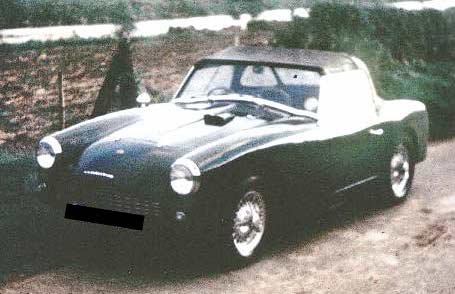
This photo is of my Turner I bought it for £300 from a work colleague (who was the 2nd owner) when it was painted pale yellow and, after I sold it years later, it was repainted lime green. The car began life with a mildly-tuned Ford 1340cc motor that I replaced with a new Ford 1500cc unit and gearbox, with the 1340cc motor ending up in a pal's Cortina. It was still in use in 2000, but I don't know where it is now.
-
The first car I owned (a 1962 Turner Mk 2 that I bought in 1965) had wire wheels with 'knock on' spinners and wheel-changing was a doddle. The first motorhome I owned (a 1996-built Ford Transit-based Herald Templar I bought in 1999) had wheel-hubs with studs and changing its rear wheels was an absolute nightmare, with owners confidently asserting that it needed two trolley jacks to do it. I found that I could perform the task at home using the standard Transit scissor-jack, but only just and I would not have attempted a roadside change. My many other cars and motorhomes have had wheels using stud or bolt fixings. It's never much bothered me which type - stud or bolt -and I've always been able to carry out an 'emergency' wheel change without much difficulty using the jack supplied with the vehicle. I remember phoning Ford about the Transit-based Herald, complaining that the Ford handbook advised owners to retighten the wheel-nuts securely but provided no torque value. The guy I spoke to said "It's not necessary" and when I said "Why not?", he replied "It's 200Nm and this is clearly stamped into the edge of the wheel-nut's washer". Up to 1991 Transits with twinned rear wheels had left-hand threaded wheel nuts and mechanics unaware of this could snap the studs. Turner cars had fly-off handbrakes and, unless a mechanic or MOT tester was warned about this, the handbrake mechanism could get broken or the MOT test failed. Those were the days...
-
The pair of 'pins' you bought for £15.98 are described in the ebay advert as "made from high tensile steel and bright zinc plated for durability" so they should be snap-immune and much more durable than the two aluminium-alloy pins I bought for£1.41 from AliExpress. Do you know where your pins were made, please?
-
The 'pins' I bought via AliExpress are non-magnetic (so presumably not steel) but that's also the case for the tpi-branded pin I provided a photo of in my 1 July posting on Page 4 of this form thread and that cost (from a UK supplier) around £9 for a single pin. The AliExpress pins weigh 67g - much heavier than the tpi-branded pin - and are nicely made (and I'm notoriously fussy). Presumably the tpi-branded and AliExpress pins are castings and, if one wanted a last-forever use-many-time-a-day stainless-steel pin, it would need to be machined and attract a suitably elevated price. The £1.41 overall price was an introductory 'special first AliExpess purchase" offer and (as highlighted above) exactly the same item can be advertised on AliExpress much more expensively. Deleting cookies and/or using a different device can side-step this special-offer limitation. I am near certain that, if I screwed the alloy tpi-branded pin or the alloy AliExpress pin into my Skoda car's hub and than violently hit the end of the pin downwards with a heavy hammer, the pin would snap, whereas a steel pin would just bend - but I'm never going to be hammering my pins. I'm averse to buying 'foreign country' online, but I was prepared to do that in this instance as an experiment and - once I had successfully placed the order - the delivery process was seamless and I was kept fully in the loop. That I shall buy through AliExpress again seems unlikely. (I recently replaced my 2009 Roomster's H7 halogen bulbs with LED equivalents that I bought from a UK-based supplier at an overall cost of £42. The LED bulbs (unsurprisingly) are made in China, but I'd be unprepared to order LED bulbs via AliExpress as their quality and longevity would be much more of an unknown factor.)
-
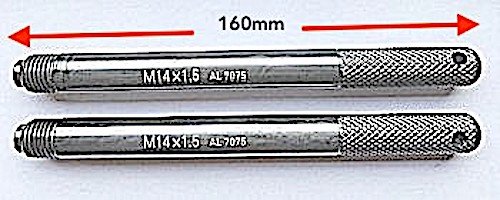
As I had a wheel-alignment tool for my Fabia, I thought I should get the same thing for my Roomster and I ended up purchasing the pair of 'pins' shown below These are longer than the pin I keep in my Fabia and their shaft is the same diameter end-to-end (rather than being waisted like my Fabia's pin and thus less likely for the wheel to fall off the pin). They fit OK in the Roomster's (and the Fabia's) hubs and are well made and adequately sturdy. They have a thin smooth clear-plastic sleeve from (on the photo) the left end up to the start of the knurling and carrying the M14x1.5 marking. The sleeve's plastic surface would undoubtedly soon become worn if used 'professionally, but that's immaterial where my own usage is concerned. Ordered through AliExpress on 23 August with an anticipated delivery-date of 3 September and arrived today. E-mail notifications sent to me from when my order was accepted in China and at each stage of the package's journey to my home address. The pins were well packed and clearly labelled and the total cost (including taxes and postage) was £1.41 (that's £0.705 per pin!)
-
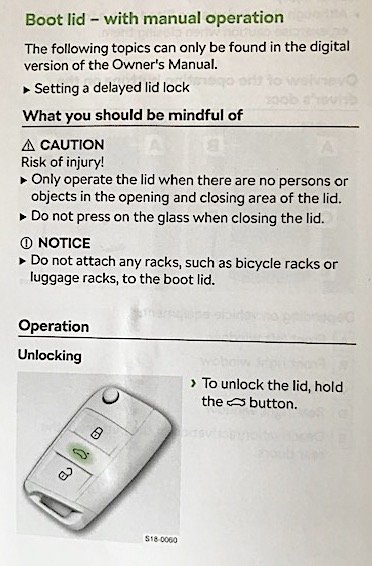
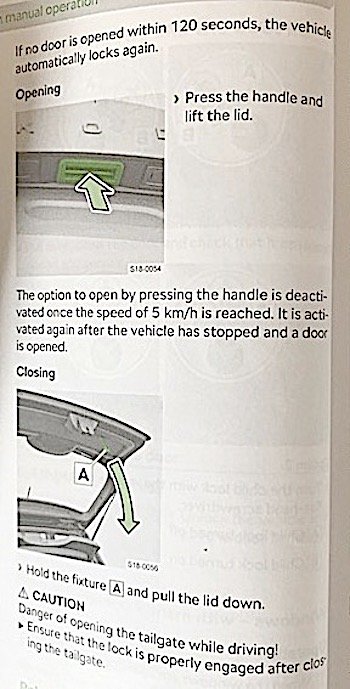
The Fabia Mk 4 Owner's Manual includes a discrete section headed "Boot lid - with manual operation" and I've copied this below. As advised in the postings above, to unlock the boot lid the key-fob's centre button needs to be held down for roughly 2 seconds, and the only indication that unlocking has occurred is that the car's turn-signal lights will flash twice. If the boot lid's handle is then not pressed to release the lid, the boot lid will re-lock after 2 minutes (120 seconds) and the car's turn-signal lights will flash once to confirm this has happened. If the boot lid's handle is pressed to release the lock and lift the lid, when the lid is next shut properly re-locking will take place immediately and the car's turn-signal lights will flashing once as confirmation. There's a risk with this arrangement that an owner might lock the key-fob in the boot and (apparently) a Skoda dealership can program in a delay between the lid's closure and it actually locking. This 'delay' capability was discussed in a 2019 Karoq sub-forum thread (link below) and I assume current Fabias' locking could similarly be tweaked. https://www.briskoda.net/forums/topic/462682-tailgate-lock-delay-question/ My 2009 Roomster's key-fob's centre button operates in the same way, except a) there's a very audible 'clunk' after the button has been held down for a couple of seconds and b) the boot lid then physically disengages from its lock and can now be lifted without pressing its handle. This is more convenient, though it does mean that the boot can only automatically re-lock when the lid is next slammed shut.
-
Are you referring to a Skoda Fabia Mk IV? The following link suggests that the latest official/possible firmware update for the ("SWING") head-unit may be MU 8742 https://mib-helper.com/index.php?train=MEN2_EU_SKGPX_P7381L A GOOGLE-search on MEN2_EU_SKGPX_P7381L retrieves this very long BRISKODA forum discussion https://www.briskoda.net/forums/topic/505770-updating-swing-radio-software/ and there's a video here that MIGHT help... https://www.youtube.com/watch?v=4I5Lnwc1w5c
-
It wasn't advice, just a statement... Mu understanding of the term "ECO" when tyre manufacturers apply it to their products is that it does not indicate a tyre that is optimised for fuel economy, but that it had been made from 'sustainable' materials. Obviously I don't know what tyre-related expertise you have, but the RAC's advice on 'eco' tyres is here https://www.rac.co.uk/drive/advice/tyres/green-tyres-how-are-they-different/
-
As you will be buying a Fabia SE L (according to the the Skoda website) the tyres will have a 195/55 R16 91V XL specification with three make/pattern possibilities Continental ECOCONTACT 6 (Fuel efficiency class A/Wet grip class B ) Goodyear EFFICIENTGRIP PERFORMANCE (Fuel efficiency class A/Wet grip class B ) Bridgestone TURANZA ECO (Fuel efficiency class A/Wet grip class A)
-
Michelin's advice on summer, winter and all-season tyres can be read here https://www.michelin.co.uk/auto/advice/choose-tyres/summer-winter-all-season-tyres If you will be getting a Monte Carlo model with the 1.5litre motor, according to Skoda's website the OE tyres for 17"-diameter wheels will be 215/45 R17 size and either Kumho Ecsta PS 71 (Wet Grip A ) or Bridgestone TURANZA Eco (Wet Grip B ). The optional 18"-diameter wheels are shod with 215/40 R18 Continental ContiSportContact 5 (Wet Grip A ). Living in central England for most of my life, I've never found any persuasive reason to swap the 'summer' tyres fitted as original equipment to my new vehicles for 'all season' equivalents when it came time to change those tyres. In the rare spells of very cold winter weather over the years I would have liked to have had 'full winter' tyres fitted, but, If I planned to drive regularly in such conditions, I would not be choosing a Fabia in which to do it. Good luck with your quest for "...a decent set of tyres fitted rather than those Eco tyres which don't offer the best grip in the UK climate.". There are plenty of 'best tyre' reviews online, but my own opinion is that you'd be wasting your money.
-
The current range of Fabia cars marketed in the UK can have as original equipment (OE) ) tyres made by Bridgestone , Continental, Goodyear or Kumho. For Fabias with 15"-diameter wheels the OE tyres may be Kumho Ecowing ES31 185/65 R15 and for Fabias with 17"-diameter wheels the OE tyres may be Kumho Ecsta PS71 215/45 R17. If a Fabia has 16"-diameter or 18"-diameter wheels, Kumho tyres are not fitted as OE.
-
50 years ago (when I was unmarried and mechanically reckless with my cars) I used to DIY significant alterations, though always relating to performance not looks. I well recall fitting stronger springs (that buckled the spring compressors) and adjustable Spax damper-units to a Reliant Scimitar GTE that had a rare 'blow-through' turbo conversion. The result was a car that had as much suspension movement as a skateboard, was too fast for the brakes, was positively lethal on wet roads and, as there was no power-assisted steering, every journey was like a visit to the gym. I'm sure I thought it was wonderful at the time...
-
Hello everyone, I have a DSG box with a steering wheel without paddles, is it possible to change the steering wheel to obtain them and therefore have my gear change on the steering wheel? Thanks in advance ............................................................................................................................................................................................. This 2022 Skoda press release claimed that the Fabia Mk IV Monte Carlo model with DSG transmission would have paddle-shifters on the steering wheel. https://skodamedia.com/en-gb/releases/1299 However, every relevant online comment has highlighted that UK-marketed Fabia Mk IV Monte Carlo cars (or any other UK-marketed Fabia Mk IV model) do NOT have paddles. This 2020 forum entry mentioned that an Octavia VRS steering-wheel with paddles had been successfully fitted to a Fabia Mk III https://www.briskoda.net/forums/topic/479919-octavia-vrs-steering-wheel-retrofit-onto-fabia-mk-iii/#comment-5388632 so it MIGHT be possible to do the same with a Fabia Mk IV. ............................................................................................................................................................................................. Ce communiqué de presse de Skoda de 2022 affirmait que le modèle Fabia Mk IV Monte Carlo avec transmission DSG aurait des palettes de changement de vitesse sur le volant. https://skodamedia.com/en-gb/releases/1299 Cependant, tous les commentaires en ligne pertinents ont souligné que les voitures Fabia Mk IV Monte Carlo commercialisées au Royaume-Uni (ou tout autre modèle Fabia Mk IV commercialisées au Royaume-Uni) n'ont PAS de palettes. Cette entrée de forum de 2020 mentionnait qu'un volant Octavia VRS avec palettes avait été installé avec succès sur une Fabia Mk III https://www.briskoda.net/forums/topic/479919-octavia-vrs-steering-wheel-retrofit-onto-fabia-mk-iii/#comment-5388632 il POURRAIT donc être possible de faire la même chose avec une Fabia Mk IV.
-
The VAG Part Number for my Fabia's jack is 2Q0 011 031 It is labelled as having a 900kg maximum lifting capacity and being appropriate for the following vehicles VW Polo (>2018) SEAT Ibiza (>2018) Audi A1 (>2019 Skoda Scala (>2020) Skoda Fabia (>2021) It's tip-to-tip overall length is 39cm and - as that length will relate directly to the jack's maximum lift-height - if you buy a different jack you'll need to check that its overall length is at least as long. As I've said before, buying the VAG jack is not cheap - but this 'once used' secondhand jack is not unreasonable at £28 and at least it's the genuine article with the correct crank handle. https://www.ebay.co.uk/itm/276496209179
-
It's the former... At the jacking-points, the bottom of the pronounced reinforced metal seam just sits in the Skoda jack's quite shallow 'groove' and, consequently, all the load is born through the seam/groove connection.