DerekU
Members
-
Joined
-
Last visited
Everything posted by DerekU
-
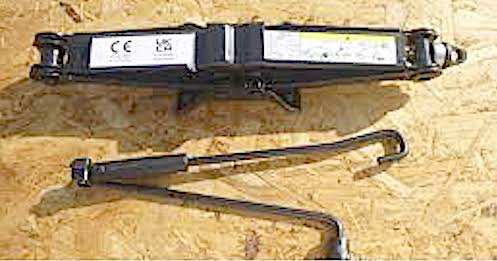
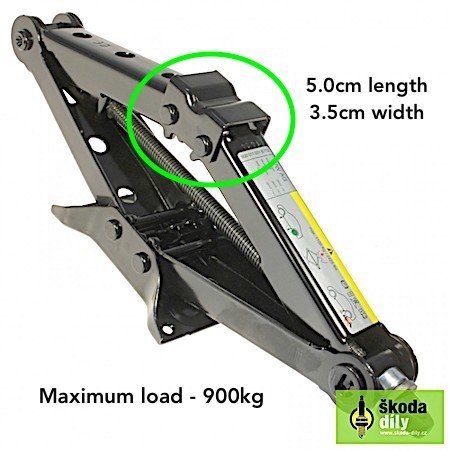
I THINK the VAG Part Number for the jack that's provided if one chooses the spare-wheel option + tools is 2Q0011031E and is as shown in the photos above. The 'genuine' jack is certainly not cheap (and one need to check that the folding winding-handle is included as I'm pretty sure that has its own Part Number). Much cheaper scissor jacks (with equivalent or higher lifting capacity) are widely advertised, but the top of many of these has a slotted or flat 'plate' (examples on link below) rather than the central 'groove'. https://www.thewheelshop.co.uk/product-category/accesories/ This might suit you as it's 'groovy', plus a wheel-brace is included. https://www.amazon.co.uk/Wheels-Bits-Universal-Include-Hatchback/dp/B07FB4TC19
-
On my 2024-built Fabia Mk 4, the 2-part fitting that secures the spare-wheel to the floor of the wheel-well in the boot is marked 2G0.803.899 A on the bottom of the threaded upright section. https://www.skoda-parts.com/spare-part/2g0803899a-bolt-for-mounting-the-spare-wheel-skoda-41623.html Similar-looking fittings are advertised that have a different final letter (and at very different asking-prices) but I've no idea whether the final letter has significance.
-
I highlighted the shallowness of the jack's 'groove' in this other thread. https://www.briskoda.net/forums/topic/525354-jacking-pads-for-fabia-scissor-jack/#comment-5871417
-
As a forum moderator for many years my view is that, if someone asks a question that elicits (sensible) responses, it's plain bad manners not to reply. I'm not a great fan of the 'like' button, but at least using it acknowledges that the enquirer has read the response(s) and appreciates the effort made.
-
The same enquiry was made on the Fabia Mk IV forum on 28 June 2024 and resulted in a reasonable number of responses. https://www.briskoda.net/forums/topic/524652-is-the-fabia-a-good-or-bad-car-to-own/#comment-5863266 (The originator of the 'reliability' enquiries "mikcatta" has not visited the BRISKODA forums since 8 July 2024, so further comments on either thread are unlikely to be worthwhile.)
-
This Wikipedia entry relates to TPMS https://en.wikipedia.org/wiki/Tire-pressure_monitoring_system The "United States" section includes the statement below that may explain why indirect TPMS (certainly older versions of indirect TPMS) can be slow to provide warnings of tyre-pressure loss. The final rule requires that the driver be given a warning when tire pressure is 25 percent or more below the vehicle manufacturer's recommended cold tire inflation pressure (placard pressure) for one to four tires. A while back, the day before I was due to drive several hundred miles mostly on UK motorways, I checked over our Skoda Roomster and, discovering that the pressure in one of the front tyres was 26psi rather than the 32psi in the other three tyres, a quick inspection revealed a screw embedded in the tread. There had been no warnings from the Roomster's indirect TPMS, but If an up-to-25% reduction is 'allowable' before a warning is issued, the 32psi reduction to 26psi would have (just) been acceptable. I'm a moderator on a motorhome-related UK forum with over 23k postings to my name. UK motorhome owners have something of an obsession with tyres and tyre pressures as the recommended tyre inflation-pressures are generally high (70-80psi) and, if the motorhome is light or lightly loaded, the resultant ride quality can be bone-shakingly harsh. Historically, It's been common practice for UK motorhome owners to take their vehicle to a weigh-bridge and, based on the measured axle-loadings, reduce the tyre pressures accordingly after taking advice from the tyres' manufacturer. This was fine until direct TPMS began to be fitted as standard to most new UK motorhomes, when it became evident that even a small downwards alteration (say 0.5%) from the recommended high pressures that had been factory-input to the TPMS would trigger low-pressure warnings. So the moral of this tale is that, if a driver wants a system that will provide pressure-drop warnings earlier rather than later, direct TPMS is the better option.
-
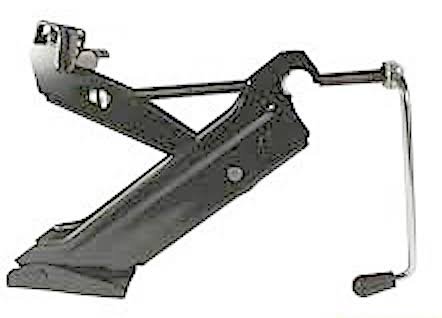
I don't know which design of jack your 2015 Skoda Fabia has, but if its the type that was provided historically as standard with VAG cars (and with my 2009 Roomster), it will be unsuitable for a Fabia Mk 4. My Roomster does not have a scissor jack: it has a jack with an integrated 'fold-up' operating-handle as shown in the image below. It's very neat and usable with cars that have an under-chassis reinforced metal seam (to which the jack attaches) fairly close to the car's outer side. That's where the seam is on my Roomster and I could also use the Roomster's jack to raise my 2021 Hyundai i20 (that came without a jack) as the i20's metal seam was similarly positioned. However, the Fabia Mk 4's reinforced metal seam is much further in from the car's outer side, making it impossible to raise a Fabia Mk 4 with the Roomster's jack as, when the jack's head is beneath the Fabia's metal seam, the integrated handle cannot be rotated. This is why a Fabia Mk 4's OE jack is the scissor type with a long separate 2-section operating handle (image below) that allows the jack to be positioned under the metal seam and the handle to then be turned. It's not penny-pinching that defines which of the two designs of jack are provided as OE - it's where the seam is.
-
My understanding was that VAG vehicles generally do not have 'direct' TPMS (where inflation-pressure sensors are fitted to the base of each tyre valve) but have, instead, 'indirect' TPMS that exploits the vehicle's ABS and (basically) compares the rotational speed of each road-wheel against an overall setting. Direct TPMS permits actual tyre pressures to be displayed. Indirect TPMS does not, but may be able to indicate which wheel(s) there's a problem with. If a vehicle has direct TPMS, there is normally no driver-operable RESET facility. If a vehicle has indirect TPMS, there will be a driver-operable RESET capability. The two TPMS types are explained here https://www.schradertpms.com/en-gb/driver-education/direct-tpms-versus-indirect-tpms Unsurprisingly Schrader 'likes' direct TPMS as the company has a vested interest. Personally, I 'like' indirect TPMS, as there are no tyre-valve sensors, but I fully recognise this system's limitations. In the past, where a vehicle has not had TPMS, I've used TyreSafe products https://www.tyresafe.org/the-checks/ This involves fitting a sensor to the top of each tyre valve and allow inflation-pressure data to be read on a small display-screen in the cab.
-
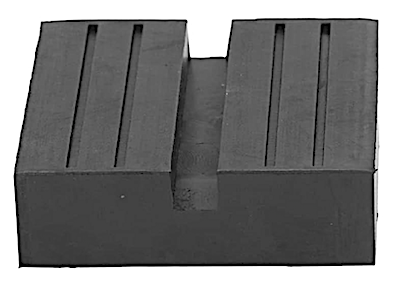
Since 1964 I've been driving/owning vehicles that have included six VWs (5 Golfs and a Polo) and two Skodas (a 2009 Roomster and a 2024 Fabia Mk 4). If my memory serves me correctly all the VWs had, as standard, the swivelling slotted-head design of jack shown in my last posting (as does my 2009 Roomster). However, the Fabia Mk 4 has a different standard jack that is the traditional scissor type (image below) where the head is not slotted and has a quite shallow central lateral groove that abuts against the reinforced metal seam of the jacking-points beneath the car. As has been mentioned above pucks/pads are not intended for use with the jacks provided as standard with VAG cars, but it might be practicable to glue the type of pad shown here on to the head of the Fabia Mk 4 jack if one so wished, or to glue a rubber/plastic 'block' each side of the groove to facilitate positioning on the metal seam. (Me, I just stuck a couple of layers of Gorilla tape on my Fabia's jack-head to give a little extra 'grip' between the head and seam.) When removing/replacing road-wheels on my vehicles (that have included three 3500kg motorhomes) I have never used other than the "Jack of Doom" provided as standard. My attitude is that, if I HAVE to change a wheel myself, this will be the jack I'll have to use, and it makes sense that I should fully familiarise myself with the standard jack's capability well in advance of any 'emergency' requirement occurring. Over the years I've successfully used the standard jack in emergencies several times. More recently I replaced my Roomster's failed windscreen-washer pump but, as that was done at home, I made 100% certain that the car was not supported solely on the standard jack before scrabbling underneath it. Years ago, while in France with a rear-wheel-drive Ford Transit-based motorhome, I asked a garage to check the oil-level in the vehicle's rear axle's final-drive unit that I knew had developed a slight leak. A French mechanic directed me to drive the motohome into a shed with a badly broken concrete floor and proceeded to raise the back end of the vehicle by positioning a single trolley-jack beneath the centre of the final drive unit. The vehicle wasn't 'chocked' and the hand-brake was, of course , not operating with the rear wheels off the ground. The mechanic then slid under the motorhome beneath the vehicle's rear entrance step. At this point I told my wife, who was standing next to me, "Go and wait at the reception office" and later she asked me why I had said this. I replied that, if the motorhome had fallen off the jack, the mechanic would have been crushed to death beneath the step and it would have been a pity for her to see that happen. (I was far more concerned with the repercussions a dead mechanic would have on our holiday.) Anyway, the jack didn't topple, the mechanic didn't die and the oil-level was OK. But it's that sort of foolhardiness or incompetence that generally injures people, rather than the inadequacy of the jacking equipment being employed.
-
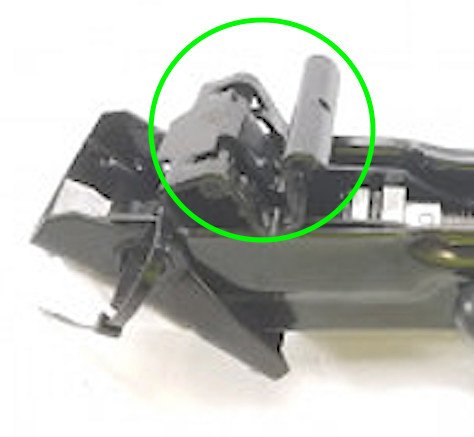
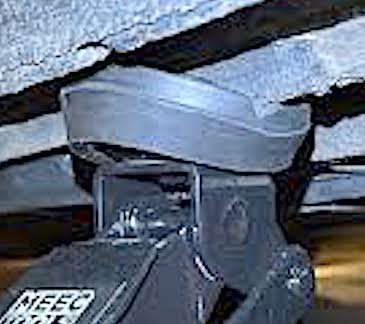
The head of the standard VAG/Skoda scissor-jack (image below) has a slot in it designed to fit around a reinforced metal seam on the car's underside. To avoid direct contact between the slot and the seam I stick a layer of Gorilla tape in the slot to act as a buffer. This provides a useful degree of protection for the seam and, when the tape gets scuffed (and offends my visual OCD) it is easily replaced. Rubber 'pucks' are advertised as being appropriate for use with a scissor-jack (example below) but I'm wary whether these would fit securely to the head of a standard VW/Skoda jack, or be any better protection-wise than my Gorilla tape ploy. At least, when I fit the jack to the seam of my Fabia (or to the seam of my Roomster) I can see that the slot on the jack's head is properly located on the seam.
-
-
The Fabia Mk 4 "Monte Carlo" model has 17"-diameter wheels as standard, or 18"-diameter wheels as an (expensive) option. There is plenty of on-line discussion about peculiar 'noises' from VAG cars fitted with the 1.5TSI motor that has ACT (Active Cylinder Technology) but there's no persuasive reason to think ACT should produce vibration in the steering. The common-sense approach for Scott to take would be to test-drive another Fabia Monte-Carlo with the same specification and check if it behaves in the same way.
-
I believe your car has the BOLERO infotainment unit https://www.briskoda.net/forums/topic/522139-bolero-screen-update-fabia-monte-carlo/ which probably explains why the photo of your display differs from what appears on my car's AMUNDSEN unit. I can't assist with your update question, though I note that there have been problems with Xaiomi phones and (wireless) Android Auto. https://www.androidpolice.com/android-auto-xiaomi-fix-android-14-update/#:~:text=But as longtime users will,whenever mobile data is unavailable. A long forum discussion here, but I don't know if it will help you. https://www.briskoda.net/forums/topic/511569-software-update-available-for-bolero/
-
It might help to know which infotainment system your car has, as the data on your photo is significantly different to what shows on my 2024-built Fabia's Amundsen unit's screen (photo on this recent forum thread) https://www.briskoda.net/forums/topic/524942-thinking-of-coming-back-to-a-skoda-fabia/ When was your Fabia Monte Carlo built?
-
Suggest you try asking on the Octavia sub-forum https://www.briskoda.net/forums/forum/235-skoda-octavia-mk-iii-2013-2020/
-
Varooom last visited the BRISKODA forums in August 2023, so probably won't see your request. Besides which, if your 2023 Fabia is like mine, system and navigation updates are carried out OTA (Over The Air) and not involve the car's owner transferring the update data via a SD 'memory' card as used to be the case.
-
For the latest Fabia, only UK models with the most powerful 1.0TSI motor or the 1.5TSI motor can have a DSG transmission. Given the significantly higher power/torque outputs of the 1.5TSI motor (and the resultant higher on-road performance of the car) compared to the 1.0TSI, it's to be expected that the ratios of the 1.5TSI's DSG gearbox should differ from the 1.0TSI's. However, despite being 'geeky' myself, I can't see this really matters as the driver is constrained by how the DSG transmission behaves and cannot affect it outside what Skoda allows. The "Automatic gearbox" advice in the Fabia Owner's Manual defines what's possible (drive or sports program, manual gear-changing and kick-down) and that's it.
-
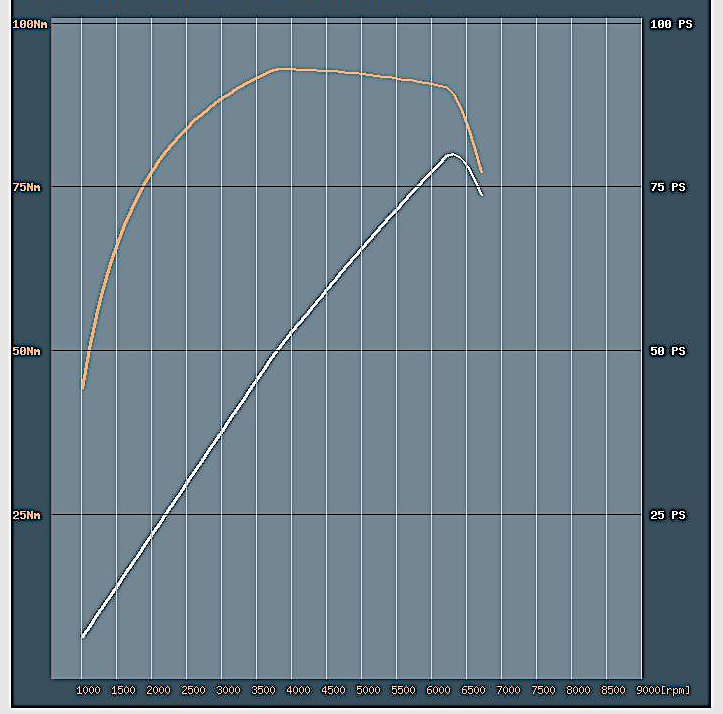
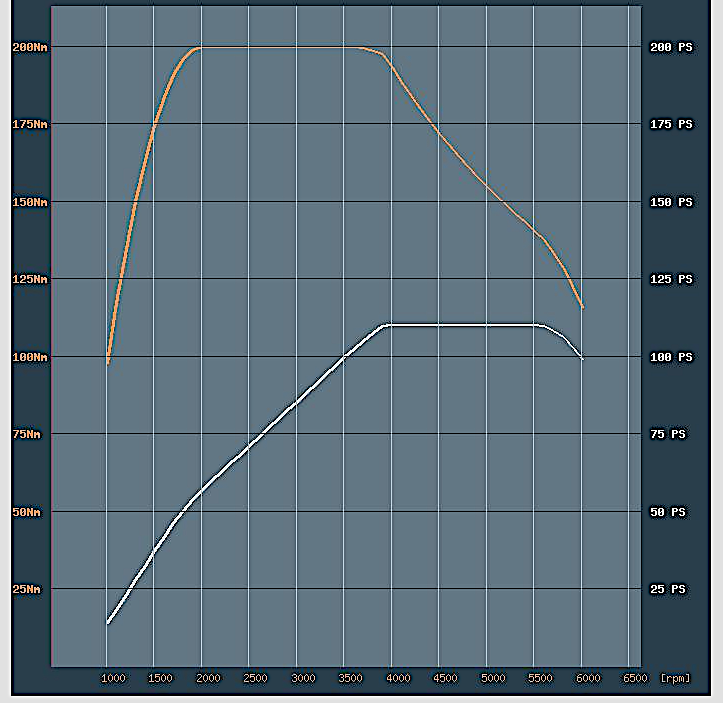
This 2017 .pdf file provides Fabia gear-ratio data - and I'm guessing that current Fabias have similar ratios. https://cdn.skoda-storyboard.com/2016/05/FABIA-en.pdf The power/torque curves for the 1.0TSI motor are shown below It should be apparent from the graphs that (unlike the non-turbo 1.0MPI motor) there is a large chunk of torque at 1000rpm, rapidly increasing to peak at 2000rpm. Regarding JFrankMiller's comment about his car's DSG gearbox changing down lethargically from 7th to 6th when the car was slowed from 50mph to 40mph on a motorway, I'm a mite surprised that the transmission did not remain in 7th at a steady 40mph speed, with a downwards shift only taking place if the driver pressed the accelerator pedal.
-
Prior to buying a Skoda Fabia I owned a 2021 Hyundai i20 SE Connect. This was a '3rd-generation' i20 (built in Turkey from 2021 onwards) and was the entry-level model that had an infotainment head-unit with a 8.0" display screen and without navigation. Other (more expensive) i20 models with a higher specification had an infotainment head-unit with a 10.25 display screen and with navigation. The i20 infotainment head-unit with 8.0" display had a wireless Apple CarPlay/AndroidAuto capability. Conversely, the head-unit with the 10.25" display did not and, in order to use Apple CarPlay/AndroidAuto, the phone needed to be connected via USB. This omission infuriated owners of i20 cars that had the 10.25" display and there were on-going complaints (from 2021 onwards) about the lack of a wireless capability on the lines of "When will Hyundai get their ****** in gear and provide wireless Apple CarPlay/AndroidAuto for cars with the larger display?" I'm not sure whether Hyundai did eventually provide that capability, but there's no doubt that i20s with the larger display did not have the wireless capability as standard and that i20s with the smaller display did (as I confirmed with my own i20). This situation was not confined to the UK - all i20s with the 8.0" display, wherever they were marketed, had the wireless capability, and all i20s with the 10.25" display (wherever they were marketed) did not. (It was said/claimed that this difference was due to a licensing rule based on the size of the display, but I've no idea if this was correct.) Anyway, as you've advised, to use Android Auto or Apple CarPlay on a Skoda Fabia MK4 (at least one with the Amundsen infotainment unit) the phone MUST be connected via a USB cable and this is made 100% clear when the Android Auto or Apple CarPlay option is selected on the display unit. There's no doubt whatsoever that this is the case as (although I've no interest in using this feature) I found that, once my (old) iPhone had been USB-connected, running Apple CarPlay was very simple. And, when I deliberately disconnected the USB cable while Apple CarPlay was running, that feature shut down. I believe that owners of i20 cars with the 10.25" display would sometimes (with varying results) use a dongle/adapter to sidestep the USB limitation, and I'm guessing Fabia owners could do the same. But, otherwise, there's no alternative to USB-connection.
-
This guidance on the link below covers 'running-in' a new vehicle and is from the UK's AA (Automobile Association). It will be seen that (besides advising that a car's motor be treated carefully for a while) the AA highlights that a brand-new car's brakes will not yet be at full efficiency and neither will its tyres have reached their maximum adhesion capability. https://www.theaa.com/car-buying/running-in-a-new-car A Fabia Mk 4 (whatever motor and transmission it has) can be driven hard (hard acceleration, hard cornering, hard braking, high engine revs) but, if that's the way someone chooses to drive habitually, it's certainly not going to be beneficial to a Fabia's long-term reliability if they drive like that from the moment the car leaves a Skoda dealership's showroom. It may be that, if JeffffeJ cruises his new Fabia for hours at the Slovenian highways maximum permitted speed of 130kmh, it will do no absolutely no harm and not in the least impact on the car's longevity. Conversely, treating the car with kindness during the first 1500km will do no harm either and, in my view (and I've been driving for over 60 years and consider myself a reasonable mechanic and technically competent) should be worthwhile.
-
-
-
My understanding is that a Fabia Mk 4's service interval will be 'calculated' rather than (as historically) a fixed maximum mileage or time interval. My 2024 Fabia's information display predicts that the first service will be at 2-years, however the salesman told me in passing that, if the car's annual mileage was low (which it will be) a service at 1-year would probably be recommended. A recent on-line comment about current Skoda servicing policy. Oil change interval is BETWEEN 15km and 30km and between 1 and 2 years. Dashboard display will show when the next oil change is due based on a range of factors that include readings from oil level/quality sensors, number of engine cold starts, outside temperatures on engine cold start, driving distances from engine start, etc. Basically, if you do a lot of starts only to drive 5-10km each time, the dashboard display will advise that the next oil change is due towards the beginning of the interval (let’s say 15k km/1 year). If you start less frequently and drive long distances each time, the next service due will be towards the end of the interval (max 30km/2 years). This 2018 discussion on the Karoq forum related to the gear-change indicator https://www.briskoda.net/forums/topic/452335-question-about-the-gear-change-indicator/ My 2021 Hyundai i20 (6-speed manual transmission) had one and regularly suggested a 2-gears upwards change that might have been possible for ultimate economy but I seldom reacted to. I don't know if the gear-change indicator on modern vehicles works solely on vacuum-pressure - I think it's a bit more subtle than that nowadays. My 2nd Golf GTi (bought in the early-80s) had a precursor 'drive more economically' system that probably was vacuum-pressure triggered. It comprised a simple blue LED in the instrument cluster that illuminated to suggest that fuel consumption could be improved by driving less hard (with a Golf GTi???) Snag was that the headlamps-on-main-beam indicator was also a blue LED and this could be really confusing when driving at night. I used to alternate between driving so that the 'drive more economically' LED was on as much as possible or on as little as possible. In the end I got fed up and stuck a piece of black tape on the cluster's 'glass' to mask the LED. The only vehicle I've owned where I found the gear-change indicator beneficial was a diesel-fuelled 2015 Fiat Ducato-based motorhome, where I'd occasionally notice that I was blithely bowling along in 5th gear rather than 6th. The system would also suggest a down-shift and, when it did, there was no doubt that this was correct.
-
For my last several vehicles I mounted my Garmin sat-nav on an adhesive disc stuck to the top of the dashboard, but I'd rather not do that with my Fabia. Using one of the USB sockets to power the Garmin device would be tidier than using the 12V socket, but I'm pretty sure that's not practicable without using a special 3rd-party cable. (More on-line research needed.) On my Roomster I use the dashboard disc and the car's 12V cigar-lighter socket, but the latter is further forwards not far behind the gear-lever. The navigation on my car's Amundsen infotainment system may be fine for many drivers, but I'm used to Garmin sat-navs and they suit the way I plan trips.
-
JeffffeJ The graph below shows the MPI 1.0 motor's power curve (white line - PS (horsepower)) and torque curve (orange line - Nm (Newton-Metres)) Torque is a measurement of a motor's 'twisting force' and (basically) the higher the Nm number, the greater a cars' pulling power. Torque is what you need to start from stationary and in order to accelerate. You'll see from the graph that, at 1000rpm, torque is at its lowest, as is power. By 2000rpm the power figure has not risen much, but the torque figure has increased significantly and peaks at 3700rpm. Regarding 'labouring' there's really no Yes-or-No answer. If your car's motor were turning at 1500rpm in 5th gear and you were driving on a steep downhill slope, the car would still accelerate quite quickly if you depressed the accelerator as not much torque is required in that situation. However, if you attempted to accelerate in 5th gear at 1500rpm on a steep uphill slope, not only would the car be unable to do this, but it should be apparent to you that the motor did not 'like' being treated in that way. My Fabia has automatic transmission, but the "Economical driving style" section in my car's Owner's Manual indicates that Fabia Mk 4 cars with a manual gearbox have a gear-changing prompt feature (my Manual says "Follow the gear changing recommendation on the instrument cluster display") Nowadays most modern cars with a manual gearbox have an indicator showing the gear the car is in and - if the car's computer 'thinks' a higher gear could be used for better fuel-economy - it will be 'suggested' to the driver that he/she changes up. This feature can also operate vice-versa so that - if the computer 'thinks' the driver is in too high a gear (when the car may well be 'labouring') - it will recommend a downwards change. You will need to get to know your car to decide how best to drive it, but - for now - the gear-change indicator should give you a reasonable idea of which gear you should be in.