



chimaera
Resident Member
-
Joined
-
Last visited
Everything posted by chimaera
-
Pretty much every decent towing electrics kit comes with a 13-pin socket these days, even if it's the simpler '7-pin' setup. The Skoda 13-7 pin adapter is really cheap if you need the older style 7-pin socket.
-
What head unit are you planning to fit to replace the damaged Bolero unit? Unless you have a clear answer to that question, it's difficult for any of us to offer advice.
-
Basically yes. Whatever is inside the box, its only interaction with the engine/ECU is inserting itself between a sensor and the ECU so that it can modify the sensor reading sent to the ECU. Having looked at a bunch of the popular ones in the past, I saw nothing in their setup/installation that would allow them determine anything else about what the engine is doing e.g. read RPM, load, etc. It was plug one end into the sensor output, and plug the other end into the sensor lead going to the ECU. If there are more sophisticated devices on the market, well and good, but they're still inferior to a remap in terms of being able to control the engine behaviour properly.
-
No. There's a fundamental difference. A tuning box is sending bad data to the ECU so that it overfuels and overboosts relatively indiscriminately. A remap is changing the known parameters fed into the ECU to change its behaviour while retaining full control over the engine. With a tuning box, the ECU doesn't know if the fuel rail pressure or boost has gone too high because that information is hidden from it until the engine has gone way over the limits set by the ECU. With a remap, the ECU knows at all times what the actual rail & boost pressures are and can take action if they're in danger of being exceeded. Let's say a tuning box is set so that it will deliver 5 % more rail pressure above the ECU spec, or put another way, the ECU is now being told the rail pressure is 95 % of what it actually is (give or take a small bit). If the ECU's upper limit for rail pressure is 2000 bar, the tuning box will now run the rail up to 2000/0.95 = 2105 bar. These boxes are dumb devices in the sense that they don't have any feedback from the ECU to allow them to tweak/control what they're doing to the engine. They're a bunch of resistors set up so that an input signal from the sensor is manipulated to present a lower reading to the ECU. This is done irrespective of operating condition or load. The better ones may have some curves to tailor the manipulation as the sensor value changes, but they're still operating blind relative to what the ECU is doing. Consider a simple example: modern TDIs have multiple injection events per combustion cycle, generally some small pilot injections followed by the main injection event. The engine has multiple sets of injection patterns, combinations of duration and pressure, depending on operating condition e.g. cruise, warmup, DPF regen. The engine designers, and remappers, can look at all of these and tweak the injection patterns exactly so that the right amount of fuel goes through as it's needed, so maybe a short pilot injection and the rest of the fuel in the main injection during cruise, or under light load, just small pulses of fuel as the flame propagates down the cylinder. During DPF regen, they might want to avoid too much fuel in the post-injection but still push fuel during combustion. And of course, all of this can be matched to the turbo's behaviour to ensure the best use of fuel and air to maximise power without damaging things or clogging everything up with soot. All of these things are under the control of the person writing the map, and leave the ECU in full control of the engine when they're done. The tuning box is incapable of this level of sophistication in managing injection behaviour. All it can do is turn up the rail pressure so that more fuel flows during each injection event, regardless of whether that's a good idea at that point in time or not. So yes, there's more fuel during the main injection, but there's more fuel during the pilot injection too, and more fuel during post-injection for DPF regen, more fuel any time the injector opens. Imagine all that extra fuel draining down the walls of the cylinder after a mid-regen shutdown?
-
I've already explained at length how it is inferior. Fooling the ECU into overfuelling and overboosting is not the same as remapping the ECU to adjust its operating parameters.
-
Factory towing prep means that a certain amount of the cabling for towing electrics would be preinstalled at the factory, so you would have less work to do to install the electrics (and you would use a different kit). Either option is still best with dedicated/OEM wiring as it integrates better into the vehicle's other systems and it is a cleaner install. The Westfalia kit linked a few posts back is a good option if you don't want to get the Skoda version.
-
PR codes are 1D0 for no factory prep and 1D1 for factory prep. I'm struggling to dig up much information on the wiring kits from ETKA, but it looks like the OE part number for the wiring kit for cars with factory prep is EEA800002EL. Westfalia's UK website doesn't show an option for this from what I can see.
-
If you have no interest in tuning boxes why are you so keen to defend an objectively inferior solution?
-
One other thing to check before you order is whether or not your car has factory towbar wiring prep. The option code for it will be printed on the options label inside the cover of the service manual (there's also a copy of the label in the spare wheel well). Go to http://igorweb.org/equidec.aspx and enter the codes printed on the label to see if you have towbar prep or not. If you do, you need a different wiring kit.
-
IIRC the ignition needs to be on & the door closed for it to work. Beyond that @langers2k's suggestion is worth trying, or see about a diagnostic scan to see if the controller has stored any faults.
-
My initial thought here is that the key has retained the original memory setting and the car is trying to revert to the key's stored setting every time you get in. That may be why you can't program setting 3 as well. To match the key to the memory, move the seat into position, store the memory using the buttons on the seat, then remove the key from the ignition and press the unlock button. You should here a ding from the instruments confirming the setting.
-
You fundamentally misunderstand what choice supportive bias is. It is not the same as confirmation bias. Confirmation bias is seeing the results you want to see or distorting the evidence to support a pre-conceived theory. Choice supportive bias is not wanting to see the flaws in a product you have invested in and are happy with e.g. in this case, buying an expensive tuning box and not wanting to accept that your expensive purchase is not as good as you want to think it is. It requires you to accept that you made a poor purchasing decision. Darkside's work as presented in the video is sound from an engineering perspective. It is exactly the sort of test that should be done with these devices to highlight their deficiencies compared to a remap. I would have liked to see a teardown of the boxes after the tests were done, but I suspect Darkside would be opening themselves up to accusations of reverse engineering for commercial gain had they done that. The problem with the video is that Darkside sell a competing product to these boxes. This leaves room for champions of tuning boxes with their choice supportive bias to accuse Darkside of confirmation bias. Thus we continue going around in circles.
-
Customers will have choice supportive bias: basically not wanting to acknowledge that the thing they have invested time and money in might be rubbish.
-
I'm inclined to think my front ARB bushes are not in great shape based on the rattle coming from the left side and the creaking noise on the right. Looking at the service manual and parts catalogues, the OEM repair is to drop the front subframe and replace the entire ARB. Doing some searching around, there are replacement bush kits available, but none from manufacturers I've heard of, suggesting that they're not a particularly good solution. So two questions: 1. Anyone know if it's possible to replace the ARB without dropping the subframe? 2. Any source for reputable/decent bushing kits for these as an alternative? PR code for the ARB is 0AE, diameter 23.6 mm.
-
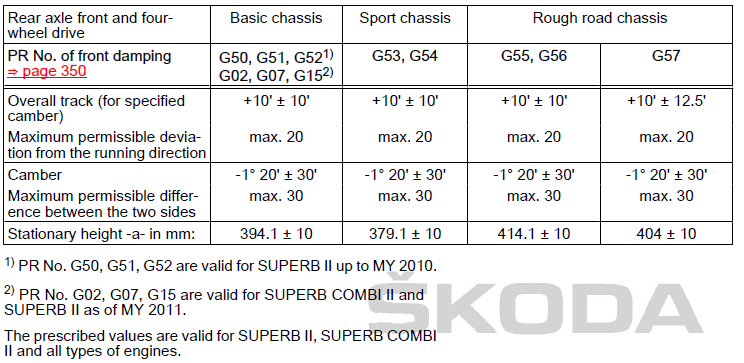
One of those things that comes up repeatedly around here is the thorny issue of rear suspension ride height and how to improve cars that may be sagging. I'm not going to present a solution to that question, as there are quite a lot of variables involved. What I have put together though is a summary of the different spring/damper combinations used on the rear of the Superb which should cover most of the possibilities for those who want to stick with OE parts if they're modifying their stock configuration; this is attached here as a pdf along with the geometry table from the service manual. Some caveats: I don't have access to a dealer version of ETKA, only some online versions: the information may not be complete as a result (come of the online catalogues are buggy at times) Even assuming that the catalogues I've found are complete, there may still be data missing from the catalogues I've come across a few inconsistencies that I've had to make an educated guess on What you do with this information is entirely your own business: I've done the best I can but if you mess up your car using it it's not my fault Changing the rear suspension without also changing the front could be problematic I'm planning to do a similar exercise for front suspension when I can make some time for it Some known issues: There are two raised ride height configurations available but I can only find information for the lower of the two (+10 mm over standard) The raised ride height configurations I can find seem to be listed exclusively for the 4x4 model I've no idea if the FWD model had this option or not and can't find information on it either way Some dampers in 1JA have a VIN split listed for the P/Ns pre-facelift This is included as an additional line in the table for the post split numbers In 1JC there is an additional damper part number listed with no associated spring PR codes It's listed as 'Other?' in the table In the main table, the lines highlighted in green represent the spring part number while lines highlighted in lilac represent the damper part number. To look up a configuration, find the weight range PR code at the top then drill down to the damper PR code on the left. every spring/damper PR code combination has a unique spring/damper combination. The additional tables below this are to explain/clarify what's going on. The weight range assignments are a relative ranking of the spring stiffness with 1 being softest, 14 being stiffest. As you can see in the table, the part numbers for a given weight range vary depending on the chassis/damper spec e.g. 0YB for 1JA is different to 0YB for 1JC, etc. Not every chassis spec includes all weight ranges. What is consistent in the springs is the relationship between paint codes and part number (with one exception: 0YA and 0YB for 1JC have the same paint code but different P/Ns - probably an error in the catalogue). Weight ranges 11-13 don't appear to be assigned on the Superb based on what I can find in the catalogue. An interesting thing that jumps out is that the spring alone does not determine ride height. In the table, 1JA/0YG uses the same spring as 1JD/0YA, even though the latter is 10 mm higher: the damper is what adds the extra 10 mm. The four damper configurations listed in the catalogue are fairly self explanatory. As noted above, the higher of the rough road combinations is not listed in the catalogues I have access to. Greenline is not listed in these, but the common opinion is that it's using the Sport chassis. rear suspension PR code summary.pdf