Austin 7
Members
-
Joined
-
Last visited
Everything posted by Austin 7
-
Do you have a phone in the car trying to pair with the infotainment system ?
-
Hi Scott If I understand correctly, everything works except that the GPS position is stuck. The most likely cause is that the GPS antenna (within the multiple antenna assembly) or its cabling are faulty, so you are getting no satellite reception at all. Various people on this forum have reported antenna failure, usually due to water ingress. So I think that replacing the antenna (and having a check of the various connectors whilst you are at it) is the most logical next step. The GPS only uses a single roof-mounted antenna, i.e. there is no fancy multiple antenna switching / diversity setup as used on FM. The GPS antenna has a tiny pre-amplifier immediatly next to it, which has a low power DC feed.
-
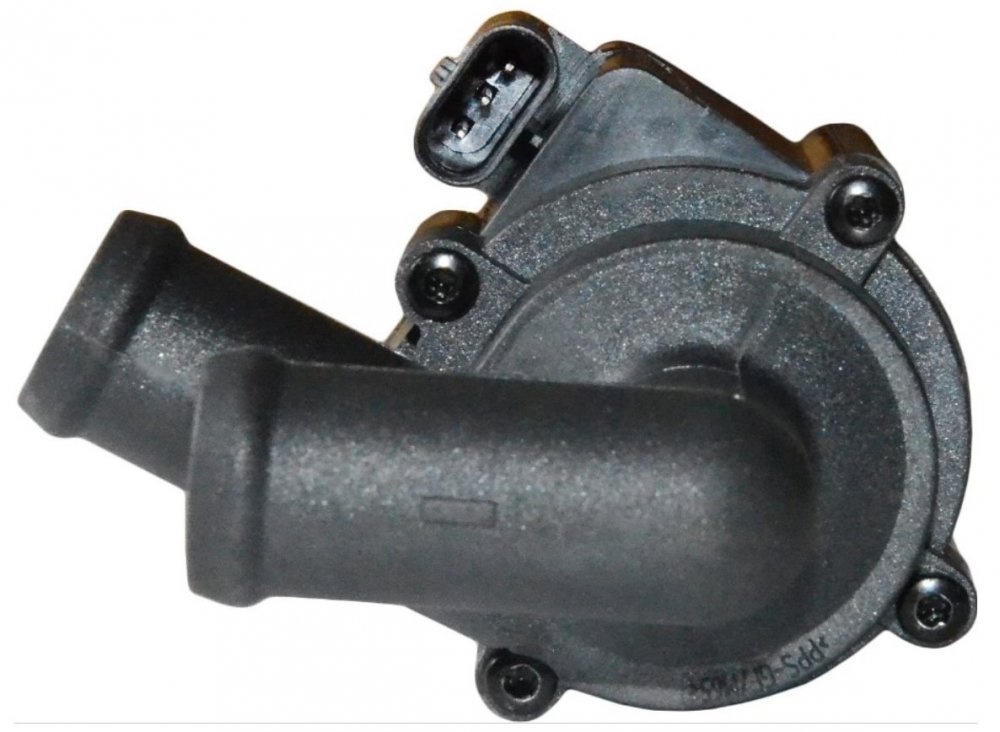
Hi The main water pump is mechanically driven by the timing belt and is the one that's often replaced at the same time as the belt. It only runs when the engine is running. The auxiliary water pump is electrically driven, so that if the engine is quite hot the coolant can still be circulated for a while after the engine has stopped. I suspect that it can also be switched on automatically to boost circulation if the coolant is especially hot and the engine is running but not very fast, e.g. idling in traffic. IF it is the auxiliary water pump making the noise, it suggests that something has failed and is causing internal rubbing, or some foreign object in the coolant has come to rest inside it.
-
Hi Iain81 The noise sounds like a tyre inflator pump, but it's clearly not that. The fuel system pump(s) shouldn't carry on after switch off. The radiator fans make more of a roaring noise, and if you open the bonnet you can see and feel them going. But there is an auxiliary electrically operated water pump which carrys on circulating coolant after switch off, to avoid heat soak. I suggest you try and locate it and see if the noise is coming from there (it shouldn't be anywhere near that loud by the way). Sometimes a length of plastic or rubber hose is useful as a stethoscope, put one end to your ear and "explore" with the other end.
-
As far as I'm aware, only petrol engines "pink" (pre-ignition). So what exactly are you describing ?
-
Hi You might be interested to know that the small courtesy light in the boot area (the one that comes on when the tailgate is lifted) will switch itself off if the tailgate is left open for an extended period. Presumably this is to avoid flattening the battery, though that would take a very long time. Next time you shut the tailgate it resets itself.
-
Hi ZJeffryes Some background info. If you have a problem with the clutch hydraulics (master cylinder/pipework/slave cylinder) you can get a situation where the clutch won't disengage fully, called clutch drag. Because the engine is still trying to turn the gears when you attempt to select them, you will find that the gear lever won't go into place, or there will be crunching noises as it goes in. The lever may not disengage when you want it to either. This isn't a gearbox fault, it's a consequence of the clutch fault. The main thing that wears in a clutch is the friction disc. That's basically what is changed when you have a new clutch. However, whilst it's all apart it is normal to also replace the clutch cover plate and the release bearing. The cost of labour (remove gearbox etc) is more than the cost of the parts, so it makes sense to fit a full clutch kit of these 3 parts. The flywheel face which bears on the friction disc should not need attention, unless you have run around a long time with a severely worn and slipping clutch. So a flywheel is not routinely replaced as part of a clutch job. However, modern cars have dual mass flywheels which also have internal vibration absorbing springs and dampers. These can occasionally wear prematurely and make noises whilst you are driving, in which case the flywheel will need replacing. I agree with other posters, check the master cylinder and pipework first, which doesn't need any expensive dismantling of the clutch and gearbox.
-
Even my local garage had fun undoing the carrier bolts, after I had given up on DIY. That was with a 2WD setup with better access.
-
I believe that FM reception uses two aerials, the obvious one above the tailgate plus use of the rear heated screen element. The FM tuner selects the aerial with the best signal, and can switch between them quite rapidly ("selection diversity"). This needs two independent coax cables running all the way to the head unit. DAB reception doesn't normally benefit from diversity, so I would expect it to use just the shark's fin (which superceded the plain bee sting). I believe this unit has a 12 volt powered preamplifier in the base. Any water ingress won't do it much good, but also if the power feed fails the DAB reception will be awful. FM will switch to use the heated screen exclusively, so will carry on working but without the benefit of diversity. The DC power feed is likely to share the FM coax inner (Phantom feed) with the power sourced from the head unit. If you use a non OEM head unit you may have to program it to source phantom power. Another possibility is that the FM or DAB coax cable from aerial to head unit (which runs under the headlining) has a joint somewhere which has got wet and therefore corroded, or has been disconnected and not reconnected. If it's the FM coax that's affected, it will cut DC power to the shark's fin which will also knock out DAB reception. It seems to me rather too much of a coincidence for water ingress to suddenly make reception bad whilst the car was at the garage. I'd put my money on someone forgetting to reconnect something.
-
Hi Subod Just wondering if it's your voltmeter you need to replace rather than your battery ! Can you borrow another voltmeter for comparison ?
-
Having seen your picture of the inside, I'd say the spot weld probably failed as a result of corrosion rather than a manufacturing fault. If you get moisture bridging two metals carrying different voltages, the corrosion is greatly accelerated. It acts like an electroplating bath, with metal being eaten away from one side and deposited on the other. I deal with electrics for motorhome owners from time to time. They often have issues like this due to their vehicles being laid up for months at a time and getting condensation which lingers. Similar vans used every day with plenty of engine heat and ventilation are much less affected.
-
Bosch used to make car relays in Portugal, but I think they were taken over by Tyco. Must have been having a bad day when yours was made.
-
Hi Juan Are you testing the original relay out of the car ? Apply 12 volts across the coil connections (the two smaller pins). You should hear the relay click as it is energised. Then use an ohmmeter connected to the contact connections (the two larger pins). This should read zero ohms when the relay is energised. Remove the coil power and the resistance will go up to infinity (open circuit). If you are seeing any voltage on the contact connections, it's probably due to a few megohms of electrical leakage. This could be due to some damp still in the relay. But it's an unusual test to be performing, not sure what you are trying to achieve there. If you want to know how the new relay is working in circuit, you need to monitor the voltage on the contacts on its downstream side (output side). Either at the relay or at the heated screen. I appreciate that it's not easy to access, you might have to fix up a thin temporary test wire and bring it out to somewhere you can get to with your test meter. If all is well there should be no more than a fraction of a volt difference between the input and output contact connections. Or wait till a frosty morning !
-
I agree, that corrosion will have a serious effect on a circuit handling high current. I suggest that even with a new relay you should try and thoroughly clean off any corrosion in the relay socket. One way to do this is to spray with switch cleaner, then plug the relay in and out a few times. That sort of corrosion shouldn't happen if the area is dry, so also look for any unwanted sources of moisture.
-
Hi I don't know what the power of the heated windscreen is, but I would imagine it's quite a lot, let's say 360 watts so it draws 30 Amps. This means that all the connections in the wiring and between the wiring and the screen need to be in A1 condition. I hope it is just a faulty relay and therefore a simple fix, but relays are usually fairly reliable things so prepare to be disappointed.
-
No pressure limiting valves these days, the anti-lock function is all done by the main ABS unit. I looked up the last MOT brake test figures for my 1.4 TSi. Weight 1530 Kg, distributed 58% front, 42% rear. Footbrake (Service brake) total effort 920 Kgf. Parking brake total effort 291 Kgf. The latter represents an "Efficiency" of 19%. I can't be sure if this is the maximum possible, or if the MOT tester just makes sure that the pass figure (16%) can be achieved. A car managing 16% would just hold on a slope of 1 in 6.25 Many owners have reported premature corrosion of the rear discs. I think there are two reasons for this. Firstly, as you can see from the above, even in the static situation nearly 60% of the weight is on the front. Once you are braking at close to 1 G, given the height of the centre of gravity there will be considerable weight transfer to the front, so there could then easily be a weight distribution of 75% front and 25% rear. The pad and piston sizes will be chosen to give braking in proportion to the weight on each axle, so the fronts do most of the work. The second reason is that there may be a pressure threshold for operation of the rear brakes, so that under light pedal forces (the sort careful drivers mostly use) the rears may be doing hardly anything. The answer may be to give the brakes a brief hard workout occasionally, to clean off the discs. One technique which might help is to press very hard on the brake pedal whilst operating the handbrake, so that the handbrake mechanism is not being tasked with applying much effort but instead is efffectively acting as a non return device.
-
Hi I think its the sunlight penetration photo sensor, which is linked to the climate control system.
-
Hi. I found this description for a VW Golf, which should give some idea of what the charcoal canister does: Evaporative emissions system Function description of EVAP canister system Depending upon the air pressure and ambient temperature, fuel vapour will form above the level of fuel in the tank. The Evaporative Emissions system prevents these HC emissions escaping to the atmosphere. In limited quantities, fuel vapours pass through a gravity valve (which closes at an angle of 45) located at the highest point in the tank and through a pressure retention valve into the evaporative emissions (EVAP) canister. The EVAP canister stores these vapours like a sponge When the oxygen sensor control is active when driving (engine warm), the EVAP canister purge regulator valve -N80-, is activated (pulsed) from the engine control module depending upon load and engine speed. The opening period is dependent on the input signals. Intake manifold vacuum draws fresh air through the vent opening on the underside of the EVAP canister during the purging procedure (regenerating the activated charcoal in the canister). The fuel vapours stored in the activated charcoal and fresh air are pulse-fed for combustion
-
Hi rover220 "problematic as the earlier 122ps ones" What problems are you referring to ? My 1.4TSi 122ps has been problem free for 8 years and 60K miles. It returns 42 MPG long term average.
-
In case it helps understand the balance shaft function: "Two cylinder block housed balance shafts are used to counteract unwanted vibration at engine speeds above 4000 rpm from being transmitted to the car body.The balance shafts run at twice the engine speed in opposite direction from one another. The direction of the second shaft is reversed by an idler gear. The horizontally staggered arrangement of the balance shafts also helps reduce vibration.The balance shafts are made from spheroidal graphite cast iron and run in three bearings." In essence, these are rotating eccentric iron weights which produce a vibration equal and opposite to the engine's secondary vibration, which therefore cancels it out for smoother running. This refinement in engine design tends to be used for larger capacity 4 cylinder engines, and has been around since Lanchester invented it many decades ago. The shafts are buried fairly deeply within the cylinder block, and are normally a reliable component unless there has been a problem with the lubrication of their bearings.
-
You could try a 21 Watt halogen type. Same current drain, same heat but roughly 40% more light.
-
Hi Helix I know this is an old thread, but did you resolve the issue ? It looked to me as though 1.) your car was OK, 2.) the garage worked on it, and then 3.) it wasn't OK. Conclusion, they must have done something ! If the cambelt is fitted one tooth out, it will run poorly but the software may just be able to maintain the correct idle speed and mask the issue to some extent. One tooth error either way probably isn't quite enough to incur any valve versus piston damage. I once had a Polo which had the cambelt changed by an independent VW specialist near Totton in Southampton. It ran like a dog afterwards, but they were adamant they had done it correctly, even going as far as to say that the notch marking on the lower pulley (which didn't line up with the fixed mark) "must have been put on wrong in the factory". Four years later I replaced the belt myself, and the car was transformed back into a lively youngster. By then the franchise had gone bust. Yep, despite the bluster they had indeed got it one tooth out.
-
From your description it doesn't sound like wheel bearings to me. They tend to get noisy gradually over 1000's of miles, and are unlikey to both fail at the same time. One test is to listen when cornering on a smooth road - the noise will tend to get louder when the bad bearing is on the outside of the corner, i.e. when it is loaded up. And of course, they make no noise at all when stationary. The only time I have ever had a wheel bearing fail suddenly on a car was after fording deep water and then not using the car for a week, the bearing internals went rusty as water had got in past a faulty oil seal (it had a tiny nick in it). By all means get the bearings changed if you have confidence in the diagnosis. But brace yourself for it making no difference. I am in more agreement with the posters who suggested the noise came from escaping exhaust gas or a hole in the air intake or breather systems. Also worth checking the exhaust and engine pipework for any contact with the bodywork which could conduct buzzing sounds. As an example, I once had an Audi A3 that made underbonnet exhaust-leak noises. After a lot of investigation, a combination of ears, nose and touch found a leak at the back of the engine. Impossible to see without a mirror. A casting with various stubs for pipes had an unused way blanked off in production with a thin metal plug. This had rusted through with a hole a few mm across and was puffing out exhaust gas.
-
I bought Brembo rear discs and pads. Equipped with a windback tool and a 12 point spline bit adaptor for the caliper bolts I set to work. After an hour I gave up as I just couldn't shift the caliper bolts and couldn't even get the disc off the hub (yes I did remove the retaing screw) to try fiddling it past the caliper. In the end my local garage fitted the parts for me, and said that even they found the bolts tight. So be prepared for a struggle !