Austin 7
Members
-
Joined
-
Last visited
Everything posted by Austin 7
-
Rubber mounted exhaust support, as far as I can see.
-
Your description points to a wheel bearing which is worn. They can start to make a droning noise linked to road speed before they are worn enough to feel play or roughness when testing by hand with the wheel off the ground. The drag from the transmission on a 4 x 4 will make it hard to spin the wheel and feel for roughness. Sometimes the noise is louder when cornering, due to side thrust and changing load, but I had a rear bearing go and it didn't show this behaviour so its not an infallible test. You might be able to find a good diagnostic workshop who can put the car on a rolling road with a vibration sensor attached to each suspension assembly in turn, to pinpoint which bearing has failed. Alternatively you could carry on using the car until the noise has got loud enough to identify the culprit, it will gradually get louder as it wears more. I no longer work on "heavy" stuff like suspension and wheels, as I don't have impact drivers or the space to swing a long breaker bar.
-
Not on my Yeti, but I have a Fiat Ducato campervan with Michelin Agilis camper rated (CP) tyres. After a holiday journey of 100 miles at up to 65 mph, I discovered that one front tyre had only 25 PSI rather than the usual 60. Tried pumping up with a brand new 12 volt powered inflator, but after 10 minutes this only got to 35 PSI before noisily failing (overheated ?). Finished off with a bicycle pump which took forever but got to 60 PSI eventually. Next morning, back down to 25 PSI so out with the bicycle pump then off to the nearest tyre dealer. They found a small nail in the tread, I guess it only leaked when the pressure was higher than 25 PSI. Tyre removed, checked, repaired and balanced then on my way for just £25. I am amazed that the tyre took this punishment, reinforced sidewalls must have helped. I will probably replace it soon as it's coming up to 10 years old.
-
My car has the same 1.4 engine. Yours sounds normal to me, given the limitations of video etc. It is most important to use high quality oil and change it (and the filter) often, as any reduction to the oil supply to the timing chain can cause premature wear. You might hear a brief (one or two seconds) rattle from the chain upon start up, especially if the car hasn't been used for a day or two. This seems to be a normal characteristic, I assume it's because oil gradually drains from the oil damper which is part of the chain tensioner spring assembly.
-
I had the front shocks replaced after the MOT tester reported slight misting on one of them. The old shocks worked fine, the new shocks worked fine. I'm pretty sure I could have just wiped the misting off with a rag before the next MOT, so you might want to consider that approach at least in the short term.
-
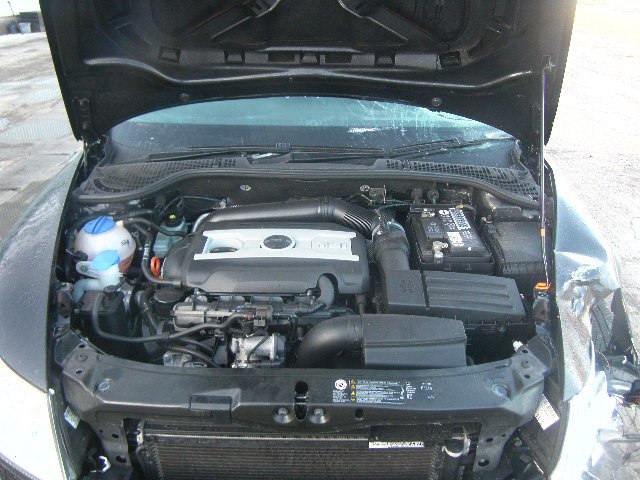
The best picture I could find online suggests there should be an upper plastic part. The idea is that the engine breathes cooler, denser air rather than the hot stuff from the engine bay.
-
I am pretty certain that only the smallest (253 mm) discs as fitted to the 1.2 can be removed by fiddling them out. My 2012 1.4 TSi had 272 mm discs and (from memory) they could not be fiddled out and therefore needed the caliper carrier etc to be removed. This involves very tight fasteners and a special 12 point spline driver, so you need the car high enough to use a breaker bar.
-
Hi I suspect this is part of the return circuit that takes unused (leakoff) fuel back into the system. The pressure in this circuit is only moderate, which is why rubber hoses are adequate. It's possible that the connection was not fully secure, and with cold weather and increased fuel viscosity the pressure rose just enough to push it off completely. I'd recommend a new hose unless it's obvious that the fitting can be re-mated properly.
-
The noise doesn't seem related to engine RPM, but increases with road speed. So much more likely to be something associated with the wheels, wheel bearings, driveshafts, output side of the gearbox etc. It is also much more prominent when high torque loading is present, i.e. when accelerating in lower gears. It is hard to trace noises like this when in the car. You might need to rig up a remote microphone for use by a passenger when driving. If a front driveshaft outer bearing the noise may change with steering angle.
-
I have had mine simply re-gassed twice in 13 years. It has never got to the point where the pressure has dropped below the threshold for operation to be inhibited, but always seems to produce colder air after being done. Not too much to pay for a year round essential item. Nobody wants to go back to the bad old days of winter motoring with damp interiors and misty windscreens. I wouldn't bother with getting the "air" side of things deodorised etc.
-
I enjoy working on my own Yeti. Most recent job was a water pump change. However, I now draw the line at "heavy" stuff like suspension and wheel bearings. You need a long breaker bar plus the car at sufficient height to be able to swing it. You also need to borrow or buy good quality splined sockets. The fasteners will have enjoyed years of corrosion inducing muck and might need an impact wrench. So my advice would be to use a good independent VAG garage. Rear wheel bearings have changed design over time, so a VIN check might be needed to get the correct one.
-
Multiple seemingly unrelated electrical faults often indicate a common cause. This might be things that share a common 12 volt feed. If you imagine the electrical system from the battery positive connector as a tree trunk dividing into branches and then smaller branches you will get the idea. The closer to the battery positive the fault lies, the more things are affected simultaneously. Of equal importance are the earth returns, which is fundamentally the same as the positive supply but working backwards. Slightly more complicated by the use of the metal car body for part of the path. In this case, the closer to the battery negative the fault lies, the more things are affected. I suggest you look again at electrical connections, starting from each of the battery connectors and working outwards. In my experience, earths are more prone to faults than the positive side, due to them being more exposed to weather. Of especial importance is any earth strap from the engine/gearbox to the body. These can sometimes corrode internally within the crimps and look OK but have higher than acceptable resistance. Just cleaning the ends isn't enough, replacement is best. Bear in mind that starter motor current is much larger than for any other electrical item, so it's the first to expose weakness anywhere. Connections in this circuit must have resistance of no more than a couple of thousandths of an ohm. Testing this is way beyond the capabilities of ordinary meters, so just because something "buzzes through" it doesn't mean it's good enough. BCMs and ECUs are designed with a certain amount of protection from faults, so there is a good chance they are OK and the fault is elsewhere. If this is beyond what you are comfortable with, I suggest a specialist auto electrician which someone has personally recommended. Franchised dealers are often out of their depth when logical faultfinding is called for.
-
Your Yeti will have an auxiliary electric coolant circulating pump as well as the mechanically driven one. It's possible you have a problem with this which is affecting circulation. As you surmise, the cold hoses suggest either an air lock or some other failure to circulate coolant through the heater matrix. This discussion might shed some light: https://www.yetiownersclub.co.uk/threads/coolant-pump-2.10954/ I suspect that vacuum filling is used at a workshop because it is quick and thorough. I recently refilled my petrol Yeti without vacuum, just let it run for half an hour and kept topping up as required. Another top up was required the next day after cooling, unacceptable for a clean handed "chequebook" customer but fine by me. So I suspect the system is designed to (eventually) self bleed. With sealed systems and effective inhibitors, engine cooling internals stay remarkably clean so blockages should be a thing of the past.
-
You give no vehicle details, but it is normal for the low pressure fuel pump to be combined with the fuel gauge sender. This whole assembly fits into the top of the tank through a circular hole and seal, and operates submerged in fuel. I suggest you get this assembly renewed, the parts are not expensive and it's a reasonably straightforward job. The separate high pressure fuel pump for injection is located on the engine.
-
This can be a sign that one of the ABS wheel sensors is on its way out.
-
Hi. The upper trim panel is held in place with hidden push-in studs. You need to pry all round from the side with a strong tapered plastic tool, which looks a bit like a door wedge. Here is one example: https://www.ebay.co.uk/itm/175585759861?chn=ps&_ul=GB&mkevt=1&mkcid=28&google_free_listing_action=view_item
-
I may have to change the water pump soon on my 2012 1.4 TSi ( The earlier CAXA engine ) after 82000 miles. Not too bad a job as it's driven by the serpentine belt and is thus reasonably accessible. At the moment the slight coolant leak has completely stopped, hot or cold. Not quite sure how this could happen. However, it's bound to be back sooner or later. I suspect the seal on the pump spindle is giving out, given the position of the pink drops on the floor of the garage and slight rust marks on the bare steel pump pulley boss. The question is, does this particular engine coolant system self bleed when refilling or does it require intervention ? I'm quite prepared to squeeze the odd hose to burp air and top up once or twice over a few days as things settle.
-
Hi I was going to reply to suggest that it could still be a stone trapped on the inner side of the disc, but it looks like you have found it ! A CV joint just doesn't make that kind of scraping noise, unless maybe the boot had split and every last trace of lubricant had dropped out. Its much more common to get knocking or clonking noises with excess wear, especially under load and with steering lock applied.
-
I think I just beat my feature discovery record today. Tried adjusting the passenger door mirror to look down a tad more so that I could see the white line of the parking space. I must have moved the knob on the drivers door clockwise one step too far, as the next thing I knew, both mirrors folded in ! I never knew they could do that, surprised the motors weren't seized after 13 years of inactivity. Closer scrutiny showed a tiny indecipherable symbol at that knob setting, which is of course normally hidden from the driver's view by the knob. It's all there on Page 58 of the handbook of course You can all laugh now......
-
Maybe I can't beat 12 years, but it did take many years before I found out that when changing the "upside down" oil filter you could undo it half a turn and leave it to let all the old drain out internally from the canister, so that when you took it off completely it didn't go all over the engine ! It does seem a shame that with spark plugs and leads being 100 year old technology they are still failing and causing grief - this seems to be a particular weak point of the 1.2 TSi. Most if not all petrol cars (including my 1.4 TSi) are coil on plug nowadays. The wastgate flap allows controlled leakage to limit the boost pressure from the turbo. I wouldn't mind betting that this is repairable without needing a new turbo, though probably not by a main dealer.
-
From what you describe, there is more being taken out of the battery than is being put in. So either your dashcam or some other device is excessively draining the battery when the car is parked up, or the alternator is failing to put enough charge into the battery. If the (fairly new) battery is failing, this will reduce its effective capacity and exacerbate the problem. Do check the obvious, like both main cables connecting to the battery posts are clean and tight. A garage should be able to quickly test the battery health, the alternator performance and the current drain with the vehicle parked (say 10 or more minutes after switching off).
-
The lights you mention are all related to systems that rely on ABS wheel sensor input, so that could well be the common factor.
-
You could try taking it to a place that has an MOT bay with a shaker plate, most likely found in a place that does light commercials and motorhomes (and ambulances !). With a good operator these can detect slight play that traditional pry bar techniques can't.
-
Hi If the connectors are FAKRA types, there is a standard colour code. Whether VAG adhere to this code I don't know, but it's a start. See here: https://www.grand-tek.com/en/fakra-connector-assembly.aspx Many GPS antennas use thin RG174 cable. Due to the cable loss (about 1 dB per metre at 1575 MHz) it is normal for the antenna end to incorporate a preamplifier of typically 20 to 30 dB gain. Power for the preamp will come either from a DC wire or by "phantom feed" using the inner of the RF cable. Sometimes the phantom feed is programmable on or off in the head unit. Failure of this power feed will result in very low gain and poor or no satellite reception. This post might shed some light : https://www.briskoda.net/forums/topic/492541-gps-not-working-help-with-wiring/
-
As far as I know, only the 253 mm rear discs used on the 1.2 TSi can be wiggled out.