Papez
Members
-
Joined
-
Last visited
Everything posted by Papez
-
If your evaporator starts leaking, you'll know the reason. Aluminium isn't the most corrosion resistant material out there, so I'd be careful using anything but A/C cleaners.
-
Was this with the engine warmed up? The cap has built-in pressure valve, so if it's faulty, it won't build up pressure. The cooling system won't work properly without pressure.
-
On LHD cars, some screws have to be loosened to lift the box a little to clear the battery holder. The battery is on the opposite side on RHD cars, but I'm not sure if there's something else that may interfere.
-
I was only able to find PNs. But the hoses have been sold out everywhere. 6U0819373F 6U0819371G
-
Bad coolant sensor would show high temperature all the time. But since the temperature looks normal on idle, it means that the coolant sensor is fine, as is the fan switch and thermostat valve. So wee need to find cause of high temperatures at speed. That could be caused by: Bad airflow (missing guide in front of the radiator, blocked inlets, partially blocked radiator, fan connected in reverse) Bad coolant flow (bad coolant pump, wrong plumbing, blocked radiator, bad thermostat valve) Gas bubbles in the coolant circuit (for example, from failing head gasket) That's all I can think of. Striked through options have been ruled out so far.
-
285x485 or 285x590? The former is 1.3 radiator, the latter is 1.6. 322x590 is 1.9D or 1.6 with AC. By air guide, I meant this plastic in front of the radiator: If the previous owner changed radiator, he could've left it out instead of modifying it for the larger radiator. One more thing, it bad/clogged coolant pump could do that. But that would be probably noticeable on idle.
-
The radiator size sounds like 1.9D. how does the fan look like? Does the heater work when it overheats like this? Does it have air guide around the radiator, under the bumper cover? Without it, the air will just flow around the radiator, which would explain why it works properly on idle. Is the fan wired correctly? Does it push air into the engine bay (I've seen someone having similar issue and the culprit was the fan spinning the opposite way, effectively blocking the radiator)
-
6-pin and 3-pin, right? On the 6-pin connector, pin 2 goes to ECU, pin 3 goes to diagnostic socket, so by bridging them together, you should be able to connect to ECU.
-
That's the handle. Just a reinforced hole in the rug, so it's easier to lift.
-
Factory wiring in Felicia is always active. Some owners modified it to ignition power. Newer Škodas turn on power after the ignition is turned on, but keep it active until you pull the key. But Felicia doesn't have ignition barrel output for that.
-
Looks a little bit like "special equipment harness" that was used to power things like electric windows etc.. https://www.sp-el.cz/pomocny-svazek-pro-pripojeni-svazku-mimoradne-vybavy#detail-anchor-description Head unit wiring had standard ISO connector with 2x8 pins. One connector for power, other for speakers (even hatchback models had all 4 wired in, but only estate had cables going all the way back to the C-pillar speakers)
-
That's the plug that connects the pickup coil to the immobilizer unit. The unit was then connected by a 6-pin plug to ECU. One of the pins in the 6-pin plug is data wire from the diagnostic socket, so if it's unplugged (which is possible, since you found the 3-pin plug), there's no way for ECU to communicate with the diagnostic tool.
-
To save money. I own a 2005 Seat Cordoba, which, compared to earlier models, is missing cover on the bottom of the dashboard. It wasn't visible, unless you got your head into footwell, so they replaced it by much smaller piece of plastic that only covered the visible part of the area. Similarly, top of the cargo area has no trim, even though rest of the trim suggests that at some point, it was planned (or maybe present in higher trims, who knows). This part of the boot floor is similar case, it's just not part that's not visible under normal circumstances.
-
If the immo unit was removed, the diagnostics cable ends in the connector. Has the diag ever been working?
-
Could it be the immobilizer? Diagnostic data line goes through the immo unit, if it's faulty (or removed and deactivated in the ECU), diagnostics won't communicate with the ECU.
-
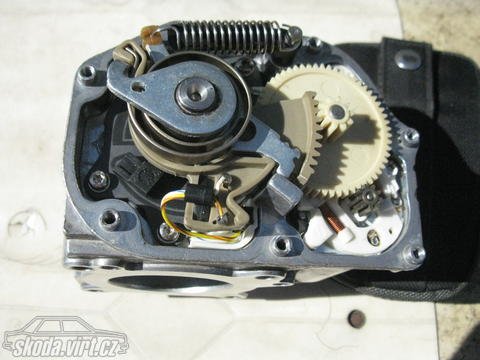
Yes, the video covers newer cars with fully electrically driven throttle valve. They use two potentiometers in tandem in both the throttle pedal and valve body to detect fault if one of the potentiometers fail, because stuck throttle valve could be dangerous. These older cars are different, the throttle is moved directly by the pedal and the idle adjustment is basically just adjustable stopper with limited range. This is opened throttle body, where you can see range of the brown part that's controlled by the ECU: Also, forgot to add that there's an idle switch on pin 3 - that lets the ECU know, that driver has let go of the throttle pedal. Unfortunately I still cannot say how do the potentiometers work. I may be wrong about them being independent, but my guess is that the idle sensor only detects movement of the brown part. Btw, you should be able to see some fault codes or weird values in diagnostics, if one of the sensors is bad. Edit: found a video (though it's a 1.3), where you can see the independent movement of the valve and the adjuster. It also shows irregular movement caused by vacuum leak.
-
It shows the left, but the list below shows PN for the right one under (10). On my car, the bottom trim was one piece, spanning over the entire width. This one seems to be from VanPlus, which didn't have the boot trim, so it's just latch cover.
-
That's redundant TPS for electronic throttle control. In schematics, it's just marked as TPS-1 and TPS-2, not idle throttle position and throttle position. Felicia uses this weird in-between, where idle position is controlled by the ECU in limited range, but the rest is controlled by cable, independently from the ECU - so it would make sense that position sensors would be independent, too. Also, potentiometers don't fail like this, unless there's a mechanical failure that would keep the wiper stuck in position. They usually fail open or show irregular values over the range. How did you get measurements while powered? Would you be able to get measurements with the engine started?
-
It looks like you get the pre-facelift frame, those are a bit sturdier, but won't fit facelift tunnel. Facelift frames have weaker tabs which break easily during disassembly. Those have been unobtainable for years.
-
Can't say, I've never inspected the throttle body, but my guess is that the idle potentiometer is feedback of the actuator, so it doesn't move with the throttle valve, but only when the ECU tries to regulate the idle RPM
-
Then the only thing I can think of is, that screws in the rear part of the rail aren't seated properly and seat rail stops on them. Or, but I'm not sure if it's correct, I think that rails are moving on bearing balls. Maybe the balls moved around when the seats were out of the car and now they act as a stop.. have you tried to move them back without any weight on them?
-
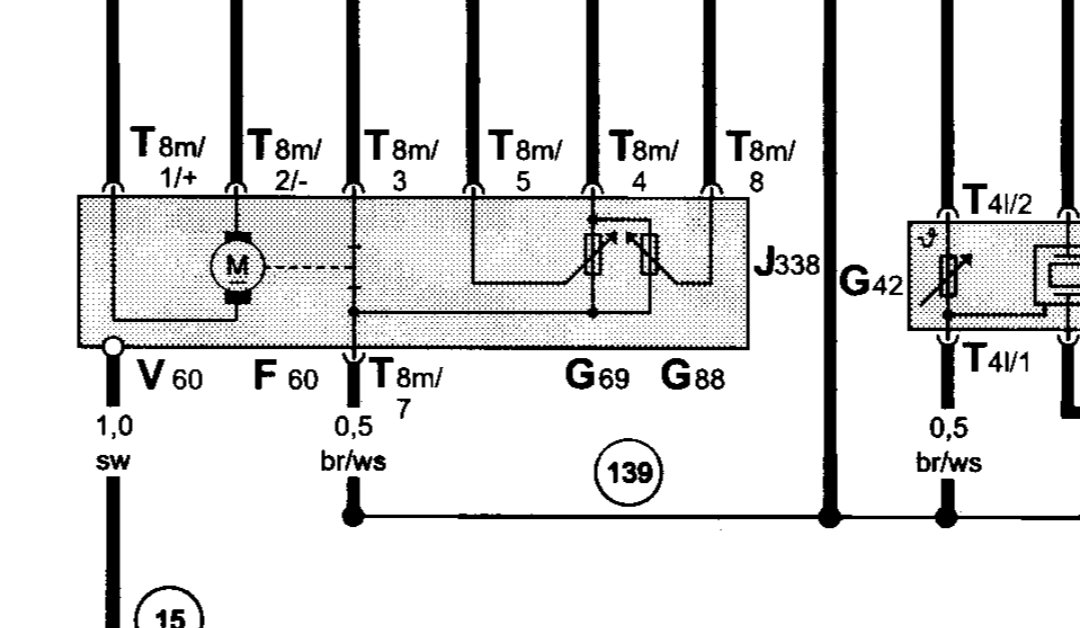
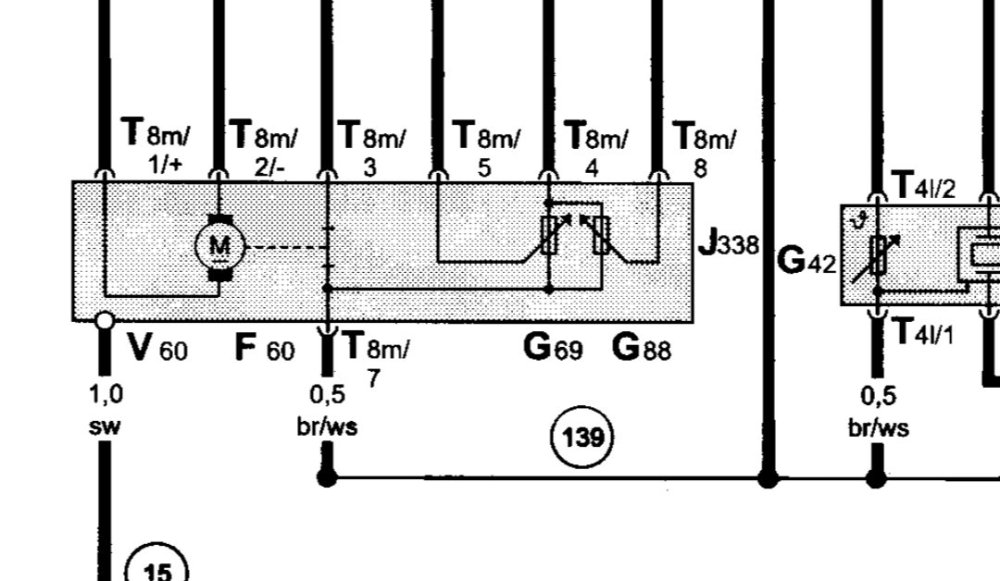
According to schematics, pins 1 and 2 are for actuator. Potentiometer pins are 4, 5 and 7 for absolute position and 4, 8 and 7 for idle position (two potentiometers, 7 is common ground, 4 is common voltage input from ECU and 5 and 8 are outputs of each potentiometer). The engine on the photo is EA827. Felicia has an entirely different engine, EA111, which was derived from 0.9-1.3 engines used in Polos.
-
Does it reach hard stop or just seizes on the way to the back? If the latter, I'd try loosen the bolts a bit, move the seat back and forth and tighten again.
-
For the next next time, I'll explain how VWs PNs work. First three are model or platform - Felicia is 6U model, so most Felicia-specific parts also start with 6U (the third character is body variant, but in this case, it's the same part for estate and hatchback). It's not a definitive rule, however, Felicia also uses a few 6X* parts (Polo/Lupo platform) or 11* parts (those that carried over from Favorit), plus engine/gearbox parts have their own model numbers. The second three is group - 8** is body Last three is part identifier. Also the last number suggest to which side the part belongs - odd for left, even for right (so parts that have left/right variants only differ on the last character). Additionaly, there's suffix that denotes part variant. It can be 3-character colour code, or 1-2 letter variant - sometimes, it can be nearly identical part that was just replaced during production, different look or function for various equipment trims, or entirely different part that doesn't even fit, because it's meant for different car variant. This is why the Fabia part has almost identical PN. Be careful when looking for parts with PNs, stores often just throw all PNs together under a product and search engines often show wrong part, because there's only one character difference.
-
W5W is not halogen. A standard Osram W5W has 50lm output, so 10lm/W