




wyx087
Resident Member
-
Joined
-
Last visited
Everything posted by wyx087
-
Nissan one is slightly different. Nissan are shutting down their server/service for old Leaf using CarWings. This system uses 2G instead of 3G, 2G is said to be the fall-back option during 3G shutdown and will operate into 2030's. So this loss of vehicle feature is entirely on Nissan.
-
Only 3000 vehicles? Leaf was on sale from 2011 onwards, I'd have thought more than that. I posted about this when it first surfaced last Wednesday in the "truth" thread. It's disappointing to say the least, only gave a month notice. But this kind of online service shutdown is same on ICE vehicle apps. It just happened on EV now because Leaf was the very first to get this feature through bad implementation. I'm sure other ICE vehicle using CarWings would also suffer the same faith.
-
Is forward pedestrian warning really mandatory? My Tesla vehicle does not emit anything going forward, only emit a reversing sound. I'd have thought Tesla would keep their vehicle fully up to date with mandatory features as long as hardware supports it. Fantastic photos from Glen Doll, btw.
-
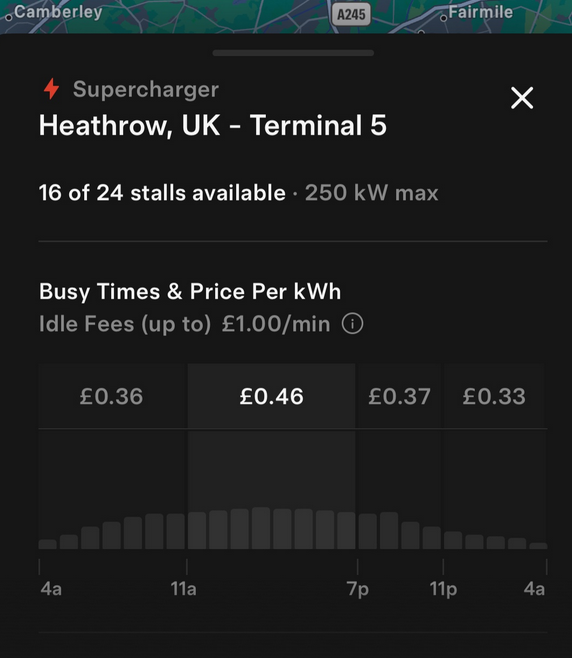
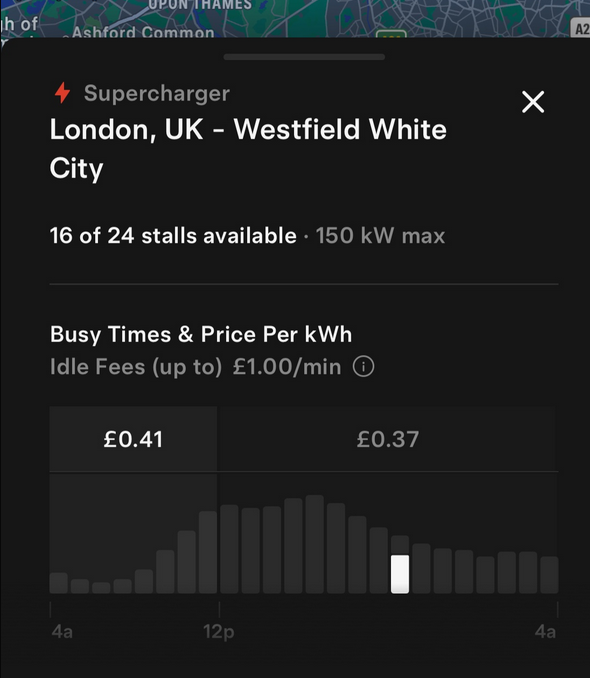
That is not right at all. Tesla owners do not need to pay the said subscription. The subscription is for non-Tesla to get same rates as Tesla vehicle. For Tesla owners, cheapest is typically mid 30/kWh. Highs are ~50p/kWh. "Granny cable" is referring to the cable that plugs into 3pin domestic socket. There is typically a bit of electronics just after the domestic 3-pin for safety protection. For example good ones monitor plug pin temperature to ensure the plug doesn't burn. First month owning our Leaf, I'd charge using this cable and an interior socket, pass the cable out of a window. Since then, I've installed an armoured cable rated up to 32 amps to a high quality outdoor double socket. As with all outdoor sockets, it is weatherproof even when plugged in. Apart from much easier doing lawn mowing, I can use those to charge my EV's in a pinch. (or something something tax ). Indeed, that's why I think future variable tariff will see bigger rate differences between windy sunny vs calm gloomy days. So I think the more storage I own, the more "protected" I can be. V2H gives the cheapest and easiest method of upgrading the battery capacity. for example £15k for 60 kWh of storage in a second hand Leaf. Insurance - this is a grey area and depends on where the fire started. House insurance would cover house fire, car owner's insurance would also cover its car. Electricity company - I pay for whatever I consume, can't see how letting other people use my charge point breach that. Mortgage provider - Only if it constitutes as sub-letting. Lending house infrastructure to a neighbour = sub letting?? Public liability - I honestly don't know. Safety - unless EV's catch fire, which might be a real concern based on internet videos 😜 Declaring income to taxman - Only if profiteering by asking for more money, otherwise there is no income to declare. I have done something similar when my neighbour got their EV and were on a long waiting list for charge point install. Let them charge about twice a week. Just read the number off my CT clamp energy monitor and they paid for whatever they consumed.
-
You are forgetting the ever increasing renewable energy mix of the grid. Renewables are inherently variable as it changes on a whelm. Battery storage will assist in this regard. But I agree with you, I believe price differences would be smaller throughout a single day, price variations across multiple days will appear (eg. windy days).
-
Sorry, I scanned through the document and searched for keywords, I can't find anywhere that mentions stock should last for 2 years. But I'm not surprised, Leaf platform is long overdue a renew, buying new Chademo rapid charging EV today will not age well. So they must have not been selling well. As Graham pointed out, buying sitting stock isn't ideal. I sure wouldn't want to get a car that has been sat for 2 years. Especially buying an EV with 2 years built-in degradation into the battery. Capacity vs cost. 60 kWh Leaf are selling for ~£15k at the moment. I don't believe you can get anywhere near 50 kWh capacity for that price for home battery storage. But the 50p gain is also quite rare, only during Octopus Saving Sessions, like today 1800-1830. Normally it is 7.5p/kWh to buy overnight and 15p/kWh export.
-
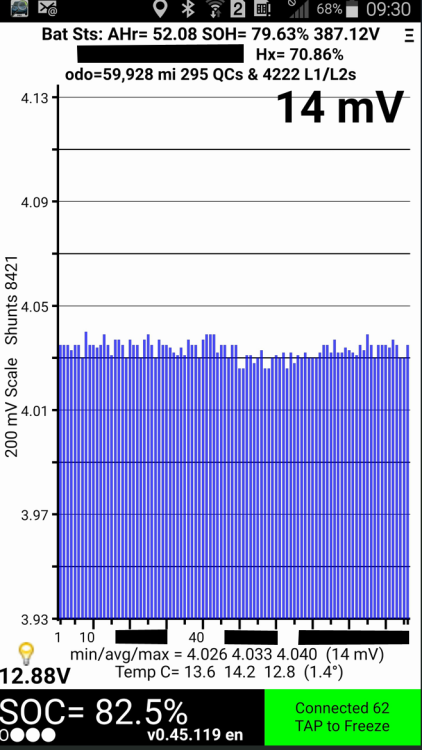
I thought all Leaf apart from Visia (whatever spelling, the lowest trim) get heat pump. Leafspy shows how many charging "events", which may not correspond to cycles. QC count is rapid charging plug in events and L2 is slower AC charging. Those are not the main things to check. From my car: The key thing to look out for is unbalanced cell degradation. cells 40-something to 60-something sits under the rear seat in a different orientation. Heat gets build up there. So the thing to look out for is to make sure at low SoC, those cells don't drain faster than rest of the cells. Make sure delta V stays within a few mV. So far, just 5-6 months in, V2H hasn't accelerated degradation for me. With low mileage, time element of degradation will play a bigger role than cycle count, so might as well use those cycles. For home battery, LFP would be the chemistry I get, definitely. For car, LFP also makes a lot of sense if software is well designed to overcome its shortcomings: low recharge speed when cold.
-
Wife isn't keen on changing her car, she doesn't like change. So may keep it, but I was hoping I can get an almost new Leaf a few years down the line. I want to change because early Leaf cannot discharge below 30% when connected via V2H, so during wintery days + day time vehicle usage, the battery size JUST falls short of what we need to power the house. Between 2020 and now, Leaf haven't had any updates apart from cosmetic change to the wheels. There wouldn't be anything to be gained buying new, apart from newer battery. Armed with Leafspy, I am fairly confident I have the experience to check battery condition. For Leaf, where they don't have thermal management, as long as hasn't been regularly rapid charged back to back, battery should be fine.
-
Sad news, Nissan Sunderland plant are stopping production of Leaf. When stocks run out it'll be end of Nissan Leaf for UK. https://www.electrifying.com/blog/article/the-leaf-has-fallen-nissan-stops-ev-production-in-the-uk But to be fair, we all knew this is coming. Chademo rapid charging is not increasing as quickly as CCS. The car platform is way overdue a refresh. Question for me, do I buy the last new one, or do I buy second hand, hope battery was looked after...... I'm buying for V2H. Or keep current 2014 car for 3+ more years, and hope there's better V2H implementation by then.
-
Yes, that was a bad summary. Those 2 points still came from the video, the first one was just very obvious. The point of the video is that due to historic reasons, military carbon emissions were never recorded/accounted for. That is changing very slowly, UK and a few other countries have recently published military carbon emissions data.
-
Recent talks about EV tanks etc, here is a video putting that into perspective: In short, climate change is the last thing to consider for military leaders. For them, most important aspect is combat capability. Also worth noting that large percent of emission comes from logistics and aftermath of war (burning ruins, rebuild efforts). I think it is same as looking at plane emissions at air show, only focusing at the spectacle wouldn’t solve anything.
-
Plugging in wouldn't be a flaw when it becomes normal. It's super easy to do. You are not taking note of the difference between destination charging and rapid charging. Former doesn't need to vacate the charge point, latter is exactly as you described. V2G/V2H are for destination charging only. You would plug in and say "I want 80% at 5pm" and the charge operator manages everything in their back end. If need the car more urgently, just tell it as soon as you know. If EV have 300 miles to begin with and you set it to keep it above 40%, that's over 100 miles always ready in the battery without needing any prior notice. One form of V2G is to use EV battery for grid frequency stabilisation. In those instance, V2G would not take a lot of energy from the battery in large chuncks, it would do tiny charge/discharges to maintain grid frequency.
-
Haha, no problem. V2G - vehicle-to-grid (bidirectional charging and discharging to the grid) V2H - vehicle-to-home (bidirectional charging, and discharging according to home needs) V2L - vehicle-to-load, allow a load to be connected to the car, for example kettle or elec BBQ etc. V2X - vehicle-to-everything. https://en.wikipedia.org/wiki/Vehicle-to-grid#Bidirectional_local_V2G_(V2H,_V2L,_V2B,_V2X) First 2 need to be phase synced with grid connection, hence V2L comes first and is available on many EV's now. V2G need communication from grid operator. V2H only need an in-home CT clamp, it tries to zero grid draw by providing power from car battery. CCS - Rapid charging connector, mandated by EU across Europe, https://en.wikipedia.org/wiki/Combined_Charging_System Chademo - Rapid charging connector used on early Japanese cars, https://en.wikipedia.org/wiki/CHAdeMO G98, G99, G100 are application to export energy, the form depends on specific install. https://connections.nationalgrid.co.uk/get-connected/solar-and-wind/generation-g99/ Nissan Leaf/eNV200, Tesla Cybertruck, Ford F150 lightning, Cupra Born, VW ID Buzz can all do V2G and V2H. Most Korean and Chinese EV since 2020 (MG4, EV6 etc.) can do V2L.
-
Regarding earlier talk about obsolescence: Nissan is shutting down 2015 and earlier car remote features: https://www.speakev.com/threads/any-way-of-activating-pre-heat-now-the-app-is-being-disconnected.183461/post-3574625 😞 Suggested solution is to buy OVMS. Open Vehicle Monitoring System | Open Vehicles for £200. This kind of service shutdown is prevalent in smart home devices, another of my hobby. But I have gotten away with it try to only use local controllable devices via Home Assistant (as I say, people always finds a way). OVMS looks like it's similar idea.
-
In case you weren't aware: https://www.reuters.com/technology/space/us-achieves-first-moon-landing-half-century-with-private-spacecraft-2024-02-23/ Moon exploration was paused for 50 years because there wasn't much financial incentive. Again, as long as there's enough financial incentive, people can and will do the impossible. With V2G, there is huge amount of financial incentive (cheaper energy, not government grant). Indeed there is benefit with the range and same usage model as petrol/diesel. But from technical adoption point of view, I fear the fuel (green hydrogen) would be prohibitively expensive. Even more expensive if transported or grid connection need to be upgraded to generate hydrogen on-site. One thing I agree very much though, the embedded carbon emission in battery production needs looking at. We should be finding ways to reduce the battery size. Range extender makes a lot of sense, both for reducing battery size requirement and in allowing wider adoption of electric propulsion, petrol/diesel now, hydrogen fuel cell in the future.
-
I've covered this previously. We are still early days for mass roll out of destination charging. Just like Intelligent Octopus Go tariff, the staggering cost of public charging can be solved with smart charging for incompatible cars and V2G for compatible cars. Everyone need to get into the habit of plugging it in when parked. Again, I've said this previously. Whinging about problems today for a ban that might happen in 10 years time only for new cars is completely pointless. We need to be forward looking, tech in early adopter's hands today will become normal given enough financial benefits. Ability to utilise more cheap, clean renewables is more than enough push. "IF" indeed. Although got to remember until we have vastly excessive renewable production, the inefficiency with hydrogen may be a big stumbling block. By which time, plugging in might be normal part of parking up in everyone's minds. 10 kWh of electricity becomes around 4 kWh motive energy, around 5 kWh back to the grid for hydrogen fuel cell 10 kWh of electricity becomes around 8 kWh of motive energy, slightly more back to the grid using a battery. Given the number of cars on the road, that's a huge amount of potential highly efficient storage.
-
As you've previously said, (paraphrasing, can't remember exact words) truth in one person's perspective is another's untruth. Unfortunately your unfriendly attitude towards this very important tech speaks volume about your attitude towards EV's, regardless of what you pretend with words. Batteries in EV is likely the biggest any individual will ever own with biggest embedded carbon emission due to production, remembering most cars are parked 90% of the time, we should try our best to make full use of it. It's a change in mentality that cars are no longer just transport. This V2G/V2H thing is coming to the mass market, delayed by CCS mandate. V2H capability for Leaf is here from 2013, and small scale V2G trials was done in 2018: https://company.ovo.com/nissan-and-ovo-announce-a-new-collaboration-to-accelerate-the-adoption-of-home-battery-storage-in-the-uk/ Concluded it's got financial benefits for the driver: https://www.edie.net/worlds-largest-v2g-trial-finds-that-ev-drivers-could-cut-725-off-electricity-bills/ Larger scale V2H for Leaf has been rolled out in last year. I'm currently using it. So it is happening right now.
-
Handy explainer of V2G, V2H and V2L, and different ways of achieving it. Video also touches on why it's been taking so long for V2G to be common. Great to see VW ID Buzz will get V2G via software update. Personally, I thin V2H will come before V2G. It removes the grid operator compatibility barrier mentioned in the video. All that's needed is a G99 to DNO and suitable hardware. Software update can come later to receive grid operator needs and become V2G.
-
Interesting you bought up children. What are your thoughts about every single cars with child safety lock on the rear door, that parents are advised to use? If it really troubles you, you can easily replace those emergency access with things like these, a single pull action will open the door. https://www.amazon.co.uk/Mechanical-Shockproof-Resistant-Replacement-Release/dp/B0C7BMVR9P/ I had driven a 2024 Lexus NX a few weeks ago. It also has electronic door release. But its manual release is a lot more obvious: https://mag.lexus.co.uk/e-latch-system/ Actually, thinking about it, I'll order one of those replacement emergency release things for my MY. Just in case, because it's 2022 car, harder to access the emergency release.
-
40 kWh and 52 kWh. Up to 150 hp. Start at £22,000 (carwow), £25k top gear video Built-in google maps and auto nav via charge points. It will have V2L and V2G via onboard charger: https://www.press.renault.co.uk/en-gb/releases/3057 Surprisingly, brake pedal is drive-by-wire. I'm loving it. The smaller size but still 5 seater and the V2H capability. Perfect in 3-5 years to replace my wife's Leaf. Need to see how it looks in cute colours such as red, otherwise can't get my wife onboard. The press release for V2G above talks about 7 kW or 22 kW depending on supply (I'm guessing phases). So it may have 22 kW in some countries?I can stop ignoring things..... so you want me to learn from you? cos you are absolutely best at it. For example, completely ignoring how important V2x will become in the future. I think you need to learn when to step away from the keyboard. I personally don't see any reason why you'd continue to respond. So this shall be my last response on this matter. V2x will be HUGE in the future, ignoring it and comparing battery to fuel tank will be a mistake.I made the point that you insist on your own narrative and disregard facts. It seems you are happy to be proven that is the case. Third time ignore stuff that doesn't suit you (1, 2, 3) . Once again childishly shut down discussions that don't favour you. Unlike last time, let's hope the toy doesn't get thrown out of the pram this time. Does make one wonder, if EV tanks can camouflage much better because no longer need to emit heat and can operate silently.Renault 5 preview: 40 kWh and 52 kWh. Up to 150 hp. Start at £22,000. Built-in google maps and auto nav via charge points. It will have V2L and V2G via onboard charger: https://www.press.renault.co.uk/en-gb/releases/3057 Surprisingly, brake pedal is drive-by-wire. V2G via onboard charger is slightly different to my Leaf's V2H via DC Chademo, my bi-dir charger is on my wall. Possible problem I can see is compatibility with other cars doing it this way. But then, only Nissan Leaf and eNV200 have implemented V2G protocol for Chademo. Kia Soul and Lexus Ux300e isn't compatible with my bi-dir charger. Info on different types of V2x tech: https://thedriven.io/2024/01/10/renault-to-fit-v2g-tech-to-new-r5-but-with-a-twist/The energy that goes into degraded battery is reduced. The degradation is on the amount of energy battery can hold. The time commitment is only when driving long distances, where it could require 1 more stop than before in the same route. Day to day, as long as your EV isn't on the limit of your daily usage from day 1, degraded battery is not going to be a nuisance........ if you can charge at home! (that social divide) I've seen Apple publish battery cycles: https://support.apple.com/en-gb/102888 I don't believe the moment reaches cycle limit battery becomes dead. But my guess is that they would say "your laptop doesn't hold charge well because it has reached our cycle limit, we recommend give us money to replace".




Important Information
Welcome to BRISKODA. Please note the following important links Terms of Use. We have a comprehensive Privacy Policy. We have placed cookies on your device to help make this website better. You can adjust your cookie settings, otherwise we'll assume you're okay to continue.