JayLibove
FREEDOM
-
Joined
-
Last visited
Everything posted by JayLibove
-
Fabulous explanation, thank you so much! And, don't I feel a bit silly now (or, old, with less good vision than I once had...) - you're right, the missing second contact is quite obvious in retrospect 😅. again, thanks!
-
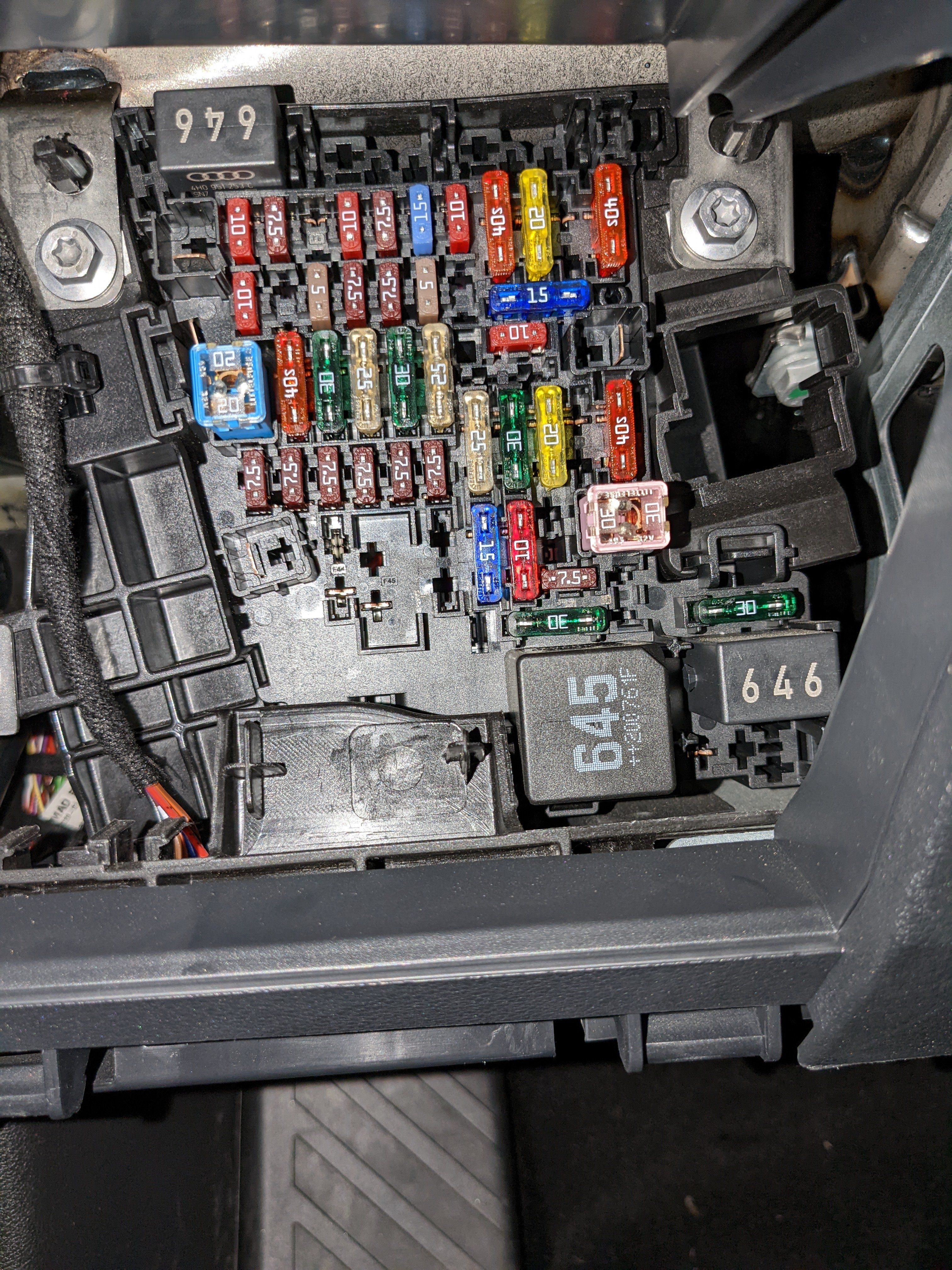
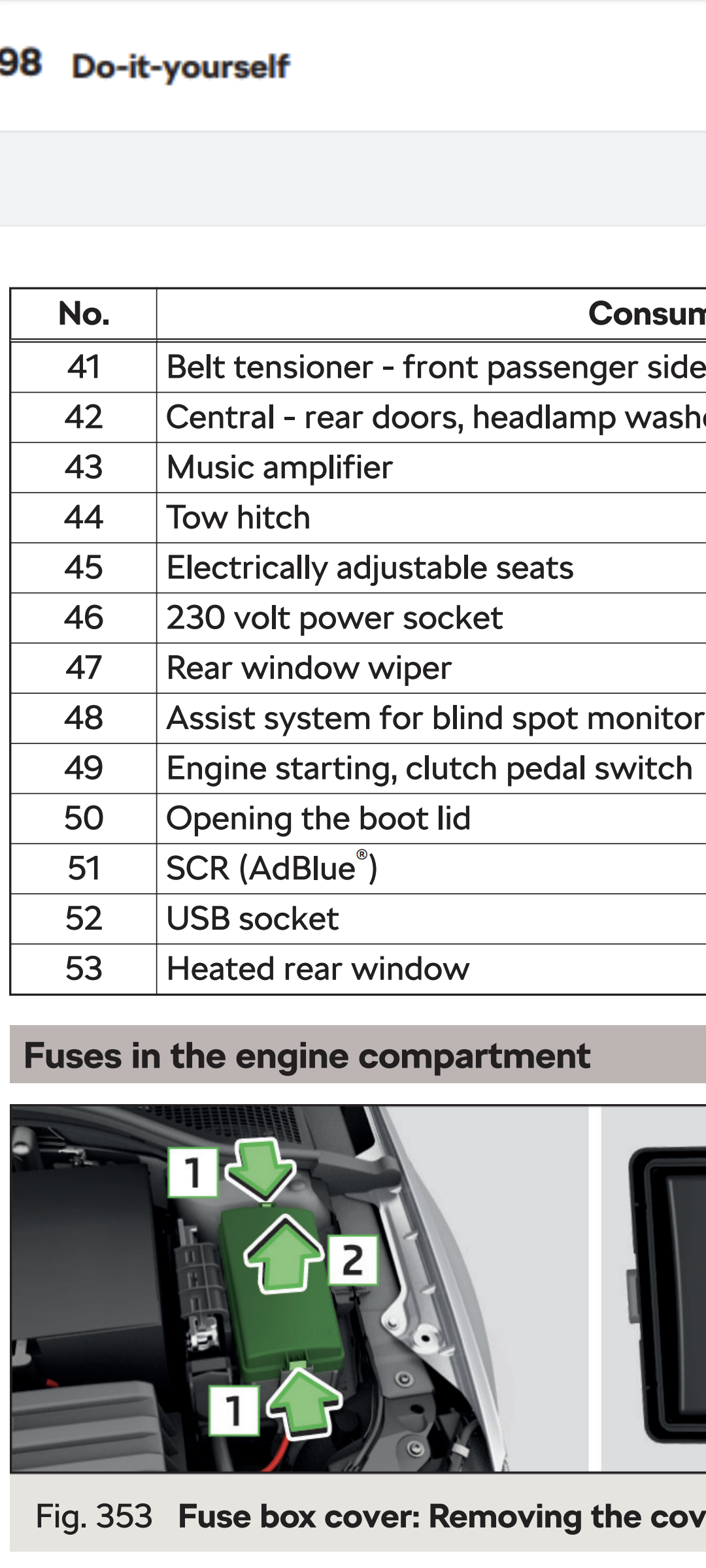
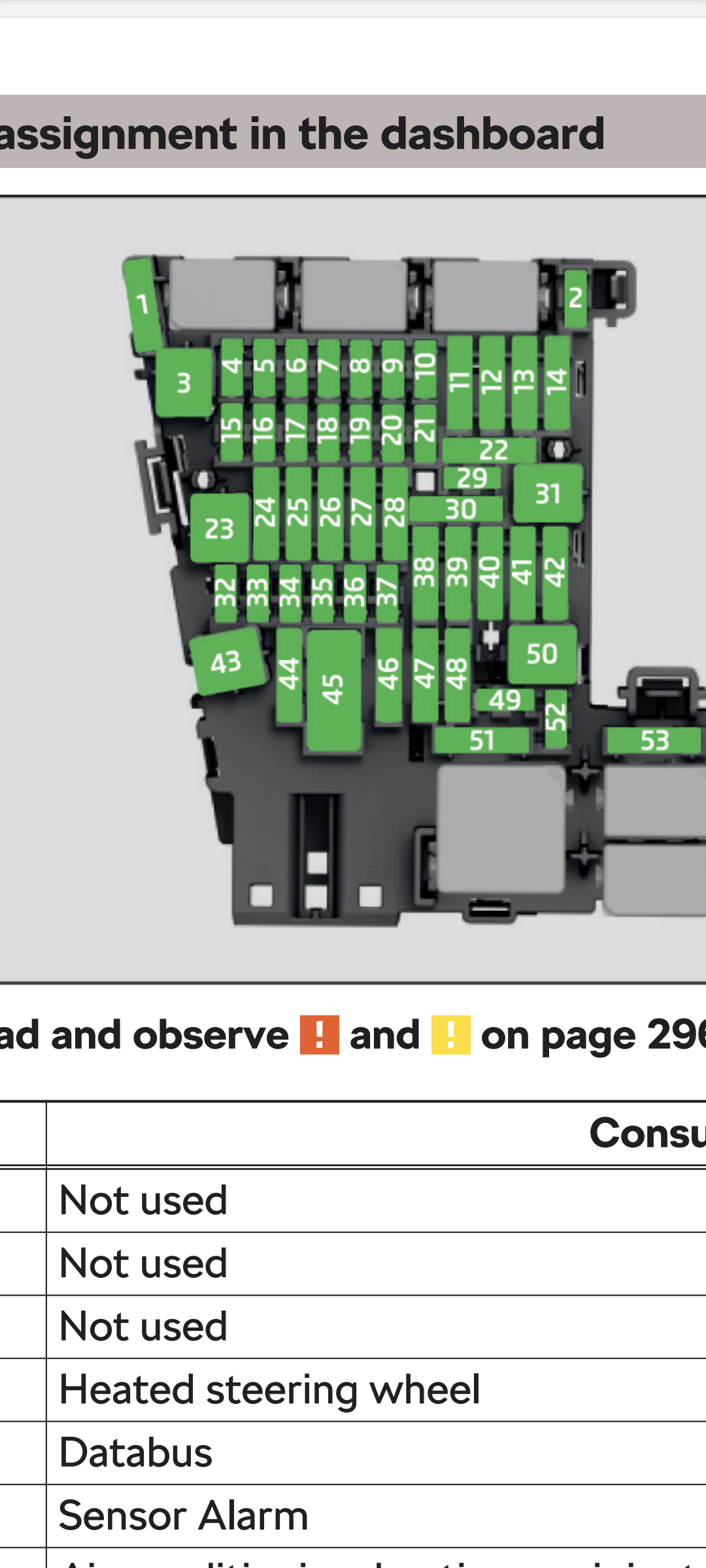
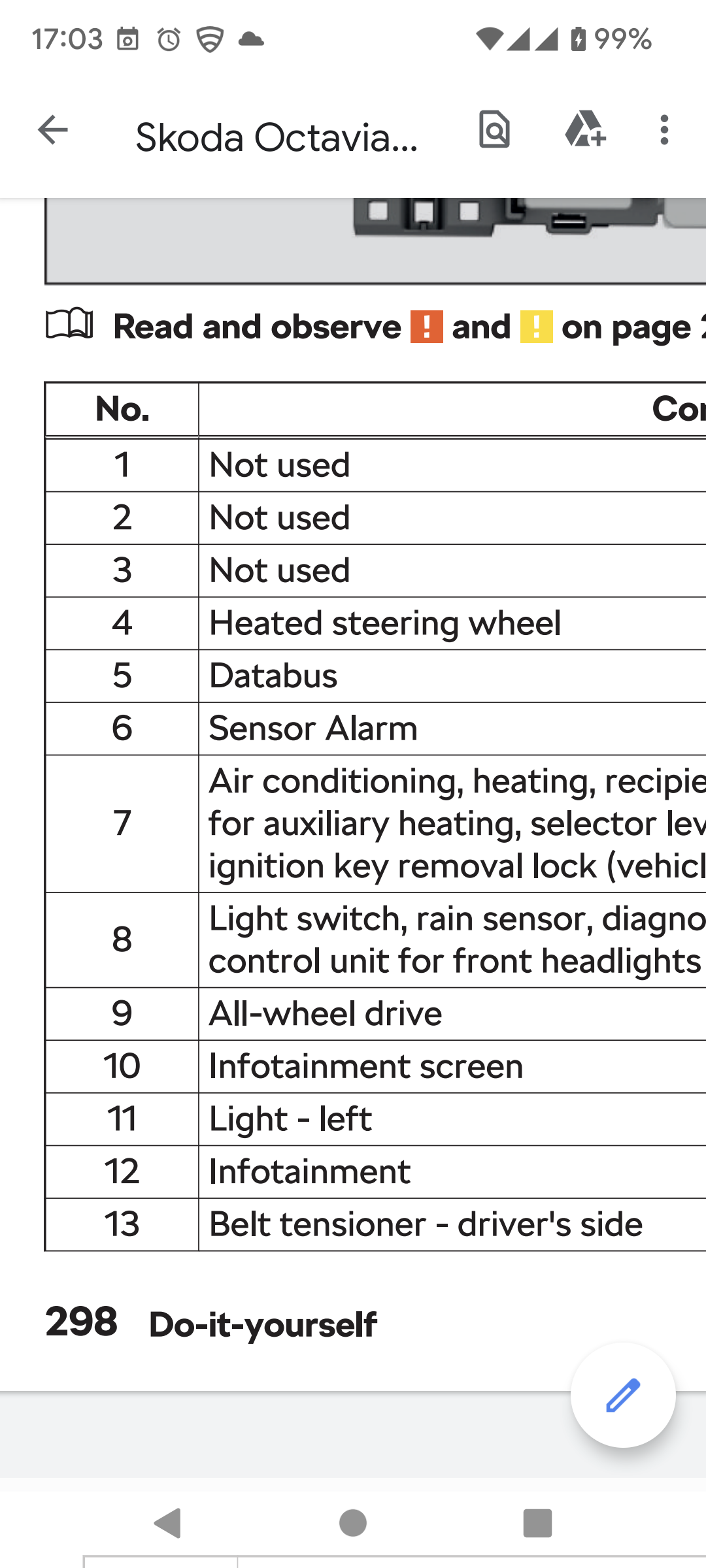
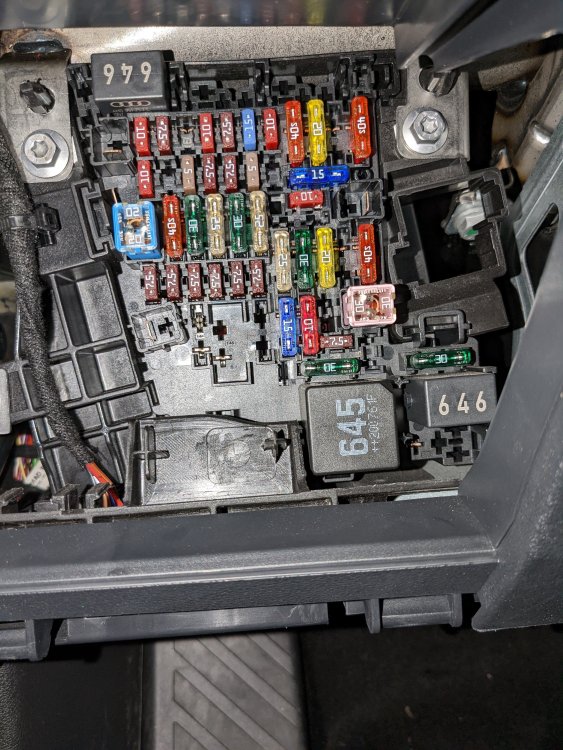
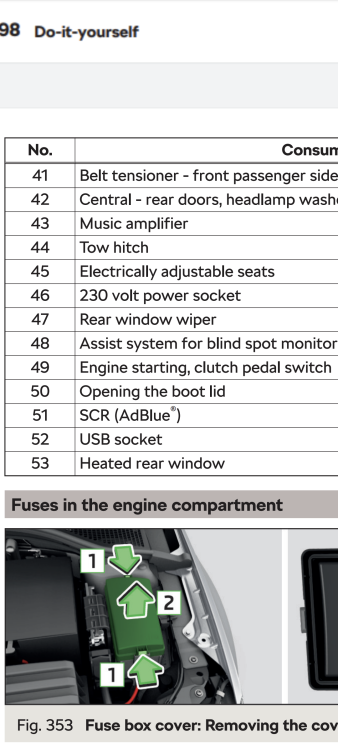
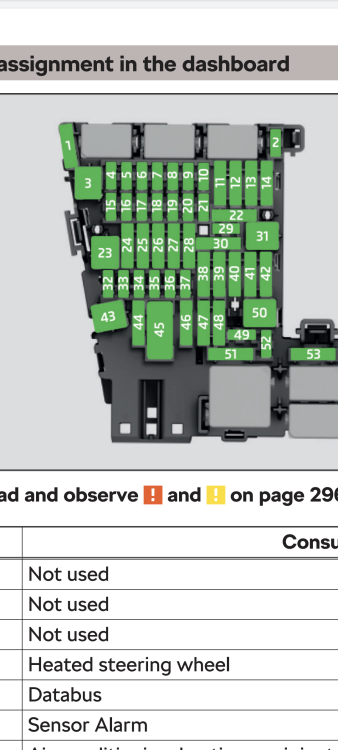
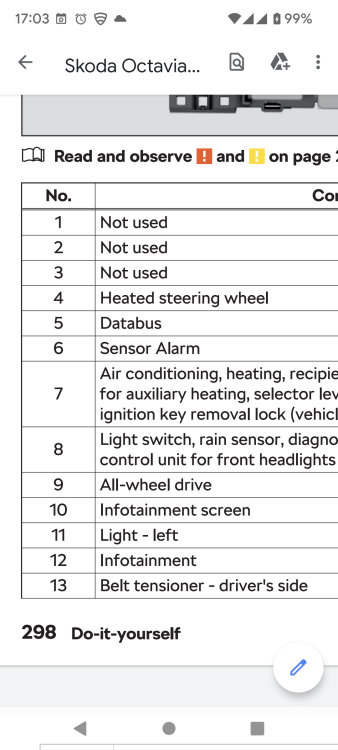
Background: Recently, the "12V socket" fuse (fuse 40 in the fuse box at the driver's knee) blew in my 2020 Octavia (MkIII) combi Scout (2.0TDI DSG-7). I'm not sure exactly when that happened. I'd had a 12V car cooler plugged in to the auxiliary 12V socket in the cargo area, and maybe also a typical USB car cigarette lighter charger plugged in in the centre console. The car cooler's plug has a 6A fuse in it, so the max it could draw should be 72W; not sure about the USB charger, but I think the two USB sockets on it are labeled 1A and 2.1A (and at most only one of the two ports was in use), so it's draw shouldn't exceed 11W. Total 83W. Even plus margin or minor surges, way beneath the 20A fuse that had been in fuse slot 40. Whatever, stuff happens. I didn't have any spare fuses at the time, so I pulled the 15A fuse from the tow hitch (fuse slot 44) which we weren't going to be using on that trip, plugged it into fuse slot 40, and it blew instantly. (The centre console port was NOT occupied at that time; the car cooler's plug WAS still plugged in in the back though the cooler itself wasn't attached). I drove back from France to Spain with both fuses out. I took the car to a local dealer here in Barcelona to ask them to look into the electrical system; they say they tested, didn't find anything wrong, and just put in a new 20A fuse. I later went looking to see if maybe the 12V socket in the cargo area could short when something is plugged into it, (literally, in the act of pushing the plug into the socket), because I've noticed that the "wall" of the cargo area into which this socket is embedded is rather flexible. I pulled the fuse, set my multimeter on impedance, held the probes on the tip and the ring of the socket, and flexed the wall - nothing. I put the fuse back in, plugged in the USB adapter and also the plug from the car cooler, all good. And then I noticed, the shop had not replaced the fuse from fuse slot 44. And I also noticed that both fuse slots 13 and 41 (belt tensioner - driver's side, and belt tensioner - front passenger side) are empty. I searched for "belt tensioner" and "octavia", "vw", "vag", and came up with a bunch of engine component stuff, and some references to a seatbelt pre-tensioner as part of the airbag system, but nothing to help me understand whether my car actually ever used those fuses. (A manual pull test on the two front seatbelts finds that, purely mechanically, they'll grab if pulled abruptly). I have the technical maintenance/repair manuals for the car; I only find the brief descriptions of how to repair components - nothing about whether those fuses are in-use. Anyone know? Does a 2020 (last of the MkIII) Octavia combi use fuses 13 and 41, "belt tensioner"s ? If so, what amperage should they be? (I found numbers ranging from 10A to 40A depending on car models, but none of those pages were specific to the Octavia MkIII). thanks,
-
Hey @roottoot Heh, you and I should sit down and have a beer/wine together. We obviously are of a mind 😅 *SIGH* I dunno, maybe there's a European, or per-State national automotive safety administration that wants to hear these things from us? (I live in Spain, for what it's worth). regards, -Jay
-
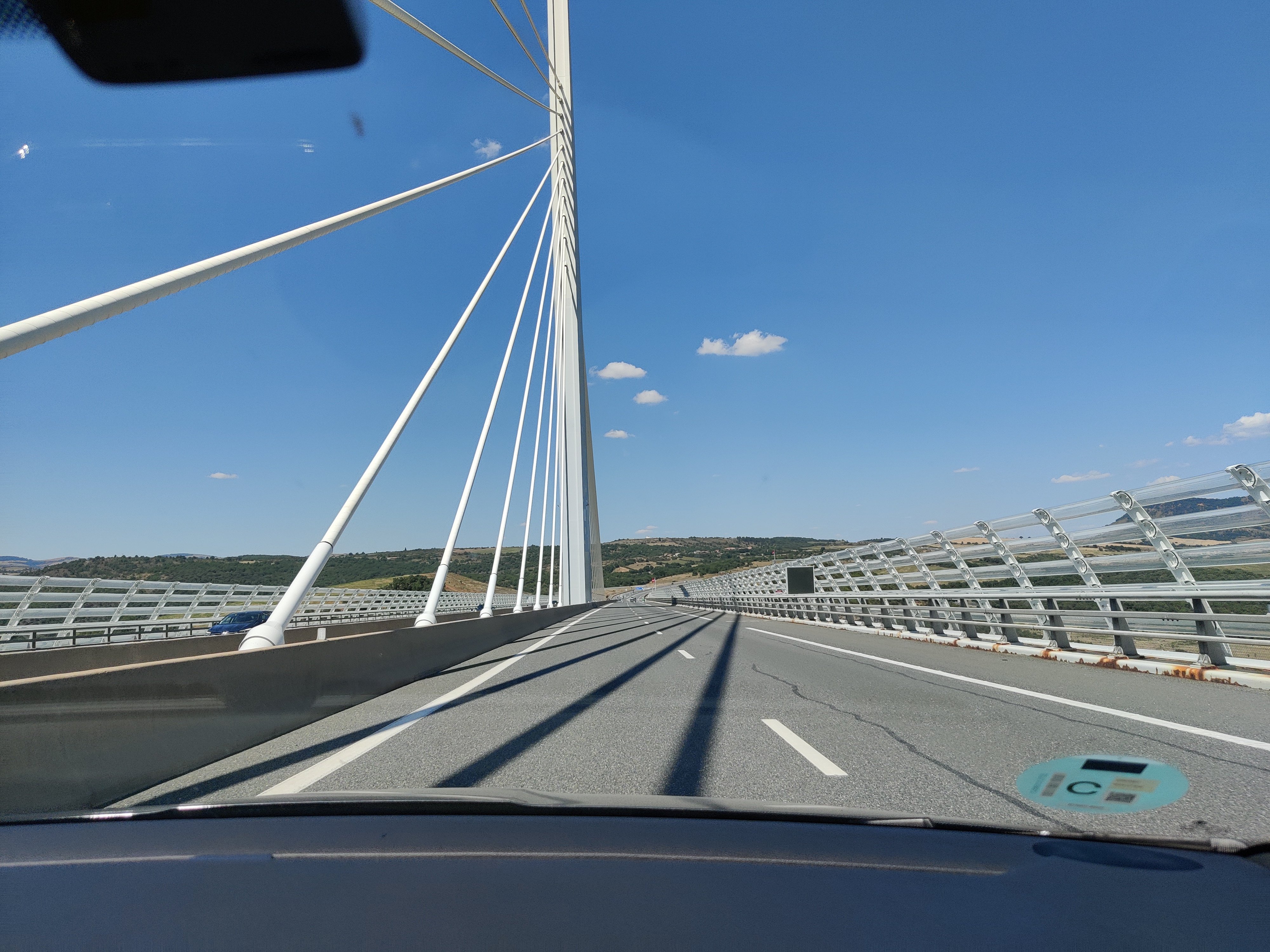
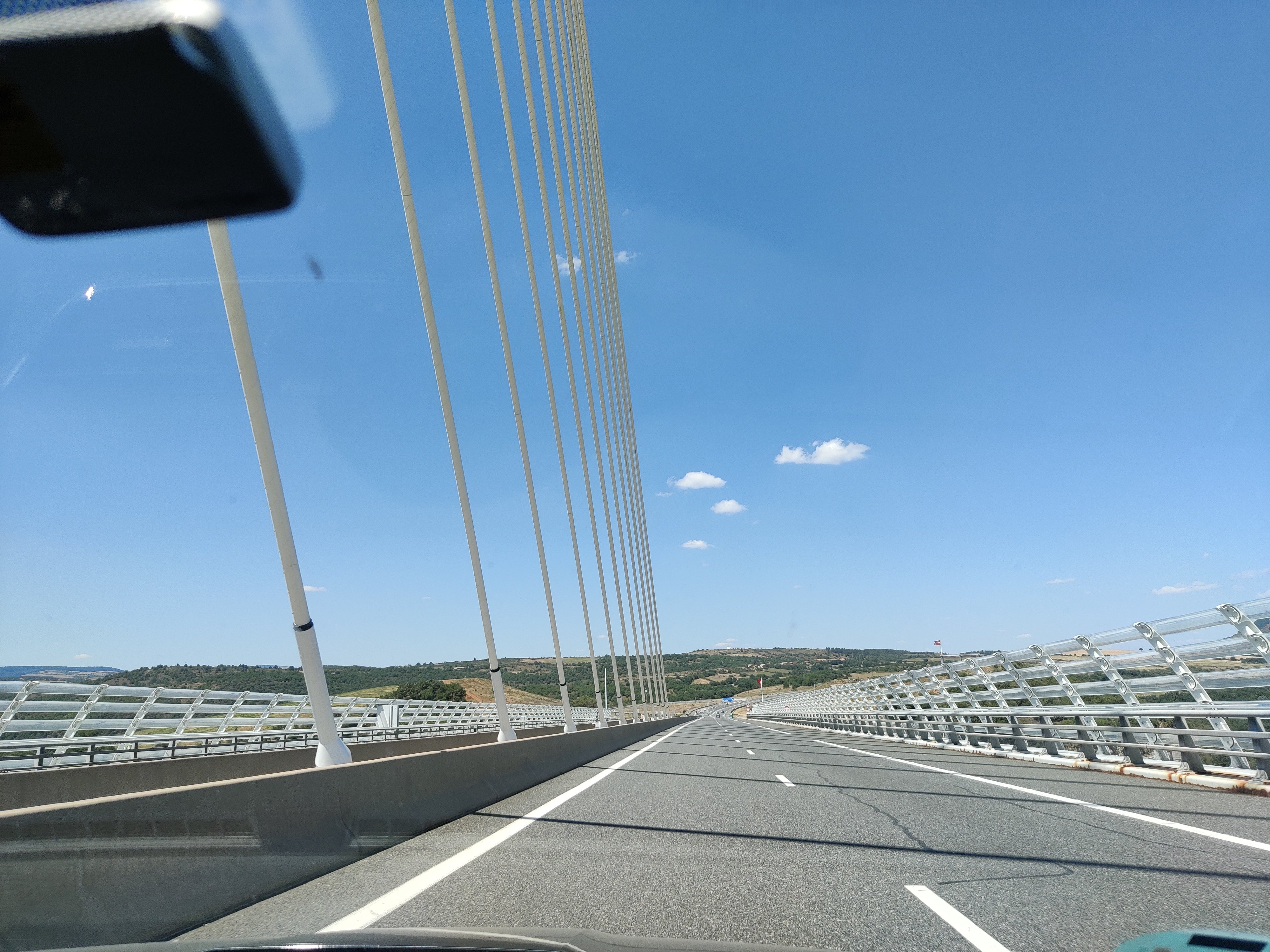
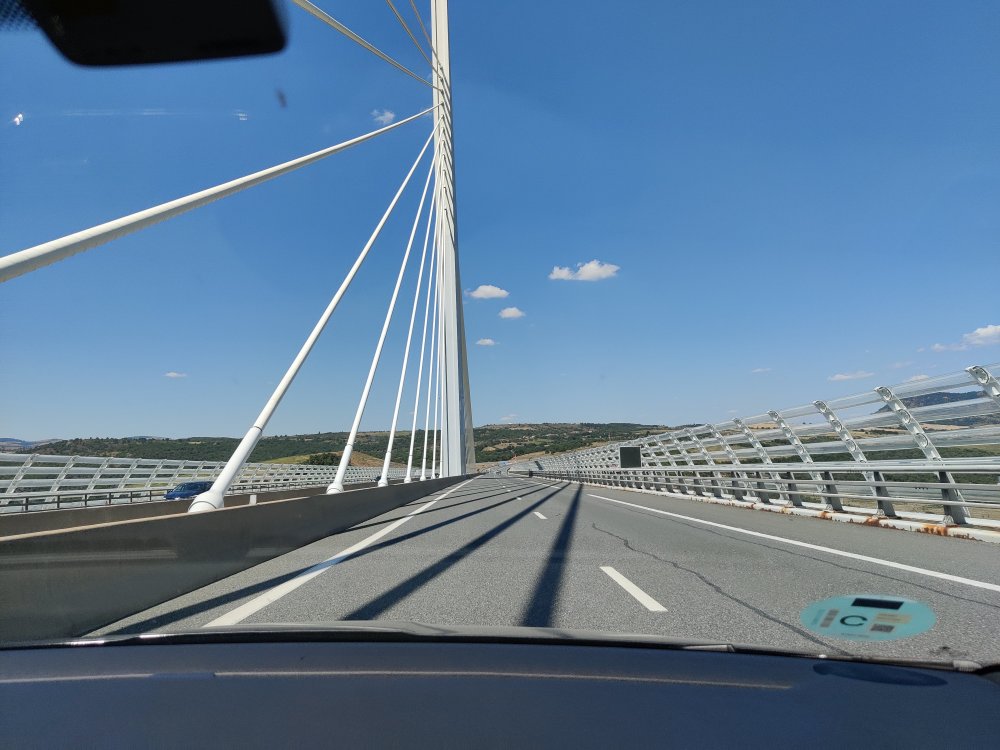
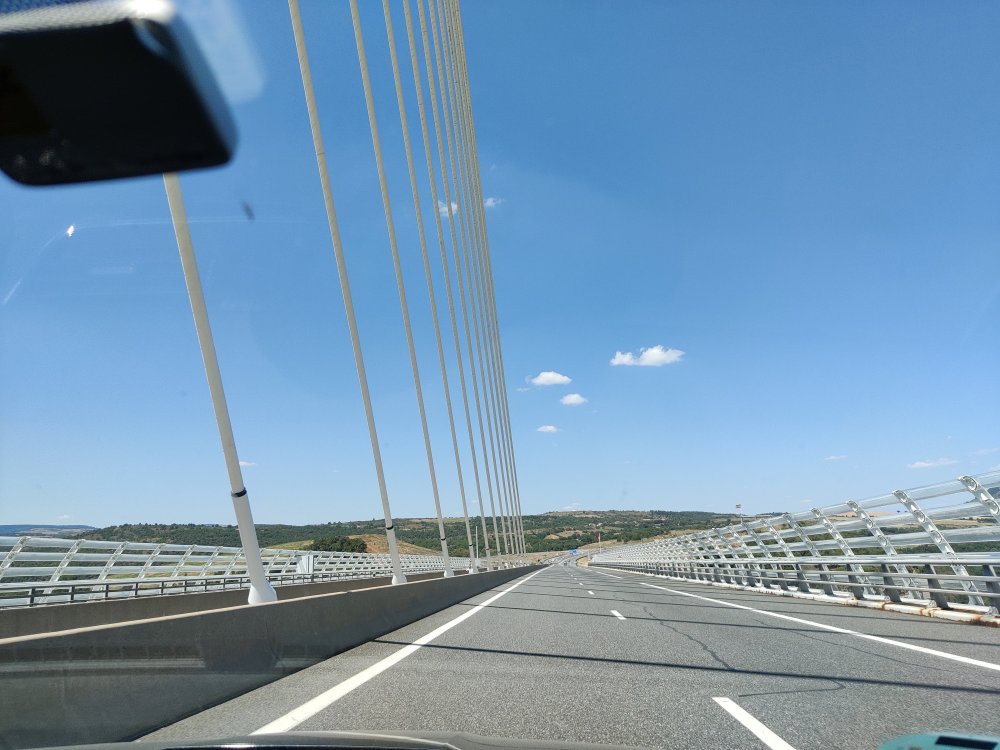
I recently drove across the famous Viaduc de Millau (https://en.wikipedia.org/wiki/Millau_Viaduct) in my 2020 Octavia (MkIII). It has the lane keeping assistant (LKA) which I keep enabled. It was badly confused by the shadows from this beautiful bridge's many and varying support cables, see pictures attached. The LKA sometimes tried to drag me to the right out of my current lane, and sometimes to the left. Do Skoda/ VAG care to know about these things? How could we advise them of these failures of safety systems? (I have told my dealership about the reliable false positives of the "collision imminent" warning system on the mountain road near my home; I'm uncertain whether they care/ whether they have a way to tell the brand/ whether the brand cares). I'm all in favor of enhanced safety systems in cars (since, as all of us know, everyone else on the road is a worse driver than we are 😁) .. but, the systems really do have to work "well enough". A LKA that actively tries to drag the car out of lane, pretty much ever, probably doesn't qualify as working "well enough". thanks,
-
Thanks both @EnterName (😆) and @threadbear. I agree with these in principle. Insurance is always a risk/reward gamble. We buy health and home insurance because the costs would not be bearable for most people. Car repairs - even fairly major (like an engine or a transmission) would be bearable for us .. but, still, if we have the feeling (and, especially, if statistics suggest to us) that we're likely to "win" that insurance "gamble", we also don't mind putting the (hopefully, in the end, net-less) money down up front. The problem, of course, is that it's quite hard to know the answer to "Will a 2020 car likely need a really major repair before 2029" until lots of 2020 cars start approaching 2029 🙂 @threadbear which year and model do you have (now at 6 years and 62000 miles)? thanks again
-
Extended warranties have of course been discussed to no end. I almost never buy extended warranties on anything. Having bought my Skoda Octavia combi Scout (last of the MkIII, 2020 model year, delivered in September 2020, 2.0TDI DSG-7, Haldex 4x4) and seeing the enormous complexity in modern cars, I wonder. (There's just so much more than can fail, and everything is more complex - and therefore more expensive). I did not take out "Longdrive" nor any extended warranty when I originally bought the car new. I follow scheduled maintenance scrupulously and take good care of my cars. The only real reason that I'm considering an extended warranty now is that, at 32000km and a bit less than two years (the statutory warranty here in Spain is two years and something like 50000km) the transmission has developed an intermittent "clack" when gradually descending the gears. Of course, I'm taking it to the shop (under warranty), and we'll see what they say, and I shouldn't end up out of pocket for this. But if anything at all is happening to the transmission at this young age which it totally shouldn't, (I drive my cars gently, mostly on highway, but I do also use my Scout as a Scout - on unpaved sometimes steep, somewhat rough roads), then I begin to worry that something expensive might happen in the few years following the end of the statutory warranty. The offer the VW Financial Services here in Spain make for an extended warranty on this car (starting from the end of the statutory warranty at the end of the initial two years) is either: * Everything (other than wear & tear or abuse) for years 3-5, then "functional" things for years 6-8, then only major mechanical in years 9-10; for €28,53/month same price for up to the whole eight years during which this is buyable; or * Major mechanical only, for €23,43/month. * (There's also an intermediate step which is the "functional" level from year 3 rather than the "total" level for years 3-5) The ultimate limitation on this extended warranty is that they'll never pay more to repair something than the write-off value of the vehicle; they declare the write-off value to be €2000 at 200000Km (I drive less than 20000Km/year, and I found a used car value for a representatively similar vehicle at 7 years and 130000km of around €9000, so if the engine went in the last year I'd still expect it the value of the car to be more than the cost of e.g. an engine replacement). So, concretely, for the Octavia Scout, 2020 model year, 2.0TDI engine, DSG-7, 4x4 Haldex, so far no major mechanical failures seem to have cropped up (like the 2013 water pump thing, and I forget what year but some kind of dry lube in the gearbox 2-3 years earlier?) ... do you think that the approximately €2500 (over eight years) extended warranty cost is worth the gamble against a single Really Big Repair during the first decade of the car's life? (I tend to keep cars for 10+ years and closing in on 200000Km). many thanks,
-
Thanks to this other thread ( https://www.briskoda.net/forums/topic/299252-enabling-boot-closing-from-keyfob-and-interior-button-using-vcds/) which got me in-cabin and remote-fob button-closing of the rear lid. Looking through the Adaptations of the Deck Lid section (I have OBDEleven), I see a few other settings which raise my curiosity; I wonder if anyone can explain what these do? "Close rear lid" "Comfort closing" (and "Comfort opening") (several ..) "when changing terminal" "Characteristics in production mode" "Close using remote control, end when leaving the immediate area" thanks, -Jay
-
There have been a few threads here that talk around this topic, and one or two comments that hit my desire straight on. (2020 model year, manufactured April 2020, Octavia Scout 2.0TDI DSG7 all wheel drive) Here are past threads related: https://www.briskoda.net/forums/topic/398017-octavia-3-driving-modes/page/2/?tab=comments#comment-5010289 (this specific comment in the thread asks exactly my question) https://www.briskoda.net/forums/topic/391746-fuel-consumption-in-normal-eco/?tab=comments#comment-4555644 (this one makes an important point about the limits of "Eco") https://www.briskoda.net/forums/topic/455164-driving-mode-effects/ https://www.briskoda.net/forums/topic/441173-sport-mode-never-worked/ My quip/question: In Eco mode, the throttle response is BOTH set to "push through more range to accelerate the same amount" AND "push MUCH farther BEFORE the throttle responds AT ALL". That's annoying. If I'm in Eco mode and I decide to accelerate ~5kph to gently pass someone, I have to push the pedal so far before the car begins to respond at all that it feels unnatural, and even after 18 months and 25000km I still have the tendency to not push/ not hold the accelerator far enough down for it to respond/ stay at the slightly higher speed that I want than where I have the ACC set to. So, I'd like to program the throttle to have the same initial response (that is, to have to push through rather little distance before it begins to feed more fuel to the engine) in all driving modes, while retaining the tighter or more relaxed (shorter or longer) range through which to push the accelerator pedal to achieve a particular total acceleration. That's definitely not a feature of the Individual mode configurability in my car, which has only "Drive: Eco/Normal/Sport" which links together the two different aspects of the accelerator pedal as discussed above. Is there e.g. an OBDEleven/OCDS programmable setting to tweak how far you have to press down on the pedal before it begins to respond, separate from [mode-based how much farther to push the pedal to achieve a given amount of acceleration, and also what RPMs it favors/ when it is programmed to shift down/up]? Not part of my question, just summarising some things I've seen in other threads and comparing to my experience, the Eco mode, if you're driving on gently rolling or flat roads, with no traffic to speak of, and you're staying below about 100kph (sorry UK folks, continental Europe "liters/100km" car here... 😅), then Eco's preference to rev lower and nearly lug the engine, and downshift only when it's really losing speed up a hill, might save a little bit of fuel. But the way it actually works, and my impatience to lose up to 5kph slowly decelerating up hills (one of my big pet peeves is drivers who don't maintain a consistent speed across rolling terrain, as it causes my ACC to get angry. Okay, it causes me to be annoyed; I'm not sure that my ACC gives a ****). At full highway speeds e.g. French autoroutes and German autobahn at 130kph (and more) my 2.0TDI DSG7 is always in 7th gear and near or above 2000rpm, so Eco mode can't do anything to save fuel unless I end up in dense traffic at lower speeds with plenty of opportunity for Eco's more relaxed ACC acceleration setting to have any effect. Aside, I've noticed that above about 110kph my fuel burn goes significantly up; the sweet spot is 90kph-100kph, which would add 20%+ to my cross-continent drives on 139kph roads, so, not going to do that... thanks, -Jay
-
The manual for my car mentions, for those cars which have a 230V socket (mine does not), that it will be shut off if the battery gets low. It doesn't say that about the cigarette lighter/ 12V sockets. It doesn't differentiate between the 12V socket on the console and the auxiliary 12V socket in the cargo area. It would be nice to be able to find an actual statement from the manufacturer.
-
Hey @PetrolDave, you note that the Battery Management System will turn off the cigarette lighter is the car battery voltage gets too low. I'm pretty sure that I read (for my April 2020 Octavia MkIII, anyway) that the cigarette lighter plug (particularly, the auxiliary plug in the cargo area of the wagon) actually can drain the car's battery to dead. Maybe VW/Audi branded vehicles have more protection, but we Skoda-ites get a little less?
-
Nope, nothing. And I completely forgot to ask the dealer about it when I took my car in for a pre-long-drive quick once-over.
-
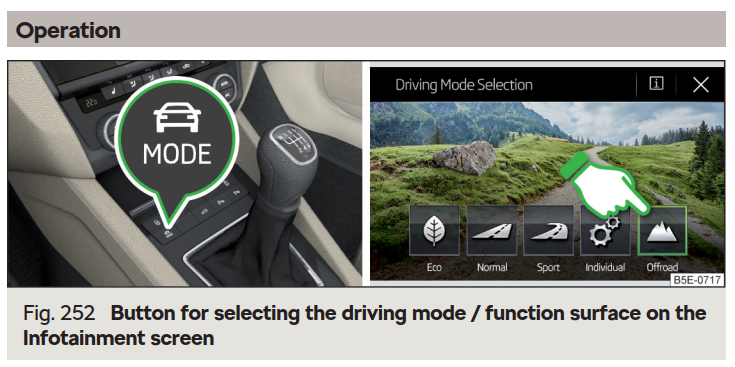
(I'm the OP) My 2020 Scout has Off-road as a selectable mode (Eco, Normal/Drive, Eco, Off-road) on the infotainment panel screen which appears when I press the physical Mode button: I observe (see details below) that Off-road mode actually makes the car in some senses LESS "sensitive", as it explicitly allows a bit more wheel slip, in order to avoid the anti-whatever systems making the car completely unable to move in the case where lots of stuff is sliding all over the place under the wheels. I've driven my 2020 Scout up a moderately rutted snow, slush, and some ice covered mountain road, in normal drive mode, several times. I routinely drive on dirt roads (nothing too spectacular, though at times the 4x4 has given me the ability to pass where a front-wheel drive car might have had difficulty, and I appreciate those extra 3cm of ground clearance). I've not even bothered to turn on Off-road mode since the very first months after I got the car new and was playing with it. The manual says: The following functions are integrated into Offroad mode. ▶ Hill descent assistant ▶ ESC Offroad ▶ ASR Offroad ▶ EDS Offroad ▶ ABS Offroad Hill Descent Assist The hill descent assistant (hereinafter referred to as assist system), with its automatic braking action on all wheels, ensures a constant speed is maintained on a steep slope when driving forwards and reversing. During an intervention, the white warning light in the instrument cluster lights up. The assist system is automatically engaged under the following conditions: * The engine is running. * For vehicles with Manual transmission the shift lever is in the neutral position and or the 1st, 2nd, 3rd gear, or reverse gear is engaged. * On vehicles with an automatic transmission, the selector lever is in the R, N, D/S position or in the Tiptronic position. * The downhill gradient is at least 10 % (when driving over sleepers, the limit can briefly drop to 8 %). * Neither the accelerator nor the brake pedal is pressed. Driving speed Initiate the downhill descent at a reasonable speed of approx. 2 - 30 km/h, the assist system constantly maintains this speed as you travel downhill. If a forwards or reverse gear is engaged on vehicles with a manual transmission, the speed must be high enough to avoid “stalling the engine”. The driving speed can be changed by pressing the brake or accelerator pedal. This is true even if the shift lever is in the neutral position and the selector lever in the N position. Engagement of the assist system is resumed after the pedal is released. ESC Offroad ESC Offroad makes driving on dirt roads easier, as no ESC interventions occur when the vehicle is slightly over or under steered. ASR Offroad TCS Offroad makes starting and driving on an unpaved surface easier as it partially allows wheel-spin. Note When disabled, TCS » page 211 Offroad mode works without the support of TCS Offroad. (The manual doesn't explain why the section is called "ASR" but the text of the section use "TCS". I suppose that TCS is Traction Control System. I guess that ASR is Anti-Skid somethingoranother. I guess they're equivalent?) EDS Offroad EDS Offroad supports the driver when driving on a surface with different grip under the drive wheels or when driving over bumps. A spinning wheel or wheels are braked earlier and with more force than with the intervention of the standard EDS system. ABS Offroad ABS Offroad supports the driver when braking on an unpaved surface (e.g. gravel, snow etc.). The system generated by a controlled locking of the wheels braked wheel before a “wedge” of piled material, which shortens the braking distance. Maximum system efficiency is achieved when the front wheels are in the straight ahead position.
-
Ah. Yes. That would fatally suck. And, in any case, I agree, there should be a manual backup method to start the car with a correct physical key despite the total failure of the fob circuitry, similar to limp mode for AdBlue Diesels. For technology (including security) to put the car driver in a potentially dangerous situation is not acceptable. -Jay
-
In this case, was the key fob totally dead, or just the battery in the key fob was dead? It seems that some of our number here have been able to get past a dead key fob battery by leveraging the RFID inducer in the start button (powered by the car battery). That should work even with the car alarm sounding (or, in my case, as my car has no alarm, just the immobiliser activated).
-
@TheWanderer ouch, 1.15am ... I wonder how well the local auto club (I'm in Spain) would handle this. I don't have Skoda Assist or any kind of extra Skoda services, just the stock 2-year warranty (which will end in Sept 2022). Though, hopefully, now that I know that it should be possible to start the car by pressing the start button with the battery-dead keyfob, I should never need the assist.... 🤞
-
Just happened to me. 16 months old new-bought 2020 Octavia Scout. I don't drive regularly, and the key is kept much farther away from the car than can possibly reach, so when the car is parked, the key is completely out of contact. No low-battery warning at all. No "have to be close for the car to unlock". Just worked fine this morning, and then this afternoon on returning to the parked car from a bicycle ride, temperature 4°C and falling, getting dark, the key fob is totally dead. I was lucky; a nearby restaurant's waiter had a pocketknife (I normally carry one, but not on the bicycle ride!) which made it possible to extract the battery (the battery in my car model's key fob is stuck in there too strongly for anything but a metal flat screwdriver or similar to remove it - we tried fingernails, plastic, even a metal wire), and even more fortunately I happen to keep extra CR2032 batteries on my bicycle because my bicycle computer uses them. If it hadn't been for that, I'd have been stuck out there in the cold dark waiting for the auto club or a taxi! I'm rather disappointed that the system gave no warning, and that when the key fob dies, it is impossible to start the car. (Or, is it possible to emergency start the car somehow?)
-
BTW, since the UK market cars step up/down by 5MPH (about 8km/hr), it's not absolutely fixed .. but it might be not-codeable and linked to units selection (and I'm not going to switch my car into English units here in southern Europe 😅).
-
Interesting. The only setting for ACC in my car is the following distance (close, medium, and far). Nothing at all about Normal/ Sport/ Eco for ACC. (And far, unfortunately, at least here on the Mediterranean, should really be "encourage every *sshole on the road to jump into the nice, safe, large gap in front of you, making your car constantly brake...). Normal/ Sport/ Eco (and/ Offroad) are available in my car as the driving modes, which does affect ACC as @CptSeasick describes, although I wouldn't call the car's behavior in Normal mode aggressive (it will vary by 1-2 km/hr and sometimes lag a little bit in coming back up to speed up a hill if the engine RPM is low and requires a shift down to a lower gear, but maybe that's just because I've got the diesel which really prefers to run low RPMs unless it's in Sport mode). As you surmise @CptSeasick in Sport mode ACC can be quite aggressive in coming up to a new speed (either when you bump the ACC control stalk +10km/hr, or for example resuming after manually slowing down e.g. for a toll; for a moderately heavy diesel the 2.0TDI 184cV can definitely kick). But, still, really, what I want is that smaller step +/- 5km/hr instead of 10. It's curious, with so many other things being computer controlled and easily modified, that this doesn't seem to be one of them 😞
-
Hi @PetrolDave, I'm not sure I understand. You mention the "mode" of the ACC. I know that cruise control can be set to either speed limiter (must keep the accelerator pedal pressed) or cruise control (car maintains speed with your foot off of the pedal). But that "mode" selection wouldn't seem related. My ask would apply to both modes, because it's just a matter of changing the speed step size from 10km/hr to 5km/hr for each up or down press of the ACC stalk. Could you clarify please what you mean about setting the ACC mode? thanks,
-
Thanks Cakemonster. Yes, I know; I use those features all the time. I'd really like to have +/- 5km/hr instead of +/- 10km/hr. And/or to be able to configure the car to more gently reach the jumped speed target; going up the car tends to surge a little (even in normal Drive mode; I'd expect that in Sport, but in Drive it should be smoother); going down the car tends to hit the brakes a little harder than it needs to.
-
I have a 2020 (last of the MkIII) Octavia with Adaptive Cruise Control. I use it frequently. One thing that I don't like about it though is that the up/down step of the ACC stalk is in 10km/hr increments. Can this be reconfigured to be in 5km/hr increments? (I have an OBDEleven, if that helps). thanks,
-
Right. My hope had been that the wind deflectors would make the car sufficiently less aerodynamic to reduce the noise 🙂 I'm actually scratching my head wondering what the point of these wind deflectors is, then, since they don't seem to actually deflect the wind....
-
Oh, well. I bought a set of Heko wind deflectors and tested them this past weekend. They do .. nothing. I'm returning them (and giving up).
-
I'm not sure I understand. If I get "safe lock" right, that's the ability to open a door from the inside (by default) unless the remote key fob lock button has been pressed twice, right? I'm happy with safe lock. I have no children nor pets, and I agree that it should generally be possible to escape the vehicle from the inside without having to explicitly unlock the door first. So, yes, maybe Safe Lock is involved in the logic that results in the 'game' of "All doors are locked light on the lock-all-doors button goes out, now guess which doors are still locked"... I still wonder whether it's even possible for it to make more sense (without adding more lights/ light colors on the lock-all-doors button, or some other kind of rather obvious indication).
-
Hi @paulski, I have auto-lock/ auto-unlock turned off. I don't particularly like the car locking automatically, and I especially don't like it ever unlocking automatically. So, yes, per my preferences, I do need to use the lock-all/unlock-all button. thanks, Jay