



weasley
Members
-
Joined
-
Last visited
Everything posted by weasley
-
I remember my dad’s 1978 Chrysler Alpine did this - I always wondered why modern hatchbacks didn’t do it.
-
-
To add some background info (for interest but not specifically to answer the question asked) - it is called the "reductant" pump because it is pumping a fluid that is used as a reductant in a chemical reaction. The emissions system this works with is called the "selective catalytic reduction" system, or SCR. In chemistry (in basic terms) "reduction" is the opposite of "oxidation". What the SCR is doing is reducing the levels of NOx (or nitrogen oxides) in the exhaust gasses. The NOx has been formed by the oxidation of nitrogen in the air during the combustion process. The SCR effectively undoes this, by "reducing" the NOx back to nitrogen and oxygen. It does this through the use of a catalyst (the box in the exhaust) and a "reductant"; a chemical reagent used to perform the reduction of NOx. Ideally what you need is ammonia (NH3) but this is a hazardous chemical to handle and carry around so a solution of urea dissolved in water is used - this is known colloquially as "AdBlue", although AdBlue is actually a trade name and the generic terms is "diesel exhaust fluid", or DEF. The urea breaks down to form ammonia in the exhaust which then reduces the NOx to nitrogen and water (plus a bit of CO2). Hence you need a reductant pump and an injector to spray this stuff into the exhaust stream so that the SCR can do its job and we all get to breathe slightly less toxic air. If the pump is not working then the SCR is not working so your emissions will be higher than they should be. It doesn't stop the engine from working per se, but in some cases a car's ECU will either limp or even shut down to prevent high emissions, which may be a requirement of the type approval and qualification.
-
A quick look in the fusebox will tell you if there is any towing wiring fitted - the fuses for towing will be in place if so, or missing if not. Towbar prep also came with the bumper cut-out in place (or it did on my pre-FL SE).
-
Scuffing/rumbling was one of the symptoms we had when the clutch finger spring failed and machined the inside of the bell housing.
-
You can read about how I discovered all this here.
-
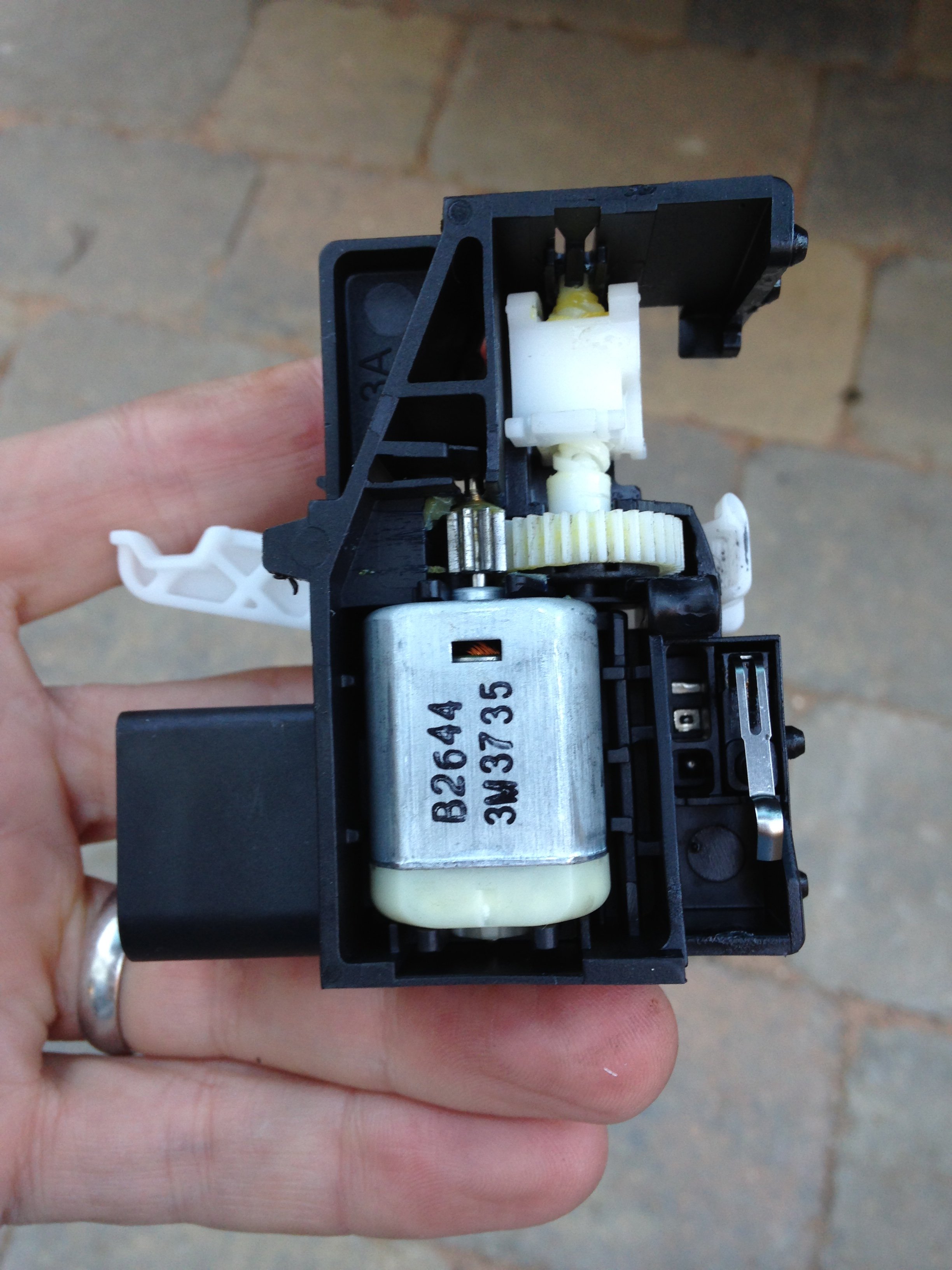
It’s a screw-linear actuator- the motor turns the gear, which has a worm gear type of shaft, which moves the white plastic block up, which pushes on the latch to pop it open. The motor only turns a few revs until the plastic block reaches the end of its travel. When power is released the mechanism rewinds back to the beginning. The characteristic symptom of a failed unit is a ‘drilling’ sound when trying to use it, as the motor keeps spinning.
-
If it helps, this is what it looks like inside. The white plastic lever is the emergency release. The plastic shaft from the gear on the right can shear, leaving the unit unserviceable (this is what happened to mine).
-
I just looked this up - in the description text of the product it claims: PRODUT [sic] SPECS ACEA A3/B4 (2012) ACEA C3 (Chemical limits differ) VW 504.00/507.00 BMW LL-04 MB 229.51 Porsche C30 Please check your service manual to find out which oil you need Let me break this down: ACEA A3/B4 (2012) - the latest version of the ACEA specs is 2016; you are not allowed to make claims against obsolete versions. Furthermore, in order to make an ACEA claim you are required by ACEA to be signed up to their code of practice - guess which company isn't signed up? Furthermore ACEA A3/B4 (2012) is incompatible with most of the other claimed specifications by virtue of having too high an ash level. ACEA C3 - same applies as above regarding code of practice signatory, but also the "(Chemical limits differ)" caveat is nonsense - the whole point of ACEA C3 is that the chemical limits differentiate it from other specifications; the limits are on ash, sulphur and phosphorus, which are important factors regarding DPFs - you can't simply disregard these limits. VW 504.00/507.00 - given the lack of compliance with fundamental industry specifications (ACEA), I find it unlikely that they hold a VW approval (also see @Kenny R's list above). 504.00/507.00 requires that the oil meets ACEA C3 (in its entirety). BMW LL-04 - again unlikely; BMW LL-04 requires an oil to meet ACEA C3 (2016) in full. Porsche C30 is equivalent to VW 504 00/507 00 so see above. MB 229.51 - this one we can verify by checking the Mercedes-Benz published list of approved oils (last updated 11 January 2021). As you'll see, no mention of Brit Oil (in fact no mention of them at all in any MB approval categories). Furthermore notice what MB themselves say (my bold): We recommend using only products which are: distinctly marked with the label indicating the approval of Mercedes-Benz, e.g. “MB-Approval 229.51”. Labels referring e.g. to “MB 229.51” don't have an approval of Mercedes-Benz. Which are listed in the current MB BeVo. Only listed products are tested and approved by Mercedes-Benz. MB229.51 demands chemical limits aligned with ACEA C3. I can't say whether the oil is actually good enough to meet these specs, but the above evidence is worth taking into consideration when making a choice. As I said earlier in this thread, I've never heard of them (well I have as a consequence of this thread, but that's it). My personal opinion: I wouldn't use it.
-
-
Fast idle also helps compensate for extra electrical load (heater fan, a/c, heated rear screen, heated mirrors, heated seats (if fitted), lights etc).
-
When I did mine the car had towbar prep so I only had to remove the trim in the boot to access the pre-fitted wiring loom. That was a bit awkward but not difficult - sorry, I don’t know about the front trim.
-
Id recommend you don’t do it when it’s cold as this will increase the chance of breakage. And if you’re fitting a towing module it’ll need coding to offer all of the features.
-
I came home tonight and the wife reported "I can't close the boot". Sure enough, it just bounced and pushing the 'open' button on the tailgate resulted in a brief 'drilling' sound. No amount of tapping, hitting, whacking, locking, unlocking or anything solved it. So I took the lower tailgate trim off (what a pain that is, but eased by an excellent diagram I found on this very forum) and discovered I don't have a socket suitable for getting the boot latch off. A dash to Halfords remedied that (it's a splined-drive type, but a T40 Torx undoes it) and so I got the latch off. It is a single unit comprising the latch and opening 'solenoid' which is sealed... but not sealed enough to stop me getting in! On disassembly I found that a plastic worm gear had sheared, which rendered the whole opening mechanism useless and had the unfortunate side effect of failing the latch in the 'open' state, hence the boot wouldn't shut. The 'solenoid' is actually a motor that turns a plastic worm gear; this worm gear slides a plastic.... slider.... along to pop the latch mechanism open. The motor stops when the slider reaches its limit and there is a spring that winds the gear back again when the motor stops applying torque. The drilling sound was this motor spinning the broken worm gear and grinding the broken parts together. The only solution is going to be a new latch unit... after posting this I will be trawling the 'Net for a part number and possible supplier. Failing that I'll have to call a dealer tomorrow. Until then I have managed to remove the broken worm gear, meaning the latch will close but we now can't open the boot without climbing in from the rear seats and operating the emergency unlock. At least it is secure and safe.