
wyx087
Resident Member
-
Joined
-
Last visited
Everything posted by wyx087
-
Remember, charging is as simple as plugging in (for some cars). Unlike petrol pump, don't need to wait for the refuel. So if you usually take 10min to do a quick loo stop and 5min to refuel, recharge is only 5min extra to leisurely stroll back from the loo. The famous Tebay queues reported during Christmas. A few months later, 8x 150 kW (v2 where power were shared between 2 stalls) were removed. Upgraded to 12x 250 kW v3 dedicated no power sharing stalls. https://teslamotorsclub.com/tmc/threads/uk-and-ireland-supercharger-site-news.91118/page-295#post-7632095 24 stalls on M25 near Heathrow T5: https://www.tesla.com/en_gb/findus?v=2&bounds=52.03664989336715%2C0.37566186914063326%2C50.9127711509502%2C-1.4068698691406167&zoom=10&filters=supercharger%2Cparty&location=heathrowsloughsupercharger And nearby Reading only had a single 2 stall location back in ~2019 when I was considering first wave of Model 3. Now has 3 locations, 4, 12, and 16 stalls.
-
It's more about numbers of charger. There's usually 12 pumps at petrol stations, with much lower numbers of EV's, we are already seeing 8-12 rapid charging stalls as standard by Tesla. The queues are growing pains, I'll just leave this early 1900's quote here: "In England the automobile comes into favour less rapidly than on the Continent. A London writer calls it “a fad, and an extremely dirty, dusty, uncomfortable fad,” and a nuisance on the public ways. He thinks it will be many years before “these crude, impracticable machines” displace in the Englishman’s affections “a fine trotting-horse and a smart trap.” No doubt the horse is here to stay, and no doubt the automobile is still in its clumsy beginning; but just wait a little, till the problem of a light and cheap storage-battery has been solved.” What have we heard from Mazda and Honda? the other big Japanese manufacturers. How well does Toyota's current pure EV function in comparison to current market leaders? That's where the sentiment came from.
-
Toyota lost its electrification edge by sitting on their hands, waiting for hydrogen. Most Japanese manufacturer seems to have similar belief about hydrogen fuel cells, thus were late to adopt battery electric. I personally wouldn't believe any "we'll have this new miracle breakthrough in mass production by year X" promises. Certainly not from a follower in the industry who obviously have a lot to loose, if people were to buy existing solutions that they don't have. The way I see it, any EV with 200 miles real world any weather is more than enough. We already have those and they can recharge back beyond 120 miles in under 20min while I go to the loo. Take a 30min breather and it's back to at least 160 miles, ready for another 2.5 - 3 hour drive. Do people seriously drive regularly 3+ hours non-stop? So yes, we are at tipping point right now, the cars and some charging network is ready.
-
This thread sums it up nicely: https://www.speakev.com/threads/panorama-bbc-right-now-20-00-12-06-new-hatchet-job-or-progressive-discussion.178097/
-
Was it due to better fuel economy? 'Cos in terms of local air quality, without DPF is certainly a big no-no. Totally agree. Unfortunately data often end up with companies who don't know how to manage it. Nissan, for example are not able to provide me with a way to download historic data as per GDPR for my old car, due to zero development for this old platform once sale stopped. I get the feeling many car company will handle software and data this way.
-
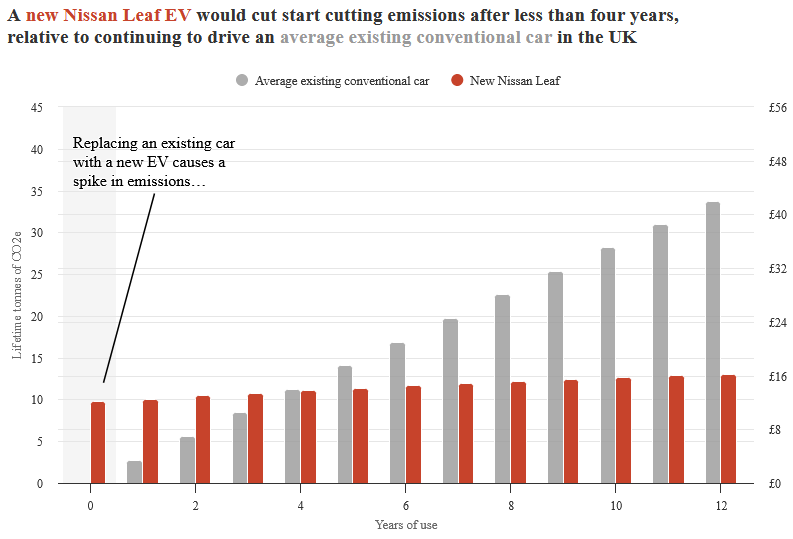
I find that very hard to believe. EV's generally break even to fossil fueled cars, accounting for EV production vs just fuel burnt in existing ICE cars, after 3-8 years over average mileage, variation is due to grid CO2 emissions. Here's where it was discussed a few days ago: I used to do that plan A/B/C and calculating distances when driving any distance with Nissan Leaf. I don't do it anymore, just quick glance at charge points near destination and rely on the car to route me to a supercharger if it thinks I may run low. Closer to home, I'd override it because arriving home at 10% is already too much, no need to use public chargers. Only commute times to/from work, and calendar entries. When getting in the car at appropriate times, the route to those destination are automatically loaded. Of course, you can turn those features off if you prefer. The fear of technology is more due to not knowing.....
-
Only surrounding area, can't make my son sit still for more than an hour or two. So we rarely need charging away from home. The cameras, etc. is no different between power trains. I think China already bans Tesla cars from visiting sensitive military/political area. Even if military use civilian airports, they wouldn't jam any signal without a good reason. Anti-drone system are more targeted, not jam-all. For bomb detection. Obviously the x-ray image will be different. But the principle should be the same: ignore car parts and look for problems.
-
https://www.ofcom.org.uk/spectrum/interference-enforcement/spectrum-offences/jammers#:~:text=It is a crime to,the Wireless Telegraphy Act 2006. Why would civilian airport, park&ride have GPS reception problem?
-
Unless due to physical blockage (mountains, in tunnels), GPS will just work when there is a large enough view to the sky (eg, at airports or park & ride). Only other explanation is jamming. I doubt airports, park & ride are actively jamming the signal. Civilian jammers are illegal, I think. Not working well around military base is possible due to jamming, but the jammer has to have a reason to be on. So vast majority of the time, it can be dependent upon to work well enough for car navigation. You got that right! Commuting is the worst imaginable activity. Sat-nav work to home was an example, I know the way very well, but just like many people, I still set the satnav to avoid traffic. Traffic are dynamic and turning into a junction after hitting traffic is already too late. On the way home, I can drive down M1 or M25, I need to know which way is the quickest before I get to the junction. I agree, sitting in the car setting up sat-nav is stupid. It should all be done from the phone before getting to the car. Again, that software experience.
-
So VW/Toyota end up like Nokia is all okay? Millions of jobs at risk due to changes of owners, all for it to end up making ultra-low end products. Or be supplier to a software company. I find the comparison apt. This change to power train is indeed evolve or die. From company culture at the top, right down to production line and to the way software integrates with user experience. Not much different to smart phones vs Blackberry. GPS doesn't work the same way as mobile signals. Only short sections of road with no GPS, eg tunnels, which vehicles are able to account for using wheel measurements.
-
Not having home charger seems to be the biggest source of problem. There's a lot less mucking about when driving EV's and recharge at home. I've visited public infrastructure probably around 5 times over last 8 months. All other times re-energising the car is not a consideration and no time is wasted on it. This push-back against "tech" is sad to see. Cars are driven by emotional beings that are often distracted. Yes, touchscreen have the potential to distract. But I'd take driving past a car with a good touch screen and assistive tech over a 1990's style basic car. The driver is usually the source of problem, having the assistive tech could potentially makes it safer. I think problem is often bad touch screens and bad UI. I try not to operate touch screen in my previous Octavia or Leaf while driving, the UI is bad and it's slow. Whereas I've no problem with quick presses on the Tesla. It's very responsive and most-used items are on the screen ready to be pressed, at worst it's 2 presses using muscle memory. Put it this way, how quick can you get in your car and start driving home after work, with sat-nav set to home. How many button presses? My previous Octavia is 2 press to set sat-nav, turn the key and change gear. My Leaf is 3 presses to set sat-nav, press ON and change gear. My Tesla is change gear. It integrates with my calendar and pattern, otherwise it's a single swipe of address field to navigate home. Point is, not all touch screen are created equal. I have more faith in Volvo's Google UI (I think?) than VAG or far-east car brands' attempt at writing software.
-
Obviously, by someone who is unable to provide a credible source...... All I am seeing is a lot of ranting based on one man's perspective. Unlike the article I posted, the video contained: no scientific study referenced, not referencing any sources of his information. @11:05, he ranted about EV trucks needing to charge 12 hours, not understanding EV's have rapid charging. @15:10, he goes on a rant on EV servicing cost without research. EV's should always be cheaper to service. From my experience, servicing plus fixing cost of a many-years old car will be as much as standard servicing of regular fossil car at main dealer. Over 3 years it costed me £690 average per year for a 9-11 yr Mercedes C coupe. Over 5 years it costed me £320 average per year for my 4-9 years old Skoda Octavia, that that was on a shoe-string 2yr service interval at cheap chain tyre place. The only credible point is the debunk article's author, where he digs out the funding organisations behind the scene. But I see major benefits with organisations supporting tackling climate change and scientific data driven fact check websites. Mr Atkinson was promoting inaction, keep waiting for the next miracle technology. This is unacceptable from climate emergency point of view. https://www.theguardian.com/environment/2023/mar/20/ipcc-climate-crisis-report-delivers-final-warning-on-15c
-
That's waaaay too expensive. Any reason behind it?
-
That sounds defective. I've never had any sort of veering without autopilot. Even with assistive tech such as lane departure, the driver is always in full control without autopilot. With autopilot, it only had problem when being used outside its comfort zone, it tried to follow the yellow chequered box in a junction.
-
This was mentioned in the other thread, but I think this thread is more suitable. Original Mr Atkinson's article: https://www.theguardian.com/commentisfree/2023/jun/03/electric-vehicles-early-adopter-petrol-car-ev-environment-rowan-atkinson The follow-up fact check: https://www.theguardian.com/environment/2023/jun/08/fact-check-why-rowan-atkinson-is-wrong-about-electric-vehicles The idea that keeping old banger produces less carbon emission is false: https://www.carbonbrief.org/factcheck-how-electric-vehicles-help-to-tackle-climate-change/ (This is "assuming both cars drive 150,000 kilometres over a 12-year lifetime", lower annual mileage than UK average of 8k) Mr Atkinson also talked about e-fuel, here's a timely summary video:
-
It's only 82 miles from KY16 9PF to GLA. 50 miles to EDI. Are executive travel EV's first-gen Nissan Leaf's? The thing with off-street parking is that allocated parking for flats or some cheaper new builds do count as off-street parking. So key here is somehow getting charge points installed in those parking spots, often across public space. I see government support to help with those kind of charge point installs is still on-going: https://www.gov.uk/government/collections/government-grants-for-low-emission-vehicles
-
Who are you?
-
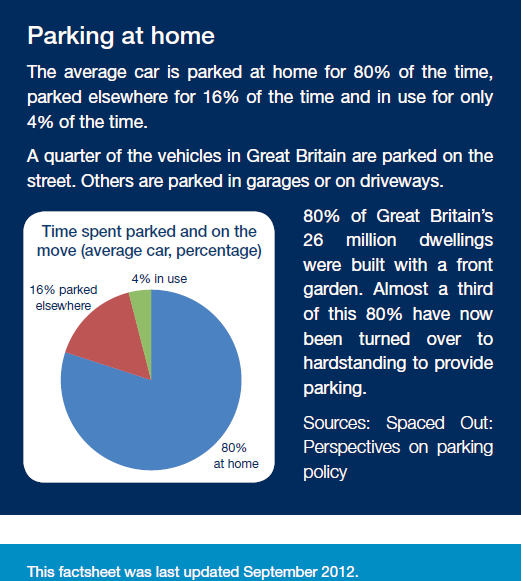
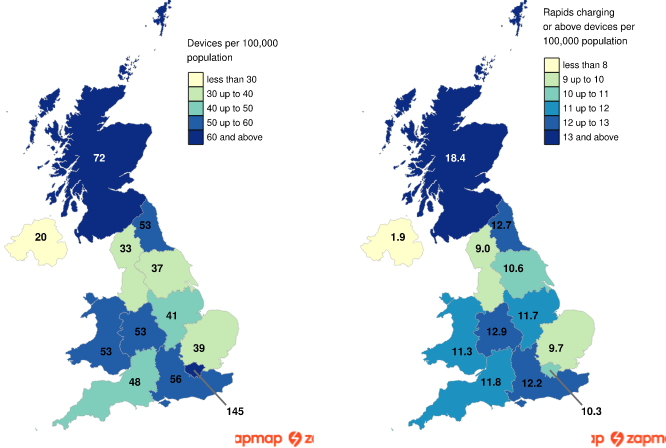
I did some searching for the source of off-street parking stats, can't find the actual research. But did find varying statistics: This 2012 fact sheet from RAC, but top result in Google, says only a quarter of vehicles in GB are parked on the street, all others are in garages or driveways. https://www.racfoundation.org/assets/rac_foundation/content/downloadables/facts_on_parking.pdf Also from RAC, 2021, they say cars are parked 23 hours a day on average. Perfect to function as grid support battery IMO. https://www.racfoundation.org/media-centre/cars-parked-23-hours-a-day From government publications, DfT published "Public Electric Vehicle Charging Infrastructure" research report. In there, section 2.1, says 24% households in England do not have access to off-street parking. https://www.gov.uk/government/publications/public-electric-vehicle-charging-infrastructure-drivers-without-access-to-off-street-parking From government "Statistical data set, English Housing Survey data on amenities, services and local environments " , go down to "Parking and mains gas", the statistics for "garage" and "other off road parking" added together is just over 67%: https://www.gov.uk/government/statistical-data-sets/amenities-services-and-local-environments So we don't know how all the different data came about, but the conclusion I can draw from the statistics is that UK households that can charge at home is definitely well over half. Related stats for public charger numbers. This report shows exponential growth for number of public chargers. https://www.gov.uk/government/statistics/electric-vehicle-charging-device-statistics-april-2023/electric-vehicle-charging-device-statistics-april-2023 Scotland seems to have the best per capita charger numbers:

-
The issue for people who can't charge at home using home tariff has been discussed in the social divide thread. No doubt it's a roadblock for many, IMHO more in terms of convenience. We are used to "EV is cheaper to re-energise" from last couple of years, we often forget other benefits such as much better to drive, servicing savings and environmental benefits. Charging cheaply is a bonus to EV ownership for some people but it would be foolish to expect this to last forever. As calculated earlier, around 40p/kWh (at poor 3.33 mi/kWh and 40p/kWh is Tesla supercharger price at any time not late afternoon) the per-mile cost is comparable to £1.50 at 50mpg. So it is still possible to own a Tesla and exclusively supercharge and still at price parity to fossil fuel. The way I see it, get it cheap while it lasts.
-
I think the crunch only happens during super busy times. It's still important to not have the bad experiences after sitting in motorway car parks, so I don't blame people switching to dino-juice. Day-to-day use, most people would charge using own charge points because most EV buyers, even today, still able to charge on their driveway. So the problem of charger lagging behind isn't as problematic as not having enough petrol stations. Wow that's super cheap. That's what solid nuclear and less reliance on shaky geopolitical fuel does to a country. I think after hitting £2 per litre diesel, in stations around Greater London, UK gov introduced a 5p reduction in fuel duty. Between October 22 and June 23, a "price guarantee" was introduced for home energy. Electricity was reduced from 51.8p down to under 35p. Similar percentage reduction for gas unit rate IIRC.
-
The HV battery is only connected after safety checks and contactors require power from low voltage battery to close. The HV battery is completely disconnected when the car sleeps/turned off. Whereas the alarm system is still on low-voltage system so that it can work when the car sleeps/turned off. This is the same for all EV's. Are you sure about alarm going off with flat battery? When I had a flat battery in my Octavia, the alarm only went off after connecting jumper cables, giving power to the car. Again, during normal operating, and with latest cars having vehicle lifetime li-on low voltage battery, the jump trick on the tow eye wouldn't open the frunk. It's not a security concern.
-
Where would the camera in the car get power when the low-voltage battery is flat? Same for alarm. It's the same for all cars. Only difference is, Tesla door handle is electronically operated and there's no physical key. So when low voltage battery is flat, need another way to re-gain access: go through the frunk to low voltage battery and then jump the low voltage battery to close contactors for HV battery. Then you can use keycard or phone key to unlock as normal. When low-voltage battery isn't flat, operating normally, jumping the front bumper connectors will not do anything. There is no security risk. On related note, latest Tesla's no longer have lead acid batteries. My one comes with a 16v li-on low voltage battery that is supposed to last life of the vehicle. So unless HV battery is completely drained or car was in an accident, chance of needing to do this front bumper trick as owner is 0.
-
The thing is, electricity price is more under control of government than petrol/diesel oil prices. So although it's not valid to compare running cost against highest peak oil price of 2022, I also don't believe it is also right to say electricity prices dictated by market forces will be expensive. For example, highest diesel price was £2 a litre in 2022. Highest electricity price in UK, where a higher percentage of electricity is gas powered than France, in late 2022 was going to be 51.8p/kWh under market conditions. Running EV is still going to be cheaper without government intervention. 52p/kWh translates to 17.5p/mi, when 3.33 mi/kWh. £2 per litre diesel translates to 18p/mi when 50mpg.
-
6-10pm (tea time to bed time) may not be enough. I can manage 4 hours off peak at home because I can do 3 charges, but if someone need re-energise 70 kWh for next day, that's going to be 10 hours parked at the charger. Indeed, the problem is not enough charging points. But, as CPS puts it, it is polite to move the car. This is also why I keep saying, if you can charge at home, do so, it's far easier. Leave more expensive public ones for people who can't charge at home or tourists/visitors.
-
All I'm saying is, generally, one wouldn't expect other people to vacate destination charger after charging finished. I don't know the in's and out's what you saw. All I can say is that if people don't move their car for days on end, that's very selfish of them. I don't feel it's a problem if leaving it plugged in overnight, say 6pm to 9am. At work place, there's only 8 charging spots. People know it's not enough so try to move their cars when possible. Sometimes people are in all-day meeting and cannot move their car, it's not end of the world. There's rapid chargers about for BEV and there's petrol for PHEV.