
wyx087
Resident Member
-
Joined
-
Last visited
Everything posted by wyx087
-
Indeed, I drove to Leicester on 26th and back (N London) on 27th. On the way back the 3 possible supercharger locations were all quite full, 2, 1 or 0 available when I looked. Plus queues going into services with 30min delay throughout M1. Luckily I had gotten a few hours of free charging at Asda, next to Space Centre we visited. Powering my return journey for free, allowing me to drive back without needing any top up.
-
Sorry, I'll remember not post referral links on here in the future. Thanks for removing it. Indeed. As Lucky puts it, most of charging will be at home. So the price of rapid charging, especially near home, wouldn't matter vast majority of the time.
-
Remember kW is different to kWh. 50 kW, 120 kW are power rating of the charger. 58 kWh is energy size of the battery. 50 kW charges 50 kWh in 1 hour: 50 kW * 1 h = 50 kWh 50 kW charges 100 kWh in 2 hours: 50 kW * 2 h = 100 kWh. For rapid charging, the battery charging characteristic is also important. With ideal conditions (battery pre-heated in winter, cooled in summer) Cupra Born should follow the following charging curve (the green line for faster charger, yellow for 50 kW rapids) https://support.fastned.nl/hc/en-gb/articles/4415872109329-Cupra So your questions: A. We get 50 kW all the way to 80%. Battery is 58 kWh, therefore 30min (half of 1 hr, simpler to calc than 35min) gives you 25 kWh, which is 43%. So 30min from 20% on a 50 kW charger gets you to 63%. B. 50p/kWh for 25 kWh costs 0.50 * 25 kWh = £12.50. 50p/kWh for 5%-80% on ultra rapid costs 0.50 * (58 * 75%) kWh = £21.75. For cost calculation, always start from kWh used, because charging speed changes. Not worth subbing IMHO. I've yet to use ANY charging away from my house. But it's worth getting Octopus Electroverse for a tiny discount and the RFID card, no subscription cost and works in Europe mainland as well as many chargers here. Use my link to sign up to Electric Universe & we both get £5 credit! (Removed)
-
So the Carwow video explains it, it's got air-sucking fan like an inverse hovercraft. No wonder it's got incredible downforce. Give it more seal we might be able to see it drive up a wall. On that basis, I'm personally more impressed with VW ID R that achieved a time close to this car without the downforce vacuum cleaner trickery. But still, 1.4s 0-60 acceleration is mental.
-
I used 6% of 75-80 kWh battery to drive 6 miles this morning. No charging no preconditioning, car sat unused since Sunday due to snow. That's almost 5 kWh for just 6 miles...... if only driving 1 mile journeys it would probably be worse than 1 kWh for 1 mile.
-
Dual-motor EV vs Audi systems in snow with summer tyres: 86% but only 6 kW…… cold battery? Does Corsa and 208 cars have battery heaters? Running it down should also give you faster charging speeds.
-
I have to confess my all-time average of 3.9 mi/kWh for Leaf is due to driving slower during winter commute so I can minimise not-home charging. Also probably due to not driving Leaf when temperature is extremely cold, icy or snow because I had all-season on my previous Octavia. I got around 2.9 mi/kWh in the Tesla over the weekend with -4c to 0c temperature. Drove it like I normally drive in these conditions: safe distances and more slow down for turns but no holding back with speed on well maintained motorways/dual. Just snowed here. Just typical: when I had all-season tyres, snow didn't persist on the ground. When I have summer tyres snow stays on the ground and temperature is freezing for days.
-
Indeed, as long as it's cheap/free, it doesn't matter. I drove 110 miles today to spend half a day or so at a free museum. Used 37 kWh, probably more like 45 kWh from the plug account for battery precondition but still very pessimistic. That's just £3.40 for me. I took my parents to spend time with their grandson, also saves 2 households using their central heating. They are averaging £15 per day on heating last few days, today they only used £10. A net saving AND half day out. Of course lunch costed £25 and kid's activity sheet costed £1, but it's possible to spend less than staying at home if efforts were made with packed food. That's just mad.
-
VW MEB platform owners should be able to chip in on vehicle specifics. I've not read about 12v problems on MEB platform, so far. For HV Li-on battery, if sitting unused for a long time, it's generally best to keep Li-on charge level at around 50% if possible (at 3.7v per cell). Storing at 100% for days stresses the battery causing more degradation, same at 0%. Generally speaking storing Li-on battery between 30-80% will be fine. I've no idea what VW manual will say for care of their battery. But Tesla manual differs to Nissan's. Nissan: we offer "long life" mode to charge to 80%, no mention of long term storage. Leaf doesn't connect the HV battery unless the car is "started", so it will happily sit for months. Tesla: set charge limit to "daily" (50-90%) and leave it plugged in. Tesla will use HV battery to top up 12v and heat/cool the battery to maintain temperature, so need external support if unused for many months. The power rating of charge point will not matter. The important thing for modern EV is that it can draw from external source to maintain its charge levels. A well designed car knows what is best for itself. I've parked up for 2 months on the Leaf without problem, at 50%, no % loss for charge level. For Tesla longest was 10 days not plugged in at a car park as we went on holiday in October. Dropped a few % on the HV battery. I think leaving it not plugged in up to 3 months is absolutely fine.
-
One thing is for sure, the information that are fed to public are always simplified for consumption. Not everyone understand everything, so it's reasonable to encounter simplifications from reality (eg. the way electricity flows in a circuit). Whether that means there is a false narrative, I don't think so, but you are free to believe whatever you wish. It will be a membership cost for how many sockets in-use at once, no limit to number of cars. 2 cars can be charged via 1 socket membership same way as 2 cars share 1 home charger. Idea is that eventually EVERY parking space will have a charger socket available. Either via lampposts now or later via other type of infrastructure. It wouldn't matter where you park, you can plug in overnight. The thinking is that the monthly cost is to access near-home public charger at discount rate similar to those rates available to home chargers. Essentially the monthly cost is to pay for installation, maintenance and admin of those public chargers. A standing charge if you will. For example, current best EV tariff is 10p/kWh for overnight, it controls your car's charging depending on grid conditions, you tell it departure time. With a 1 socket membership of £20 per month, you can access a socket that will charge overnight in same way at similar price. You tell it your departure time and it manages charging. So inequality evaporates. Driveway owners pay equivalent of ~4 years subscription up front to install their home charger. Road-side owners pay the subscription. Both access the same or similar priced electricity and most importantly both are able to lend their car to the grid to support cheap renewables' fluctuations. Key barrier here is that government need to recognise this type of charging as domestic at 5% VAT rate same as home electricity use. All other barriers are technical. Essentially, original point of thread is similar to this campaign: https://www.faircharge.co.uk/
-
I think it's car dependent. Hyundai and Leaf are prone to this problem. it's to do with 12v charging algorithm. For old cars like Leaf, it's basically replace ICE with battery, zero consideration to other systems. I recently gave my Leaf a 12v top-up using 12v charging from mains. When I connected it, it read 12.1v the car was unlocked but not started. After a charge cycle, it read 12.6v. This was the first time I've done it, the 12v battery is 3 years old. So it's reasonable to say Leaf isn't charging 12v sufficiently and charge inside the 12v is dropping slowly if not topped up. Recent Tesla's have got a new system. They have a tiny 12v li-on battery that is designed to last lifetime of the car. Whenever the car wakes up, the HV battery is connected to provide power. So the tiny 12v is only required to maintain a few W of standby power. Car periodically wakes up to top up 12v from HV battery. My Tesla has been sat untouched for 4 days so far as I WFH this week, shouldn't have any problem starting up. The downside is that IF one runs out of juice on the HV battery, the 12v cannot sustain car functionality and it will quickly discharge. For this reason I have a 12v booster pack just in case, because everything needs the screen. So to answer your question: - Any booster pack will do. Unlike ICE car, it does not need to provide cranking power, it only need to bring the voltage up for the car to close HV battery contactors. So the smallest capacity with low charge should still work. - If the EV's 12v battery is standard lead acid type, yes you can use any 12v charger. If it's li-on type, depends on the charger, must not use dumb trickle charger.
-
First sentence is about how expert consensus is reached, why it changes overtime. Second is about myself discovering the public debates and industrial lobbying are often not scientific based. There is no contradiction. Re charging for people without home charger: Pay a monthly subscription for their local street-side charge points (similar to home owners pay one-off install cost). This allows them to access much cheaper off-peak pricing. Off peak pricing like this. me-of
-
Science is always changing because there are always new technology and thus new discoveries. We cannot say just because the consensus changed or unrelated theories changed, it means new or previous consensus or theories had an agenda or are not to be trusted. Remember, in science, there is no definitive conclusions. Even gravity is just an observation of a theory. I don't know what is your background. But I've always been STEM orientated. So I had always followed science and held my belief with exports of the fields. Up until ~2010 I felt climate change is nothing that concerns me, it's still an on going public debate. But after researching it, it's clear the experts of the field had a consensus and opposition usually have other motivation. The tactics are well documented: https://en.wikipedia.org/wiki/Merchants_of_Doubt I trust these guys (groups of experts in their respective fields with well referenced papers) more than any individual claiming otherwise: https://en.wikipedia.org/wiki/Union_of_Concerned_Scientists It's best we stick to the thread. The social divide is a real concern. It's really bad that the poor are trapped by rising fuel prices and no where to cheaply recharge EV. Personally I don't see adoption and charging will be an issue, hence I didn't agree with that video. My issue is charging cost.
-
This thread shows there are indeed hidden risks buying badly designed EV's: https://www.speakev.com/threads/leaf-40kwh-2-zero-high-mileage-dud.173915/ Takeaway is to test-drive with less than 50% charge to ensure car battery still behaves well at low state of charge (SoC). Fully charged, battery can easily delivery power. At low SoC, any unbalanced or weak cells will cause the car to cut power or have SoC reading jump around.
-
Yes, diesels as young as 2015, 7 years old, are not compliant. A couple of my neighbours are facing this with their 2013-2014 diesels. ULEZ is due to be expanded to cover my home by end of next year. My previous car (2013 Octavia 2.0 TDI) was also not compliant and would have costed me every time I drive it. Result of this was that non of nearby dealer were interested in this diesel.100% of Facebook/NextDoor interest were lead with "is it ULEZ compliant" and zero interest after that. I finally managed to sell it to a dealer in Hamel Hampstead just outside M25. But as you said, very old petrol are all compliant. I'm not sure when Euro 4 became mandatory, but I know 14 year old petrol cars are compliant and typical car expected lifetime is up to 15 years. So I think it's safe to say majority of petrol on the roads are compliant. Hence very old and cheap petrol cars are compliant. Sometimes one may have to trouble a hundred or so miles into the country to get a good deal on a cheap petrol car. Disagreeing is normal in society with hugely different backgrounds. I think it's unfortunate views on EV adoption, manufacturing origin and climate change get the "political" sticker slapped on. Well, manufacturing origin is perhaps political motivated. The other 2 are not a political matter, it's a matter of personal views and how it may differ from consensus.
-
EV brake lights come on when slowing down, I can't determine if brake lights ever come on after it began to accelerate (after the first angle). There are a couple of reasons to say it's human error: 1. The first camera angle shows the car start to go crazy right at the exact moment when one would usually press the brake pedal to stop. If there had been a fault, the timing of failures of multiple systems are astronomically low. 2. In case of comms failure, the brake pedal has a mechanical connection to the friction brake system. I can feel the pedal being moving mechanically when autopilot brakes. Throughout the motor industry, brake has always been able to overpower any runaway vehicle power source. It should still slow down the vehicle or at very least has an effect on speed and not constant accelerating. 3. Tesla says there's "two independent position sensors" for accelerator pedal. Failure of both sensor at the exact same time is unlikely https://www.tesla.com/blog/no-unintended-acceleration-tesla-vehicles 4. It is still possible to put the car in Neutral and pull the "hand"brake should there be a total sensor failure. The article said Park button was press briefly, probably in panic, a constant hold will engage the "hand"brake as an emergency brake. Holding the stalk half way up will engage Neutral. This is a case of human didn't RTFM. 5. The first motorcyclist that the driver swerved to avoid would have gotten collision avoidance blearing. No inputs would cause the car to engage AEB. Only way to override it is to press the accelerator pedal. People confuse pedals ALL THE TIME.
-
If pedals get confused, electric cars will do more damage due to higher mass and quicker to get up to speed. But it's the same when moving from manual to automatic, the easier cars are to drive, the more lethal it could be when controls are misused. Problem is, whilst this happens all the time, small group people seems to get it in their heads that EV are more dangerous due to possible faults with control electronics. When these things happen, the driver usually blames the car. Not sure if this was posted on here, just like the above, this is clearly driver error: https://www.teslarati.com/tesla-fatal-model-y-crash-china-response/
-
Not all cars offer stop charging though, so you either set end percentage by calculating how much 4 hours EV tariff low rates time can charge, or use other methods to stop the charge. Nissan Leaf 1st gen can do start and stop time in the schedule, so I set it to be 0:30 to 4:30 for Octopus Go. Typically as long as it's above 30%, I'd get pretty much 100%, above 40% 100% is guaranteed. This is on a car with just 3.3 kW charger. Tesla only gives start time in its schedule, but their control API is a LOT more useful. So I use Home Assistant to start/stop its charging and do many other things. The car timer is set to start at 0:45 as backup. It is now mandatory to install smart charge points, hence all major charge point manufacturer's package deals have ~£600 charge point cost built-in. Mr Sparky probably doesn't care but they also shouldn't supply a dumb charge point. The one you linked earlier looks like a dumb unit, so check with Sparkey to make sure they are happy to install this. Main reasons for smart charger are for grid stability: Explainer here: https://myenergi.com/guides/smart-charge-point-regulations-explained/
-
I wonder how many headlines this would get if it were a Tesla. People mistake pedals all the time. As the saying goes, the idiot is behind the keyboard/controls.
-
Simple maths, assumption is the dates won't change, I can't see it being brought forward, I can only see it being delayed, unfortunately IMHO. 2035 is ban for anything that contains a tailpipe. 2030 is only banning non-electrified vehicles, after 2030 you can still buy cars that are refueled at petrol station. Typical cars last 12-15 years. So 2042, 20 years from now, it will be possible to buy an 8 years old car that is refueled at petrol station, with 4+ years of use left. The yellow vest protest has shown that "green levy" on fossil fuel, though necessary IMHO, are very unpopular and has the potential to de-stablise a nation. I don't think UK gov will do anything like this. We shall see...... more likely to put more tax on EV's. Unfortunately it does read that way, it was not my intent. My point was very old cars are still ULEZ compliant and not all old folks are scared of computer-on-wheels. Only through horrendous planning can one be caught out by expanding ULEZ zones. I, too, had noticed petrol and diesel prices have risen by a lot over last few years. This and natural gas prices are the main driving force for our current hyper inflation. All families are affected by this, poorer are affected more due to higher percentage of their income goes to essentials. This is the curse of geopolitical fuel. The sooner we move away from this to be independent from foreign powers, the better. There is no debate because climate change is not a political issue. Scientific debate among scientists occurred many years ago before reaching this consensus. Any counter-point from general public isn't going to contribute anything to what has already been examined by peer reviewed papers that had been published in well regarded journals. It may feel like climate change scientific consensus is undemocratic when being told so. But the scientific methods are well established, this method is acceptable for everything else. Only difference is that now after reaching the consensus, swift action has to be taken that affects everyone. So it feels like this "green" thing is thrust upon us like a king's decree.
-
The government deadlines in 12 years time are only on brand new cars, which by extension are usually people who are most likely able putting in charge points for at their off-street parking. In 2040, there will still be a lot of choices for cheap fossil fuel cars that are 5 years or older. In 20 years time, 2042, one can still choose to buy and run a cheap second hand car that is refuelled at a petrol station. Meaning this change to EV would not affect said "poverty" family for 20+ years. Landlords currently still have access to the charge point installation grant. Counter-point: my retired parent's Volvo S40 is a 14 years old car but it is ULEZ compliant. They are perfectly happy to drive this until beyond economical repair. They don't feel they have been priced off the road with their current car. They would like to get an EV after that and my Dad has no problem operating my Tesla, though, he is very good with computers as programming algorithms was part of his later career. It's not "someone else' green agenda". It's just another change in the motoring industry due to overwhelming scientific consensus. There will always be innovators and slow followers, the latter is always favoured by those who are less flexible with their finances. There's at least 20 years for this change to affect them.
-
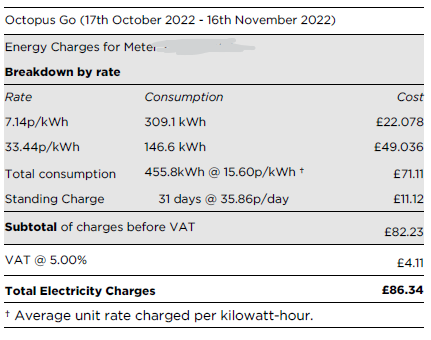
Remember there's EV specific tariffs you can use to make monthly cost vastly cheaper. I'm on fixed 1 year electricity tariff, 7.5p/kWh for 4 hours overnight and 35p/kWh other times. ends next July. This allows me to go on 200 miles day trips for less than £6. At 7.5p/kWh EV costs ~2.5p/mile for me. At 10-12p/kWh current available tariff, EV costs 3.3-4p/mile. There will always be off-peak pricing for there will always be peaks and troughs in electric demand. Batteries are well placed to capture that at lowest possible price. I'm averaging 15.6p/kWh for my electricity usage.
-
I think you posted the same one. But this one says it does have O-PEN protection so should be okay. But I can't find install manual to check what is required externally. Best way to do this is to find a Mr Sparky who is comfortable installing EV charge points and know how to test them after install. Then tell Mr Sparky the charge point you are thinking of buying. They will go off and do research on install requirements for that particular one. Yes, buy now and you'll only pay £165 (or whatever it will be) per year for VED. Buy after 2025 and if car costs more than £40k, it will also be hit with expensive car tax. But the VED doesn't account for vehicle usage. There will still be a giant hole left by fuel duty for fossil fuel. It is unknown how this will be filled. One thing is for sure, don't budget based on the assumption that there will never be any usage based tax. Sorry, don't know of timescale, you best bet is to phone up and ask. Government grant for charge point installs ended earlier in the year, so I'd have thought the installers will be relatively free now. It was impossible to get someone to do this install ~2 months before the grant ended.
-
Also, in UK with PME system. Their bodge to not require O-PEN fault protection was to connect all metal pipework to in-coming earth connection. That way in case of O-PEN fault, the metal pipework would be at similar voltage as the floating earth. Conditions are impossible to control outside, especially in the rain, so either earthing rod near the charge point or O-PEN fault protection is required.
-
Mind if I ask which ones are they? Not all chargers are created equal. Eg. the Tesla tethered charger is "just" £425, but it does not contain O-PEN fault detection. So after adding this protection in the fuse box, the total cost will be over £500 closer to other UK market all-inclusive charge points. It is unknown how EV will be taxed. If it were taxed based on liquid fuel tax mentality: tax on electricity usage. My thinking is that it is very difficult to monitor all non-smart charge point usage. If systems were brought in to ensure 100% coverage of tax, it will be extremely complex, intrusive and convoluted. Your existing commando socket (the blue one in your OP photo) will allow full speed 7 kW charging using "temporary" charge points. As discussed, if your car were remain dry in the garage, the chance of requiring O-PEN fault protection is low, so the cheapest way to achieve EV charging is what I've posted earlier, for £220. But you must be aware of the risks. A cable usually comes the car. You can always buy another one for home use should you feel the need to carry a cable with you on a daily basis. I personally prefer untethered points because it ensures 100% compatibility for everything: old EV's and new. Need a longer cable because you've changed car and charge port is at different location? easy fix. Unfortunately this is the difference between technician and engineer. My neighbour and I are working through contactors to do house insulation and modernising (eg. modulating thermostat, he's also looking at solar PV). We would find suitable products but it's not something the contractor are familiar, so they would quote waaaay higher or refuse to give quotes. A few times he had to be firm and work through the material with them. He's a civil engineer and I'm electronics, so I'm relying on his judgement for wall insulation while he's asking me about details of his solar installation.