wyx087
Resident Member
-
Joined
-
Last visited
Everything posted by wyx087
-
I never said never. If it's on charging, it wouldn't be on home charging. Because it's impossible to mandate 100% chargers to be smart. If it's on per-mile tax, fossil cars will get the same treatment on top of fuel duty. EV will always be cheaper to run than fossil fuel, it's simply politically suicide to make fossil fuel cheaper to run.
-
Looks like it, yes. So 2016 zero or low emission cars are the ones to get, if you hate paying tax.
-
Of course it will happen eventually. But not on charging, not EV-only tax per-mile like many have said. But retrospectively for VED is a shock. Has VED ever been applied retrospectively? I suppose it's their way of getting out of the "no tax before 2025" hole their predecessor dug, remembering they'll loose tax income from half of new car sales if it wasn't applied retrospectively.
-
https://www.fleetnews.co.uk/news/latest-fleet-news/electric-fleet-news/2022/11/17/autumn-statement-company-car-tax-for-evs-to-increase-by-1#:~:text=Currently%2C BIK for a pure,5% in 2027%2F28 Everyone pays! My Leaf will escape this, might be worth upgrading to a well looked after 2016 Leaf 30 for our local use. What other EV before 2017 is worth buying? Zoe, Leaf, anything else? no Ioniq BEV 😞
-
Question is, will it be retrospectively applied to all or the same as all previous VED, where only apply to new vehicles sold after that date?
-
Nice. Good efficiency as well by the looks of it. Get on EV tariffs and it'll be even cheaper! Goes to show once range of these cars are above ~200 miles real world range, it's easy and zero hassle for trips. The bigger the range, the cheaper odd-trips will be.
-
Can't really complain about cable reaching or placement issues, it's more due to stupid non-standard charge port locations. Only after all cars do the same to have charge port to the rear left (as example), then charge points can be installed to account for this. Plugged in not charging is very poor. With CCS, that suggests a charge was probably never started in the first place!? Sorry Zoe owners, I think it's about time the Type 2 tethered cable on rapids are removed. But need to install 22 kW type 2 AC socket nearby.
-
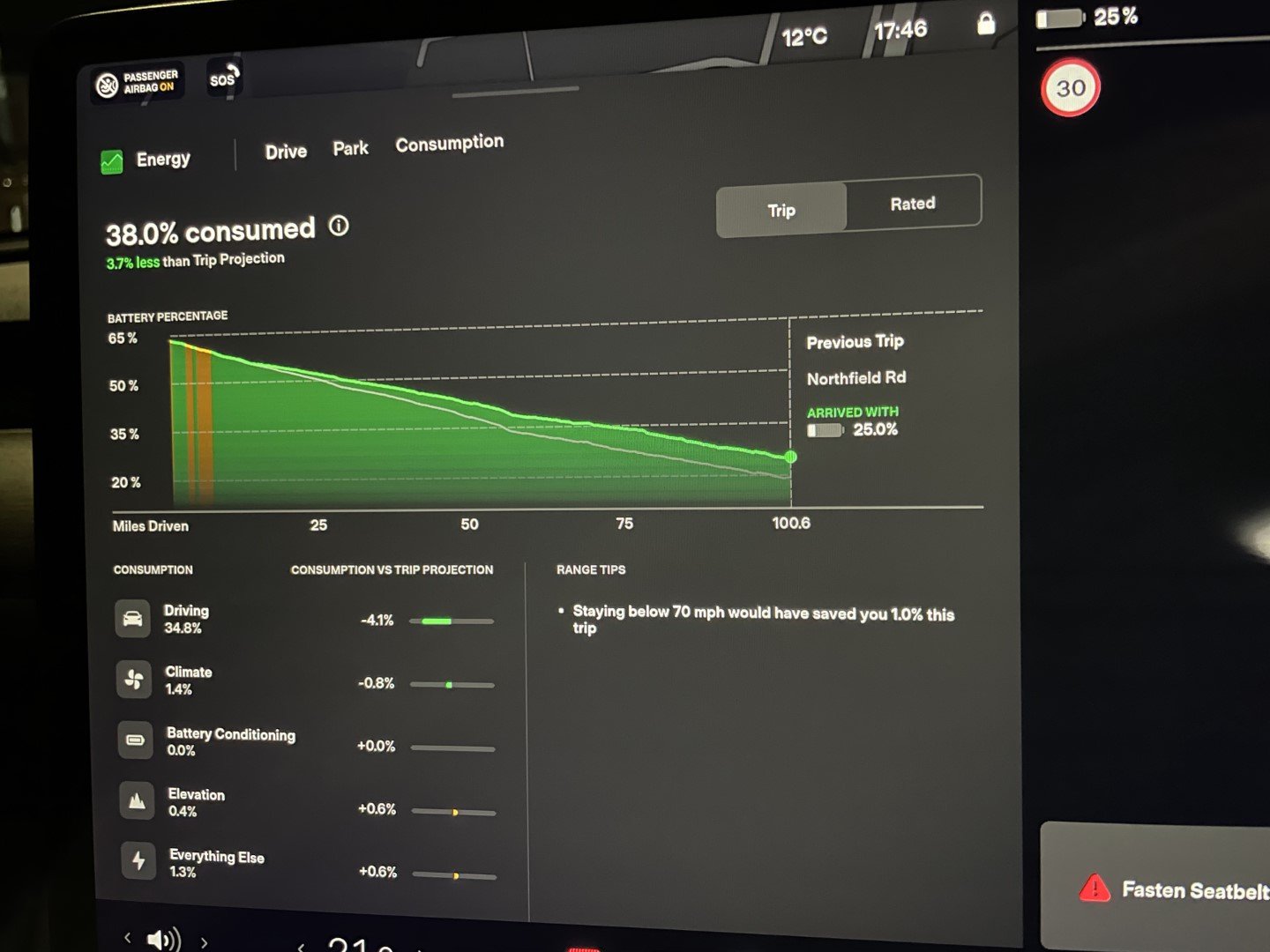
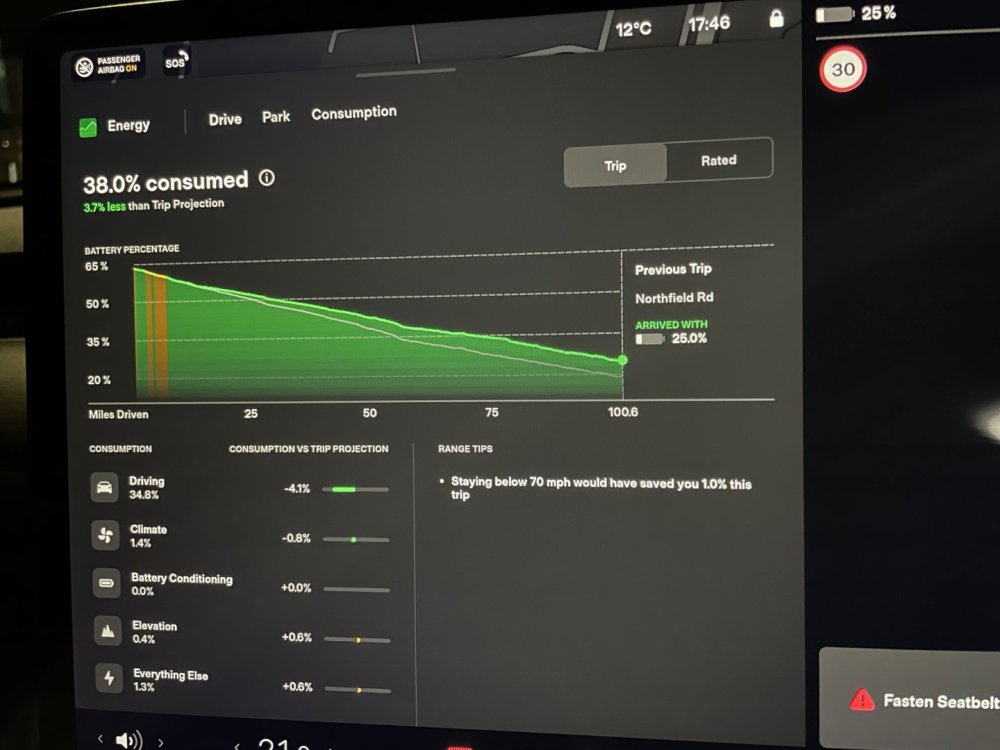
Did my first long trip with my Tesla Model Y long range yesterday, in ~12c and light to heavy rain, mostly motorway drive. Home to Warwick Castle, then to fireworks, finally back home very wet. Driving around 70mph most of the time, autopilot the whole way. Interior constant 21c, heated stuff, etc, a few minutes of pre-conditioning while plugged in, less than 0.8 kWh taken from the wall. Started with 100%. Total stat from the car "since last charge": 206 miles, 57 kWh used for driving, 276 Wh/mi (3.62 mi/kWh). Had sentry mode turned on when not driving (~7 hours), many recordings at both busy car parks. Got home with 21%. "Real world" range in this instance: >260 miles. 206 miles actually used less than 79%, because sentry mode when parked also used up a few percent. Total cost to charge: ~£5 thanks to charging on 7.5p/kWh off-peak charging. Next year after my fix with Octopus Go ends, it will probably be ~£6.30 using 10p/kWh on Intelligent Octopus. Or ~£7.56 on current 12p/kWh Octopus Go prices. This is the best feature with Tesla's: trip prediction. It takes everything into account: weather, elevation, and probably typical Tesla drive style 🤣. Just make sure predicted arrival percentage is above what you need, you are golden. This is the drive from Warwick Castle to Borehamwood. First sections where I was neck and neck with prediction was when I was catching up to friend's car on the motorway. Then, thanks to AP following a friend's car at around 70mph and a slow section on M25, I beat its estimate consumption by just under 10% (3.7% better than 38% consumed). I know 200 miles is pale in comparison to some people's actual need for their day-job. But for our family day-out, total 2 hours in the car per leg is about the most we can manage. Any longer we'll be thinking of staying the night. Original plan was staying the night in Birmingham and go to Drayton Manor park on Sunday. But plan changed. Next on the list is either British Motor museum or Silverstone interactive centre.
-
As said, it's the fact they are all relatively early designs (compared to petrol pumps) that is the problem. I bet we've all had problematic fuel stop mechanisms before, but I feel in the late 2010's, they seems to have became really reliable..... how long has fuel pumps been around? Engineering is an iterative process, things can only improve when good companies learn from all the failure data. There's also the problem of skilled labourers. I remember there was talk that during early days, back in 2017, the whole of UK's Ecotricity Electric Highway charger (equipment funded by Nissan-Renault, maintained by Ecotricity paying France contractors) were done by 2 French blocks going up and down the country...... once every few month! Finally, grid supply may also be slowing down the rollout. Last 2 weeks I've been driving past a Shell forecourt (A1 Borehamwood roundabout), there's 6 brand new chargers installed but not turned on. But in doing so, they've removed the previously working single rapid charger. Makes me wonder, which petrol station manages their logistics by ripping out old pumps, put in a new set of pumps and wait weeks before installing the tank and fill with petrol? The handshake should be part of a standard, the CCS standard. But we all know how tiny differences in implementation could create problems. I've previously read reports of new cars not able to charge on certain chargers until they were patched. Here had even been report of recently opened up Tesla supercharger bricking Honda E's. Even report of Ford car/truck and VW cars having problems on their own co-funded Electrify-America network. My solution around this is to go first-party for best reliability, buy their cars and use their chargers.
-
Imagine turning up with a 22 kW car and doing the same 15min
-
May be it comes from bad memories in earlier EV ownership. (I think he has/had a Leaf?) In Leaf, if I'm not nearly home when hit 20%, I'd be driving up to rapid chargers. I think sat-nav's "predicted arrival percentage" is very important in road-tripping EV, when driving on unfamiliar roads. In my limited, all <60 miles experience, I can completely trust the Tesla's estimated arrival range. Usually I arrive consuming 5-10% less than its prediction, has never gotten below its estimated arrival percentage so far. The live update on the sat-nav screen also means I can use it to aim for a very low arrival SoC, confident I can get there.
-
I found with just 3.3 kW on the Leaf, it's not worth sitting in the cold car with heater running, it means the battery hardly recharges anything in the 15min. Yes, I was also surprised by the thread that people don't seem to realise there's the 0% loan. I would have jumped on it. I'm looking forward to a long drive this Saturday (instead of weekend trip to Birmingham), 100 miles to Warwick castle, a bit more return (detour to food and fireworks). I think it's do-able without en-route charging, will post stats in a suitable thread next week.
-
I read there's an iPlayer video on EV's in Scotland. In case you haven't seen it: https://www.speakev.com/threads/good-documentary-on-evs-in-scotland.173305/ https://www.bbc.co.uk/iplayer/episode/m001dvbc/disclosure-series-5-6-electric-cars-ready-for-the-charge I've yet to watch it.......
-
15 min will always be "free". Podpoint's way of working is that you plug in and go. After you get settled down, you "claim" your charge. I've been doing something similar at lunchtime with Leaf back when my workplace charging isn't so busy. Plug in for 15min, have lunch, if need more charge, plug in for another 15min, go for a walk, and then return to move the car. They used to unlock the cable at charger end so a quick unplug and plug back in will reset 15min. But now it remains locked until you unplug at car end. Unfortunately now, unchanged at 12p/kWh, it seems most EV owners are hovering around the charger wanting to get a cheap charge. Work is reluctant rising the price, fear people might have committed to salary sacrifice EV budgeting on this benefit. Despite (with my input) the charger policy states along lines "do not rely on using workplace charger, home charging should be primary source " Luckily with my longer range EV doing commute, I don't need to bother charging anywhere else.
-
It's really bad the price changes are not shown on the actual charge points. For Tesco charger, there's a giant screen perfect for this! People are expected to know these things that are "published" on twitter. I really don't know how/why this is acceptable. I've had similar argument with Chargemaster Polar back in 2018, where a free rapid near my workplace became paid without warning. The screen hasn't changed, no mention of unit pricing, the first thing I learn of it was when I received the monthly membership statement. Even their website pricing hasn't changed and I was told I need to clear my browser cache.
-
Yep. I've now also mostly ditched Zapmap in favour of Octopus Electroverse app. Because Zapmap puts up a paywall for the critical multiple charger location filter. So for me it's a quick search on Electroverse app, filter by 6 charger per location (a single triple headed unit counts as 3 on this map) but show all chargers. Use their RFID card if I happen to land somewhere that accepts it.
-
Bonnet have now moved to a pricing structure that is basically like BP Pulse membership. Network pricing for payG -10% for £2 a month -15% for £8 a month That means I'll be deleting this app and just use the simpler contactless payment in the unlikely even that I need to use public charging. https://www.joinbonnet.com/pricing-update
-
Best get Octopus Intelligent at 10p for 6 hours. I think this is their intent, get more people on a smarter tariff that can better utilise spare grid capacity and not all start charging at 0:30.
-
Motor wear is negligible, there shouldn't be any motor efficiency loss. The reduction in range is purely inside the battery, it can no longer store as much energy as it ages. In this example, when new, the total capacity is 50 kWh (kW is power, similar to bhp. kWh is energy, because power * time = energy) But manufacturer specify 10% as buffer. It is probably a mix of top and bottom buffer. Total usable capacity when new is 45 kWh. In practical terms, usable capacity is all we care about. As the car ages, it may only able to retain ~80% of original capacity after 8 years (this 80% after 8 years data comes from my 8 yo Nissan Leaf, newer cars will probably do better). This means 80% * 45 kWh = 36 kWh of usable capacity left in the battery. That is called battery degradation. Battery degradation are due to many factors, main 2 are age and charge cycles. Over my 5 years of the Leaf ownership, I had not observed driving efficiency (mi/kWh) reduce as the vehicle ages. But I had observed it take less energy from the plug due to battery can hold less and less charge. As result, less range.
-
90% of 45 kWh usable storage capacity translate to 40.5 kWh energy stored. The thing you got to remember is that there's very little excess heat from the powertrain. Polestar engineer said along the line "the grill for ICE car is the reminder how inefficient it is." Most EV today, will simply dump all powertrain heat outside and use energy from battery to heat up the cabin. AFAIK (only?) Tesla do heat scavenging where any and all excess heat from powertrain are used to heat the cabin. If you supercharge and heat up the battery, the rest of the journey will use the heat from battery (a huge thermal mass) to heat the cabin. Also, lower temperature means denser air for the car to push through. Finally, battery has less capacity to store energy in winter. There's about 1 kWh difference between 20%->fully charged for my Leaf years back when I took note of it. So lollol is right to judge EV range based on winter range. I consider my Model Y LR to have ~240 miles worst-case range in winter, rated 330. I drove my usual commute 29 miles, moderate-heavy traffic, 65-70mph, got 3.5 mi/kWh from un-preconditioned car. Extrapolate to 270 miles range at ~11c.
-
I don't believe need 350 miles winter range EV, it's the charging network that needs to improve. If you were able to slow charge while parked and have zero problem rapid charging at any trunk road rest stop, then you wouldn't need to think about range. Agree with everything else. Though I hope night time tariff will not be too high. The most expensive commodity is natural gas, that's only really used in anger peak of peak time 4-7pm. There should always be much cheaper off-peak times. For personal news, I'm getting Indra V2H installed for my Nissan Leaf :D. I got past the first filter for the trial, awaiting technical survey to be done. This means I'll get equivalent to ~18kWh home battery and I'll aim to time-shift ALL usage to cheap periods or solar. Combined with Tesla for me to qualify for 10p/kWh Octopus Intelligent tariff. The truth about 8 years old EV's: they are still very relevant.
-
Please excuse my in-experience. Why not just any regular tire in the correct size? They seems to all work largely similar whatever the powertrain. I've been putting bog standard cheapest branded regular tyres on my Leaf (yokohama and dunlop currently)
-
Temperature and speed affects EV efficiency by a LOT. The route taken is a slow route and seems to be flowing very well. Temperature seems like perfect 15-20c for driving. Also got to remember the drivers are in some sort of "fun competition" against eachother, so they will all be driving as efficiently as possible. So I take it as a comparison rather than trying to map my own numbers to what they've achieved. Online, people seems like to take the best they've ever gotten and advertise that. Cherry picking the data, I can say my best run was 5.8 mi/kWh. But real world lifetime data says it's 3.7 mi/kWh over last 1.5 mintes.

-
I like having a large-battery tax on EV's. This ought to put the focus on vehicle efficiency. No point creating pollution to put 100kWh battery to only drive 300 miles. Fat and large vehicles should also have a higher road tax. I agree. Perhaps tiered system based on vehicle road-use area and weight, multiplied by road-use miles driven. Then a one-off tax for large battery.
-
Not sure how fossil burners would feel about dropping VAT on electricity 🤪 Indeed government are racking in record tax revenue, but they are also spending HUGE amounts to bring electricity prices down. Whilst I really like your idea, I'm not sure it's ever feasible. If the current government, lead by ex-Shell employee, is ever going to do anything on cost-of-living, it will probably be on fossil fuel tax. But the more pressing issue is public charging costs have a higher VAT and pays higher business rates than people with driveways doing home charging. This is the "great divide" as other thread puts it. There's a new campaign group talking about this: https://www.faircharge.co.uk/