wyx087
Resident Member
-
Joined
-
Last visited
Everything posted by wyx087
-
Where is the in-coming supply? EV charge point usually add a henley block between meter and fusebox, then add a connection to a mini-fusebox with the correct type of RCBO followed by wiring to EVSE. At any rate, a good charge point is ~£600 and installation + testing will be £200 cheapest with a mate, might as well go with "standard install" offered by big EVSE manufacturers? Keeping the commando socket in-case you need it for other (cough_tax_cough) reasons. Unless you can get a good EVSE for free? The cost difference between buying your own + employing Mr Sparky Vs EVSE install package deals will be minimum. Podpoint installed is £950 IIRC. I've been researching these because I plan on giving my parents the old podpoint that has broken wifi module, a 100% dumb unit now. Hopefully they can get Mr Sparky to do the install for less than £300 total. Hence I have rough idea how to do everything.
-
It's frowned upon to install EV charger directly to this type of socket. Reason being unless you have an earthing rod, earthing protection will not be insufficient. However, this is the cheapest (don't do this, no O-PEN fault protection!) way for you to get 7 kW charging, just buy those 2 and hang it on the wall. Compatible with all Type 2 cars (all today's EV except very early Leaf and a few other early EV's) https://shop.tesla.com/en_gb/product/mobile-connector https://shop.tesla.com/en_gb/product/blue-adapter---16a_32a- Have a look at install guide for podpoint. I think it will be straight forward install for you, considering you already have Type A RCBO, all other required protection are built-in to UK market (eg. not Tesla) charge points. https://s3-eu-west-1.amazonaws.com/podpoint-website/PP-D-130012-15-Solo-Smart-Charger-Install-Guide-1.pdf So Mr Sparky will need to ensure up-stream wiring is okay, remove this 32A commando unit, fit a new mini-fuse-box with similar Type A RCBO, wire up the new charge point. Highly recommend you only choose charge point for UK market: Podpoint, Indra smart pro, Zappi, Ohme pro,
-
CPS was down yesterday: https://www.speakev.com/threads/chargeplace-scotland-network-is-down-01-12-2022.173855/ It's so sad to see systems being this badly designed where a single point of failure almost prevents people from continuing their journey.
-
Another balanced view on hydrogen powered stuff from industry export: (ignore the rant from hydrogen skeptic Robert)
-
Arm yourself with Leafspy or similar tool, plug it in and read the SoH value. Job done. Just buy one with average miles, give or take. As long as it's being used most days, it wouldn't matter what percentage it has been charged to. Many manufacturers are now providing useful battery certificates, Unlike Leaf battery check, the VW battery certificate contains EVERYTHING needed to judge battery condition:
-
The think is always: do you need a new car? If the answer is yes, go to next line. When looking at new car, if you can charge at home, it would be foolish to discount BEV without a thorough look. For me, with ULEZ looking to expand including my home, driving Euro 5 diesel will no longer be economical. Then there is the looming hyper inflation back at beginning of the year and I have a stable job + a bit of spare cash in the bank. At that point second hand car prices were already inflated. So I took the decision to get a brand new car. All of my previous car were second hand and have ever been more than £10k. For EV pricing, I'm not so sure we'll see a rapid correction. The demand curve is on the steep slope now and more & more people's mindset are changing. My belief is that the first wave of EV's will always hold better residual percentage than similar ICE cars. For example, my Skoda Octavia bought £8800 in 2017, quoted trade price is £5200 and sold for this price. My Nissan Leaf bought same year for £8900, quoted trade price is over £8000. Yes, price of both cars are inflated, but EV second hand pricing seems to be more inflated due to higher demand, both heading for a correction. The price of brand new EV's wouldn't see as big or rapid correction as current second hand ones as this is based on global supply whereas used market is based on local consumer confidence (UK is heading in a recession).
-
Doesn't sound good experience, but we all like cheap travel great economy though. Got 160 miles planned this Saturday, day out to Silverstone Interactive museum with grandparents. Interesting to see mi/kWh this time with 3 adults and a kid. Tempted to do a quick supercharging demo to show my parents that EV charging is actually super easy. They've not seen good public EV charging experience when I was driving them around in Leaf during previous years. Single rapid locations occupied, not working chargers, etc.
-
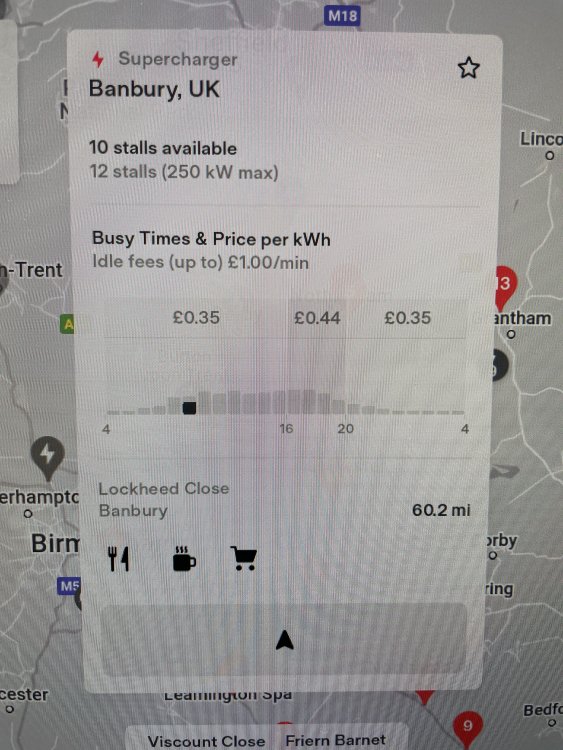
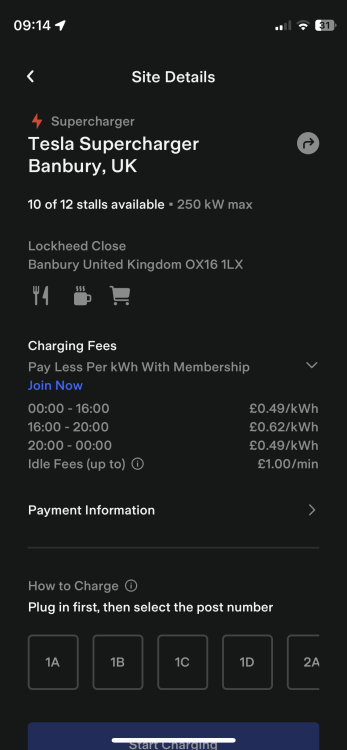
Had a quick check. Tesla seems to have dropped pricing significantly, depending on location. Some sites are 52p/67p, some are 35p/44p. All the open to non-Tesla ones are on cheaper tariff.
-
You sure that's across all time slots? Presumably this is with the subscription? Last time I checked on the in-car screen, it was 50p/kWh other times, 66p/kWh peak time 4-8pm. I wonder how are they achieving this price when business rates are still quite high.
-
I drove 7.5 miles today, to GP appointment to check my eye and a few minutes stop at Tesco to make an appointment. Then another trip to Tesco for the optician, 20min in there. Charged up at 7 kW first time and 11 kW second time, for free! Got home with exactly same percentage as I begin with. So today's local journey travel was free, thanks Tesco./Podpoint With a 22 kW car, school runs can be completely free just by popping into the shop for 15min every day. Though when I was leaving, a Leaf owner asked if I was leaving and she wanted to get on the 22 kW........ I pointed out I don't think Leaf can max out 22 kW, I think it can only do 7 kW. To my surprise she replied "oh thanks, that's good info". EV ownership education has a long way to go.
-
Real test would be driving to 55% in the morning, let the car sit for ~8 hours, drive again in the evening and see total distance it was able to cover. Agree with tyres, I'll be getting all-season next time changing tyres. Leaf is already having difficulty in the cold + wet last couple of weeks. It really struggles getting traction at particular exit from my local supermarket. It's 4mm so should last another year, but its traction is definitely worse than last winter.
-
I'm sorry, but that's where we disagree. The batteries in EV are the most valuable resources that can be used to reduce cost of electricity for everyone. The massive fleet of EV's that are not being driven can be used to help match demand to supply. If tax were to applied to all energy that goes into EV and not deducted for home or grid use, no one will sign up for V2H/V2G. This would mean more use of expensive peaker plants needed and in turn EVERYONE's electricity cost increase. What happens after energy goes into the car IS National Grid and government's concern if they don't want rolling blackouts and meeting the Paris agreement. Government sets the tax, taxman only collects.
-
Just want to clarify: I totally agree the former, efficiency need to be taken into account. But even just adding fuel-duty taxing all energy that goes into the car is not as simple as you are making out, let along the disregard for V2G/V2H. We'll just have to wait and see how it actually happens.
-
I just don't think Government will part seas only to tax energy going into EV's for the sole reason that other consumables are taxed this way. There's more things to consider than "charge up for driving". National grid is acutely aware of this: https://www.nationalgrideso.com/future-energy/net-zero-explained/electric-vehicles/evs-electricity Ok, I'm done. You are welcome to disagree with me. Come back when EV usage tax happens and we'll see how usage actually get taxed. No point arguing what-if's.
-
Your understanding of electronics is shockingly bad. Even though electronic device have the ability to identify connected devices, it does not mean all connected devices make the effort to identify themselves. Same with smart meter, to roll this out, first need a robust open standard (nothing exist for mains powered), then ANOTHER national campaign to replace all meter with new smart meter (we know how well current campaign is going), finally everyone must create mountains of e-waste by replace all perfectly working devices with identifier capability. I admire your ability to over estimate the level of cooperation competing companies can have. Let's look at how long it took USB -C to became the charging standard...... oh, it hasn't yet, and it will never be even after this has been made into law. Apple will just go completely wireless with a middle finger. But yes, government mandate can made it happen eventually, but even if this work gets started today, it wouldn't be implemented with enough market penetration for tax purposes by 2035. Demand shaping is not about what type of vehicle is in demand. I'm sorry, but you've completely misunderstood. EV charging can happen at any point when it is parked. This flexibility creates a massive opportunity to support things like this: https://www.nationalgrideso.com/industry-information/balancing-services/power-responsive Does Skoda know how to contact you to make changes to your Mk1 Octavia? There are tens thousands of EV's out there without over-the-air update capability. Just as many no longer has relationship with main dealers due to EV powertrain don't need servicing. On the same train of thought: per-mile tax is the fairest type of road-usage tax. You drive more, you pay more. You seems to be really struggling with the idea that energy going into EV battery can be taken out for other things that are often associated with low taxes (home energy) or zero tax (grid stability support). Both of those examples are needed to bring more renwables into the grid.
-
Tyre noise becomes audible above ~15 mph. For forward driving, a driver activated gentle reminder sound would be better than constant pedestrian warning noise. Because constant sound is rarely noticed by people enclosed in their bubble.
-
I hate fake engine noises or any fake noise for "driver engagement". It's totally unnecessary. EV motors have their own character already. Under max power, I've found Leaf motor have a different sound to Tesla motors. The sound changes according to speed, just like ICE. Difference is they are completely silent during normal use, which is much better. Only necessary fake sounds are a gentle sound for warning pedestrians at low speed and car park reverse warning sound.
-
https://www.indra.co.uk/v2h Sorry. Bad wording on my part. Should read: Flexibility is key here, your car battery becomes one of many variable the National Grid can use to help control their balance.
-
This will work, not sure about app-to-unlock or any straight forward way to implement it. But happy to be taxed on energy usage as long as other uses for EV battery will not incur this tax. FWIW, here's my thoughts on possible addition sources of EV taxation that are easy to implement and sends the right message: I think 20% or even higher on rapid charging makes a lot of sense. It's not meant to be used for majority of EV's source of energy. It puts excess demand on the grid (or require another battery made for buffering). To counter that, a tax on giant battery is needed. Works the same as expensive car tax: first few years. I've mentioned this before, something like <40 kWh free; 40-55 kWh band A, 55-70 kWh band B, 70-90 kWh band C, etc. This is to incentivise more efficient cars and reduce environmental damage done by unnecessary big batteries during its manufacturing. You will find this charge will be covered by the embedded value of the battery when the car around it is destined for scrap yard. ----------------- This is why vehicle-2-home, home battery or any form of demand-side shaping will take off. I plan to move as close to 100% as possible to this 4 hours cheap period when I get vehicle-2-home installed. There is actually Octopus Intelligent with cheaper than 4 hour pricing, 6 hours minimum (more cheap hours if your car needs it) if you allow energy company to take control of your charging and you only need to specify when you need at how much. (eg. 6am, 90%). Flexibility is key here, you become one of the lever Grid can use to help control their balance. For as long as EV is parked, why do I care when it is being charged? This is to be expected. The reason cheap 2 hour mid-day period exist is because of solar production. Solar doesn't do much during winter months, so there is no longer excess cheap electricity. Again, flexibility is key. For cars that are parked over 90% of the time, it doesn't matter when it's charged as long as it can eventually be charged cheaply. So I think we'll see less and less dumb 1am-5am type tariffs, more half-hourly or even shorter tariffs that will require even smarter chargers (or other control) to take advantage.
-
Again, you are forgetting EV are part of energy solution: demand shaping. The storage buffer capability they provide will make cheap renewable actually viable and overall energy much cheaper for everyone. Taxing this or dis-incentivise use of EV battery for other uses will push up cost of other form of energy storage (due to unnecessary higher demand for duplicated function hardware), push up cost of energy, and push up cost of EVERYTHING. No, smart meter does not know what is being charged. It only reports overall home usage. If it tries to guess what is being used, how can it distinguish between EV charging, home battery charging, Zero Emission Boiler charging or just immersion heater? Sure, you can do all that (from thousands of unnecessary charger re-install, to getting manufacturers on board to update cars that are long out of warranty) all for bring in a dogmatic tax based purely on previous liquid fuel ideology. Just because horses can feed off grass, doesn't mean motor vehicles can re-energise from a grass field. Just because steam trains were on tracks, doesn't mean cars couldn't go off road. Just because liquid fuel were taxed per litre, doesn't mean EV must be taxed per kWh.
-
The energy going into the battery may not be used for driving though, vehicle-2-home, vehicle-2-load. This method relies on the charger able to communicate to a central tax accounting server. Not all chargers are "smart". That is going to require many £1000 re-install of a perfectly working "dumb" charger or £650 repair bill whenever the optional "smart" feature fails (my podpoint quote to fix wifi module in my charger) Unless government is going to foot that bill like household smart meters, I can't see this will ever work as source of tax accounting. Also, in-line dumb chargers are wide spread and can still be bought now. The Tesla one can be connected up to 32 amp 1 phase or 3 phase unmetered "dumb" commando to charge at full speed. Mandatory meter commando sockets? it's a sledge hammer to a trivial problem. This would be per-mile cost instead of tax at point of energy dispense. I think this is most probable. But I'm not sure it will be through OEM equipment on older cars due to complete lack of accurate counting on all cars. How is OEM counting going to work for my Nissan Leaf that I can disable telemetric and hide certain trips from telemetrics?
-
Don't worry, that (usage based tax) will come in due course, probably 2030-2035. Question is, how it'll be implemented to make it not excessively unfair and enforceable. Tax public charging: unfair to those without private charging. Tax all electricity, unfair to non drivers. Tax EV chargers, unenforceable. So I think the solution isn't a dogmatic transpose of liquid fuel duty, where tax is applied at point of dispense. The batteries in EV are too flexible for that. This is indeed the current trend, due to poor investment in renewables: https://assets.publishing.service.gov.uk/government/uploads/system/uploads/attachment_data/file/1107502/Energy_Trends_September_2022.pdf But my energy monitor tells me my electricity is over 70% non fossil fuel year-to-date as majority of my use is overnight at 7.5p/kWh. Meanwhile, National Grid are prepared to pay £3/kWh during peak time for people to reduce their usage. Comparing the 2, it speaks volume about the cost of electricity at different times and the effect of expensive fossil fuel plants on energy pricing due to inflexible demand. I expect over next 2 years we'll see more sub-£40k cars hit the market. Or at very least ID3 style trim levels. This is a good thing and much needed. Hydrogen cars are classed as zero emission, so will be treated the same as BEV in terms of VED. I think there must be same amount of tax on all other types of hydrogen fuel except green hydrogen. Simply because all other types of hydrogen is just fossil fuel with progressively worse level of emission when making it, from waste of effort to much worse than ICE fossil fuel cars.
-
I'm getting Vehicle-2-home charger/inverter installed in next few months. How are smart meters going to understand if the high usage is car, home battery, or home-battery-car? How would it know how much miles had been done as a car and how much was used for home? There's also the "granny" charger I can use from a domestic socket. It's just as easy to install a commando socket with a dumb charger and charge at exact same rate as all home chargers. For all existing chargers that had been installed, even after the non-smart ban, there is no standard. Podpoint uses Wifi (even their latest), old Chargemaster units charge £50 a year for their SIM plans to keep smart features. Most latest use Wifi or wired for smart features, how can taxation of EV "fuel duty" be enforced if vast majority of smart chargers' smart features can be easily disabled? I'm not saying something like fossil fuel duty, aka usage based tax, would definitely not happen, It will eventually happen. I'm just saying you cannot just transpose fossil fuel duty to electricity.
-
The full changes are as follow, in the PDF version: (bold for existing cars, not just EV's) https://www.gov.uk/government/publications/autumn-statement-2022-documents 5.34 VED on Electric Vehicles (VED) - From April 2025, electric cars, vans and motorcycles will begin to pay VED in the same way as petrol and diesel vehicles. This will ensure that all road users begin to pay a fair tax contribution as the take up of electric vehicles continues to accelerate. The government will legislate for this measure in Autumn Finance Bill 2022. This means: • new zero emission cars registered on or after 1 April 2025 will be liable to pay the lowest first year rate of VED (which applies to vehicles with CO2 emissions 1 to 50g/km) currently £10 a year. From the second year of registration onwards, they will move to the standard rate, currently £165 a year • zero emission cars first registered between 1 April 2017 and 31 March 2025 will also pay the standard rate • the Expensive Car Supplement exemption for electric vehicles is due to end in 2025. New zero emission cars registered on or after 1 April 2025 will therefore be liable for the expensive car supplement. The Expensive Car Supplement currently applies to cars with a list price exceeding £40,000 for 5 years • zero and low emission cars first registered between 1 March 2001 and 30 March 2017 currently in Band A will move to the Band B rate, currently £20 a year • zero emission vans will move to the rate for petrol and diesel light goods vehicles, currently £290 a year for most vans • zero emission motorcycles and tricycles will move to the rate for the smallest engine size, currently £22 a year • rates for Alternative Fuel Vehicles and hybrids will also be equalised
-
Confident because it's the way things are going. No electable government (well, may be except Truss the shortest UK PM) in their right mind will make EV vastly unattractive before the fossil car ban. After the ban, it's fair game to jack up taxes due to deficit. But I don't believe home charging can be effectively taxed. They are "smart" for demand management, so people don't charge between 4-7pm when they get home. Per-mile is possible, but again, it will not be fuel specific. At any rate, there's 2.5 more years of guaranteed tax free EV motoring, I'm really enjoying 2.5p/mile, zero road tax.