Johngerard
Members
-
Joined
-
Last visited
Everything posted by Johngerard
-
-
-
Yes, of course, the oil pressure is higher at higher revs, because of this due to higher specific power outputs the alarm has to be annunciated at a higher oil pressure and because of this and the (money saving) necessity of having to install two pressure switches then the "fix" was to disable the alarm until ~ 1600 RPM.
-
Strange how the new stat is aparently "open" with cold/cool engine coolant temperature. The (any) stat shouldn't begin to open at say 84C ish and go fully open at ~ 98C. All Vag cars will display 90C between a true coolant temperature of ~ 75C and ~ 107C so your displayed temp should reach 90C well before the stat starts opening/top hose getting hot, you can see my 2019 Polo just reaches a displayed temperature of 90C when the true temperature only reaches 75C, if yours only reaches a displayed 70C, ~ 63C true temperature even while driving then it would appear that this new stat is also passing (even though one would think unlikely) or else installed incorrectly, if this is possible. VW Polo 02092024 Coolant Temp VCDS/Car Display 52 /52 53/55 56/58 58/62 60/65 63/69 64/72 66/74 68/78 69/82 71/84 73/86 74/88 75/89 75/90
-
If @klobb still has the old stat, see (if you can) if its partially open, if not, put it in a pot and see what temperature it begins to open, should be ~ 84/88C
-
No sure about very modern VAG cars but for at least 25 years, the oil pressure alarm isn't enabed until the engine revs are > than ~ 1600rpm, (previous to this there were 2 oil pressure switches fitted). If you have a genuine low oil pressure than it will cease to annunciate once the revs drop below this ~ 1600.
-
Maybe a compression test in order?, it may, (hopefully not), be a sticking inlet valve.
-
08:17:35 Oct 2025. Jan 2019 Polo with original 59AH EFB battery Engine Off October 2025 IDE01834 Battery voltage 12.256 V IDE01836 Battery current -4.407 A IDE01837 Temperature of battery sensor 15 °C IDE01839 Battery charge level 78 % IDE01841 Battery internal resistance 7.4 mOhm IDE01842 Usable battery charge 27 Ah IDE01948 Battery internal resistance not normed 6.8 mOhm IDE07681-MAS06086 Battery total charging throughput-Total re-charge 3480.7 Ah IDE07681-MAS06087 Battery total charging throughput-Entire energy throughput 3671.1 Ah November 2025 Ultimate Speed 5A charger with voltmeter. Model ULGD 5.0 C1 Battery came from 70% SOC with following smart charger input charger 13.3V @ 1653 charger 13.5V @ 1800 4 Bars indication charger 14.4V @ 1945 4 bars indication Voltage then fell to 13.5V with a trickle charge of ~ 0.8A, charger then disconnected, VCDS then showed 84% SOC but don't know if I had left the charger "trickling away" for hours on end if the SOC would have risen to 100%. The usable battery charge was/is allegedy 27AH so lots of starts hopefully left at ~ 0.25AH/start.
-
Even though I only use the Stop/Start selectively, I allways test it my enabling it (Stop) every time I exit the car and even with a battery SOC as low as 70% (VCDS) will still operate perfectly. The battery, a 59AH EFB, is the original and is exactly 7 years old. I returned very recently from abroad, the car had been idle for 11/12 days but Stop/Start operated perfectly after travelling the mandatory 0.5kms.
-
Diagnostics is a big money maker for Main Dealers, even if the car is under warranty I believe you may have to pay for this?, Victim: "My windscreen wipers are noisy", "Yes Sir, our diagnostics does confirm this, that will be £150 Sir, £60 for the new wipers and only £90 for the diagnostics." Sharp Brakes??, For those of us old enough to remember it, what about the brake limiting/proportional valve, or whatever it was called, before the days of ABS?
-
Yes, on my 2019 (petrol) Polo, you may have to press/release the brake pedal a few times before the engine restarts, obviously when the vacuums falls to some minimum level. Engine coolant temperature has no effect whatsoever on mine, the OAT (& engine) temperature can be as low as -2C, once you drive the car its mandatory exactly 0.5kms, the engine will stop if the stop/start is enabled, its disabled if the OAT falls to -2/-2.5C, can't rememer which just now.
-
Stalls while idling or driving or both? Crankcase "breather" valve faulty? There might be plastic piping that sometimes crack and are almost invisible but these generally cause a fast idle. ( I think you've covered that, above) Can you attach a vacuum gauge somewhere on the inlet manifold.?
-
Any update re the above?., did you get the stat to open??.
-
Actually, that little plastic tank is a Degasser, even with the stat shut, you should see a small flow of water entering this tank, remove the cover and watch it.
-
I wouldn't be 100% happy until you do that test above (let the heater off), one would have thought that if you have/had driven it after installing this stat and because the top hose was apparently air locked that you should get overheating again, I've changed the coolant in a few cars of your era and I used to just let the cover off the header tank until the coolant was good and hot, sometimes, after a drain down and a cold engine, only 1/2 the coolant could be added but as soon as the stat opened then the remainder could be poured in.
-
Very good, what you might do now sometime is to drive the car normally and ensure the diagnostics see a temperature of at least 86/88C, the stat opening temp, it goes fully open a ~ 98C so would expect around 90/93C (actual temp) under normal driving conditions, it might rise to the stat opening value while idling but may not at these low ambient temperatures now.
-
Overall, the discs+drums on mine gives excellent braking and doesn't seem to be quite as sensitive at very low speeds as others experience, however I can truly say that it wins first prize for the worst hand brake I've encountered in 63 years of (VW) driving.
-
Can you ensure, with a vernier calipers or whatever that the 2 replacement stats are dimensionally the same as the the original failed shut one.
-
Not sure what you mean by flat, what do you get when you open the coolant header tank cap, you normally just get a gush of air/vapour.
-
Above, you show the coolant temp as 57.6C and you show the Coolant temperature cooler output at 39.6C. Is the Coolant temperature cooler, the radiator??, if so then that points to the coolant (maybe) being cooled from 57.6 to 39.6C but may only be one of the air venting pipes that has a very small flow through it into the top of the rad. Just to clear up your original statement "My car went overheated due to the thermostat being stuck open, and I replaced it with a new Febi thermostat with a new o-ring, but it is open at 84 °C; the older one was 87 °C. The car is still overheating!" Was it overheating? and did you check this original stat's opening temperature (87C) as well?.
-
My 2019 Polo is very sensitive but only as said above when it's barely moving . I too had a VW Formel E, 22 years in the family, a fabulous car only marred by the need to remove the Carb's auxiliary jet a few times a year and clear it by sticking a bit of wire fom a bristle brush through it, could never figure out why a very hard deposit used to build up in it. Anyhow back to the brakes, my model certainly had a servo but the brake pads were tiny (with rear drums), the only way I could get somewhat reasonable braking was to install very cheap, quick wearing pads that lasted only around 6 to 8 thousand miles, interesting though about the servo being on the wrong side on some other model, above, I thought my servo was on the drivers side but could be mistaken, will check my manual. Just checked, servo was on the left, not the driver's side.
-
Do most people have their engines running when jump starting someone else? and if so, why?, even a 500A load for for say a 3 sec crank, enough to start almost any car, will only drain the donar battery by 0.42AH, the sqroot of nothing from even a 56AH battery.
-
I have never required a jump start but have a 1.5M length of just 2.5sqmm with 4 crocodile clips and have started quite a number of cars using this bit of cable, I allways connect up the cables and then let my car running for ~ 10 minutes or so, then rev to around 2000RPM while the flat battery car is being cranked, never failed yet. I would think that the "flat" battery is doing some of the heavy lifting here because the voltage drop through my 1.5M (total 3M) cable even with a fairly low 300A crank will be ~ 6.5V if supplying that full current, so without that 10min or so charge then very doubtful IMO of working. Of course, if a proper set jump leads are used then no need for the initial charge.
-
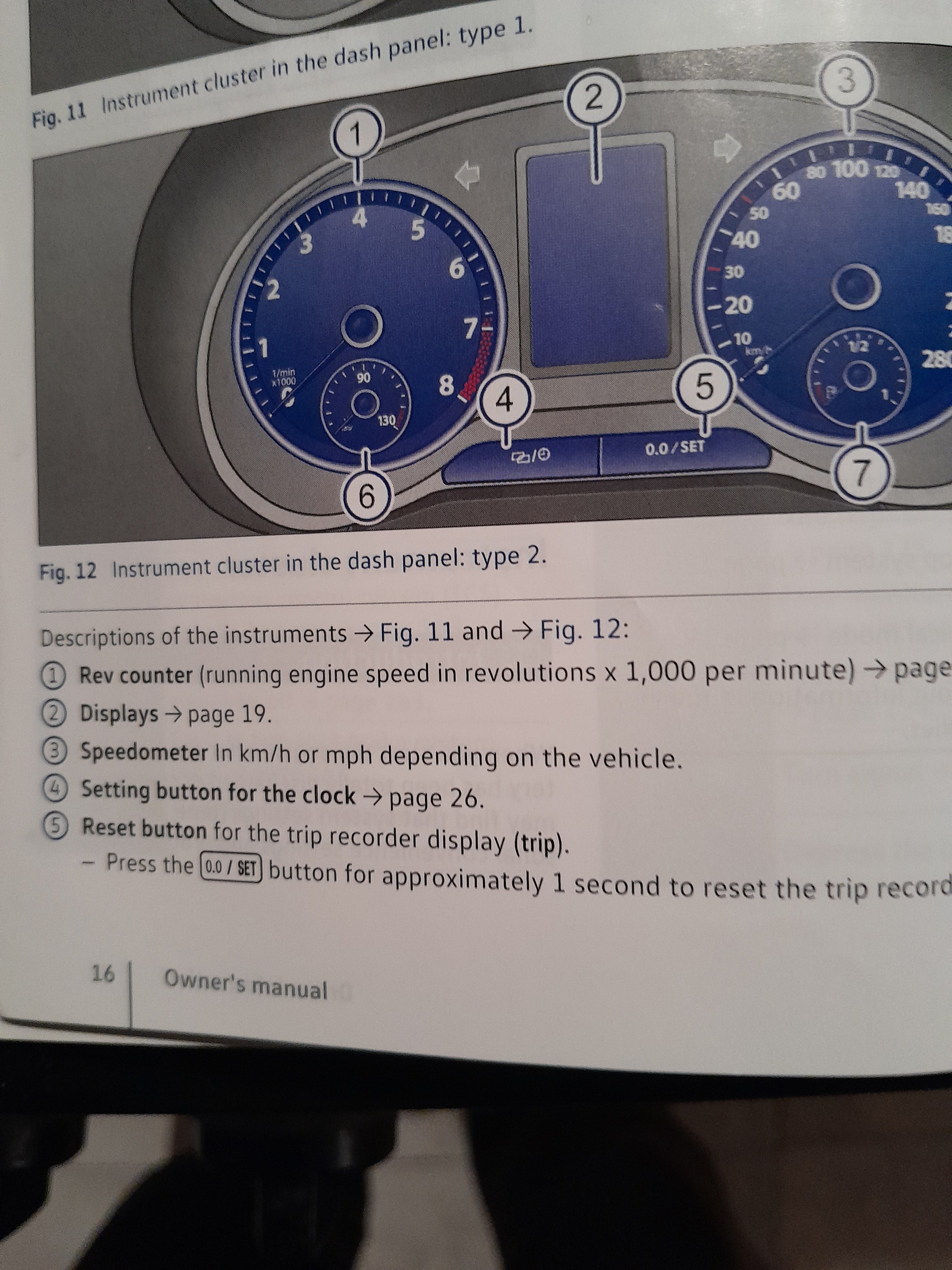
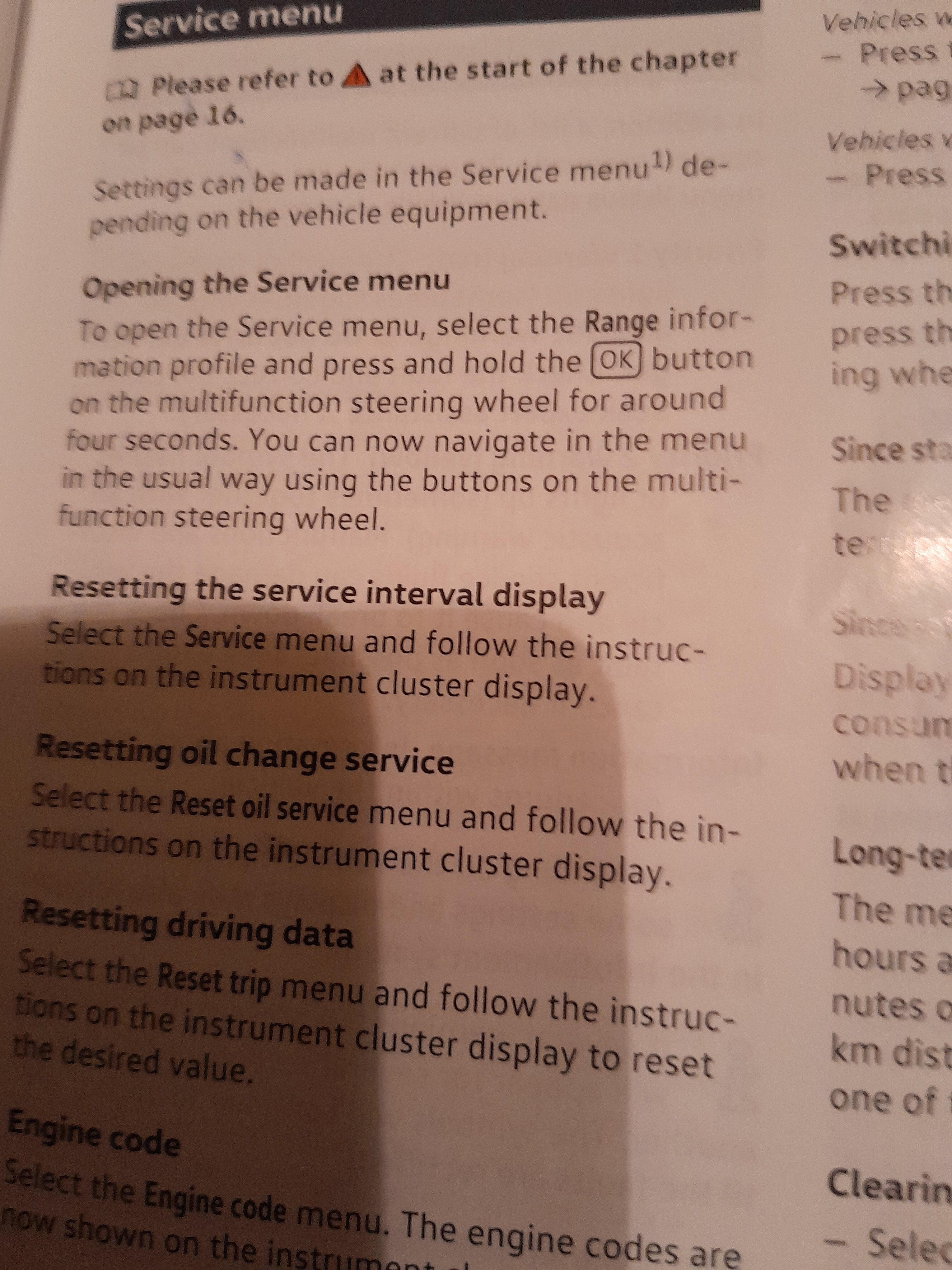
I might have got a bit mixed up re resetting our own Polo as I look after 3 Polos and a Sharan so here now are the directions for resetting the service displays on a January 2019 Polo as per the Owners Manual Edition 11.2017. The trip reset buttons don't seem to have anything to do with resetting, see S.Shots 1 and 2, may help.
-
Doesn't/didn't work on my 2019 Polo, I have to use my VCDS to reset it.