Graham Butcher
FREEDOM
-
Joined
-
Last visited
Everything posted by Graham Butcher
-
Last post on this with you, just go back, re-read what I wrote and watch those 2 videos I posted and actually pay close attention to what he says, and you should then hopefully understand that neither he nor I are saying anything conclusive other than that car in the photo is a Porsche Taycan, if you cannot decipher what the car is or was from the photo of the shell and the photo of the car side by side then that is your problem, not mine. I also said that assuming the photo was not a fake, but the only other car ship that could have photographed on, which had a fire was the Felicity Ace, and that has sunk, so its highly unlikely that it was that ship. YES we will have to wait for the official report to be published, and I respectfully suggest that you do the same thing instead of leaping the EV defence every time as if I said the was started by an EV which is not what I said, just go back and check and be honest with yourself.
-
I know, the point I was making is that we have come a long way from the poorly designed and heavily polluting cars we used to drive, and they are still getting better. I did say I that I would hate to know how much pollution those early cars were producing
-
@wyx087Look, if you are not even going to consider anything said about EV's that does not agree with your viewpoint then I'm done with this discussion with you, its already dragged Colin into this and I'm sure there are other members getting a bit fed up with the tooing and froing, lets agree to disagree, thats it I'm all done, over and out.
-
So are you now saying that you never said this wyx087 Members 1.6k Location: N London Model: Tesla Model Y LR EV; Nissan Leaf 24kWh EV Posted 14 hours ago https://cleantechnica.com/2023/08/17/a-ship-carrying-electric-cars-is-on-fire-we-must-run-and-tell-the-king/ So the uncontrollable fire on the ship had nothing to do with EV's. Quote All I'm doing is correcting the misinformation you were posting about it. As mentioned in the videos, unless that photo is a fake, that photo proves that your statement was incorrect, the car shown is a Porsche Taycan, a 100% EV car. If you watched and listened to the videos and also read what I wrote, there is claim anywhere that EV car was the cause, that is yet to be determined, but it is an undeniable fact that EV cars were involved in the fire, they were not all on another level of that ship and 100% untouched by the fire, which is what you are implying. This is what you claimed that you were doing to my posts, but nowhere did I ever say that the fire started by an EV, I just said the involvement of EV in the fire made putting the fire out impossible, don't me that you still don't think that they were involved.😣
-
I'd like to think that your right, maybe the powers to be will come to their senses and see that it looks like a bad move. I'm not anti EV but I cannot see that will solve the climate crisis, its IMV just moving the pollution away from the tail pipe and concentrating it elsewhere.
-
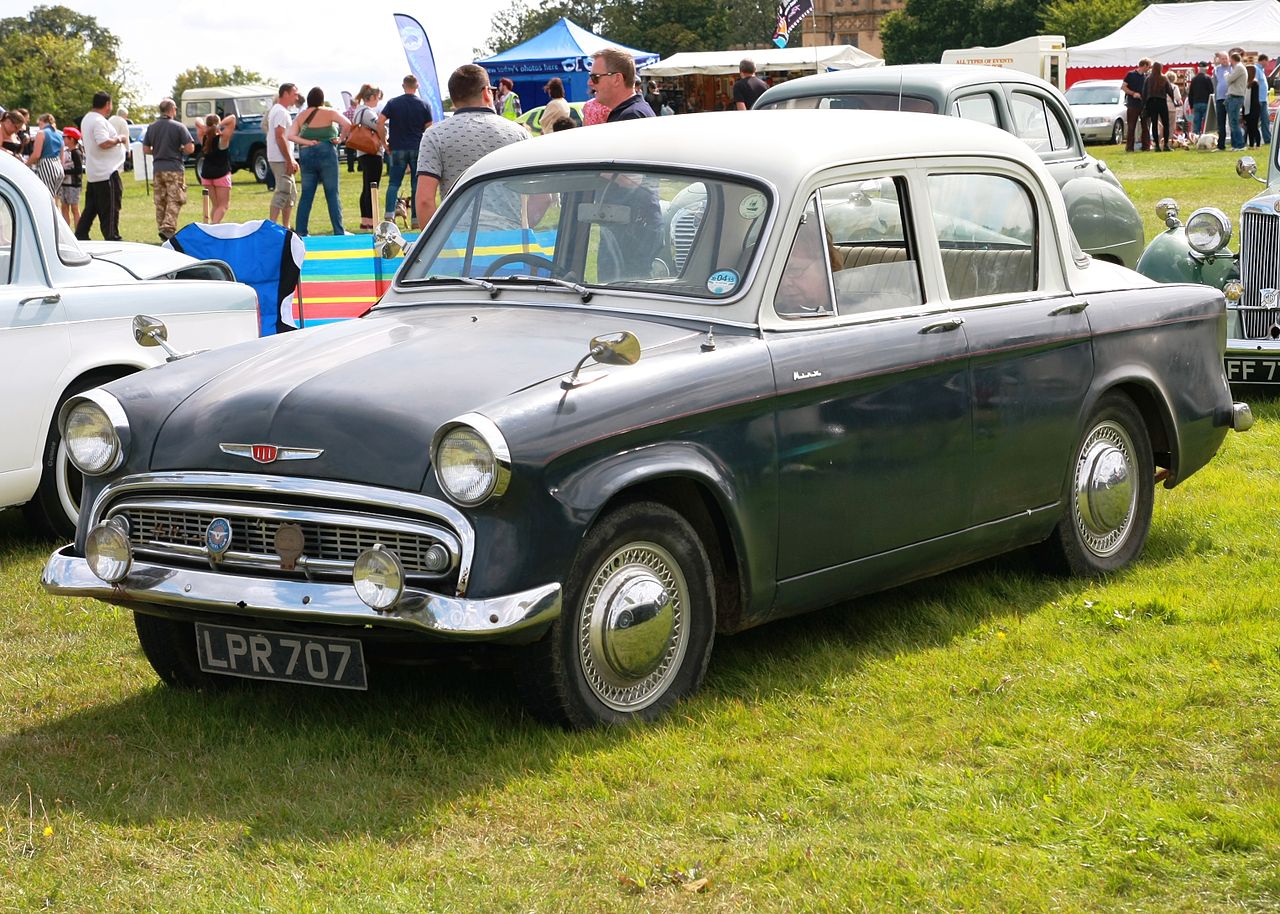
To give some ideas of the great strides modern ICE engines have made over the years, my first ever car when I passed my driving test was a 1957 Hillman Minx of just 1390cc with a top speed of 77mph, a 0-60miles time of 25.4 secs, power output of 47HP and did just 26mpg, and I'd hate to think about the amount of pollution it and cars of the era were spewing from their tailpipes. Today I have a 2017 Skoda Superb, 1968cc top speed of 137mph and giving out 150HP, 0-62mph of 8.9 secs and gives up to 71mpg with a Euro 6 engine and all the time engines are getting more efficient and Euro 7 engines are now coming out, pushing the economy up even further and pollution levels down even lower with increased HP and torque outputs. Air quality has been vastly improved and there are exciting new developments being introduced all the time. If we stopped destroying vast amounts of forests and actually planted more trees and plants and stopped tarmacing or concreting every bit of green spaces, left proper grass verges at roadsides etc along with the reduction of tailpipe emissions with modern cars, stopped making and selling cars with engines huge great engines (don't forget we have a national speed limit) we will go a long way to reverse the climate change surely?
-
Excellent, a sane and savvy person who can see both sides of things and not get excited, well done. I do think that EVs have place and might well be the perfect answer for the future but have a long way to go yet. However I do not think that new ICE cars cannot can longer be sold from 2030 onwards is a good move. A better move might have been to put a ban on ICE cars over 2.5litres. Anyone wanting a performance car would need to look at EVs and the biggest polluters would be drastically reduced.
-
Did you actually watch both videos right through?
-
Exactly, claiming that EVs started it or not are NOT actually helping their cause, but unless that photos was faked, they were in involved. The world's fire brigades as I posted before can see that there is a real problem which is not going to get any better, only get worse, as more and more EVs take to the road to the point where they are not the minority any more but become the majority and if nothing is done to improve their safety that a real massive problem is just waiting to happen.
-
You might want to reconsider your post and your statement, "So the uncontrollable fire on the ship had nothing to do with EV's. " When you watch this video from an actual real life motoring correspondent, and I'd be inclined to believe his expert knowledge over that of a German Politician as quoted in the article that you referred to. Very often politicians resemble the main stream media in as much as they have a hidden agenda and will often twist the truth to suit that agenda. In fact, I have seen that photo that is shown in the video before, I'm pretty sure that it has been posted here in this thread, and I was a bit concerned by it then, but was unable to work out why I was uncertain until this guy points it out. Strangely enough, I have since looked for that photo here, but it no longer seems to here, so maybe the poster has removed it? Once again, before everyone dog piles me, I'm not saying that the fire was started by a EV, but that it certainly appears that EVs were involved in the fire and that would explain why the fire was able to ravage the entire length of the ship and why it was so difficult to put out (assuming the CO2 system was deployed). All these answers should be revealed in the official report when it comes out, which is often a few years later. But for now it is looking like a massive whitewashing job and cover up job. When it was first announced, the amount of EVs was played down to 25, when in fact there were 498 and also, all the other brands of cars were able to provide details of their exposure to the fire but not VW, that seems to be odd. I offer 2 videos for consideration, and I suggest you take them in the order listed for clarity.
-
That is the ideal price point to encourage more people to take up an EV for sure, trouble is however that small cars just do not suit everyone, certainly not for me. Nobody would be able to use the seat behind me as I'd need the drivers seat to be all the way back till it was touching the back seat, in order to drive it. And there is no way on earth I'd be able to get all weekly shopping for done for 4 people into that boot space, I'd have to make multiple trips, thus adding to the traffic congestion and also of course increased chances of be involved in an accident and of loosing my parking spot while out so much. And with such a small boot space, there is nowhere to put our steps when visiting military airfields etc.
-
This is still not concrete evidence by your own terms of reference, it needs to written by a couple a professors 😆😆 I'll wait for the official report to confirm the actual cause. Personally I hope no EVs were involved at all, it would improve confidence in them.
-
Well, I'm not going head-to-head with you on that one, let's just wait and see what happens, but my gut tells me, that software and electronics have minds of their own at times and thanks to Murphys footsoldiers, capacitors will wreak havoc in time, mark my words on that one.
-
Well both really.
-
Now this is the type of thing we need more of, up to now it has been one of the missing links in the whole EV loop, now we need to address the problem of preventing / or reducing the chances of thermal runaway, maybe design the sealed enclosure so that if it happens, they vent downwards rather than sideways to minimise the collateral damage (dragging other EVs into the meltdown and creating a massive chain event). While it is a pretty rare event now for EVs to catch fire, as they become more common, the events will increase naturally. The other elephant in the room that everyone needs to take on board before complacency sets in, is that it is also very rare for new cars to catch fire, it tends to be older cars, 10 plus years old with many miles under their belt and everything is getting worn and fuel drips onto hot exhausts etc, so we might well see increases in EV fires as they age. I think the reason why EV hire cars are so expensive to hire is a reflection of their higher purchase price, higher performance, and also their higher insurance costs, seems to be a perfectly logical conclusion.
-
More wind turbines?
-
I tried a Enyaq, still not as big as a Superb and a much smaller boot as well.
-
How many people have the ability to charge at home which the above figures are assuming, plus you need to factor in the £1,000 plus cost of the home charger and its installation, plus the extra up front costs of the EV against its ICE equivalent, also of course there aren't that many EVs that could accommodate 4 people that 6ft 4" tall and still have a boot space similar to that of a Superb. Most of the public chargers, which I would have to use, are in the realms of 50p per KWh and higher, which destroys your calculations, then if you don't do that many miles per year, any potential savings are not worth having as the upfront extra cost is never going to be repaid unless you keep the car for a long time. As I've always thought and said, EV's are currently not suitable for everyone and if the above figures are reflecting your scenario, then I'm pleased for you, but is not the case for a large part of the population.
-
Ideas like that may be the catalyst that is required to convince people to make the switch to EVs as well reducing the cost of ownership to make EVs comparable to that for ICEs. I know that @wyx087 goes on about overall costs, but that is of little comfort if the cost of entry is seen as being prohibitive for those on low incomes, it has to be affordable. Overall costs are such a subjective issue as they will vary greatly by the style of driving and of course the annual mileage, but ticket to the dance has to within grasp and not just to the better off sectors of the population.
-
Thank you Colin, I have been trying to do just that but someone has to keep poking the fire because I don't share their particular point of view. Strange when most of us agree things need to change. 👍
-
Interesting that he said about e scooters have been banned from being inside buildings in America and they only have a very small battery. Maybe that is where the London thing is coming from. As I understand it, it is not the authorities banning EVs in their residential underground carparks but the leaseholders or someone with the responsibility for the overall safety for the entire of a building as a whole? 6. They said it was a brand new EV car costing £22,000. 7. A new car with a 2014 number plate 🤥 8. There is so much to this story.
-
Thanks to you all, I have now been able to update my 2016 map set to the 2023 current ones 👍 Now does anyone know how I can make or get my own POIs and enter them?
-
Whatever evidence I provide, you somehow try and rubbish it or totally ignore it and then you go on to provide evidence that second hand EVs are less expensive than ICE cars with this link https://www.speakev.com/threads/second-hand-evs-are-cheaper-than-ice.179449 🙄 Are you trying to say that I shouldn't want to buy a new car because new EVs cost more than their new ICE equivalents. Then when I said about old second hand EVs would also suffer from battery degregation and thus less range and tried to counter that with "There's a healthy scrap market for second hand batteries: https://www.ebay.co.uk/sch/i.html?_from=R40&_trksid=p4432023.m570.l1313&_nkw=leaf+battery&_sacat=0 So to my mind, how would an old EV be liability when its batteries are an asset waiting to be re-used? " How on earth does that relate to what I was saying. Firstly eBay is not a scrap market, the prices shown on that link are what they are selling them for, not what I could get if I brought a second-hand EV and replaced the battery and sold the old one, and then the that car would leap up and become much more expensive than and an ICE car. You gave me this link Electric Vehicles | Bedfordshire Fire and Rescue Service (bedsfire.gov.uk) which only mentions E scooters and even then hardly anything about them. I could have hit you with these links but I decided it was not worth it because you would not even accept what they were saying as gospel. Lets try it and see, here are some links that actually the scale of the problem and these are some die hard ICE lovers but mainly people charged with trying to protect us and our property when things go wrong, are they all so wrong???? https://www.youtube.com/watch?v=qwxZu3nVOZ0 The Red Boxx – a Bathtub for Cars – open source lab (dfki.de) https://en.wikipedia.org/wiki/Plug-in_e ... _incidents Essex firefighters adapt to new hazards in electric vehicle fires | Essex County Fire and Rescue Service (essex-fire.gov.uk) Electric car batteries: What you need to know (firerescue1.com) Firefighters develop special vehicle to fight EV fires in car parks (thedriven.io) Firefighters still struggle to defeat EV fires effectively | CarExpert Electric Vehicle Fires Spark Firefighter Safety Concerns | The Regulatory Review (theregreview.org) Firefighters Still Aren't Sure How to Quickly Defeat EV Fires (jalopnik.com) Electric Vehicle Safety Advice | County Durham and Darlington Fire and Rescue Service (ddfire.gov.uk) Emergency responders guide for alternatively fuelled vehicles (nationalfirechiefs.org.uk) UK company reveals 6WD EV battery fire response truck | Autocar Fire crews' fears over electric car blazes as they are having to double the crews sent to deal with them because their batteries cause 'rocket-like' infernos | Daily Mail Online Thermal runaway EV battery fires controlled with water cutting tech | Auto Express Data reveals extent of electric vehicle fires around the UK | CE Safety Blog Tackling fires in electric vehicles (ife.org.uk) Electric Cars Have One Problem: They Keep Lighting People's Houses on Fire (futurism.com) Lydden Hill Race Circuit fire started in battery of Special ONE team electric car while charging, say FIA World Rallycross Championship officials (kentonline.co.uk) (500) EV fires are tough to fight and pose new hazards. Inside the race to get responders ready. - YouTube (502) Why Are Electric Vehicle Fires So Hard To Put Out? - YouTube (502) Why Tesla, GM And Other EV Companies Have A Fire Problem - YouTube (541) Examples of Lithium Battery Fires - YouTube (544) Is Lithium Iron Phosphate (LFP/LiFePO4) Safer? - YouTube (541) Can Lithium-ion Battery Fires be Extinguished: Small/Medium Devices - YouTube (541) Fighting EV car fires with the FIRE ISOLATOR concept - Live testing UPDATED VERSION - YouTube (544) Controlling and fighting EV car fires with the Fire Isolator concept - live demonstration March 2022 - YouTube (544) Do Firefighting Tools for Extinguishing Electric Vehicle Fires Really Work? - YouTube (544) Electric Vehicle Fires: Let It Burn - YouTube (544) Does Submerging Electric Vehicle Fires Work? - YouTube (544) Vehicle Fire Data: Electric vs. Combustion - YouTube (544) Why Tesla Fires are Impossible to Put Out - YouTube (544) Lithium-ion Battery Fires: Full Charge vs. Low Charge - YouTube
-
@wyx087 I'm so sorry, you are taking what I'm saying so personally and skirting around what I've written and misunderstanding the points I've raised. If it has got professional firefighters in many countries highly concerned when there aren't so many BEVs on the road, and yet they really are worried about the consequences, I suppose that we the public shouldn't be concerned at all? Look, it's clear that you can see nothing wrong here, so I think its best if we just draw a line in the sand on this issue and lets it leave there.
-
Maybe you might have to leave your BEV either side of the channel and then hire another when you get to the other side?