Gerrycan
Resident Member
-
Joined
-
Last visited
Everything posted by Gerrycan
-
If you are using a PC then go to the top of the page and click on the 'Forums' in: and then roll the page up to see the models and variants

-
Welcome to Briskoda. Navigate to the appropriate model and the latest version and you will find there will probably be many opinions, issues and reports already posted there by existing users. Just be aware to look at the date any issue was raised and see if there have been any updates by Skoda to rectify the reported problem. This forum is one of the better ones and there is usually someone ready to respond to any questions you may have or offer advice on what to look out for.
-
The tank size on a non-AWD Octavia is a nominal 50 litres, and that will be the minimum amount it holds. If the 50 mpg displayed is reasonably accurate then 500 miles would use about 45 litres of fuel. So as others have previously stated it really comes down to how much fuel you are putting in the tank (and distance covered) to work out whether your perception of reduced range is real or just as a result of change in the accuracy of the fuel gauge and it's now prompting you to refuel a little prematurely.
-
I think you should consider installing both: A good quality, but not too dark, tint will provide good protection from UV A, B and C (everyone benefits on a long drive). It will still allow reasonable external vision for passengers and driver when it is not especially bright. Shades for when it is exceptionally bright, or you just want to reduce stimulation to allow baby to sleep.
-
I got about 3 minutes in and decided that it was too long to view on a subject I am already reasonably knowledgeable on, and in agreement with anyway, and have been for decades, which is well before the presenters were even born. The simple truth is we are subject to incessant marketing of addictive processed foods, high in sugar/fat/salt, low in nutrition/fibre which are good for their profits and bad for our health. I've always thought that if there is a Satan on earth, then he is probably a marketing executive. Actually getting the message of the benefits of a healthy diet across to those who really need to know about it and apply it, is another problem. I reckon my 89-year-old mother-in-law consumes a big cup of sugar a day (600ml packaged egg-nogg with the equivalent of 10 teaspoons, 2 teaspoons in each and numerous coffees, flavoured yoghurts, chocolates, cakes etc) but only has a small breakfast and her small main evening meal may occasionally have a couple of vegetables (because for some reason she is not hungry). She is overweight, her joints are overloaded and painful but amazingly her main organs are performing well, and it is a tribute to her doctor and the incredible number of medications she takes. Naturally she ignores all nutritional advice, from her daughters, one of whom is a recently retired but highly credentialled nurse.
-
I had mine changed at 50k km but really did not care what was fitted, leaving that decision in the dealer's 'capable' hands. I did ask to see the old plugs that came off and quite honestly, they were pretty much like new, with very little wear or carbon deposits. I suppose as the car is approaching 100k km (2014 model) I should consider getting new ones fitted during next year's annual service. As long as the plugs are from a reputable brand and as specified for the engine then I'd be surprised if there was any noticeable performance difference between your options.
-
Tough choice, but no real bad one though. If you have home charging and don't mind the smell of Musk then have you considered salary sacrifice and Model 3 Performance or LR?
-
Are you still on the original tyres? At that age they could well have hardened, and the noise/ride/handling suffered as a result. It was something I experienced with Michelin Primacy tyres on my Octavia when they were about 4 to 5 years old and new tyres fixed what I suspected, incorrectly, were suspension issues. Check the weeping shock for yourself and see how bad it really is. Seems that some MOT testers can be overly keen to point out a minor 'moistening'. Our Octavia is now 10 years old still on the original shocks and it has done a few hard kilometres on corrugated and gibber strewn dirt roads.
-
I had Michelin Primacy tyres on my mk3 Octavia for a similar period and they were fine up to the last 20k km where noise and ride gradually deteriorated to a point where I suspected possible suspension issues. New Continental tyres rectified the road noise and ride issues completely. Unfortunately, I got a screw puncture shortly after purchase and I think I can hear the plug repair's effects on smooth tarmac. The car came new with Dunlop Sportsmaxx and I found them surprisingly good for their whole life (only 40, 000 km though) which is contrary to most other's reports of the tyre. Sportsmaxx are expensive here in Aus though, and have a short life compared to contemporary lower priced first tier options.
-
Not even sat in a Rapid but I am a little surprised it is thought to offer more legroom than a Yeti.
-
I really feel I escaped a bullet! I nearly bought a manual Scala when prices were really low in Aus pre-Covid but just could not arrange a test drive of a manual with my wife before everything shutdown. The standard 205/45/18 tyre from a decent brand is almost 'unobtanium' rare here as @Mikey_au says, which is simply 'Not-Clever' on Skoda's part, well actually grossly STUPID and I'm not attracted to the idea of fitting Chinese Ditchfinders. 205/45/18 are standard for both the 1.0 and 1.5tsi and no other option. Looking at the British Skoda website they specify either 205/55/16 or 205/50/17 and I'd be tempted to convert to the latter because at least there are then a few more quality tyre options available here. Not a cheap exercise though. Absolutely grasping at (low cost) straws, I'd try lower pressures around 32psi and see how that feels. I'd also jack up the car and let the front suspension droop so you can ensure the colourful transport blocks had been removed when first sold. This is rare but certainly not unknown. I feel the OP is in an awkward fix not of his making although I remember a work colleague many years ago (pre-internet sourcing!) buying a 'special edition' Holden Commodore and when the tyres needed replacing was quoted about AU$2000 for a tyre size only available from overseas, and this from a local manufacturer (he literally lived 5km from the Holden factory).
-
@Bikerjon, What size wheels and tyres are fitted? Do you know how many miles they have done? How much tyre tread is there left on the tyres, front and rear? Is there any evidence of 'saw-tooth' wear? What tyre pressures do you run? Is there any indication that a tyre(s) had punctures repaired with plugs? When was the last wheel alignment? All these factors can have a major effect on cabin road noise. My experience with Michelin Primacy tyres fitted to my mk3 was that over the last 15k km of their life that the road noise became much worse (even on smooth tarmac), as did the ride, so much so I thought there were spring /damper issues. Fitted Continentals (purely on best price at the time) and normal sound levels and as new ride characteristics were restored. As discussed by others Skoda don't fit much (any?) sound-proof material, but I have been in worse cars. A hire Toyota Corolla hybrid that was absolutely awful on Australian coarse tarmac highways but silent on smooth tarmac and also surprisingly bad was a new Merc C Class on the North M25 concrete sections. The latter might have been due to higher expectations though.
-
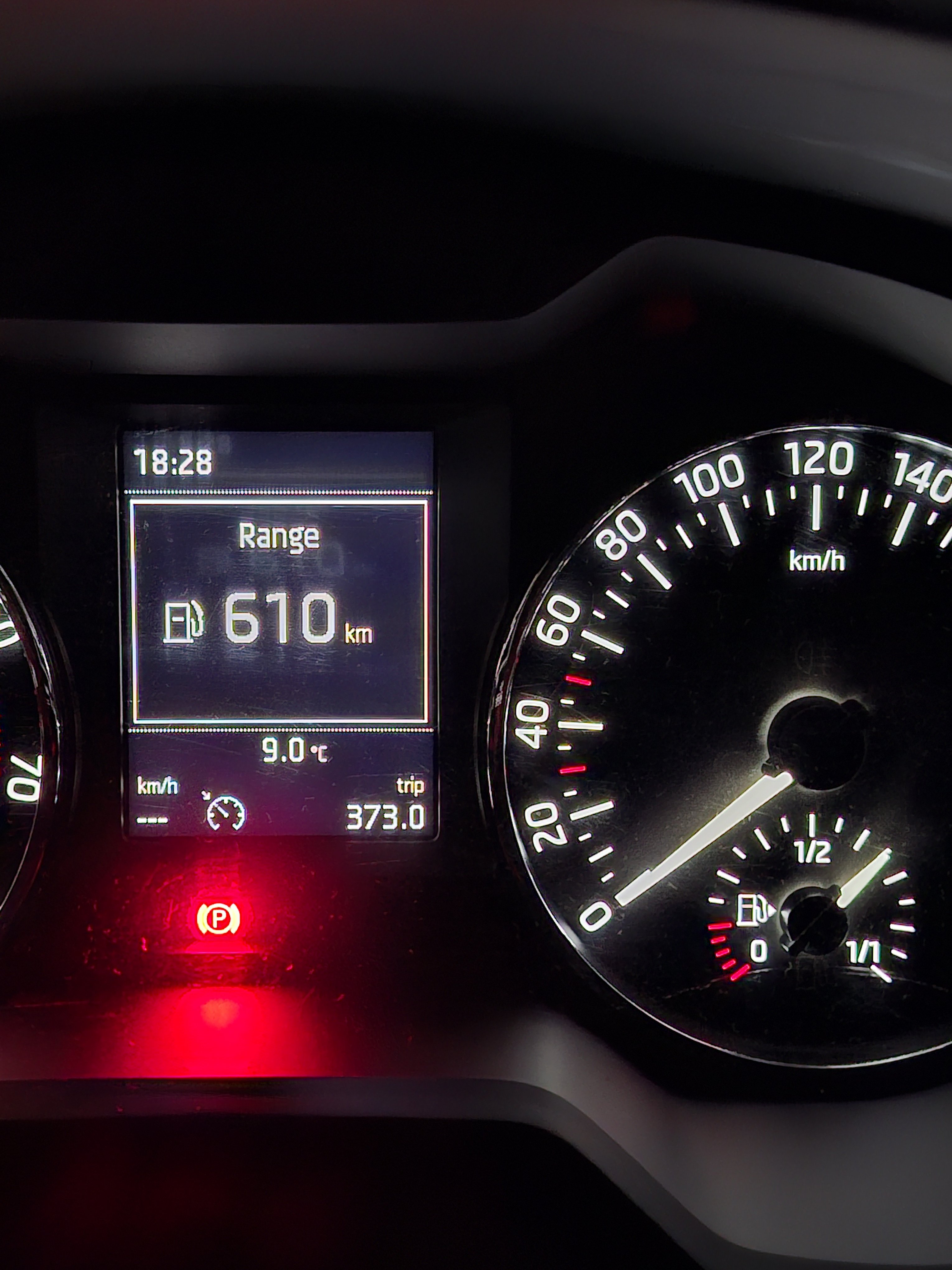
This is from my 10 year old 1.4tsi manual before I topped up before local fuel prices go up by 20%. Trip distance since last refuelled. 310 km by my wife over a couple of weeks and the last 63km by me (four separate journeys on one day because I left my phone behind on the first trip) were all urban. My stint averaging 5l/100 at 30kph average speed accounts for the high projected (and unlikely to achieve) range on remaining fuel. I would expect a 1.0tsi manual to be capable of improving on consumption of a 1.4tsi in similar conditions. You will note it is winter here 😞 .
-
By my calculations that equates to 45 litre tank with a smidge over 6L/100 consumption. I knew they put it in the smaller engine and more economical Octavia mk 4 but I'm a bit surprised they put that small a tank in a sporty 2 litre turbo engine medium sized car. Might have expected you to crack 50mpg at the 45mph average speed but the slow average speed also suggests there might have been some jams or some urban driving which knocks consumption and speed averages down.
-
32°C is not that hot really but add a bit of humidity and the sun shining through the windows and then it can become quite uncomfortable without aircon. I suspect that dehydration was the real problem for you. Pretty easy to be caught out when the weather has been cold for so much of your year to date. I hope the GTN was not Gin and ToNic
-
Decades before the current popularity of non-alcoholic beverages (beer, wine) there was an Australian non-alcoholic wine called Claytons with the advertising line "The drink you have when you are not having a drink". It meant the name became an Australian reference to something that is not quite what it appears, or an inferior product. I have often set myself what I would call my 'Clayton' (none binding) sporting objectives. I'd do the training preparation but was not really worried if I didn't compete in the 'target' event (bike, run, or triathlon). However late last year I set myself a realistic 'Clayton' objective of running 10 km on or close to my 70th birthday in January this year. It seemed a fairly achievable target until real life (and medical issues) got in the way of any running, much less regular training. In the past, not competing in an event did not bother me, but at least I was capable if I had really wanted to, this time, however, it actually looked like this was one target I would not be capable of doing and it might slip away. Well today, a bit later than anticipated and a quite a bit slower, I eventually achieved my target distance. Feeling pretty chuffed about it really.
-
An annoying colleague at my wife's work claims her physically larger Mondeo wagon (Australianese for estate) is super huge and can carry everything, always volunteers to move equipment to events so that lots of people can help load and admire the vehicles internal capacity and her selfless 'volunteering' (in paid work hours of course). Funnily enough she is never able (family commitments?) to bring the stuff back, when there is no one there to impress, so that duty often falls to my wife and our Octavia estate. Not only does my wife fit in equipment complete that had to be disassembled for the Mondeo but on more than one occasion managed a two-trip Mondeo load in one Octavia trip. Wisely, my wife keeps quiet about the Octavia's Tardis interior because you can't argue with an idiot. It really is a 'Swiss army knife' of a car, can deliver near hybrid consumption, more than enough performance (for us) when needed, roomy and a joy to drive interstate. Seriously nothing presently on the (Aus) market worth the expense to change imo and I dislike all the now obligatory safe driving aids in new cars.
-
Goodness, what temperatures were you experiencing, and please tell me you had your air-conditioning on and not suffering just for better consumption.
-
I would never say never. I don't know about the UK but prices for some (mostly Chinese) EV have suddenly plummeted here in Aus recently. An ORA Good Cat can be had for A$35k (18,400 pounds) drive away with a '7 year warranty' That's good in one way as it means I am looking again at EV options for our mostly urban driving, but it means that early adopters, even recent purchasers, suffered some major unexpected depreciation. What I don't like is the Chinese throw-away design mentality, lack of local spare sparts, financially supporting the CCP (or pairing my phone with their system, which is also why I don't have tiktok). I'm still better off running our existing old, still economical, ICE cars into the ground than getting a current new EV, but I will be keeping a close eye on battery tech and/or 2nd hand prices.
-
The Octavia 1.0tsi is actually not that heavy compared to most direct competitors, I can only think of the slightly smaller Peugeot 308 estate being lighter. Acceleration times to 100kph are supposedly a fraction under 10 seconds, which is pretty respectable for a 'lawn mower' sized engine but expect performance to be noticeably compromised when loaded. The turbo is more tuned for low end torque but I thought the engine revved more easily and smoothly than I expected from a 3 pot, though not as turbine smooth as the larger 4 pots. There should be no problem with motorways, or the hills in your area. If you lived in a hilly area a bit more capacity would be welcome. Consumption can be outstandingly good when driven sensibly, or just reasonable with a heavier right foot. Performance and especially economy should be noticeably better than your 1.2 Yeti imo due to less weight and better aero.
-
Driving education in Australia (and UK) is pretty bad! Totally unlike the thorough driving student education required in Scandanavian countries. Once you pass your basic driving test you pretty well learn through the school of experiences survived and hard knocks, which is really not the best way. Do yourself a favour and enrol in a one-day Defensive Driving course where you will first learn on a track to perform emergency braking and then steering while emergency braking. I have done the same course twice, several years of car technology apart, and really recommend them. One of the main points they make was that the manufacturer's normal recommended pressures are mainly for comfort and not for safely coping with emergency braking. They recommend about 5 psi over recommended pressures (for a given weight) to avoid the front tyres deforming under heavy braking causing loss of tyre contact with ground and therefore maintains better braking performance. Coincidentally the extra pressure usually coincides with the best economy pressures from the manufacturers, and it can give a noticeable improvement in fuel consumption. As mentioned above, set the pressures when the tyres are cold. Too high a pressure can be dangerous, cause uneven wear across the tyre, and make for an uncomfortable ride on rougher roads. Too low a pressure for the weight in the car with high speeds can cause tyres to overheat and destruct.
-
@LuxoviaRS, you have not bought a very economical car in the first place. It has useful performance, and it can be relatively economical in the right circumstances, but obviously not if you use the performance, and not particularly good in heavy traffic, but then again what is? Other than a hybrid or EV You have not said in what part of Australia you live. If the east coast, then you may have experienced a lot of rain and high humidity and, as I mentioned to the OP, running the aircon to control humidity will have a noticeable adverse effect on consumption (it runs the heating and cooling at the same time). None of the official consumption figures include running any other equipment, which I think is wrong. I have never used adaptive cruise control in a city environment. I'm sure it is very convenient, but I cannot think that it would actually be very economical in stop/start traffic, probably using a lot of low gears, a lot of relatively late braking and killing consumption. I think your best bet to test the car is run it on an open flat road in top gear at around 100kph and if the instantaneous consumption is somewhere around 6l/100 then your car is probably fine and your expectations for city driving a bit optimistic.
-
While it is important to correctly code the battery type and size for correct charging and longer battery life there is no reason why it would noticeably affect fuel consumption. The only time I have seen idle consumption at or near 2.2l/hr in my 1.4tsi was related to several factors: Outside temperature of 47 deg Centigrade, 5 occupants, city driving, air conditioner going full blast to cool us and radiator fan going full blast to cool engine and air conditioner. These loads really affected general consumption adversely as well. Controlling high humidity with the aircon also worsens consumption. I see that recent Istanbul temperatures are at a relatively comfortable low 30's so it may not be the reason for your problems. When the engine is warmed up and the aircon turned off what is the idle consumption showing and what are the revs per minute? My car would show 0.5L/100 and 700 rpm.
-
'Urban' and 'highway' are generic but non-specific terms, the former usually has more interrupted flow patterns and slower speed limits than the latter. Still useful terms to distinguish between the driving environments, I think. You don't have to be in neutral, you can also coast just by disengaging the clutch on a manual . The point is that I can coast more freely than some seem to be able to with their DSG box and associated programming. It had never occurred to me that there would be so much variation between similar models with DSG. If I ever make the transition to DSG (but probably more likely an EV) then I'd like to have the option to coast where I think conditions will promote lower consumption of fuel or electricity.
-
I have a different car, an old 1.4tsi manual Octavia, and of course I can choose when to coast where and when I want. I have experimented with coasting and there are pros and cons. An example of 'pro' I have cited before is a long descent on a 110kph limit highway where the gradient allows the car to coast at a constant 110 kph (aero drag matches gravity), the (my) engine is idling and consuming 0.5L/hour. If it is in top gear, then some extra throttle has to be applied for the engine to maintain 2700rpm to avoid engine braking and slowing the car below 110kph and that shows consumption near 2L/100, which is nearly four times as much. If the gradient was more then I would be better off with car in gear using engine braking and zero fuel to keep the car below the speed limit. In an urban environment, coasting will get better consumption than having to maintain revs in a lower gear for a low speed. If lessening of speed is required, then you are better off using engine braking than coasting the distance and then applying the brakes. While I know what works I cannot be bothered to utilise that knowledge all the time and just do what is easiest, which is read the road and anticipate traffic movements to avoid unnecessary use of brakes. Mad keen hypermilers in the US have a kill switch in the car so that when they are free coasting then can turn the engine off, the semi-sensible ones have pumps supplying air pressure for the brakes. And continually accelerate and coast (engine off), getting up everyone's' nose. Remember the time when they built tiny vehicles with specialised engines that achieved 1000mpg? IF they ran the engine all the time then they would 'only' get consumption in the hundreds, but by accelerating to speed and then coasting with engine off they managed multiples better consumption. It also utilised the factor that an ICE engine is at its most efficient at revs and under load. It is somewhat confusing for some that an ICE car running at its most economical speed (let's say top gear at 65 to 70 kph) is actually operating below best efficiency because a high percentage of the fuel consumed is just to get the engine to the required revs and the rest in propelling the car. A formula one car at full throttle is one of the most efficient engines in the world despite the huge amount of fuel consumed.