ejstubbs
Members
-
Joined
-
Last visited
Everything posted by ejstubbs
-
I must have had a reason to order one in, but blowed if I can remember what it was! IIRC the Missus' now-departed Polo used the same part for its rear wiper, and it's possible that the one on her car needed replacing at some point - but I don't understand why that would have made me buy another spare "just in case". They don't fall/snap off that often, do they? EDIT: I just found an eBay order confirmation for the part, dated January 2021. So it wasn't that long ago that I bought it, either. Must be getting senile...
-
Many thanks Varoom! Quite by chance I discovered yesterday evening that I had a spare stashed away in one of the darker corners of my garage, with precisely that part number. I've no recollection of having had to replace one before, though, so it's a bit of mystery why I had it!
-
I managed to snap the cover for the rear wiper arm pivot off my 2107 2.0 Tdi DSG 4x4 Yeti last week - somehow it caught the cuff of my jacket and the wee retaining clips snapped straight off 🙁. It wasn't going to stay put after that so I resigned myself to buying a replacement, and with that in mind I carefully put the broken one aside so that I could check the part number. So carefully did I put it aside that I now cannot find it 🤬 Might some kindly soul be able to provide me with the part number for item I need to buy?
-
I don't think that would close the windows - in that same way that the automatic door locking once you go above a certain speed doesn't.
-
Some 13-pin trailer socket testers are known not to work with CANBUS-equipped vehicles anyway, see: https://www.gov.uk/government/publications/mot-special-notice-01-19-towbar-electrical-socket-test-tools-diesel-smoke-meters-and-annual-training-and-assessments/mot-special-notice-01-19-towbar-electrical-socket-test-tools-diesel-smoke-meters-and-annual-training-and-assessments Basically, the testing devices concerned use LEDs and, as I think we all know by now, the CANBUS will throw a fault if it finds an LED bulb where it's expecting an incandescent. My Yeti was failed for this very reason in 2020. I took it back to the testing station with my towbar-mounted bike carrier fitted and connected up, and they passed it. Which wasn't a huge surprise, since it worked fine. I've read elsewhere that fitting a 13-pin to 7-pin adaptor to the trailer socket on the car is another way to avoid arguments with MoT testers about this. Apparently the test procedure for a 7-pin socket is purely visual - looking for damage, corrosion etc - and they aren't allowed to remove the adaptor to check the connectivity of the 13-pin socket it's plugged in to. Which I'm sure makes perfect sense...to someone. If they struggle to make a device that works properly when it's just testing the supply of current to individual lights*, I wouldn't hold out a great deal of hope for them being able to come up with a device that can test a digital solution as proposed by J.R. * I suspect a good number of us on this forum could construct a functional test device at home with a hour or so's work and a few pounds' worth of materials. Yet apparently it's beyond the wit of the great global automotive industry 🙄
-
It's always a good idea to take a photo yourself before you start taking something apart, especially if you don't have any actual documentation as to how the thing is supposed to go back together!
-
Exactly what I was thinking. Localised diesel spill maybe? Having experienced one such on the bike a few years back it's scary how the grip just suddenly disappears (though not as scary as the bill for the fairing plastics 😱). On a bike you can sometimes get a warning if you notice the smell, although that can be very dependent on wind direction and other atmospheric conditions Not so much in a car. Classic spots for diesel spills are roundabouts and curved slip roads, due to the combination of centrifugal force and an optimistically over-filled diesel tank. It was a roundabout where I had my diesel-induced off. I have to say that the smell wasn't all that obvious even when I was sitting on it on my backside. It clearly wasn't a fresh spill, though, so maybe the worst of the aromatics had had a chance to evaporate. It was still horribly slippery nonetheless.
-
Nope, it's bog standard just like the OP said his was. So it seems to be still a bit of a mystery how his MFD managed to lose its km/h display.
-
I just checked the MFD data options on my 2017 2l SE DSG 4x4 and I couldn't see anything like that.
-
I've done the window reset a few times now and I've never had to do the "slight outward pressure" thing for it to work just fine. YMMV as they say...
-
Some people may go about the job differently. I certainly tend to keep a very close eye on the 'key', on the grounds that if it goes walkabout during the process I'm stuffed. I repeat, though, that the most up-to-date edition of the Yeti manual does not say anything about the order in which the anti-theft wheel bolt should be installed or tightened/loosened vis-a-vis the other wheel bolts, which strongly suggests that there is no technical reason for the recommendation in previous editions.
-
It's not in my user manual (2017/05 edition). Anyone who doubts me can download it from the Skoda web site to check for themselves. All it says about the order of tightening is: Tighten the wheel bolts opposite each other using the wheel wrench (“pull-ing crossways”) I strongly suspect that the advice about loosening the anti=theft wheel bolt first and tightening it last is simply a convenience thing: you use the 'key' first, put it aside then don't use it again until tightening the last bolt. That saves switching back and forth between the normal socket and the 'key' more than necessary (I have a feeling that this is how I do it anyway, for that very reason, though it's been a while since I had a wheel off). As things stand now, I can't conceive of any good technical reason why the anti-theft bolt would behave any differently to the other wheel bolts in terms of holding the wheel on the hub. Or why one might want it to. As ever, though, I am more than willing to accept correction from an authoritative source.
-
I just had a nosey at the under-used (mostly due to cost) Carista app on my mobile and I noticed that the list of supported vehicles only seems to cover the 1st generation Yeti. Does this mean that facelift models - especially the diesels with AdBlue - aren't covered? Or does the developer simply regard all Yetis as "1st generation", with the facelift models not counting as "Mk IIs"? The last time I used the app in anger was on my Elegance 140 4x4, so I'm quite keen to know whether it will actually work properly on my SE 150 4x4 DSG before I bite the bullet and cough up a month's sub! EDIT: Assuming that it does work for my Yeti, I'd also be interested to know what customisations are available for my car. It seems a bit poor to have to shell out £9.99 just to find that out. I don't suppose anyone has a list handy?
-
From that link:
-
According to Wiki, an R22 weighs 399kg empty. Fuelled up and with a pilot on boar I'd guess it would be closer to 500kg. In the clip, the helo's rotors never actually stop rotating. I'm pretty sure it was a "touch and go", a bit like the helicopter that "landed" on the summit of Everest in 2005.
-
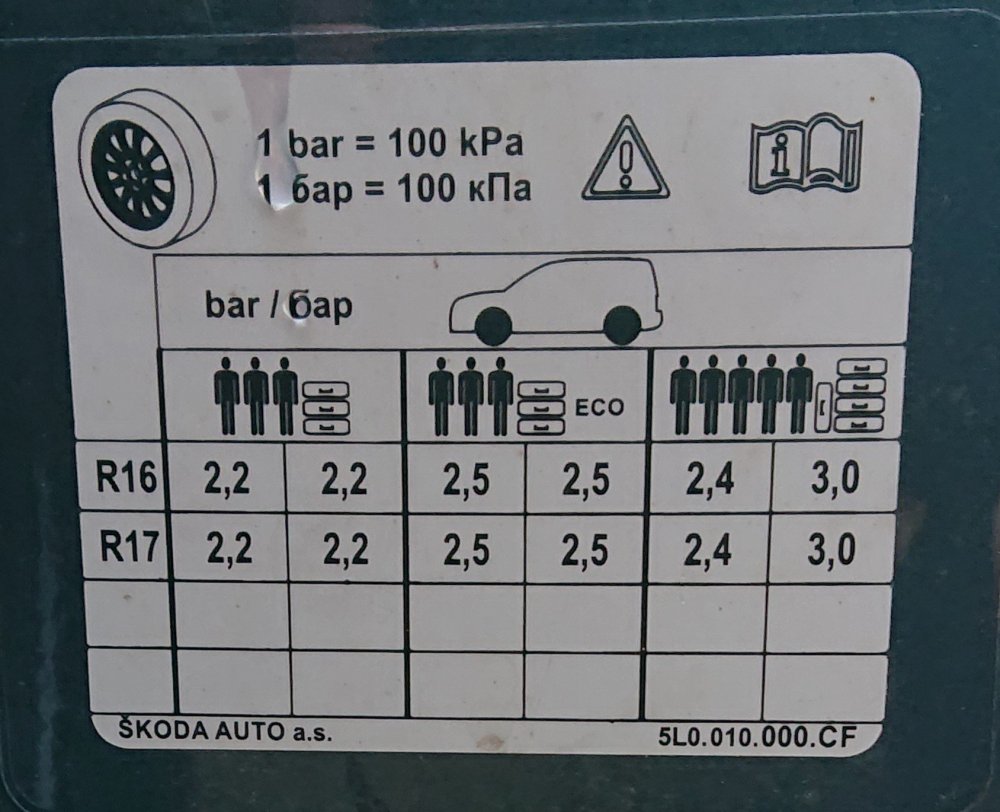
The label inside the fuel filler flap on my Yeti seems to allow up to 3 bar when the vehicle is fully loaded, which Rustynuts says his usually is: (I have to say it's not entirely clear why there are two figures under each load category, nor why they're the same in each category except for the fully loaded case.)
-
Do any Yeti owners have any views on the pros and cons of running their tyres at the "eco" pressure shown on the label inside the fuel filler flap? I understand from the manual that it's supposed to improve mpg - but does it make the ride harsher, or have any other adverse effects? The reason I am prompted to ask is because my tyre pressure warning light came on the other day. I stopped and had a look at the tyres but they all seemed OK. I drove the short remaining distance home and let the car cool down, then checked the tyres. I found the front nearside was at the "eco" pressure of 2.5bar whereas the rest were at 2.2bar, which the label inside the fuel filler flap indicates is the nominal pressure for the car when part laden. I will admit that I'd never consciously noticed the "eco" pressure setting on the label before. I assume it must have been like that for a week or so, dating back to when I had had the NSF tyre replaced and the front wheels re-aligned due to excessive wear on the outer shoulder of the NSF tyre. I'm a bit disappointed that the garage that did the work, which I usually trust to do a decent job, had apparently not thought to check the pressure in the existing good tyres before inflating the new one. But in the long run I think no significant harm was done in this instance. This is only the second time I've had the tyre pressure warning warning light come on. The first time was after I'd had to fit the spare - which is a bit smaller than the normal wheel+tyre - after ripping the sidewall of the OSF on a sharp piece of protruding kerbstone ☹️ (no chance of fixing that with goo!) In that instance the light came on after about ten miles of driving, which I thought seemed like rather a long distance to cover before the computer decided that the wheel revolutions were significantly unmatched. In this more recent instance I'd probably covered about 50 miles before the light came on, which seems even worse - although I suppose the actual difference in the rolling diameter between the same tyre at 2.5bar and 2.2bar is likely quite small. Nonetheless, it does reinforce my view that the tyre pressure monitoring system is really only useful as a warning in the event of a fairly major deflation - in other words, the kind you'd expect to notice anyway? - and is no substitute for regularly checking tyre pressures (which I admit I probably should have done as a matter of course after the new tyre was fitted, just in case).
-
I'm pretty sure that car would have been due to get the emissions "fix". which did involve an ECU update. Whoever had the car at the time the "fix" was being rolled out would have had to explicitly request that the "fix" not be applied during a dealer service. If you had the car from new, had it serviced at a dealership, and didn't refuse the "fix" then it will almost certainly have had it done. If you acquired the car second-hand then it will likely depend on whether or not the previous owner refused the "fix". I believe there is a way to find out if a particular vehicle was due for the "fix" and whether it got it - somewhere on the Skoda web site I think but someone else on here may know for sure.
-
Have you got that the wrong way round? (On second thoughts, did you mean: "there is no risk of discharging the battery if the headlights are left on because the car will turn them off" - which I agree would make sense.) Although, as Cornish_Lad noted, it is allowed for in the Highway Code, in certain specific circumstances. Not that I would ever do it, since my dipped headlights are correctly aligned. What I can't imagine any justification for, though I see it all too often, is driving on sidelights plus fog lights. If visibility is reduced sufficiently to make the use fog lights legal then it is also sufficiently reduced to oblige you to use dipped headlights (also as per the HC extract quoted by Cornish_Lad above, and also Rule 226), regardless of the presence or otherwise of illuminated street lighting.
-
I can find no specific reference to either of the situations Ken mentions in the UK Highway Code. AFAIK there are no circumstances in which you are obliged to use only sidelights, although in situations such as being parked or broken down at night - when you are recommended to leave your sidelights on - it certainly wouldn't make a lot of sense to leave your headlights on as well (unless the visibility was really bad). For parking, the Yeti has a feature whereby you can use the turn signal stalk to switch on the sidelight and rear light on the side of the vehicle adjacent to passing traffic. Not everyone will necessarily be aware of this, however (I don't think I've ever seen it used) and TBH I think its usefulness is questionable. (For those not familiar with the feature, the car pings at you when you move the turn signal stalk after you've turned the ignition off, in case you just nudged the stalk by mistake. It turns the ping off when you close the doors and lock the car, but pings again when you unlock the car and open the door, to remind you that the parking lights are on.) I wouldn't as a matter of course switch my headlights off if I was pulling in to a passing place to allow another vehicle to pass on a single track road. I might make an exception if the topography meant that they were effectively approaching from downhill of my position and there was a risk that even dipped headlights might blind them but I'd imagine that sort of thing would occur pretty infrequently. Where the 15mph traffic reference arises from I'm not at all sure. Maybe someone can enlighten? (See what I did there!)
-
So you did, my apologies.
-
They're not specifically illegal (as in there's no UK law that says "though shalt not use studded tyres on the public road") but official advice has been that you can be done for using tyres that damage the surface of the road* - so in theory you'd have to swap wheels every time you came to a dry piece of tarmac. * Road Vehicles (Construction & Use) Regulations 1986 section 27(h): "the tyre is not maintained in such condition as to be fit for the use to which the vehicle or trailer is being put or has a defect which might in any way cause damage to the surface of the road..." I'm sure an inventive officer could come up with a few more offences, depending on how the initial conversation went...
-
According to Briskoda member e-Roottoot, the service interval on the Haldex is now three years: So it should have been done last year on Lee_D's 2017 car. My 2017 Yeti was due (and got) its Haldex service last year despite having done a lot less than 30,000 miles (it was low mileage when I got it, and then lockdown happened...)
-
That's the one. The clutch pump on my 2010 Yeti failed in 2015 and back then WES Sighthill were 100% insistent that there was no filter and that a Haldex service involved nothing more than an oil change. After several short and not very pleasant conversations with WES about what a Haldex service really ought to include, I took my car to Autohaus to get the work done. WES Sighthill may have changed their ideas since then but when my 2017 Yeti needed its Haldex service last year I took it to Autohaus for the full 3-year service because WES Sighthill had already destroyed any faith I had in them. So their poor attitude six years ago is losing them business now. Their loss. I don't see any reason to spend my time trying to get a dealer with a rather annoying "we know best" attitude* to understand why the official service regime is inadequate when there's a well-regarded independent within the same travelling distance who is already well aware of the issue and is perfectly happy to do the necessary work. * I had a run-in with WES Sighthill before when they denied that some other, very minor, work that I wanted done was even possible to do. When I presented them with clear evidence from Briskoda that other Yeti owners had had that work done on their cars by their local Skoda dealers, they dismissed it out of hand with "you can't believe everything you read on the Internet". If they'd just agreed to look in to it in more detail (e.g. they could perhaps have contacted the dealers in question) then I'd have felt less fobbed-off. That was their first chance. The Haldex issue was the second chance they had with me to put in more than the bare minimum of effort and they blew it.
-
Even if the car's service history says it's had the Haldex service 'done', you need if possible to ask the dealer to confirm whether that included cleaning the filter. This is not included in Skoda's list of actions for a Haldex service (or any other VAG manufacturer's, AFAIK - although other manufacturers e.g. AIUI Volvo do include it) but if not done it can all too easily lead to the Haldex not working (perhaps strictly speaking it gets disabled) because the car thinks that the Haldex clutch pump is faulty (when it may just be gummed up with crud). The net result is that you end up with a 2WD Yeti, and potentially a bill for a new Haldex clutch pump to get the 4WD working again (been there, done that). There are numerous threads on this forum and elsewhere about the issue. These two threads on the Yeti forum as an example: https://www.briskoda.net/forums/topic/463463-check-your-haldex-pump-people/?tab=comments#comment-5202503 https://www.briskoda.net/forums/topic/440020-haldex-clutch-pump-error/?tab=comments#comment-4947117 The clutch pump error can be detected using an app like Torque Pro or Carista on a smartphone, with a compatible bluetooth ODBII adapter plugged in to the diagnostic port under the dash on the driver's side. (If you use the Carista app, they will also sell you an adapter that is guaranteed to work. Many of the cheaper adapters on eBay and Amazon will also work just fine, though it can be a bit of pot luck finding one that does - it's important to check the item description so you can send it back if it turns out not to support the necessary bits of functionality within the overall ODB II protocol spec. I use an Android App called ELM327 Identifier to check which bits of the ODBII protocol spec any given adapter does actually support.) If your Skoda dealer can't/won't confirm that the filter was checked, and cleaned if necessary - or refuses to accept that it is necessary at all (unfortunately not at all uncommon) - then I'd be inclined to get the Haldex serviced at an independent garage that does know about the issue, and what to do about it. Or at least furnish yourself with the necessary ODBII adapter and app to check for the error if you start to suspect that the Haldex is not functioning.