
nta16
FREEDOMLite
-
Joined
-
Last visited
Everything posted by nta16
-
Were any of the new sensors fitted before the 2018 city traffic issue started? You seem to be well on top of things generally. What synthetic and semi-synthetic oils did you use, make, model and grade? My engine is from 1959 design and (probably) built in the 1970s and I've used Mobil 1 and other local synthetic oils in it for many years as I have in other "classic" (over-priced and over-valued) cars I have owned and used and the synthetic oils have kept the engines well with real world regular use well despite other "classic" car owners telling me it would ruin the engines.
-
When you start comparing more than two tyre sizes it gets harder to keep track of all the figures - but on the other tab of that link it lists alternative (USA) sizes with rim widths for the given tyre size and I know 185 can usually go on to 5" rims.
-
John makes some good points and showed I'd put a wrong figure for speedo error. Depending on the tyre manufacturer 185/55r16 might not be recommended for a 7" width rim, that tyre size calculator shows it as for 5-6.5" rim and only a nominal 5mm extra to sidewall. This year I changed the tyres on my car ( not a Fabia) from (don't be scared now) 145/80r13 to 155/80r13 and because of supply issues had to have a more comfort than grip tyre but the improved ride comfort over the poorly maintained English roads is very much appreciated.
-
I only started redoing stuff on my car because of so many ****-ups by the professionals and "specialist experts" I thought if I'm going to employ an idiot it might as well be me but I really l - o - a - t - h -e working on our cars. I don't have a garage or many of the tools and certainly not the will, attitude, aptitude, patience, enough physical strength or condition. Made me laugh when Wino put check with a Vernier, plastic ruler and magnifying glass more like. 😄 A crowsfoot type sensor socket might help with removal next time but just use a spanner for installation this time as that way you're less likely to overtighten (short lever to tighten, long to loosen). Do check which part is wrong, fitted or new and that you ordered the correct part, we all make mistakes, I've just got the refund from ordering a set of road springs to discover at delivery I'd ordered a single spring - who fits a single spring! (most it would appear).
-
This is the problem with this decades old fashion of having oversized wheels and tyres on road cars. There is no real need for these over-wide wheels and tyres and the wheel size only needs to clear and ventilate the brakes and take the weight of the vehicle fully loaded. You get a nominal 24% increase in sidewall and a nominal 22mm and 44mm to fit under the wheel arch. (3% 7% difference to speedo.) I'm not sure how this might affect your warranty as Skoda would say that the car's suspension has not been engineered for that size of tyre and who knows what wobbles the computer programmes might have. Ride comfort will also depend on the type make, model and composition of the tyre too. If your model also had the 15" wheel option (Fabias could easily use 14" wheels) then that would be the way to go perhaps and less unsprung weight depending on wheel and tyre. That's if you can take the frightening prospect of having only a nominal 185mm width tyre (which if you wanted could possibly have more more grip than a (245 typo) 215, all about the compound of the tyre tread) depends on how fashion conscious you are and how much you are influenced by others. Do check what will affect your warranty though. https://tiresize.com/calculator/
-
If for some reason you can't recut the thread all is not lost as you can buy a new nut boss. On installing the new sensor make sure it has anti-seize on the threads, many come with it applied and clean the socket the electric connector is to go into and apply your choice of protective "grease" to both sides of the connection (I favour Contralube 770 applied with a small cheap artist's brush). Make sure any cable supports that were there from new are used or replaced if missing. There are many specialist exhaust places that take more care than the usual bash merchants so are worth seeking out. M18 x 1.5 is what comes up, so I think Wino has it again but as he's put always check.
-
So what happened in 2018? Is this TC-6 some sort of plug in monitoring electronic monitoring device, if so where does it plug in and how long can it safely be plugged in without causing problems? Any testing equipment needs to be tested itself to check it is working and its accuracy, ideally before every use, has it been used on another vehicle to verify how accurate it is? The time does not sound bad to me - but I am not a mechanic or expert in anything - but the amount of fuel seems a lot. If it was a carb you would check the choke settings, the choke cable and any linkages and give everything a good clean and lubricate but with these dumb computer programs running the show it can be more awkward, will a scan tool give you much information on a 2000 car. As I remember it the coolant sensor and lambda sensor were favourites for playing up but it might also be whatever regulates your fuel, I am a big fan of removing the MAF and spray cleaning with the correct cleaner and the same for the throttle body. If you have not done either of these since 2018 it might be worthwhile and particularly the throttle body for this issue perhaps. Anything to do with car computers I always think of checking that the car's battery and connections are in good condition and that the battery is really in a good state of charge and that does not just mean the car starts and the lights seem bright. With the sensors for the dumb computers they need to be clean and the electric wires and connector clean, secure and protected, a bit of crud on electrics can cause all sorts of issues that a bit of damp or wet could exasperate.
-
1100 doesn't sound bad to me (assuming the read is accurate), is the car park damp at that level? It might be that you are taking it too steady, give yourself a few seconds to check everything before pulling away and then drive it a bit brisker get the revs up from 1100, don't accelerate gently to 2nd but briskly, don't pull away in 2nd but 1st. The economy is from getting into the highest gear briskly, allow for condition of engine car and driving. You want to warm the engine and car but without being harsh on them. My long wait on the modern car is to allow the computer programs to stop arguing with each other, being a VAG product probably over how much to cheat emissions and mpg. Is the smoke from the exhaust condensation, petrol or oil? What does it smell like? The exhaust smoke may be more noticeable because of the underground car park, try parking on the 1st floor and see if the exhaust smoke is still noticeable when you are out of the car park and for how long. You have a 20+ year old car to expect it to be as per book when new might be difficult, there is wear, tear and age, also perhaps the fuel sold has changed and you may be using different parts than factory standard. All this assumes your car is fully and timely serviced, maintained and repaired and that it is virtually factory standard, if not then what has been altered, improved/upgraded? My carbs idle at about an indicated 1,000 in summer, more if given a run, the book IIRC is 700 but if the needle was there the tickover would be very rough but my car is 48 years old and not as it left the factory (hopefully some bit better than 1970s certainly the oil and ignition. I used to worry about getting the idle down but there is no law to say how high it should be and sitting at idle is bad for the engine so I do it as little as possible so now I don't worry and prefer it higher to move the water pump more whilst stationary as I have removed the engine driven fan.
-
With your modern, only 21 years old car, this is what I'd do being used to cars twice that age plus on a cold but not very cold day say 5c (41f) without too much wind chill. Switch the ignition on whilst putting my seatbelt on and check all the warning lights light up, start the car, check all the warning lights go out, see if the fuel gauge needle has risen above a required minimum and listen for unusual sounds, let the idle settle or remain level , then pull off. Letting the idle settle or remain level may take 5 or 10 (or more or less). I find my wife's 2016 Fabia takes a lot long to settle the idle from cold as all the over-complicated VW computer programs compete with each other, they can be 20 seconds plus to settle which is fine because the windscreen is still missed because of all the cabin glass despite Pingis, synthetic chamois, directing the sun visors I don't turn on the electrics including the car's blower, heater and aircon until after the idle has settled - all hail the computers. For Scotty Kilmer you must bear in mind that generally he refers to things as they are in the USA not Europe. Synthetic oil is generally a marketing term for oil, a good oil is a good oil, but some oils are better than others, generally a good "synthetic" will offer better working and protection characteristics and for longer. Also the numbers for the oil 10w and 30 are within ranges so can A of 10w30 may be "thicker" than can B 10w-30 (see chart below, SAE crank case column) which may be useful or not depending on the circumstances, or may make very little difference as to be of no matter. The engine wear is a lot from actually starting the engine, the oil will be less contaminated once it reaches its proper operating temperature, for the engine (car) and engine oil so the quicker it gets there the better (within reason). This relies on the engine cooling systems of the "water" side and oil side, both are best with thermostat control to speed up the engine warming by not having the cooling systems working fully to cool a cold engine (you do not have to worry about an engine driven cooling fan though). A couple of friends swear by Castol Magnatex, one in his 1960s car the other in his 1996 sports car, I prefer to use a local oil blender's products.
-
Having to help find the correct connectors that were only used for an early 1990s Ford ECU I was surprised to learn that Ford had ECUs going back to IIRC 1981 or 1982 with IIRC (?)their race engines. Northampton was the base of Cosworth Engineering that Ford were tied in with for a good while.
-
Older Rovers and SAABs had freewheel. - https://en.wikipedia.org/wiki/Freewheel
-
In the 1990s in the UK there was a desperate need by some to have the letter 'i' included in the boot badge, 'i' was for injection. The sales rep (travelling commercial company sales representatives) types that were all about self-image (many times over substance) were particularly concerned about the letters in a boot badge.
-
As far as I remember this started as Americans calling Japanese cars, I'd guess because generally the Japanese cars were so much better built than American cars (and UK and European cars) and old memories of Pearl Harbour. This did/does reduce the control of the car and could mean delayed and fumbled reactions to getting back into gear for emergency braking or acceleration plus it confuses ECUs on modern cars and would use more rather than saving fuel.
-
In the UK back then, and now still to some extent, people who bought BMW were not interest in fuel economy and to suggest such would diminished the marque's UK snob appeal. Later on the fashion was to debadge the car, removing the badges for model level and engine size, so that it would be less easy to see it was not higher up in the range and give the impression it might be a more expensive model.
-
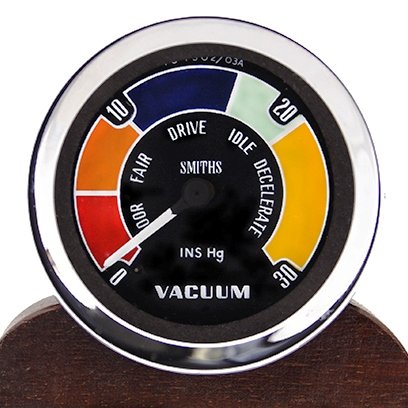
The photos and information are not mine but just taken from the internet. On reading the information on the Smiths gauge it reminded me that they were also known as Econometers. This might suit you car - "A NEW OLD STOCK ECONOMETER VACUUM GAUGE 2 INCH", no numbers on the gauge to worry about how accurate or not the gauge reading is like most gauges of yesterday you just had to know the needle position on the gauge that is usual or good for your car without worrying about the numbers and how they might compare to other vehicles. -https://www.ebay.co.uk/itm/334172075443
-
Can you not go off the inlet manifold or tee into any existing supply? There are lots of cars vacuum gauges about, new or used, sometimes were called economy gauges, Redex gauges were well know here back in the day I believe (even I am too young to know), eBay and others and the Smiths one I linked to. For the hill it depends on how long it is and if it's a steady regular climb without levelling off and tight bends and how much load the vehicle is carrying, altitude and all that was mentioned before. You certainly don't want to be at full throttle in 2nd gear for too long or at 4,000rpm, unless you are racing. I depends on your gearing and engine power as to how good going at 2,000rpm is. Do you know your vehicle's actual or claimed torque figures at different points of revs? If you know the gearbox and axle ratios and can give me your tyre size I have a table for revs to mph for 1st to 5th gears.
-
No, no problem with puddles. Braking distance I'd say not as the higher pressure is a specified option by the manufacturer, bear mind I was referring to a 2016 Fabia MK3 so a modern car with an alphabet-soup of braking and driving electronic aids for drive and tyres, of course they can't overcome the physics of tyre to road surface. The car feel light on dry roads so you're ready for wet roads. As the Fabia Mk3, at least the one my wife has, isn't the greatest handling chassis in the world, but perfectly adequate, it's a matter of sacrificing a little bit of that handling for less rolling resistance which I find very noticeable. I have to lift off the pedal earlier to slow down otherwise I need to brake more and perhaps leave more distance say from the car in front that will brake harder over a shorter distance to slow for changes in speed restrictions as my speed rolls off slower from reduced rolling resistance and reduced braking. On the way a mate had a 90s Jag saloon, long heaver cars, that was a Sport model and IIRC one of the highly technical British sports suspension setting in the Driver's Handbook was higher tyre pressures, remember these are heavy cars.
-
£50's worth a lot more outside of the south. 😉 If it's only 10-minutes work to replace then it's only a little longer to check it, remove it, clean it, put it back in, my concern is that it doesn't become another £50 and 10 minutes that is unnecessary or doesn't resolve the issue if which case it hasn't saved time and it's not just £50 but an additional £50. I've spent my fair share with the parts cannon and more than that in helping keep the world economy turning with my car costs. There's a good chance it's the lambda and you'll be able to rightly say you said so - but it's not certain, yet any way.
-
Stewartasb, sorry missed your posts, I was thinking of next year's MoT for you and myself as I left the Fabia so late at his year, day before, and ended up with a very distressing "distress purchase". No sucks or blows is good in one way and at least you know at next to no cost.
-
No lambdas on very old British Leyland cars but very occasionally there's an odd dusting of rust on them and their fittings. 🙂 I've no doubt getting such out will be "fun" and stock levels of time and/or patience can often be out of stock, my lot of can-be-arsed is often on back order. But you can't know for sure, despite the possible odds, if the probe has actually failed, it could be tested before removing or cutting of wires. The hard work is getting it out so I can see as I put before the saving in hassle just to replace it if it's not considered expensive but IIRC this one's only been in two years of low mileage and they can often come pre-coated with anti-seize. With parts you can often get different brand labels put on the same units and a brand that makes or buys in good parts x may not make so good part y, I've no idea of the service like of a lambda sensor but I'd hope for more than two- years of low mileage.
-
The links sepulchrave put up also have the leak side I forget to put, exhaust, the blow to the hiss of inlet, a spray around with carb cleaner or other may highlight a leak (gasket, joints (i don't know what you have there). Only other thing as highlight in links is computer wobbles. I'm not keen on committing to replacement by cutting the wires, just in case some sort of clean up can be done, but if the sensor's low cost then the hassle might not be worth it. What make of sensor is fitted now? For future reference, if you didn't already know, an MoT can be done up to one calendar month before the expiry date and still keep preserving the anniversary of the expiry date - but if it fails you're without MoT until you can pas a retest. As long as you don't mind losing the months you could have the test months before to move it to a more convenient (warmer, lighter) time of the year.
-
Good videos, the gauge gives a register of how you can drive with more control and efficiently, something that can be taught or picked up with experience but probably honed more with the gauge. Though I don't fully agree with everything in the second video, you do not want to be going too far outside of manufacturers' recommendations on tyre pressures going to the higher recommended setting will reduce rolling resistance, my wife's Fabia Mk3 is run at the Eco setting of 35 psi instead of 30 psi and it makes a noticeable difference on the rolling resistance but at a small loss to handling. The size and type of wheels and tyres can also make a difference. Rather than running the engine oil low on the dipstick put in good quality oil with less resistance and timely change this goes for transmission oils too. As for the big exhaust that depends on the system and the engine and its set up. And with percentages you must always ask "as a percentage of what", an extra 1 mpg over the original 1 mpg saving might be express as a 200% saving. A couple of good engine/carb rolling road tuners I have been to in the past have said that a vacuum gauge would help with mpg and driving.
-
You want to check and if required clean all sensors you can and the other checks I've mentioned, I'm not dismissing sepulchrave idea just that it might not be that so you don't want to replace it for the sake of it without checks first. Service parts do need to be of good quality and sometimes the car manufacturer's fitted items can be there for price more than quality but not always, sometimes they are very good and can be replaced with inferior items at servicing. Sometimes an old part works better than a new made and fitted part if its quality is low., brands and prices don't always relate to high or low quality. Lot of fantastic-plastic now, weight saving on already over heavy (cough, German) cars.
-
A vacuum gauge as used in the 60s and 70s would help greatly in this. https://www.caigauge.com/blog/new-smiths-vacuum-gauge-launched-by-cai
-
Thank you for the reply, I understand this but I think we're thinking of different things along different tracks.