chimaera
Resident Member
-
Joined
-
Last visited
Everything posted by chimaera
-
When you say major service, what do you have in mind? DSG fluid change requires a special tool. Cambelt also requires special tools to set the timing. I'd suggest you sign up on https://erwin.skoda-auto.cz/erwin/showHome.do and buy a 24 hour sub to download the service and repair manuals before you get stuck in.
-
Yes, yes you would but people don't want to hear that when it means buying springs and dampers for all 4 corners as well as a full alignment when it's done. When it comes to suspension you can't just mix and match and hope it'll work. The metal fatigues over time, reducing the stiffness of the spring. Damper wear also reduces ride height as the seals on the gas cartridge wear out and let the gas escape. I've posted the ride height table several times across these threads if you have a poke around. If you're more than 10 mm off it's time for new parts.
-
The airbag fault only happens if the ignition is turned on while the lamp is unplugged. Ignition on is what powers up all the control modules, and when they'll throw any faults like that.
-
It is covered here:
-
The wishbone pinch bolt is single use so make sure you have a set of replacement nuts and bolts bought you start.
-
Master adaptation channel is a diagnostic function. You'll need VCDS or similar to do it. Travel mode should be in the maxidot settings menu though.
-
Unless you get a remap, it's a really bad idea to remove DPF and EGR. Even with a remap it's still not a great idea. It's also very premature to suggest this course of action when it's not even certain that the problem is engine related.
-
Thule Wing Bars are what I use and they're barely noticeable even at 120 km/h on the motorway.
-
It sounds a bit long to me. I rarely pay any attention to the temperature gauge though - I prefer to go by the oil temperature. That is usually up around 85 *C for me within 10 km which is reasonable (I think). The DSG has a second thermostat which is known to fail and leads to longer warmup times. Do a search around here, it's come up a few times.
-
Diesels are never good on short journeys, especially modern ones where a lot of the emissions controls hardware likes to be warmed up properly to work best. On the flip side, in the Superb 2 the 1.8 TSI petrol doesn't have a good reputation for reliability, the 2.0 TSI is vanishingly rare, and the 3.6 is very expensive on fuel. All that being said, I mostly do shorter journeys in mine (work is only about 6 km away) and it's running fine. I got a Terraclean done on it recently and it increased the distance between DPF regens by about half, so there was probably a certain amount of crud built up in the engine that got cleared out. Keep an eye on oil level and get the VAG DPF app to keep an eye on regens and it's possible to keep a CR TDI running well under those conditions.
-
The common rail engines were discovered to have an illegal test mode in the ECU that allowed the engine to pass official emissions tests while emitting higher than permitted NOx levels in real world driving. When this was discovered, the end result was that VAG committed to updating the software to a legally compliant configuration. It isn't an enforced recall programme - owners have the option of getting it done or not. A lot of people have demonised the update, particularly early on, but we're here over 4 years after the update started rolling out and there doesn't appear to have been a deluge of broken cars arising from the update. The only thing I've noticed is slightly more frequent regens, and I can keep an eye on that with VAG DPF. The CR engine is far smoother and more refined than the PD on the road.
-
It looks like your car is now much too high at the back, and too low at the front. Rubber spacers in the springs will prevent the spring from moving properly too.
-
The point is there are too many variables involved if you measure off the ground. But I've pretty much given up on you seeing sense here, I'm posting for the people who find this thread in the future and who might be wondering about how to do this properly.
-
The total height is easy to get wrong when a tyre half a bar under pressure can drop the car by 10 mm, and the difference between a new tyre and one down to the wear bars could be 9 mm, meaning a car on soft, old tyres could be 19 mm lower (using that measurement) than the same car on new, correctly inflated tyres, and might lead someone to incorrectly assume there is a problem with the suspension. Centre to wheelarch is not affected by tyre pressure or tread depth, which is why that measurement is specified by the manufacturer for this purpose. It gives a true reading of the condition of the suspension.
-
Ground to wheelarch is the wrong measurement. This has been pointed out several times on this thread and all the other ones you've posted about this on. The distance from the ground to the arch is affected by tyre pressure and condition as well as the suspension, and is therefore unreliable. The correct measurement is the top of the wheelarch to the centre of the wheel. It has also been pointed out to you so many times by now that your car is, absolutely, without any possible doubt, sitting lower than it should be and you've been given lots of good advice on how to sort it out. Please sort it out instead of posting about it every few months in the hopes that some kind of magic solution has turned up in the meantime.
-
The main risk with running out of fuel in any diesel car is damage to the fuel system components that depend on the fuel for lubrication i.e. pumps and injectors. On old VE cars the lower operating pressures meant lower clearances and greater tolerance of low fuel lubricity or dry running. PD cars would have been more sensitive but owners' experiences suggest it's still fairly tolerant. In the CR engines, the common rail and injectors are working up around 2000 bar, which is generated by the high pressure fuel pump. These don't tolerate lack of lubricant very well at all, something which caused no end of grief for US owners when the CR engines launched there and HPFPs were failing left right and centre due to the low quality of US diesel. HPFP failures tend to send metal filings into the injectors, and also back down towards the tank in the return line, meaning most of the fuel system ends up needing replacement or extensive cleaning following a failure. Lots of €€€€! Going by the service manual, the Yeti seems to share its fuel tank with the Superb 2. There are two fuel gauge senders, one on each side, so I suspect the instrument cluster is reading both individually and averaging. The official procedure for draining the fuel tank is to hook a battery directly to the fuel pump in the tank and use that to drain out the fuel. Taking out the fuel delivery unit requires a special too (T30101) which lets you unscrew a lock ring using a ratchet/t-bar. As to your question, there is an adaptation channel that allows the fuel gauge to be adjusted. It used to be that you drained the tank, refilled it with 9 l of fuel (I'm not quite sure of the origin of this figure and the service manual doesn't shed any light on it) and set the needle to a certain point by tweaking the adaptation channel. From digging into it now, for anything based on the Golf 1K, the channel adjusts a resistance value used by the cluster. My guess here is that it sets a reference value for the resistance output of the fuel level sensor and generates gauge position and distance to empty based on that and the current resistance. It's possible that it's the resistance corresponding to that 9 l of fuel. There's almost certainly a map of resistance to needle position somewhere in the cluster EEPROM too if you have any tool that can read that. I'm trying to think out the experiment that's needed to get the calibration right via VCDS. In the real world probably something like: Note the current value of the fuel gauge adaptation channel Drain the tank completely and see what resistance the level sender is showing (hopefully it's exposed in VCDS measuring blocks) Refill to 30 l and read the resistance (if you can get away with using laptop/phone on the forecourt to monitor filling) Refill to 60 l and read the resistance again You could also keep an eye on it as you work down through the tank - IIRC VCDS does read out fuel remaining in measuring blocks, so you could log that against distance remaining and MFD average economy for the tank and see if the data makes any sense. I wonder does 0 km remaining => 0 fuel left?
-
As was pointed out back up the thread, it's not just the spring that matters here, the damper plays its part too. Also, you have no information on the metallurgy of the spring materials, or what the spring constant of any of them is. That said, maybe it's wrong but you will need to put that to Skoda as to why their parts catalogue is wrong. In the absence of any other reliable information the most robust choice is to stick with the parts catalogue.
-
The spring is correct. Your car is a facelifted model though, so the correct damper is 3C0 513 049 CP. If I remember correctly, the BR part was superseded in production by the CP part, so even if you went into the dealer looking for the BR part I think you would probably be given the CP one.
-
1K0 511 115 BL is what's in the part catalogue for that weight range. If you think it's wrong, take it up with Skoda. I'm guessing you think there's a pattern in part number assignment that's somehow been broken here. If so, a dangerous assumption. This rear axle is shared across a large number of brands and models and generations of models and a lot of different spring and damper specs will have been specified as a result. This leaves a lot of latitude for a suspension engineer getting to work on a new variant. The Superb 2 uses springs that were originally specified for the Golf Mk 5 (1K), launched in 2004, and the Passat Mk 6 (launched in 2005). The Superb 2 was launched in 2008 so engineers starting work on it would have had a lot of choice in springs and dampers to get the setup they wanted.
-
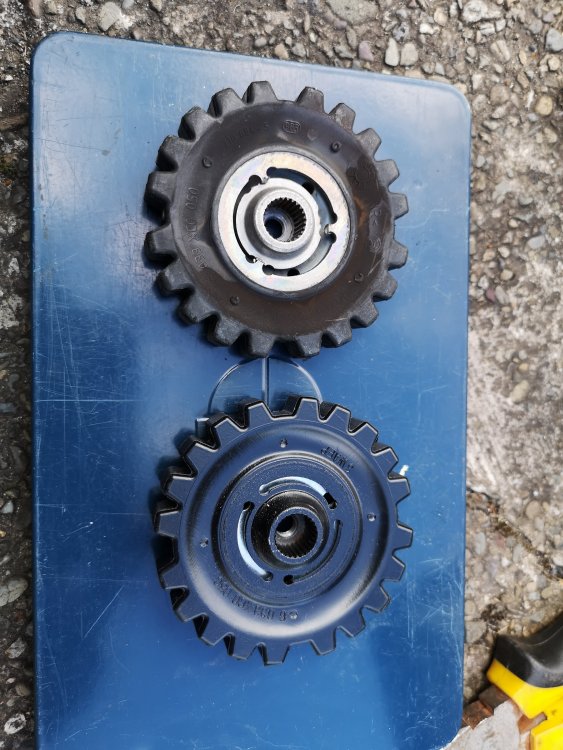
I think they have multiple compressors from different manufacturers under the same p/n. I had a lot of trouble trying to track down a replacement pulley for mine as it seems to ve an uncommon one (can't for the life if me remember what brand). I ended up sourcing the pulley from a German website who listed it as a Mercedes spare.
-
EGR is not used to reduce fuel consumption, it's used to reduce NOx formation during lean running by reducing the amount of oxygen available to oxidise atmospheric nitrogen at a given level of fuel consumption. Burn the same amount of fuel but leave less oxygen left over to form NOx. Under those conditions EGT will stay the same or go up for the reasons I noted earlier.
-
The pulley linkage is designed to fail if the compressor seizes to avoid having the auxiliary belt getting mangled and stopping the water pump too. It means that the pulley linkage will eventually break anyway from the wear and tear of starting and stopping the compressor over time. I had to change this on my Superb last year for the same reason (different compressor though and different pulley design). There's room to get at it from inside the wheelarch once you remove the plastic liner. You'll need something to counter hold the pulley while you loosen the nut/bolt. The pulley should come off easily enough.
-
The MAD springs are a valid option for people who may not want the expense of a whole new set of components. You have added nothing useful to this thread, only filling it with links to parts and part numbers I had already included in the OP.
-
How exactly does reeling off a list of Skoda part numbers support an assertion that fitting auxiliary springs made by a different company will "have a very negative effect on ride quality"? Yes the auxiliary springs will make the ride a little stiffer because the effective spring rate increases but it's not a "very negative effect", and is easily canceled out by the fact that the car is more stable on the road, and quieter because the suspension geometry is working properly and putting the tyres on the road correctly.
-
No they don't.