Breezy_Pete
Sponsor
-
Joined
-
Last visited
Everything posted by Breezy_Pete
-
Should be fine, but don't overdo it; and don't bother even trying if everything in there looks clean and shiny. They're usually pretty well waterproofed.
-
Ah, well done, you're sorted then. 61mm instead of 51; interesting... I'll edit my last reply accordingly.
-
What's the height of each of those? As far as I can see, 51mm should be right. (But see below, 'cos it isn't) Any part number markings on the old ones? Presumably original factory fitted?
-
Rear brake PR code does tend to be on the data sticker, it probably starts with 1K, followed by a D an S, or a T. Last two diagrams here show the part numbers for those options: https://skoda.7zap.com/en/cz/octavia/oct/2016-753/6/ That site doesn't go up to 2017, so not sure if anything changed beyond 2016.
-
Any chance you could video this? 😁
-
As @Carlston suggested, probably easiest to measure. My top tip is to go round the circumference with a tape measure or piece of string, then divide that number by pi (3.14). Knowing the possibles makes it relatively easy to figure out which you have even with slight measuring inaccuracy.
-
Probably won't Dave, front brake PR codes seem to rarely be there, sadly.
-
Because you may have to make sudden, instinctive avoiding manoeuvres that challenge the directional stability of your car. Continuing safely is more likely if the rear of the car is not in front of the front.
-
The problem may be other people nearby driving like maniacs, which can cause trouble for even the best drivers.
-
You/I can find out via erWin (not poss via VCDS etc. to the best of my knowledge). PM me to discuss. You could do it yourself if you register etc and pay 7 Euros plus tax for an hour's access. "Car data" is what you look for/download. Go in via the 'vehicle-specific data' tab here https://erwin.skoda-auto.cz/erwin/showHome.do
-
Also a 7 at the end instead of a 1 though. Will look at circuits in a bit regarding relay.
-
It's beyond quite a lot of people's minds, but that doesn't mean it's wrong.
-
Check/replace the fuse if you haven't already, relay coil fuse is number 10 in the e-box, should be 5-amp rated. Look for corrosion or looseness of contacts, as well as fuse itself. If that is OK, check continuity between ECU pin 49, and pin 6 of the 40-way connector to the e-box, that's the wire which the ECU grounds to energise the coil.
-
You can probably start them moving with a hammer and punch applied in the appropriate angle/rotation to the outer area of the wide flange part. Access to do this may be difficult for some of them though. I tend to buy them from this fella: https://www.ebay.co.uk/itm/Genuine-VW-25x-Wheel-Arch-Undertray-Interior-Exterior-M5x16-Screws-N90974701/174236468474?hash=item28914d84fa:g:4BgAAOSwYY1egziQ
-
Pull metal clip out to release, then pull, possibly very hard. Twisting prior to pulling may help. Did new rad come with replacement o-rings?
-
Everyone loves a free fix (except garage professionals) Looking up that part number on oemwolf.com tells me that it was superseded to 6R0953507C 9B9 (with an associated part) on VWs and Audis (no mention of Skoda or Seat, unless it's obscured by the advert): https://oemwolf.com/oem-parts/6r0953501c.html Doesn't give a date for when that occurred, which is usually shown. This post gives a couple of part number researching tips:
-
UV light exposure and heat from weather and usage will account for most of the age-related degradation when fitted to a vehicle. All of these should be absent until the tyre is fitted. So not a biggie.
-
No need to apologise, made me double-check my thinking. Never a bad thing.
-
Not sure about that. The problem right now is that at maximum pedal travel downwards (= maximum slave cylinder piston extension) the clutch only just disengages. So lengthening the actuator attached to the piston should make the clutch disengage with less pedal movement, no?
-
Good idea; well worth a try.
-
Looks like I did, Sachs part from GSF via ebay; and judging from some photos I was looking at earlier of the 'new' gearbox minus a fork, I swapped the recent one over onto it. Can't see any harm in an experiment to extend the slave actuator so I'll have a look at adding a few mm to that somehow. Think I've still got the slave that came with the JJL box too somewhere, maybe.
-
Struggling to remember. Certainly considered it, and have a vague memory of finding that local GSF had one on the shelf. Email/purchase records should be able to remind me.
-
Thanks, that sounds reasonable. Starting to think I must've knobbed up something when I swapped gearboxes 16 months back. I bought a JJL code gearbox on instead of the original GSB code, without much research or thought, beyond knowing that they were fitted to the 1.2/12v engines a little later. Tempted to try cobbling together a short extension piece to go on the end of the slave cylinder actuator to see if that moves the biting point away from the floor.
-
I would definitely advise looking at the part number on ones existing part before ordering anything, if it's visible just by popping off that top cowling. There are still other part numbers for the part in the ETKA pages for earlier years, 2009/10/11, so a tricky one to get right 'in theory' without looking at the specific car. Mentioning that for the OP @Fawnrush's benefit. Some will probable be interchangeable, but I wouldn't gamble on it.
-
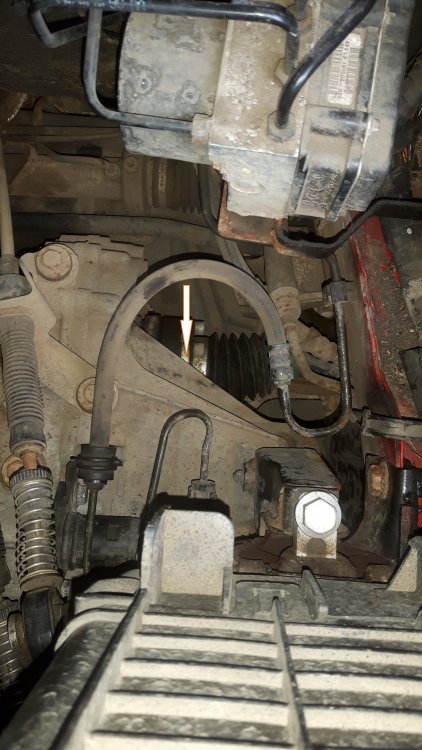
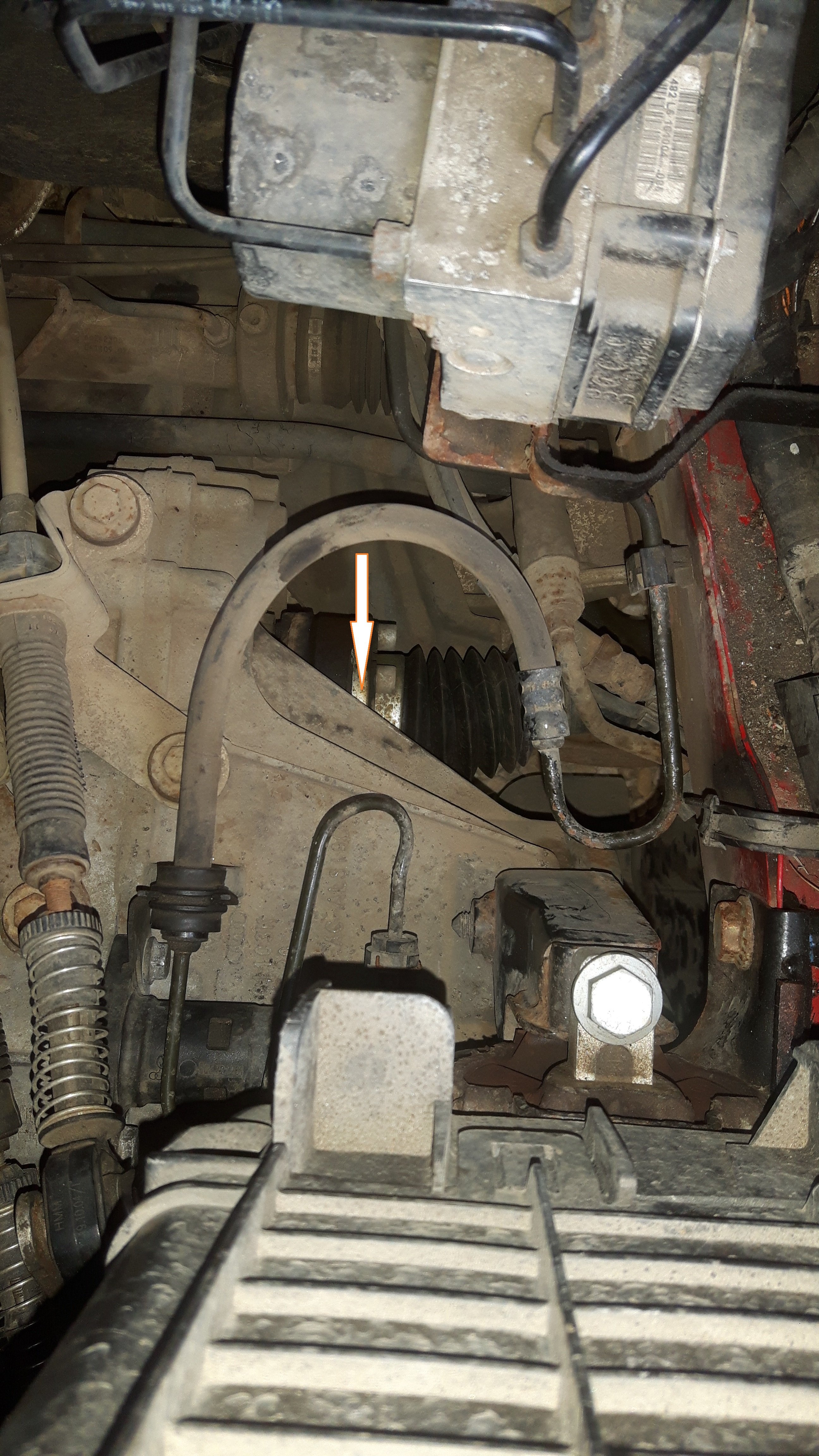
Had a go a few minutes back. Nothing bulgy but interestingly, the whole flexi section can be felt to move slightly (in the direction of the arrow) as the clutch pedal is pushed fully to the floor. Not sure if this is to be expected, or how to imagine exactly what's going on structurally there; but doing the same check on my Polo results in much less noticeable (but still detectable) motion in the same direction.