



Skip to content

Is a Felicia safe with winter tyres on front only?
Featured Replies

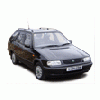
After last year's snow I was thinking of using two spare wheels I have and getting a pair of winter tyres on them for the front of my Felicia diesel. Now we're back in the thick of it again I wondered if that's really a good idea. I've just been in to the nearest town and even taking it easy managed to get slightly sideways on one roundabout. I think if I put winter tyres on the front only I may get too confident and risk having the back slide out more often.

I barely used the brakes on the whole trip as the diesel's excellent for slowing up on the gears but other drivers get really close because they see no brake lights. It was this that got me sideways - touching the brake for the car behind. Any tips on how to deal with that? (Stay at home? :) )

Thanks

Mitch

  • Replies 77
  • Views 7.7k
  • Created
  • Last Reply

Top Posters In This Topic

if i'm honest there's probably no point at all in fitting winter tyres to a felicia unless you drive in the snow a lot, it's not recommended to mix tyre types for the exact reason you highlight, you will get unpredictable handling.... although i would love to be able to get the back end to step out on corners :wonder:

After last year's snow I was thinking of using two spare wheels I have and getting a pair of winter tyres on them for the front of my Felicia diesel. Now we're back in the thick of it again I wondered if that's really a good idea. I've just been in to the nearest town and even taking it easy managed to get slightly sideways on one roundabout. I think if I put winter tyres on the front only I may get too confident and risk having the back slide out more often.

I barely used the brakes on the whole trip as the diesel's excellent for slowing up on the gears but other drivers get really close because they see no brake lights. It was this that got me sideways - touching the brake for the car behind. Any tips on how to deal with that? (Stay at home? :) )

Thanks

Mitch

As the back wheels don't contribute to the "driving" of the car (they are just glorified jockey wheels), I would say just the fronts would be fine.

However, there was an arcticle on the radio a few weeks ago about snow tyres: as they're not "standard issue" for the car, you have to tell the insurance company, who will probably up your premium, even though it's safer with those tyres. Otherwise if you do have a prang, they'll cite the tyres as non-standard and say you're not covered. Either way round, it's all money again. :-(

Alex

Having just inadvertently been out in probably the heaviest snow I've ever driven in, it seems a Felicia estate with normal EcoContact 3 road tyres is apparently one of the most capable bad-weather vehicles out there. That or 99% of people, especially the ones with Shoguns and BMW X-series, have f'-all idea how to drive safely or sensibly in snow... :@

The handbook recommends Q M+S rated (mud and snow) tyres for winter, which would probably be a better compromise (and I imagine more economical) than full-on snow tyres, and in the standard 165/70R13 size would also prevent any type-approval worries. I do however feel it's worth mentioning that the M+S rated bargain Chinese ditchfinders fitted to my car when I got it had worryingly little grip on normal roads, especially in the wet, compared to the new Continentals, so personally if my budget was limited I'd spend my money on one set of good-quality all-round tyres instead of 2 cheaper sets (as indeed I have!)

ive just driven back to colchester from cambridge! and my 1.3 estate on newish tires (firestone) was climbing hills that was defing these baby 4x4s!! also on the back roads where you can play a little, the car is so easy to control while sliding, just let go of the handbrake and lift off and your back in a straight line again...

My L&K Deisel Octy was not good even with brand new tyres (I do carry a lot ot stock in it tho) invested in a pair of snow socks for £58 inc delivery, they're simple to get on & off. About a min each to get off! They are totally awesome grip wise & would be marginally cheaper for a Feli. But unless you like going sideways round bends as the back tries to catch you up, you might want to stick some on the rear!

i :love: going sideways. rwd conversion methinks (thinking outloud!)

  • Author

Thanks for the advice. I'll stick with it as it is then. She'll climb the hill outside here in the snow on idle when a lot of the others are spinning their wheels. I don't do a lot of snow driving but some of the roads to work are not the busiest so don't get gritted, the snow packs to a glassy surface when it's bad. This lot seems a lot more powdery so it's a bit better at the moment.

RobinSLXI - I've seen a few round here today, big 4x4 on wide low profiles thinking they've got it sussed.

Beryl's Chief Pilot - I may give the socks a go. They'd get me to the main roads where I could take them off. I'd not heard of anyone who'd used them before.

Fingers crossed for Monday. Thanks everyone.

That or 99% of people, especially the ones with Shoguns and BMW X-series, have f'-all idea how to drive safely or sensibly in snow... :@

I've found most of them don't even know how to turn the 4-wheel drive on. :rofl:

Alex

Conventional wisdom says that new tires go on the back, so by that logic, I'd say no!

Theory behind it being (i think), in an emergency situation, losing traction at the front is fairly easy to control, whereas unexpectedly losing traction at the back can easily send you into a backward pirouette through a hedge/school/central reservation.

The back tyres are only glorified jockey wheels when everything is going smoothly and you're in overall control of the car. They can get important quite quickly.

So while having winter tyres just on the front will probably help with traction in normal every day driving (IE when you're in control and there's no nasty surprises), it's not a great idea having unmatched tyres ever.

/flat cap, pipe, slippers

I'd say the opposite is true - I'd be far happier with a loose back of the car and a planted front with better grip, braking and traction. But what do I know?

Conventional wisdom says that new tires go on the back, so by that logic, I'd say no!

Theory behind it being (i think), in an emergency situation, losing traction at the front is fairly easy to control, whereas unexpectedly losing traction at the back can easily send you into a backward pirouette through a hedge/school/central reservation.

The back tyres are only glorified jockey wheels when everything is going smoothly and you're in overall control of the car. They can get important quite quickly.

So while having winter tyres just on the front will probably help with traction in normal every day driving (IE when you're in control and there's no nasty surprises), it's not a great idea having unmatched tyres ever.

/flat cap, pipe, slippers

Hmmm, would have to disagree muchly there. The Skoda Felicias are front-wheel drive so having the more grippy tyres on the back would do nothing to help applying power or steering. Under emergency braking, the weight distribution shifts towards the front of the car, not the back. I usually find in those rare occaisions the back has tried to go first: a) steering into the skid and a lil' flick of the handbrake puts it back.....and B) I was driving too fast in the first place. ;-)

The "backward pirouette" concept comes from the Estelle I believe, the days when the engine was in the boot.

You're more likely to have an understeer situation before you get an oversteer situation in this weather. Therefore you need the front wheels to have as much grip as possible.

Winter tyres in normal conditions, will just wreck the tyres and add nothing to the driving experience.

Unmatched tyres is not ever a great idea? Sure? Ever looked at anything such as a Mercedes SLK? Completly different sizes front and back, as standard. Unmatched on the same axle is illegal.

Regardless of what tyres you put on the car, if you don't feel safe or confident driving in these conditions, don't. If you do have to go out, take it easy, gentle movements on the controls. Upsetting the balance of the car is what leads to accidents. Exessive speed, sudden braking, steering and acceleration will cause an accident far far earlier than anything the car will want to do.

Alex

I'd say the opposite is true - I'd be far happier with a loose back of the car and a planted front with better grip, braking and traction. But what do I know?

Ah, maybe your wisdom doesn't come from convention, just all those hours and hours mucking aroung in the forests ;-) ;-) :-p

Finances permitting I would get a spare set of wheels with winter tyres.

Premiums should not increase if you fit winter tyres http://www.bbc.co.uk/news/business-11969958 and to be honest I wouldn't even bother telling them. Tyres are tyres and if you had an accident in cold conditions and they tried weeding out of it because you were being safety conscious and had fitted winter tyres then that would be rather stupid. I think the problem is the call centres are all in India, people call their company about a modification and mention "winter tyres", Indian call centre person hasn't a clue what they are and slaps on an extra charge from some generic manual.

I'd say the opposite is true - I'd be far happier with a loose back of the car and a planted front with better grip, braking and traction. But what do I know?

Hmmm, would have to disagree muchly there. The Skoda Felicias are front-wheel drive so having the more grippy tyres on the back would do nothing to help applying power or steering. Under emergency braking, the weight distribution shifts towards the front of the car, not the back. I usually find in those rare occaisions the back has tried to go first: a) steering into the skid and a lil' flick of the handbrake puts it back.....and B) I was driving too fast in the first place. ;-)

The "backward pirouette" concept comes from the Estelle I believe, the days when the engine was in the boot.

You're more likely to have an understeer situation before you get an oversteer situation in this weather. Therefore you need the front wheels to have as much grip as possible.

Winter tyres in normal conditions, will just wreck the tyres and add nothing to the driving experience.

Unmatched tyres is not ever a great idea? Sure? Ever looked at anything such as a Mercedes SLK? Completly different sizes front and back, as standard. Unmatched on the same axle is illegal.

Regardless of what tyres you put on the car, if you don't feel safe or confident driving in these conditions, don't. If you do have to go out, take it easy, gentle movements on the controls. Upsetting the balance of the car is what leads to accidents. Exessive speed, sudden braking, steering and acceleration will cause an accident far far earlier than anything the car will want to do.

Alex

I agree with you both, but current advice says otherwise, regardless of driven wheels. It's been done to death on here.

Where?

I agree with you both, but current advice says otherwise, regardless of driven wheels. It's been done to death on here.

Am not trying to be agrumentative here.......current advice from whom? All the advice I've ever been given about FWD is "all the best up front", usually from people who have the same sort of past-time as DJay.

Alex

Am not trying to be agrumentative here.......current advice from whom? All the advice I've ever been given about FWD is "all the best up front", usually from people who have the same sort of past-time as DJay.

Alex

Michelin, for a start, and tyresafe I can't find the threads on here, at the moment, but there's several. Like I said, I don't find this argumentative, because I'd rather have the car go where I point the wheels...

Well, having read those, I'm amazed the Michelin one makes the claims that it does at the bottom, and the comment about traction balance is just bizarre - it comes from a point of view that the car having no grip at the front should continue to do so; obviously it is easier to control the front wheels than the rear, but that doesn't mean to say that you want a car which has less front grip, as the grip at the front is precisely what allows you to control the car; having grip at the rear isn't much use as the wheels can't steer you, move you forward or brake you! The tyresafe one also seems to be making something of "industry research" that is then extrapolated into far more than it should be; the rear puncture claim is probably when a car is cornering heavily and a rear puncture occurs, when oversteer would be inevitable. I'd like to see the original research and all the conditions of the tests, rather than a 2-line precis of it.

Either way, neither are talking about winter tyres, and again, with the majority of braking effort in all cars being at the front, and all the traction being at the front in an FWD car, I know I'd still rather have the grip there than anywhere else. And given the complete toss that the IAM have been giving on the news about driving in ice/snow recently, I'm happy to take my own advice rather than the complete *******s they've been dishing out!

Either way, neither are talking about winter tyres, and again, with the majority of braking effort in all cars being at the front, and all the traction being at the front in an FWD car, I know I'd still rather have the grip there than anywhere else.

Indeed. Winter tyres or not, it's all about where the grip is.

And given the complete toss that the IAM have been giving on the news about driving in ice/snow recently, I'm happy to take my own advice rather than the complete *******s they've been dishing out!

I was amazed on BBC breakfast the other day, they had someone giving sensible advice. There's a lot of half-arsed ****e about.

Any idea where this 'advice' and 'conventional wisdom' comes from? When I got my Felicia rear tyres replaced a few months back due to a puncture (and the other side being fairly worn as well) by a Skoda dealer, they specifically told me it would be best to swap the wheels over so the new tyres were at the front.

Let's face it, in a lightweight, front-heavy FWD family hatchback you'll have understeered into a ditch long before you need more grip at the rear. And if by chance you do get into a situation severe enough for the back end to go first - mid-corner bump on an icy road for example (I speak from experience ;)) - then that almost certainly would have happened regardless of what tyres you had, and in that case you then still need front-end grip more than anything to have a chance of controlling the skid.

As for extreme situations like the snow I was out in yesterday, I note that far, far more people were struggling for traction up the slightest inclines than for control - the only vehicle (of hundreds) I saw having actually skidded off the carriageway was an 18-wheel artic.

I'm with DJay on this. What's more, I'm fairly sure Michelin South Africa (the .za in the domain name gives it away) wouldn't be offering advice about winter tyres for use on snow and ice. And Michelin (in fact any tyre manufacturer) would be encouraging you to buy more of their tyres anyway.

Also both cited articles are about worn tyres and everyday driving, not about driving in the conditions that currently surround the UK. The Tyresafe Winter Tyres article also contradicts itself. In the video, Count Quinten Wilson says about the winter ones stopping you up to 6 car-lengths shorter than normal tyres, yet the text shows 11 meters. That's 6 cars (nose-to-nose) of less than 2m each. A Smart For2 is 2.5m. Also, as DJay says, there's no evidence, just a couple of sentences.

Given that Kwik-Fart are always looking at ways to fleece you, you'd think they'd be up for fitting your new ones to the rear instead of the front, charge you that bit extra. Y'know, being tyre experts and all that.

Also the BBC were happy to tell everyone that the police would be stopping people, fining them £60 and giving them 3 points for driving with snow on the roof. The police themselves have no knowledge of this happening, and they have confirmed that there is no offence code for such, therefore, you can't get points or fined for it. (Just think of all those lorries that would have been stopped!)

Alex

Edited by RainbowFore

Aww, it took me so long to type that last post it now looks like I just wasn't paying attention :'( Interesting links to those articles - I'm on the verge of kicking into work mode and write a full-on deconstruction of both of them to highlight all the self-contradictory nonsense, but I'd be up far too late...

For now I'll simply cite my own practical experience on this one:

  • new back tyres = no noticeable effect
  • new front tyres = noticeably better grip
  • Felicia on normal road tyres in heavy snow = extremely capable

Any idea where this 'advice' and 'conventional wisdom' comes from?

Oops! Didn't mean to light touch paper. I think the argument's been done to death on just about every car forum ever, but yeah.

Tyresafe

Popular Mechanics

SaabScene (Where I first heard it iirc)

Kleber

Merc stirring things up (But they're RWD...)

Etc!

But that's not to say it isn't all *******s. I was just applying the new tyres back logic to unmatched tyres, which would accentuate whatever difference there was between the axles, presumably.

Properly unmatched tyres (as per OP) sounds like an unnecessarily hairy idea to me, but each to their own!

As far as the new tyres on the back debate goes, if you're non new tyres are that shagged that it's going to make a massive difference, buy 4, not 2!

Edited by tone_depear

Create an account or sign in to comment

Recently Browsing 0

  • No registered users viewing this page.

Important Information

Welcome to BRISKODA. Please note the following important links Terms of Use. We have a comprehensive Privacy Policy. We have placed cookies on your device to help make this website better. You can adjust your cookie settings, otherwise we'll assume you're okay to continue.

Account

Navigation

Configure browser push notifications

Chrome (Android)
  1. Tap the lock icon next to the address bar.
  2. Tap Permissions → Notifications.
  3. Adjust your preference.
Chrome (Desktop)
  1. Click the padlock icon in the address bar.
  2. Select Site settings.
  3. Find Notifications and adjust your preference.
