
FabiaGonzales
Members
-
Joined
-
Last visited
Everything posted by FabiaGonzales
-
2.0T Golf R engine and IS38 swap? (Or that new garret one?) I imagine it'll take a bit of wiring work swapping the ECU across though.
-
True, but off the shelf options don't fit without modification. Any idea what caused the valve(s?) to drop? Seems like it's not the first time an EA211 has dropped a valve.
-
Unfortunately you have the older EA111 engine, JBS has offerings for it but nothing here helps you sadly. Exhausts are also specific to chassis aswell as engine, so Golf / Leon / A3 / Octavia? (Or is it Superb?) are the same as they're all MQB chassis (given a specific engine), but the Fabia / Ibiza / A1 / Polo one is different given they all use the PQ26 chassis. For those with EA211 engines, the exhausts are interchangeable between the 1.2/1.4 (many use the exact same part from factory). Provided you find a 1.4 exhaust from the same platform, it'll fit. Most of the decat downpipes you see online are all for the Golf platform, so won't fit the fabia etc.
-
160,000 sounds like KM, equivalent to roughly 100,000 Miles. Beside being used, rubber does degrade slowly from disuse, 50,000 miles as a first point for inspection seems about normal (then check again every following service, then replace at any sign of wear) - i'd rather fork out a bit for a cambelt change and have my mind at peace, than risk it for a biscuit and potentially total the engine on the premise of "well some bloke on the internet says hes on his original cambelt after 200,000 miles, so mine must be fine for the same". It's probably still a good idea to check it every now and again, it's easy enough to take the top part of the timing cover off. As for spark plugs, if you're getting any sort of lumpiness at idle, it's time to change em. Instead of the usual OEM plugs (NGK), i went for the Denso IXU line, given i'm running hybrid turbo i went one stage colder (IXU24), but for a standard or stage 1 car, the IXU22 is the perfect replacement. Given that they're iridium tips, should last longer than the NGKs too. Avoid Bosch plugs. Brake fluid is an essential thing to replace. A friends Rover 25 was suffering from awful brakes, one caliper was seized and the other side was bare metal! We replaced the seized caliper, and put in new pads and discs all round but the brakes were still pretty trash, figured we'd put the spare brake fluid to good use and flush the whole system, what came out was practically black! First test after a full flush and bleed, it went from having to stamp on the brakes to get any form of braking to stamping on the brakes and almost going through the windscreen!
-
Looks like i'm getting a new house then! These gearboxes have synchromesh on all gears except for reverse (it's the good old dog engagement type, and that's why you get people going "ohmagerd sometimes reverse gear won't go in unless i lift the clutch for a moment, my gearbox must be broke and this car is the worst thing ever made" - because the teeth just happen to be aligned in a way that it won't engage..) 1st and 2nd are double synchronised, to quote from the 02T gearbox workshop guide/manual: http://www.volkspage.net/technik/ssp/ssp/SSP_237_d1.pdf That will have an effect that makes 1st and 2nd a bit clunkier to shift into. I have found that the gearbox likes to be shifted with a big more weight to the throw. Trying to shift it really gently and lightly results in a clunky shift.
-
I bought FAG parts; Front: 713610470 Rear: 713610490 What was already on the car both front and rear was identical, FAG branded and everything.
-
6Q0 407 623 E That's the part number for the protective ring. It should clip firmly over the end of the driveshaft, if it's not clipped firmly it will rub against the sensor (destroying it slowly) and not protect the ring from dust/dirt. Happened with mine when Skoda did mine, wasn't too happy but they reimbursed me the cost of a new abs sensor and wheel bearing so i can't entirely complain lol.
-
The ABS magnetic ring is part of the wheel bearing, since the sensor looks like that, i would assume dirt/grime has gotten behind the protective cover and has destroyed both the sensor and the ring. Wheel bearings are ~45 a piece and fitting usually around 50.
-
The notchiness is just how synchromesh engagement gearboxes roll. You can run thinner oil, which will make the synchro's match each shafts rpms and engage quicker, but you will increase wear on everything as it'll be less protected. Double clutching with some rev matching (and making sure you're fully pressing the clutch pedal) almost completely eliminates any notchiness. Applying more pressure to the shifter as you shift will help it move in quicker too but obviously it won't make it go away.
-
This one only needs a breather filter, fresh air goes in this bit from the filter housing. The foam covered pipe that goes into the side of the turbo is the bit what needs a catch can.
-
The Rapid is MQB based, like the Golf 7/7.5 that's been around as long if not longer. The mk5 polo and mk3 fabia are PQ26. Mk6 polo (AW) and Fabia MK4 are fully MQB. It can probably be modified to fit with the standard air inlet thing, but that's fairly closed off and restrictive, so that'd need modification (or something custom making like im doing 😉) for it to be worthwhile or you'd be better off having the airbox just pull air in from the bay, in which case you're spending a lot of money and only using half the kit and not even using the half you are using as it was intended anyway.
-
Sadly the cold air inlet part of it doesn't fit non-MQB platform cars, we have the PQ26 platform and our inlet is different. I am looking to make something better (and cheaper) than the forge intake too. Just wait and see when it's ready to be released
-
Small diameter increases the turbulence and the velocity of the air, as the diameter increases it accelerates the air too, which is good for helping the turbo spool quicker and earlier. The diameter however is definitely the limiting factor. The MST elbow tries to help by going as wide as possible right from the turbo inlet. Good for max power, but not great for spool and low end torque. The ECS elbow takes a different approach, slowly dropping the diameter of the pipe from the 65mm at the top, down to about 38mm where it meets the turbo. This helps responsiveness and low down power, which is noticeable vs the MST comparing one after the other. Being a big chunky silicone pipe also means it doesn't fit super well into the space available (its very very jammed in tightly). The disadvantage of this one is that our turbos have an inlet diameter of 41mm (the 1.2 and small 1.4 turbos by mitsubishi/mhi), so the ecs pipe's 38mm at the turbo end is technically a little restrictive for top end power in that regard, though as i've not got access to a dyno, all i can do is test by top speed reached at the end of a given distance, which was the same between both MST and ECS ones. The fact that it is cast aluminium means it has two other downsides, first being heat soak, aluminium absorbs and conducts heat much better than plastic/silicone, and so radiant heat from the engine does get that elbow quite hot which will negatively impact intake air temps. The second downside being accuracy of manufacturing cast parts, the post-casting machined surfaces (turbo end and top end to airbox) are as you'd expect, perfect, but there's variance and a lot of scope for impurities and other manufacturing irregularities. There's a third less important issue with this and that as it's designed more for the (large 1.4) IHI turbos with inlet diameter of 38mm, they are made with the o-ring on a different face compared to standard. The IHI has a much larger face for this o-ring to seat, but our MHI ones do not, so this ring only partly seals. Given the ring still touches all the way round and the flatness of the surfaces i don't see this as much of an issue anyway. anyway, aside from that, i have a little announcement of sorts.. I am in the process of designing and manufacturing a plastic elbow (similar to ecs, but fixing all of its downfalls), to replace the standard one and allow use of the OE airbox and most aftermarket induction kits, and provide a best of both worlds in terms of performance that shouldn't restrict top end power at all. My first prototype is promising but fitment was way off, all angles and dimensions are fixed now and i'm awaiting the second prototype to be made so i can get that on the way. I plan to develop a whole OEM+ intake system, from the elbow, to the airbox, right to the cold air inlet bracket thing that connects to the bumper. It WILL take time though as i have limited experience designing and making stuff like this, and given everything else going on in life i get about 8-10 hours a week to work on it tops. When i have something ready to offer that survives all the testing, abuse, ragging to feck, and everything else i throw at it.. i'll provide more details 🤫😉
-
The MAP sensor itself and the ecu can read up to whatever the physical sensor supports, but the data feed that the ecu sends out over obd only reads up to 2.55 bar.
-
The MAP sensor itself and the ecu can read up to whatever the physical sensor supports, but the data feed that the ecu sends out over obd only reads up to 2.55 bar.
-
Calculated boost in most apps use "manifold absolute pressure" sensor, which as i mentioned before can only read up to 2.55 bar (1.55 bar boost). The ECU has different set of sensors that report stuff like "turbo requested boost" and "turbo actual boost" that will read the actual boost and don't have that limit.
-
That's an issue with the Bosch ECU data reporting, for some reason they used an 8 bit value for MAP (which reads in kPa) so the maximum value it can ever report is 255 kPa or 2.55 BAR absolute pressure. Since roughly 1 BAR of that is atmospheric pressure, you end up with a max reading of 1.55 BAR boost. Which is around 22.6 PSI. The ECU is still able to internally read the actual boost and control it appropriately but it will never be able to report more than 1.55 BAR / 22.6 PSI. So calculated boost is pretty accurate unless you're running past 1.55 BAR boost on a Bosch ECU.
-
Had a little read through this thread now i've gained more knowledge about stuff. Boost is calculated, but it's not just guesswork like the calculated torque and power are. It takes the MAP sensor reading, IAT sensor reading, and the Barometric Pressure sensor and External Temperature sensor readings, and calcuates them based on actual calculations to do with air density and stuff. So it's pretty darn accurate. There is actually a "turbo boost: actual" "sensor" reading available but that is rather slow to refresh, where the calculated boost refreshes some 20 times per second. Calculated HP is based off fuel consumption but is wildly innacurate, aparently my friends 2.0tdi makes its most power at 5500rpm.. lol nah. Calculated torque follows a correct trend, but usually is incorrect by a certain % margin. Not really worth looking at either.
-
Which engine do they have though, the EA211 initially people thought they were like the EA111's which would top out about 130-140 with everything standard bar a remap. As times progressing tuners see what's working reliably and they can push it that bit further. Being the first with the JBS hybrid, it was kind of an unknown how much the rods can take, mine has proven reliable (mine does not live an easy life) doing 26k miles on the hybrid so far, so future ones they know they can fairly safely start at that point wnd work from there. All it takes though is a bad map and it's bye bye turbo and possibly the engine along with it, so wherever you go, make sure you take it somewhere reputable!
-
For 150bhp, get a decent intake and sport cat exhaust and a good tune on it, you'll see close to that mark. You could try looking at the 1.4 EA111 turbo only engines and see if those turbos might fit, it's possible they might work. Be careful which ones you go for as there's also the twin charged ones which are definitely different lol
-
JBS have a hybrid package too, for 180-190bhp
-
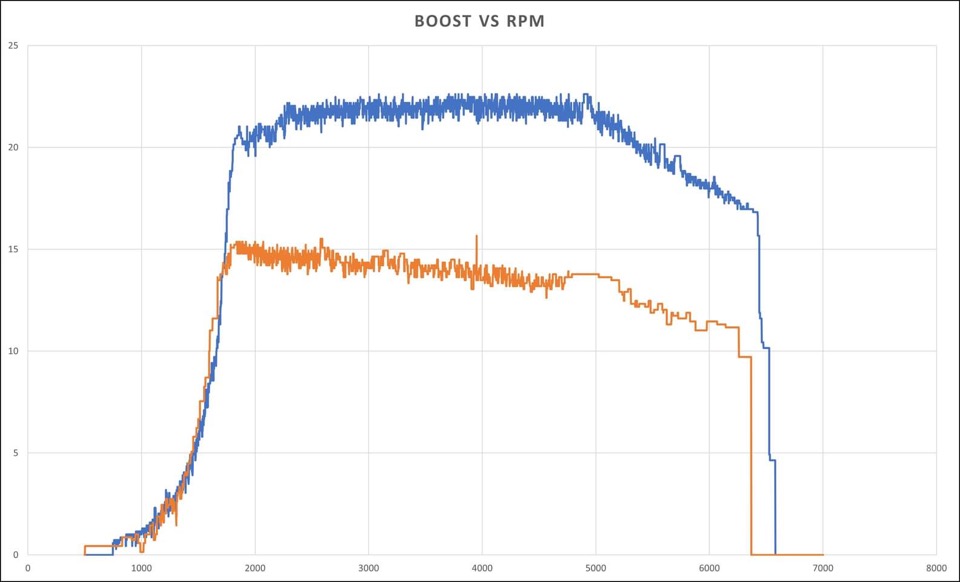
I've done 26k miles now with the jbs hybrid turbo, it's had two services since, and the oil's come back pretty clean so far. Driveability is great, still got that low down torque and spool is decent, it feels slow but that's cos the turbo has to spin to about 3x the rpm it used to and obviously that's gonna take longer but when it comes in it comes in strong! It hits full boost around 1800rpm. I've got a friend running stage 2 on a completely standard 1.2 engine with a decat exhaust, his is running about 145bhp, we compared the boost vs rpm of both, the hybrid just holds onto it forever (i'm on stock exhaust btw, hence the drop-off after 5k) Blue is JBS Hybrid with standard exhaust, Orange is Stage 2 with decat.
-
No, we have the newer EA211 1.2 TSI, you have the older EA111 1.2 TFSI. They won't fit.
-
That part number is for a charge cooler from the EA111 1.2TSI, Code CBZC. Unfortunately none of this helps thread helps you. Howver JBS Auto Designs in Chesterfield does make a Hybrid Turbo for that engine capable of 180-190bhp, so there's that.
-
What engine code?