Austin 7
Members
-
Joined
-
Last visited
Everything posted by Austin 7
-
Hi I can't really think of anything that would link a clutch replacement to a change in real mpg. The Yeti seems to normally have particularly low rolling resistance, so for lower speed journeys this helps the mpg. I have a number of regular medium length journeys and find the two main things that affect mpg are the amount of traffic (no surprise) and whether it is raining. I put the latter down to the extra drag of tyres on wet versus dry roads, and the extra drag of driving through puddles etc. I used to run on ethanol free Esso fuel, but that's now 5% ethanol so I am back to E10 which has made consumption about 2 mpg worse. I'd be inclined to see how things go, but you could have a peek under the bonnet and under the car to make sure all the cables and hoses have been put back !
-
Hi Occasionally, the clutch friction disc can stick to the flywheel due to a very thin rust layer if it gets damp and hasn't been used for a few days. A bit like brake pads sticking to the discs. Sometimes starting in gear (carefully) and driving for a bit so the friction disc is called upon to transmit some torque will free it off.
-
Hi Raising or lowering the dipped beam by a fraction of a degree makes a big difference to the distance at which the dipped beam top cutoff intersects with the road. The same change to the main beam is much less noticeable. I suggest you go back to the VAG indy and get them to reset the dipped beams nearer to the upper tolerance limit of the beam setter. I have my beams set at about -0.7% which with headlamps 780 mm above the ground places the cutoff on a level road about 100 m away. With this setting it always passes its MOT but I very occasionally get flashed by someone. The headlamps do also have manual allen key adjustments, in case the NS and OS beam heights are not quite the same.
-
Let's be clear about this. The car is 11 years old with 70,000 miles. I use it 3 or 4 times a week and it always starts immediately, hot or cold, rain or shine. Then I do two cold starts in quick succession and drive a total of 50 yards, stopping the engine well before it has warmed up. Next day it will turn over but not a sign of starting. Hold the throttle fully down for another attempt and it starts. Since then it starts immediately every time. I am convinced this is a flooding issue, i.e. Air /Fuel ratio below the threshold for ignitability (about 8:1) and I suspect any AA or RAC man would tell you they have encountered it many times. So my post was just to help anyone else to avoid the same mistake, or to know how to simply solve it without calling for breakdown assistance. I don't need a new battery !
-
To answer some of those points, the battery is only a few years old and is regularly charged by the car being used 3 or 4 times a week. No stop-start (thank goodness). Using fairly fresh E10, but last time this happened (years ago) was in E5 days. Air filter is reasonably young, but airflow at cranking speed is pretty minimal anyway. I didn't "hear" about spark plug insulators absorbing fuel, that's just my own thoughts trying to reason out what's going on. Lambda sensor is effectively out of circuit during warmup, and in my view during the crank/start phase the injectors will be pumping fuel but if it doesn't ignite for any reason there's only one place it can go - out of the exhaust valve and into the catalyst/exhaust. There was never any misfire in the normal sense, more a total non-fire. Once I tried the full throttle technique the cranking seemed more vigorous and startup happened reasonably readily. The plugs are due a change, and the new ones are sitting on the shelf nagging me so it will get done once it's not so flippin cold out there ! Anyone else have a view as to what's going on ?
-
My Wife thinks I am a fusspot for insisting on only starting the car if I am going to drive somewhere. However, a few days ago I came home late with a heavy load, so it had to be dealt with the next day. This involved a cold start ( 5 degreees C) backing out of the garage for 25 yards to a convenient spot, unloading and then restarting and going another 25 yards back into the garage. I followed up with a token 30 seconds or so of idling before switching off. Next day (5 degrees C again), it refused to start.... Despite a good battery it felt like the starter was struggling to turn it over. I then remembered the same thing happening years ago in similar circumstances. The solution is to hold the throttle pedal fully down whilst operating the starter. This time after some churning it fired up and cleared, with a brief puff of grey smoke from the exhaust and a smell of raw fuel. Since then, it's all completely back to normal and starts immediately every time as usual I can only assume that this is due to the spark plug insulators absorbing fuel vapour overnight, or maybe the catalyst getting loaded with unburnt fuel or condensation from the previous cold starts and thereby choking the exhaust. Maybe the ECU has a "clear flood" mode if you hold down the throttle to pump plenty of air through, just like in the days of carburettors ? Anyway, lesson (re) learnt and no more very short journeys !
-
Just to clarify, these are standard 17 inch factory wheels with 225/50 tyres, no "rubber bands" ! No visible problems or unusual wear noted with the tyres, but they were down to about 2.5 mm tread depth, and were replaced a few weeks ago. The garage that did this (a VAG specialist) balanced the wheels without needing an excessive amount of weight and then carried out the MOT. That was when the buckles were noted as an advisory. On querying this, I was told not to worry, that it was commonplace and something they saw all the time. I was still uneasy, hence my own check and the decision to get them straightened. The second garage (tyre specialist) told me that the damage was mild compared to some that they have dealt with. The new tyres are Michelin Primacy, and are noticeably quieter than the Dunlops they replaced.
-
Yes, flat wheels not flat tyres ! Had an advisory on the MOT a few weeks ago that both offside wheels were slightly buckled. Took advantage of fine weather a few days ago and jacked up the car and span the wheels by hand. Sure enough, a flat spot on both wheels on the inner rim i.e. the weakest part. Each probably about 70 mm along the circumference and 3 mm out of round. I can only assume that this was a result of inadvertently hitting a deep pothole or a speed cushion in the dark some time in the last 12 months. Since then I found out that this is quite commonplace and many tyre shops now have a wheel straightening machine. I took it to one such, and they explained that after removing the tyre the alloy is heated (not too much) and a hydraulic ram pushes a mandrel against the rim in small stages, under the control of a skilled operator. An hour and £120 later I now have round wheels. As a further precaution these have been placed on the rear of the car. An interesting side benefit is that the slightly uneven braking (like oval drums if anyone remembers them) I had been getting at speeds below walking pace has now disappeared. I had been puzzled by this, as it felt like there was a high friction or rusty spot on one of the discs, but all 8 faces were perfectly shiny and even.
-
Just to add to this. I too had an MOT advisory for light misting of oil on one damper. The car drove fine, with no sign of under-damping so I suspect I could have safely gone on for several years. However, I replaced them anyway, and fitted BilsteinB4 units. Part number 22-183712 which is a standard replacement i.e. not one of their fancy ones. The same type is listed for the Golf VI. Bought direct from Bilstein for about £80 each. Anyway, a marked IMPROVEMENT in ride quality. I always thought the factory ones were too aggressive in their damping action, and those sharp type speedbumps you find in supermarket car parks had to be taken at a crawl to avoid a big jolt. Now it rides over like it should. Shame I have had to put up with a hard ride for 11 years !
-
My 1.4 Yeti 2WD has 272 mm solid rear discs. Definitely couldn't be slid out. I tried undoing the carrier with correct tool but just couldn't get enough force on it. Garage job with a 4 post lift and a long bar.
-
Hi Last April I suggested the cam timing might be 1 tooth out. Until you can get this properly checked, I don't think its worth looking at anything else. I agree with J.R., don't rely on the marks as it's not completely unknown for engine parts to be machined with errors. Ideally the motion of the valves should be compared with the motion of the pistons. The Yeti crank pulley has something like 26 teeth, so 1 tooth is about 14 degrees of crank rotation - a significant amount. My experience with this on a petrol engine (1 tooth error made by a so called specialist garage) is that it killed power at both ends of the rev range. They could not be persuaded that they had made a mistake. Later did the job properly myself and the car was transformed.
-
Hi The whole idea of thermostats is that they allow more rapid warm-up than would otherwise be the case. Once warm-up has happened and the thermostat(s) are open they won't be affecting the temperatures one way or the other. Your symptoms appear to be consistent with a thermostat that is not fully closing when cold, and may even be stuck wide open all the time. Low coolant temperatures won't be doing much for engine efficiency. Worth noting that the "needle" coolant temperature gauge indicates rock solid 90 for any coolant temperature between roughly 80 and 100, thanks to software. This is presumably to dissuade customers from bothering their dealers unless something really is awry.
-
Hi BertH To put some figures on it for 2010 (pre-facelift) cars: Panda 1.2 75 ft-lbs torque 60 BHP 0-62 in 14.0 seconds Yeti 1.2 129 ft-lbs torque 105 BHP 0-62 in 11.8 seconds Yeti 1.4 147 ft-lbs torque 122 BHP 0-62 in 10.5 seconds Yeti 1.8 184 ft-lbs torque 160 BHP 0-62 in 8.4 seconds (4x4) I'd say the Panda is the anaemic one ! The effect of mild turbocharging is to increase the torque by typically 50 to 75 %, or to put in another way a Turbo 1.2 will "feel" roughly like a non-turbo 1.8. In practice it's even more favourable as the torque is developed at lower RPM. This more than makes up for the extra weight of the Yeti. A test drive will demonstrate it better than I can describe. When I bought my 1.4 in 2012 none of the local dealers had a 1.4 demonstrator, and all were very keen to push Diesel. We test drove a 1.2 and it was fine, but chose the 1.4 for a bit of margin when laden with camping kit. Never regretted that decision, and manage 42 mpg.
-
Hi Just wondering if you have suffered a broken wire in the tailgate loom, usually at the point of maximum flexure i.e. the short rubber covered bit between the body and the tailgate frame.
-
Hi My 2012 car has the CAXA engine and has covered 107000 km. No problems, I find plenty of power when needed. I think maybe the wastegate actuator is on your turbo is sticking. Maybe the spray is a lubricant which prevents it sticking for a few days ? I recommend you fit just a new actuator, no need for a complete new turbo. I do not think the remap is connected to the wastegate problem. Maybe you don't need a remap, just fix the original problem ? Can you read error codes ? See this video:
-
Hi To answer the direct question about the starting issue, there is likely to be both a crankshaft position sensor and a camshaft position sensor. If the ECU doesn't get a sensible signal from the crank sensor the engine won't start. Some engines can run (possibly in limp mode) without a sensible signal from the camshaft position sensor. The fault codes will pinpoint which sensor is at fault. Sometimes the sensor is OK but its alignment is off, a millimetre or so can make a difference. These sensors aren't overly expensive. However: VAG must have produced thousands and thousands of 1.8 20 Valve EA113 Turbo engines in the late '90s for the likes of the Audi A3 and the Audi TT, with powers from 150 HP all the way up to 240 HP. They were very successful and have a reputation for strength and high mileage reliability. Presumably to meet ever-tightening emissions standards, VAG produced a completely new design of 1.8 TSi engine (Type EA888 Generation 1) from 2007 onwards, which was revised in 2009 (Gen 2) and fitted to the Yeti. Unfortunately this turned out to be a step backwards in reliability, and the Yeti 1.8 TSi engine has a reputation for consuming large amounts of oil due to piston/ring issues, which is a much more serious proposition than replacing a sensor or two. It seems to be pot luck whether the engine suffers or not. In 2011 the design was revised again (Gen 3), I don't know how successful this was at solving the oil problem. The car you are looking at likely has the Gen 2 engine.
-
Hi The thermostat you list opens at 80 degrees C. For the 2009 to 2017 Yeti the OE part number is 1K0121113A , which opens at 75 degrees C. I suspect 5 degrees isn't going to make much difference, but you might as well get the correct one. The Febi Bilstein 172376 one example of a part that meets this OE spec. There are many equivalents from other makers, mostly around the £20 mark in the UK. The same part is used in many VAG cars.
-
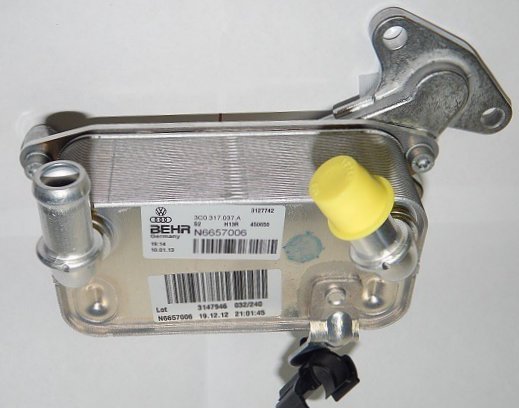
Hi Presumably the transmission oil cooler is a transmission oil/engine coolant heat exchanger, so it initially warms the gearbox oil when it's cold and cools it when it's hot. The coolant shouldn't begin to flow through it until the engine has warmed up enough for the "second thermostat" to open.
-
Hi Those graphs from VTP-122 are for soot (carbon) load. The soot load goes down during regeneration as the carbon particles are oxidised (= burnt). The ash stays behind
-
Hi I suggest you try a new switch. Should be less than the cost of diagnostics.
-
Hi A worn driveshaft joint will tend to make more noise the more torque it's being asked to handle, so lower gears and more throttle are the severest test. The traditional method was to open the window and listen for ticking/knocking while you drive round (slowly) on full lock so as to exercise the outer joint through a large angle It doesn't take much free play to give noises, probably not enough slack to detect with the car up on ramps and the driveshaft grasped by hand.
-
Hi From what I have been able to ascertain, ash in a DPF has a packing density of roughly 0.4 grams per cubic centimetre, which equates to 400 grams per litre or 72 grams for 0.18 litres. Unlike soot, ash cannot be removed by oxidation during a regen i.e. it's the residue that gets left behind I have no idea what algorithm VAG use to calculate the ash volume, and in any case this calculation is only a guide to what's really happening.
-
Hi Yety I would expect the (calculated) oil ash residue to be in grams or percent. There is a maximum limit, I don't know the exact figure for the Yeti but something like 100 grams. The differential pressure is as you would expect, the difference between absolute input and absolute output pressure. The bigger the pressure difference for a given mass air flow, the more restrictive the DPF. Presumably there is a threshold which triggers a regeneration. I have no information on the high pressure loop EGR except that it is mainly used at lower speeds and engine loads, with the low pressure loop EGR used at higher speeds and loads. The latter is fed post catalyst so is less inclined to carbon fouling.
-
Hi "it’s booked into a garage for a haldex oil change at the end of the month" I hope you are already aware of the slight risk associated with this. Some garages (even Skoda ones) have unwittingly confused the drain plugs for the haldex and the diff, which aren't far apart. You then end up with an emptied diff and a doubly filled haldex. A short while later the diff overheats and fails through lack of oil and you have a struggle on your hands to prove who's fault it was. The other factor is that some generations of Haldex have a mesh filter which is ideally changed, but isn't on the routine schedule and therefore stays untouched. Once it clogs up it's bad news for the Haldex. I only have a 2WD petrol, others on this forum have more direct knowledge, so take a look for more threads on the subject.
-
Hi I have replaced the element in my drivers seat. The "wire" has something like 7 parallel strands insulated from each other by a thin lacquer or plastic coating. Where they pass under the raised bolster cushion at the side, they are vulnerable to flexing damage. Firstly one core will break, then another. Each time a core breaks, the wattage goes down and you get less heating. Eventually the last core breaks and you have no heat at all. For longer life, don't kneel on this part or sit sideways on it to put your walking boots on !