
Skip to content

BigEjit

Members
  • Joined

  • Last visited

Everything posted by BigEjit

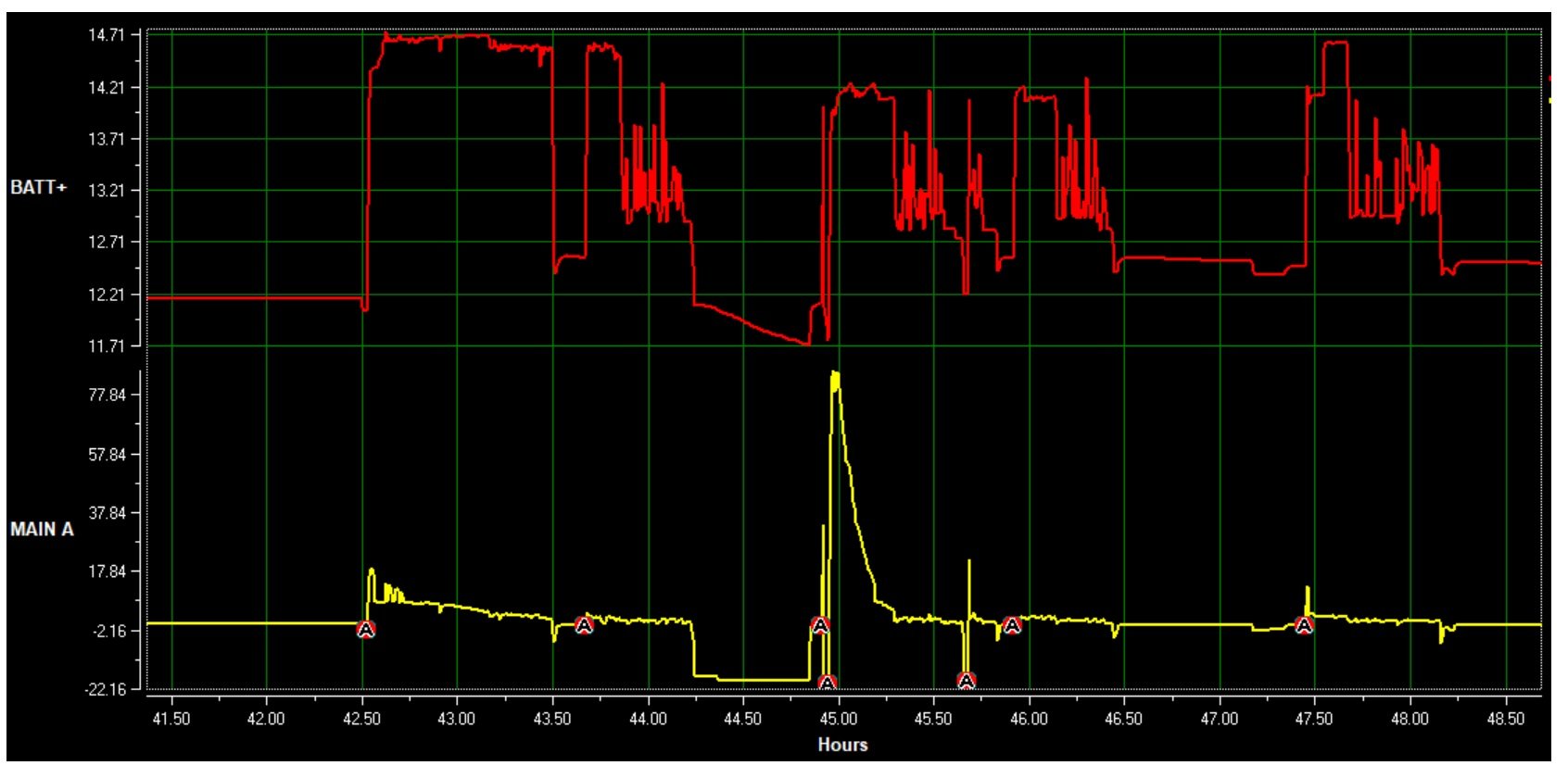
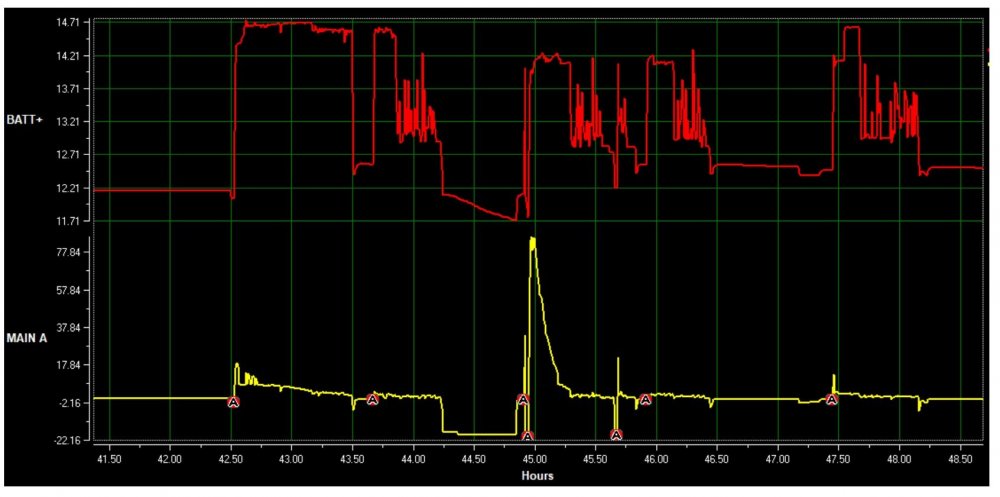
  1. As an example, here’s an 8 hour data logged session from a 2014 2.0TDi VW Caddy with a 096 AGM. It shows fluctuating voltage based on current demands from the vehicle. The ‘A’s in the graph are engine starts where current draw is at its maximum. Depending on the system current requirements, the voltage is changed to allow charging, maintaining or battery only power supply. There is no S/S feature on this vehicle but the energy management principle is the same. Neg current shows when drawing off the battery and voltage is low, Pos charging current when the alternator is operational and voltage is high. There is a significant current draw midpoint from an external device spliced into the harness that didn’t switch off with the ignition. The charge profile immediately called for high current next engine start to recover the battery charge state and tapers off back to normal once the battery is good. its constantly monitored and adjusted.
  2. As a suggestion for regularly carrying super long lengths, how about using roof bars and fabricate a T topped staff off the front towing eye as a support to tame the random flapping aboutery. That’s got to be better than hacking about with the doors open, surely??
  3. Seriously, driving with the back door open on any vehicle is never a good idea. Having done fume ingress testing on vehicles in the past, it doesn’t take long to fill an unpartitioned cabin with carbon monoxide especially on squarer vehicles. Dangerous levels of CO can be present and you won’t even know about it. Opening the front windows for more ventilation creates a vacuum and just draws more air and fumes in from the rear of the vehicle. That’s why the dash warnings for open rear doors never go away when moving. As for the lighting, you are asking for a software change, or you could just overlay manually switched lamps into the load space or even get a usb rechargeable LED head torch for a tenner. They last hours on a single charge and are really good.
  4. Roofbars....... And bunch of lashing straps.
  5. Couldn’t be bothered with the effort. It doesn’t get dirty in there, there is a cap to plug the socket when not in use and you can’t see anything of the opening unless on your hands and knees. And if you do use the cut out as a cover, it’s just more faff to mess with when putting the swan neck back in.
  6. There’s not that much info out there for looking after batteries which is surprising considering every car for the last 90 years or so has one. I guess it’s not that interesting as a subject. BU pages are probably the best available for free. For AGM, the charging should be voltage limited to 14.8v max, current can fluctuate within this limit. Flooded batteries are charge current limited. All batteries need protection from overcharging so they don’t dry out. AGM naturally hold less electrolyte over wet flooded batteries and need more protection from this but certain duty cycles will force a loss of moisture from the assembly regardless of tech. Pressure valves in the lids aim to stop this water loss (Valve Regulated Lead Acid - VRLA) and in-vehicle charging strategies hold the battery in a confined charging window to protect it from overcharge and try to recover it from undercharging depending on available engine run time. Excess heat is also a silent battery killer from overcharging and environment and is bad for all lead acid batteries. Too much heat and the lead plates decay and turn to mush, it takes a while for this to have a noticeable effect but once started, it’s not reversible. Equatorial markets go through batteries quicker than temperate climate markets. It’s also the reason for the module on the neg post has temperature sensor so that charging is restricted relative to battery temp. General mis-information leads folks to think cold weather kills batteries. It doesn’t! It shows up weak batteries damaged from summer heat/discharge/overcharge. The insulation bag the battery is covered in is to reduce the speed of heat soak from the engine bay when stationary or slow moving with no airflow underbonnet. Regulations only allow AGM to be fitted inside a vehicle cabin for occupant protection from spraying acid in a crash situation. It usually ends up in the load space somewhere accessible but then needs to be bigger to overcome the losses in heavy high performance cabling stretching the length of the chassis adding more weight. Then you get those folks pulling the fly lead off the battery module to inhibit S/S and throw all these carefully engineered compensation factors out the window! 🤦‍♂️ Dried out batteries go pop!
  7. That is a result if the charging strategies set up in the software and after this year, a dramatic shift in how vehicles are used. The batteries themselves from the top manufacturers are the best available but they are built to incredibly tight specifications and tested to more stringent durability requirements. OEM’s also have to remove the use of hazardous materials and get weight out of the vehicles as much as possible to achieve emissions targets. This just puts more pressure on getting efficient use out of the smallest batteries they can fit, as much as possible. The batteries will last if they are looked after from the moment they are first fitted. They have to be protected from discharging and critically when they are in the dealer network from new
  8. For the curved ball option, theres this depending how big the bike is... https://eshop.skoda-auto.cz/en_CZ/interior-bicycle-holder/p/3T9056700 Strap on rack come with too many compromises and risks to bodywork. This is a mates car after his popped the glass. And that was a week after the bikes had fell off and been dragged part way up the M42 in Friday rush hour.
  9. There’s another point to consider, the time between build and first on-road usage from new. There’s about 6 months stand time there. It’s unlikely there has been much engine run time between building, shipping and getting to first end user. The battery is entirely at the mercy of the transport chain and dealer network to ensure the voltage remains high with checks and recharging if necessary. If It’s been left to discharge at any time, it is possible there has been a slight loss of capacity in the battery which is not always as recoverable on EFB vs AGM. This affects battery life and performance depending on how long and how discharged it was. Its possible to still have a good voltage but the punch from the cranking amps is reduced a little. It’s another S/S inhibit point and the most likely if all other vehicle variables are OK. It will need a performance check with a Midtronics gadget to be sure, which is equipment most main branded dealers have and use. OEMs have these preset with specific programs to measure the battery types in their vehicle ranges. There's nothing more you can do with this at home than you have done already. Further overnight recharging could help, otherwise butter up the service staff. 😉
  10. Skoda are good at paint marking the terminals for factory torque setting confirmation. Check if the bolts are painted and it’s still in line across adjacent components. Also, the battery will have a date code on it, VARTA is week no over year on the neg post in 4 digit format. This should predate the vehicle build by a few weeks if it is correct. This will tell you if it’s been fiddled with.
  11. For reference, even if you switch off stop/start, it’s not a good idea to fit a normal flooded battery. The specific charging and operation profile for the type of battery technology installed remains active even if the engine never stops. It will work a basic battery very hard and wear it out quickly. It’s the primary reason for coding a new battery in.
  12. Yes. EFB is a lower S/S battery tech. It can take quite a while for the engine to cut with S/S using one of these, as much as 45 mins. AGM allow earlier operation in just a few minutes after an engine start. The battery voltage is good in your case. There are multiple settings that inhibit S/S operation including steering wheel inputs, pedal movement, seatbelt connectivity, even vehicle angle. Otherwise it’s as RootyGeorge says above. 😕
  13. If the connector arrowed below is loose or not fitted into the battery clamp, it will affect S/S operation. What’s the battery voltage with the engine off and car locked? Is it an AGM or EFB marked battery?
  14. Just pull the old one off and knock the new one on with a rubber or wooden mallet. Holding the hard plastic lower trim away from it just a little as you do so helps it seat better. Make sure the seal is pushed into the corners properly around the door aperture and flip the inner lip out over the adjacent trim pieces.
  15. The best option is to go for roof bars and carriers. I used the Skoda accessories bars on my fab but Thule on other cars, they all work well. If not wanting to buy new stuff, Autumn is the best time to pick up cheaper used gear as folks move it on after summer. I buy top end used instead of cheap new stuff and never had any issues.
  16. That’s the cause. Sulphation damage- The battery was deep discharged by being left connected for months in storage and not getting checked and recharged.
  17. @kenfowler3966 Check the build date of your vehicle. If it was built several months ago and you have only recently recieved it with delivery miles, that would explain the cause...
  18. Long nerdy post alert! Johnson Controls are now out of the battery business. The entire battery division and the brands such as VARTA and Optima was spun off to an investment company. VW group take batteries from all the main suppliers in Europe to spread supply risk so there will be several battery manufacturers for one VW part number. I reckon there will be a primary setting in the vehicle software listed against a single supplier for a particular part number regardless of who actually supplied the part to the assembly line. At the point of fit on the assembly line, the 2D code label on the battery lid is scanned to assign the battery to the vehicle and make sure it’s the right spec for the chassis/power train combo. Some manufacturers even have two suppliers sending in batteries to one assembly line at the same time which are the same part number and spec but are totally different cosmetically. Batteries are being classed as vehicle lifetime parts so there should be no need to replace them. Exhausts and dampers used to be consumables last century.
  19. Don’t worry about it. Just let the charger get on with it. It’s not going to do any harm at all being a Ctek. There’s no electronics in a starter battery so you aren’t going to damage it by picking the wrong charging program once in a while for a quick top up charge. An occasional recharge esp on low mileage cars helps the battery stay at peak performance and allows stop start to operate more frequently - a good sign in itself that the battery is hunky dory.
  20. It’ll be fine. AGM are more at risk of drying out if charged as a flooded battery, it doesn’t matter anywhere near as much EFB charged as AGM.
  21. I hope it is a step towards reforming attitudes of road users who enforce ‘I, self, me and don’t care about anyone else’ and encourage folks to be more tolerant of others making errors. It adds another level of awareness to hazard perception of trained road users that ‘should’ make for a more cautious approach around other lesser trained people. I also hope that the most vulnerable the changes are designed to protect don’t grow overconfident and put themselves into situations that are inherently dangerous on the basis that if they get hurt, it’s the other persons fault. However, there will always be those who travel with a ‘just don’t care about you’ mentality and those are the people who are most aggressive towards others and most likely to overreact and give off at the first slight against themselves.
  22. It depends on how much you are prepared to do yourself to save a few pennies. A quick and dirty fix, warm up the bumper plastic with hot water or hair dryer and push it out from behind. There will be a few light creases left in the plastic and for around £100 you can then get the paint sorted. Get a replacement lamp off the bay for about £50. Make sure the paint isn’t broken around the lamp area. Or for approx £400, buy a bumper from a dealer and get it painted then swap it yourself. The parking sensors can be transferred over (probs need a tube of bonding mastic to stick the sensors back in). Plus a lamp £50. Check the paint as above. This is not much harder than building flat pack furniture. Or let a body shop sort it, over £500+ depending on what else they find damaged.
  23. Sure it’ll be ok for some folks and short term there will be no noticeable effects, if you regularly bin the car off after a year or so or are prepared to just bung a battery in when it fails. But then you get those who are long term owners on a tight budget wondering why the battery is done after a few years normal use and they are stranded somewhere spending hard earned on the car, recovery and garage services, (supplier quality issues aside). 10 years/100k miles is the achievable lifetime target for the battery set by the OEM for 95 percentile customer usage pattern. Changing the optimised charging strategy reduces that expectation.
  24. The stop start batteries are specifically built to handle the extra demands of repeated engine starts and are specc’ed according to the vehicle electrical system. That’s why amongst other things you can’t just shove any old battery in and not tell the car it’s been changed. The programmed charging strategies in the car systems target 80% SOC as 100% is just not necessary, the alternator is turned down when not needed above this. Each type of battery takes a different charging profile. EFB takes a much more gentle charge rate than AGM which take all sorts of abuse way better. Stop start operation can take a while on EFB equipped cars vs AGM as a result. Overrun charging is free energy that the battery can hold so there is less time needed taking energy from the fuel and the alternator turns down until the battery is back down to 80% SOC again. The alternator is still used when necessary. What you don’t want to do is send the charging system blind by disconnecting the fly lead off the battery monitor. It inhibits stop start but it also creates an overcharging situation pushing the battery outside the specific window of operation. This slowly overworks the batteries eventually drying them out and turning the materials inside to sludge due to increasing acid density particularly in EFB types. The minder also controls temperature compensation strategy turning the charge rates down the hotter the battery gets further preventing water loss. Three prime methods to kill car batteries are underuse of the vehicle, repeat deep discharge cycling from constant background energy drains, and overcharging. The latter is the worst situation as the battery materials decay quicker leading to loss of capacity, overheating and drying out as they can’t handle the extra energy, in some extreme instances they have been known to pop!
  25. Check out page 13 of the Octavia thread. The fix is now to add a piggy back switch fitted onto the shift lever instead of ripping the stick and mech out. Instruction TPI there too.

Important Information

Welcome to BRISKODA. Please note the following important links Terms of Use. We have a comprehensive Privacy Policy. We have placed cookies on your device to help make this website better. You can adjust your cookie settings, otherwise we'll assume you're okay to continue.

Account

Navigation

Configure browser push notifications

Chrome (Android)
  1. Tap the lock icon next to the address bar.
  2. Tap Permissions → Notifications.
  3. Adjust your preference.
Chrome (Desktop)
  1. Click the padlock icon in the address bar.
  2. Select Site settings.
  3. Find Notifications and adjust your preference.