agedbriar
Members
-
Joined
-
Last visited
Everything posted by agedbriar
-
Unfortunately, that doesn't work for everyone. Even the manual says it's something to try. Personally, I've had mixed results from that expedient. It sure must be attempted several times before giving up.
-
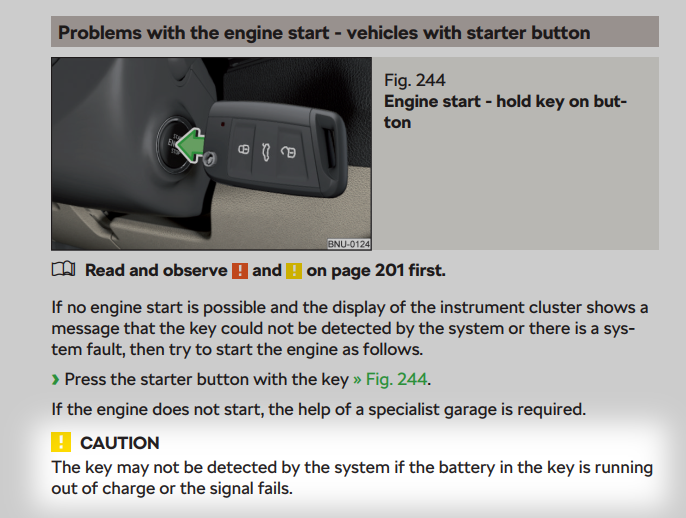
... unless it's of the KESSY kind. For those, a spare battery in the wallet helps.
-
From standstill, there is practically no difference between S and D, at least in mine. As long as the car is moving, yes, S will keep the revs higher and the car will thus accelerate more promptly when requested.
-
My 2019 1.5 TSI DSG is my first non-manual car. With this technical soul of mine, I can only be amazed by the smoothness of DSG gear shifting. My only grievance is the inability to jump briskly in a fast moving traffic gap, except by launching, which seems pretty extreme. When normally starting from standstill, DSG engages the clutch far before the revs reach the turbo boost threshold.
-
I second that.
-
Actually, on the following two balancing sessions I did remind my tyre fitter of that detail and he didn't seem to mind. He is a nice person.
-
There was no problem fitting my 215/60R16 6Jx16 ET43 wheels at all. As my fitter was using two sizes of balancing weights, he pointed out that the lower profile weights should be used in my case. Just a heads up. 🙂
-
Low profile wheel balancing weights may be required on front 16" alloy rims.
-
To keep in mind that wipers for a LHD Karoq differ from those for a RHD model. For continental Europe the code is Bosch Aerotwin A863S.
-
-
Long before shutting down subsystems, low battery will start developing sulfation, which deteriorates the thing. For this reason we should not let the battery rest at less than 12.4V. I don't drive much and so I have to charge the battery with the external charger rather frequently. A Bluetooth battery monitor helps me keep an eye on the battery resting voltage.
-
Keeping the speedo error within prescribed limits is a car maker's concern. As long as the user mounts wheels from the approved wheels list, they are not responsible for any speedo reading inaccuracy. Mounting wheels that are not approved is illegal, but still, excessive speedo error is not the main reason for that.
-
Is the Lights setting item missing in your Car Settings infotainment section ?
-
On my 2019 I can set the halogen lights' height on the infotainment: Car > Settings > Lights
-
At first it seemed too empty looking, but after a while it started to grow on me... I'd certainly redo the test on a picture taken in the open, in soft light.
-
You should be banned from this forum for that! 🙂
-
On mine, it's also printed on the label affixed to the B pillar, driver side.
-
Those dips are proof of how careful one must be when measuring the at-rest battery voltage to check its State Of Charge.
-
In Slovenia, the dealer hands the homologation certificate over to the first owner and we are supposed to have it along when driving. It lists all the approved rim/tyre sizes.
-
I'm happy with 17" wheels for summer and 16" for winter tyres. Mind that 16" rims require low-profile balancing weights, the front brakes are so close.
-
That's expected, but did you find any decrease in the at rest voltage dropping rate? Also, do you have KESSY, which seems to be to main load at rest?
-
Well, yes, this is the line I have been thinking along. But, what comprises the level above which the system will charge the battery only if it can do it in the so called regenerative mode? Is it a definite % of SOC or a given amount of energy stored? If it's the % of SOC, a bigger battery of the same technology will start the resting period from the same voltage as the current one, but will drop to the critical 12.4 V later, which is my goal. (If this was the case, though, the system would only require the technology input, wouldn't care about nominal capacity.) If it's the given amount of energy stored, a bigger battery of the same technology will stop being charged at a lower SOC, the battery will start the resting period from a lower voltage than the current one, which might even shorten the time to 12.4 V. In this case it would be better if the system didn't know that there is a bigger battery installed.
-
The damages caused by deep discharge and resting the battery below 12.4 V are different. Repeated deep discharges cause plate distorsion which with time lead to an internal short-circuit and the unexpected battery breakdown, most likely on the road. This isn't my current topic. Letting the battery rest below 12.4 V leads to sulfation, which gradually reduces the active metallic lead available for energy storage (i.e. battery capacity) and reduces the battery charging speed. The battery capacity loss is felt upon starting the engine, preventing on the road mishaps. EFB batteries are no more sulfation resistant than conventional ones (or maybe just "somewhat", to cite the Varta representative).
-
Although it may seem so, I do not. 🙂 I'm wondering if, by replacing the battery (when the current one is depleted) with a bigger one without telling the system that there is now a bigger one installed, I might avoid battery sulfation without external charging between trips.
-
That's exactly what I think might help me. I don't want the system to restrict charging even more on account of the higher capacity of the new battery. My problem is not the SOC in terms of amount of available energy. The battery has never let me down upon starting the engine. My issue is the resting voltage dropping early to 12.4 V, which induces sulfation. That's what I strive to prevent. Thanks for the table Kenny, I saved it. Interesting the transition at 80% > 70% SOC.