J.R.
Resident Member
-
Joined
-
Last visited
Everything posted by J.R.
-
70-90% alcohol 🤯 Do you really believe that?
-
You can choose whatever circuit you want to interrupt with the latching relay. "Cutting off" the battery negative cable would not allow the fuel pump and starter circuits to run which is what it seems you desire. The motorsport battery cut off switches are notoriously unreliable, cheap shonky contacts that are not capable of reliably and frequently carrying the starter current, choose your circuit(s) to immobilise with care, the lower the current the smaller the relay the easier it is to hide, the pushbutton for the latch can be as small as 3mm, not visible but you the driver will be able to find it easily every time by feel.
-
Do you have a 6 speed gearbox?
-
Air being drawn into the O ring joint within the bellhousing for the concentric slave cylinder. Each time you lift the pedal you draw more air in but I appreciate that you have little choice. Bleeding (a very simple operation done by hand in a few seconds without tools using gravity) will make the system work again but the problem will recur and the interval between bleeding will get shorter and shorter. The only proper solution is to remove the gearbox and replace the slave cylinder and clutch assembly while you are there. I lived with it until I could go no more than 5 miles in urban traffic before losing the clutch again.
-
I have used latching relays in the past to cut the power to everything except the main starter cable, they were operated by a hidden N/O push switch, I used tiny ones for electronic circuits and hid them up & under the dashboard, in the area around the steering column, invisible and not even obvious to touch until it became a routine thing. You would switch on the ignition in the normal manner but nothing would happen, no dash lights no nothing, then feel for and push the switch which would latch the relay in and the vehicle could be started and driven as usual, switching off the ignition would break the latching circuit, if the vehicle stalled you could restart it as the ignition does not need to be turned off, only back to the accessory position. A refinement for motorsport use was using a pair of larger red N/C pushbuttons as emergency cut off switches mounted visibly on the dash and beside the drivers A pillar in accordance with the RAC blue book and with the relevant stickers, they met the spirit of the regs if not the fine detail as a short to the main battery cable could still cook the battery but that is relatively safe compared to having the loom of much smaller wires catch fire, it met the requirements of the scrutineers in that it would stop the engine if it was running (and not kill the alternator diodes), it was amazing how many so called pro prepared vehicles had cut off switches that did not stop the engine from running from the alternator. Proof that the hidden switch worked was when I recommissioned my self engineered motorcyle engined Caterham to sell 3 years ago when I sold up in the UK, I had not driven it since 2004, I knew I had to push the hidden switch, I knew where it was but could I feel it? - No way! Could I see it even lying upside down with my head in the footwell using a torch? - No way! My vison had deteriorated in the two decades. I had to remove the scuttle (4 knurled nuts, another race modification) to find the N/O push switch, it was exactly where I recalled putting it and I had lost the feeling of it, it worked fine and the engine started. Using a latching relay in this way no current is drawn when the vehicle is immobilised and only a few milli-amps more when running. Google will give you the circuit diagram but basically you energise the relay coil from the push switch which then puts 12v onto a second N/O contact wired to the relay coil, you push the button which energises the relay and the second contact keeps the coil energised, the kill switches are N/C ones wired in series with the wire from the second contact to the relay coil, it will be clearer when you see the circuit diagram. I have also used a variation of this on high compression engines with race cams which would struggle to crank against the ignition advance and a couple that would kick back and run backwards (fatal for cam followers) in that case the latching circuit was the ignition coil only, you would start the engine like Biggles, crank it over at high speed (no ignition advance opposing it) shout "CONTACT!" and push the latching button and the engine would roar into life! I first did this on a 6 volt split screen VW camper, when timed by ear you could get the engine to develop a lot more power compared to stock and it drove much better but would struggle to start, others converted to 12v or used a seperate 12v battery for the starter, I used a latching relay.
-
Its doable, I did mine which would have been 6 years old at the time, it takes a different skillset and mindset taking apart something that was never designed to come apart, it can be somewhat destructive if not thought through at every stage, plastic gives very little feel when its approaching yield point. Certainly replacing both the inner and outer grille together is the 100% safe option, now that my painted black finish has failed so spectacularly I regret not buying both, I had to replace the grille, it has been shattered in the accident, the surround was fractured but I reasoned that my repairs could be hidden by the black finish, I should have bought a new surround but the black ones were are probably still are stupidly expensive compared to the chrome ones that cost more to produce.
-
55K miles on a set of Hankook Ventus Prime 2 which had already done an unknown mileage before I bought the vehicle. Vehicle is 4x4 which increases tyre wear. Probably 10K miles of that were done towing very overloaded trailers beyond the rated towing capacity. The tyres were regularly rotated and I would measure and record the tread depth in 3 places across the width to fine tune the pressures dependant on what corner they were next being fitted to. By the end they were all uniformly worn down to the legal limit by that time I had become fed up with comments from well meaning but ignorant people telling me my tyres were bald. I fitted the same tyres as replacements except they are now Prime 3, A rating for wet grip, I fitted them myself with my manual tyre changer and tyre levers, I respected the positioning of the red and yellow dots and as a consequence they needed no balancing. The key to longevity is watching the wear like a hawk within the first few thousand miles and taking corrective action, the new tyres have moulded in depressions right on the wear edges at 0.5 and 1mm depth which makes this much easier but it still needs to be done in conjunction with the tread depth gradient measurements.
-
Bottom burps! 😄 Sounded like sly ones!
-
Pre cat yes, its one of the rare times when I drag out an analogue multimeter, if the needle is swinging back and forth around the 1v( or was it 0.7v?) reference then all is well, I have yet to work on a post cat sensor, I'll have to Google to learn about them.
-
Yes, that brings back memories, they were quite inaccessible and I thought I might have to remove the bumper but with determination I succeeded.
-
From memory I think you have to unclip and remove the grille and frame before you can detach the grille from the frame.
-
I listened to the video, it is flatulence!
-
There will be no air movement when the brakes are not applied unless the diaphragm (think thats the word in English) has a hole in it.
-
The Lambda correction software would adjust the fuelling to maintain the correct Stochiometric ratio within its limits of correction, a problem with the PCV system would cause a weakening of the mixture if too much air was getting in to compensate and you would see a positive fuel trim at the injectors. A rich mixture could be a blocked air filter but highly unlikely unless you live in the Sahara and have done a million miles since it was changed, for me the likely culprit would be the Lambda (Oxygen) sensor but you say it does not run rich off idle. MAF sensor maybe? But again if it was overfuelling due to the MAF sensor showing a higher than real airflow the Lambda correction should bring it back. It sounds like you are using VCDS, have you checked the Lambda sensor output at idle and higher RPM?
-
I was a part time mechanic from 15 through to late 20's, evenings and weekends alongside my Engineering apprenticeship, I was homeless at 16 so its how I supported myself through college till 24 and purchased my first properties. Because for 17 years I was living in a different country to where my workshop was my breakdown toolkit was and still is fairly comprehensive and decent tools, some like the Bahco socket and spanner set as good as those in the estranged mechanics toolbox, it is nice now to have the whole toolkit to hand even if I'm squeezed into a small garage until I build the workshop extension. Daft me for speaking of the clutch when I knew yours was a DSG, a senior moment! That is a similar or maybe the same centralising tool as I bought, even that is 800km away from me one day I will have everything in one place, its down to 2 places now but still one too many.
-
It was indeed the support bracket for the transfer box or angle drive box as its also known, I think I left it attached to the transmission and removed the bolt or bolts to the engine block, it was one of those which was hard to access but I definitely did it without removing the driveshaft output flange of that I am certain. The cross member had to be removed, there is no way of removing the manual 4x4 gearbox with it in place. I didn't need to remove the engine fan to drop down the rear propshaft, after the engine is supported by the cradle and the mounts are removed there is plenty of movement, again the DSG might be different. Is there really 16kg of transmission fluid in the DSG? I think my gearbox, differential and transfer box weighed 78kg but was managable because I lowered it on ratcchet straps from the engine support beam. If I have a rear main bearing seal or driveshaft output flange seal leak in the future I will regret not doing them at the time. I don't recall seeing a clutch centralising tool on your list, instead of using the mandrel set I made as a first year apprentice (it was in the UK with my mechanics tools and I was in France) I bought one of the plastic centralising tools which clamps the driven plate to the clutch cover before fitting both as an aligned assembly to the flywheel, they are cheap and very good, my old set is now just for reminiscing! Writing the above made me realise I did the job without my main toolkit and pretty much with the tools that I carry in the vehicle, my pal brought along a 3/4 drive breaker bar and some sockets for the driveshaft retaining bolt.
-
Mine was a manual gearbox, was yours being a DSG the reason for removing the drive flange? You did not explain the actual reason for doing so only that not doing it was a no-no and it would cause lots of trouble. I really like your scissor lift, it looks portable, is it? Do you find it stable? any drawbacks that you have found? It might be the solution for my new workshop not having enough height, I did not want to have a 2 post lift outside in all weathers.
-
I did the job somewhat differently and I think from reading your description it was an easier procedure but not having done it each way I cant be sure. I left the steering rack hanging in situ. I did not remove both driveshafts, its hard to recall after a couple of years but I think removing just the NS (left) one gave enough clearance to drop the transmission. I left the drive flange in situ, it did not cause me any problems at all and I did not have the complication of removing it, I do recall that there was one fastener on a support bracket in that area which was difficult to access but it did not give any real trouble. Only reason I can see for removing the flange and by consequence the one opposite (held by the same through bolt I believe) is to replace the oil seals which are a failure point. I wish I had known back then about the subframe centralising pins or the importance of using them, I used spray paint to mark the position as best I could but the vehicle was crabbing badly afterwards, I DIY'ed a laser pointer set up to align the front and rear axles to the body centre line, I could not pull the front crossmember far enough to correct the error and had to ratchet strap it from the rear axle against the bolts and then tighten them to death. I could not get enough mechanical advantage to release the rusted rear subframe bolts to move it the tad it needed from my laying on my back position and did not have my Bosch 1/2" impact wrench then. I knew what the pins did when I learned of their existence but from seeing them could not work out how, your photo answers that question so thanks for that! Good to see someone else tackling these that scare mots people into the greedy hands of the garages and their exaggerated labour hours, how long did the job take you? Did you find the weight a problem and how did you mitigate it?
-
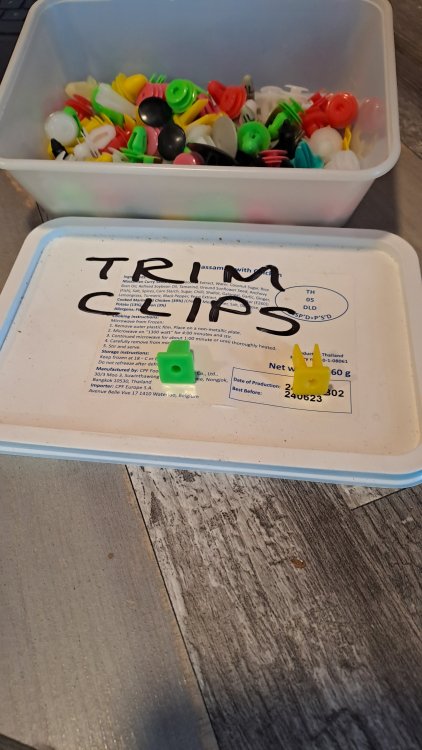
I can visualise exactly the ones you mean now, the square section is split in one axis and is tapered with a location step on the end, they push in and snap into position and yes the securing screw further expands them, they are very good and its worth spending the time to find them rather than using anything metallic. The company of the link above probably lists them elsewhere, they are a standard fastener. I just found a couple of variants in my box of Trim Clips I bought from Ali-Express, another good source for the search
-
One of my poorer decisions in life was to buy the 3 Vin version of VCDS.
-
I used them on my MK1 Octavia, they were OK and a reasonable price back then compared to new springs, TBH its pointless fitting them if your rear springs have already sagged, new ones from Lesjofors or Kilen (same factory) are very cheap these days and you can choose the upgraded ones for increased unladen height and carrying capacity, I have fitted them to the last 2 vehicles and they have been great. You should look at the colour coding of your existing springs to decide what uprating will suit you best. Carlston is the font of all knowledge on this subject!
-
While we are off topic, tonight I got my best ever MPG on a short run that I do at least once a week. Cold start, 4 miles outward journey. Return a couple of hours later so another cold start and 4 mile journey, well not so cold here in September! I got caught by the traffic lights on both journeys. Overall was 61.5 mpg which is pretty amazing for a non slippery brick with 4wd transmission! I was up to 54 mpg on arrival at destination after 4 miles. My best ever before was 57.something probably with green lights both ways. I was probably driving a little slower the road has been planed for resurfacing and had no markings and I see my opthalmo tomorrow, perhaps my night vision is not as good, hardly any traffic as always.
-
A little bit less of the top of my head. How did the thread deviate to the fuel capacity of an American Passat? 😀
-
Opening the bonnet to check the battery voltage will give a false reading as the canbus will be awoken, if you wait several hours it will remain awake and significantly discharge in terms of the 10ths of volts that you are looking for. The only practical way to do it is close the bonnet catch using a screwdriver or similar and lock the car, take a voltage reading straight away (this will be a false low one due to the parasitic discharge) and another 20 or 30 minutes later which will be a little higher and the one to use.
-
Given the BS about "balanced gas mileage" that will be US and not imperial gallons.