J.R.
Resident Member
-
Joined
-
Last visited
Everything posted by J.R.
-
The dealer is not going to do anything other than the proper by the book repair, they should have directed the guy to a smaller garage with staff who use their grey matter. Sadly there are those that would happily have just lodged an insurance claim, it would I believe be an insured risk, just like many with minor flood damage that could be fixed, the vehicle gets written off for (I will use your figure) £8K less the policy excess lets say £7.5k, owner is only £500 down and buys a new car, insurance company sell it at auction as the lowest category, it will probably make £6K, take away the insurance premium and the loading on the insured future premiums and the insurer has lost very little maybe even nothing. The new owner does the £5 repair and has a cheap vehicle. Unfortunately it happens all too often, the owners will take the £500 loss route rather than engage on repairs that could cost them a lot more and have a car that may have constant electronic problems. Which they will probably get anyway if they replaced it with a new Octavia
-
Every time I check prices for parts like that on Superskoda and Ebay sellers in every case they have been more expensive, often significantly more than TPS. That said the grille surround is expensive for what it is, mine was accident damaged, I bought the inner grille from TPS, far cheaper than Superskoda but repaired & painted the chrome outer, it has not been a success as there are lots of stonechips and/or automatic car wash damage. If Mr Muscle is strong enough to remove the chrome finish it wont do the plastic underneath any favours. I stand corrected, Google agrees with you!
-
Every system leaks, in most cases when people put their vehicle in for a recharge it is because the system has lost some refrigerant through the normal losses across the flexible hose materials and to a latter degree the pump seals. A vacuum test is the quickest way to detect if there is a leak and a pressure test is the best way of detecting where it is. There is no benefit in weighing the gas recovered other than for accounting and possibly charging the customer by weight for the recharge, if oil mist is recovered and seperated then I can see the value of replacing the same amount but I am unconvinced that this happens with the automatic plug in & leave machines that all the operators use that demand zero technical knowledge of the user.
-
Yes they do, or should do, in France not many do the nitrogen test or have the die. I am just a hobbyist with a manifold set, vacuum pump and a 13kg R134a cylinder and a timeshare hole in the ozone layer I tried weighing how much was taken on by the system but every electronic hook type scale I have bought ties out and resets to zero So I fill till the high side pressure is what my graphs say it should be. As for refilling with the "correct" quantity of oil that would require the operator to know that the system started with the correct amount and how much they removed when evacuating the system, a calculation and precise dosing to refill. What actually happens is they all have these automatic machines, they make 2 connections press the start button and let the thing do its business for 30 minutes while they make some money doing another job or serving another customer. They say the machine does it all automatically but I have yet to find an operator who even knows where to top the thing up with oil or what type of oil it has in its reservoir if any at all. As I get to see what I vacuum out & it never has any oil mist I have yet to refill any, I have noy yet bought a vessel with the valves etc to introduce it through the bleed port.
-
Unless you introduced the gas via the bleed port on an AC manifold set while the system was under vacuum (you close off the port to the vacuum pump and bleed in the refrigerant) then the system will have been full of humid air at 1 bar atmospheric pressure, if you managed to pressurise the system to say 4 bar using the cans (and you would need double the amount they say based on weight) then the air now at 4 bar pressure will be taking up 25% of the system volume, the water vapour that it contained will have condensed & unless you replaced the drier will spread around the system possibly damaging the pump but certainly freezing after the evaporator orifice restriction. I am sure that you hope you have purchased the correct gas but its illegal to sell it within the EU and virtually impossible to find, the Ali-Express sellers have to resort to calling it various inventive names like "air freshener" or "AC test fluid" I had 3 orders from different sellers that didn't arrive (I suspect they were siezed) before I bit the bullet and paid a fortune for a 13kg R1344a cylinder and even then nobody would sell it to me unless I was a qualified frigoriste, the exception being a Lithuanian seller & even he has probably been shut down. There are no restrictions however in selling propane gas despite the fact that it could cause an explosion.
-
I tested some while back and like you just ended up confusing myself more I have to check the system soon so I will do the back to back test like you did although I dont think that I have a spare working G65 sensor, its possible though. I will report back and if I have a conclusion I will write it down amongst my AC dossier graphs, notes etc otherwise I will forget once again.
-
Nobody can answer that as the high side pressure is dependant on temperature and humidity, the low side pressure is directly proportional to temperature but a very crude way of checking if the system has the correct charge. You will need to study some graphs on the interweb to see what your pressures should be, if you are measuring using VCDS be aware that it reports absolute and not guage pressure.
-
In which case you have wasted both your time and your energy, because at the very best your system will contain at least a 25% moisture laden air the water content of which will have condensed with the pressure of the refrigerant gas that you have introduced. Probably more like 50% given the low refrigerant pressure you seem to have. I am making the assumption that you have not invested in a vacuum pump (which would have told you that the system had a leak) and A/C guage set plus a cylinder of R134a gas (only available to licensed professionals) and have used some Chinese top up canisters labelled R134a but in tiny print saying "eco alternative" which will turn out to be propane gas.
-
Airbag light will be from where you removed the glovebox, you had to disconnect the keyswitch to deactivate the passenger airbag for a baby seat, if the battery was connected at any time it will be a fault code and MIL light that will remain until reset with a suitable diagnostic reader. It sounds like you did the repair without removing the dashboard, well done. You have saved a vehicle that the motor trade were ready to write off with determination and patience, well done to you! I mostly figured out how to remove the dash by myself, pulling and pushing to find yet more fasteners that I hadn't seen. The thing that had me stuck for ages was removing the steering column stalk assembly, I just could not see how the plastic parts latched together but did eventually.
-
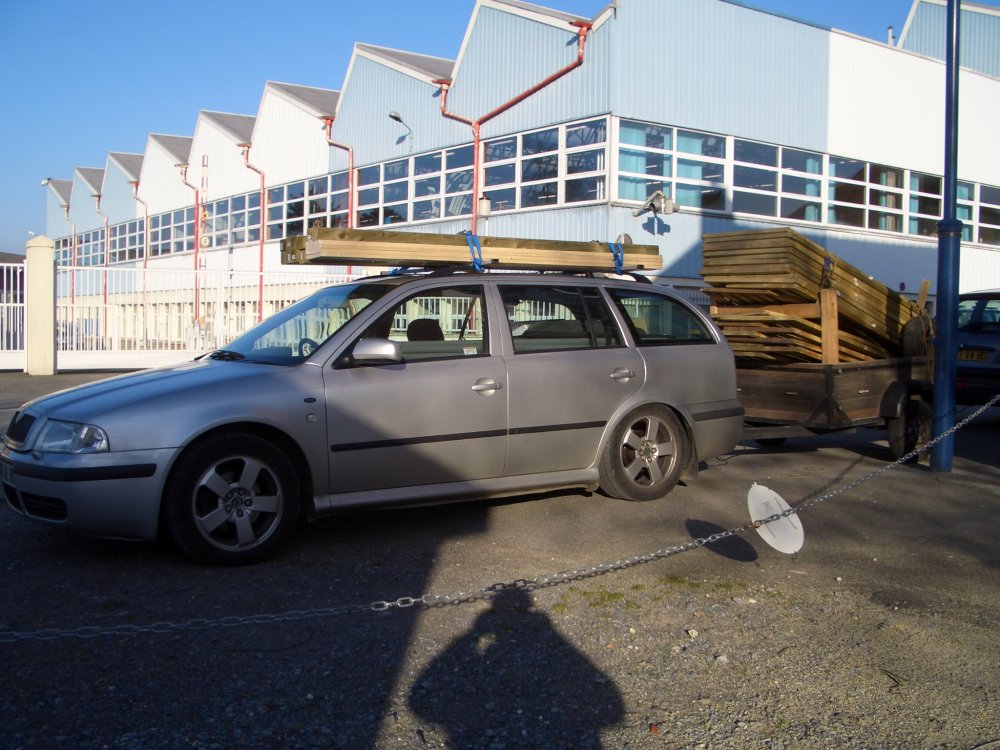
Everything was fine, totally stable around corners, braking etc, you would not even have known I was carrying any load & then all of a sudden it became like a death trap, kept wanting to tip over on the slightest turn, brakes ineffective etc, I stopped to check and found that someone had parked their helicopter on the roof but they assured me it weighed less than 750kg. There are 11 (double 6 foot) fence panels there and the posts & gravel boards to go with them, inside the boot there are lord knows how many 40kg bags of redi to mix concrete for the 8 foot posts, all ready to cross the channel to the UK. The rear suspension had uprated springs and Grayston inner helper springs. Those were the days when the £ was strong and prices hadn't gone up here.
-
Why carburettor icing occurred on cars. Latent heat of vaporisation and pressure drop across a venturi. The same could happen with headlight washers, not so much the pressure drop but the evaporation of the volatile screenwash cooling the liquid. Any nozzle in an airstream will act as a venturi, its how a pitot static tube works and the freezing of them have been responsable for aircraft disasters. In general terms if you have a vehicle at the ambient temperature of say 5°c and you drive it through that air at high speed the friction will warm the surfaces in contact not cool them
-
With the bonnet open but the latch closed so the vehicle would go into shutdown, easiest way to put a current meter in series with the battery & be able to read it without the danger of a closed bonnet cutting a lead & creating a short circuit.
-
It makes a big difference, initially there can be 200mA, it drops to lets say 60ish mA within a couple of minutes and then down to the basic quiescent current after 10 or 15 minutes on my vehicle, 30 minutes is a safe time to wait to be sure.
-
Absolutely, but I reckon if anyone had given that answer at the beginning they would have been jumped on as well.
-
That needs wet flatting through several grades of wet n dry paper followed by compounding & T cutting which would get rid of most of the white. HOWEVER! It is already through the clear coat, colour coat and primer to the bare plastic in at least 2 places and the rest of it will be somewhere between that and recoverable scratches in the clear coat, that would be fine on a flat panel with someone experienced & who knows exactly when to stop & say, "if I go any further it will be a lot worse & then I will be into colour matching & spraying the base coat and lacqueur & cutting back" also with it being on a sharp edge even someone doing it day in day out will end up rubbing through to the base coat. So the OP being inexperienced should limit themselves to the less abrasive methods, - T-cut but with carefull considered strokes & not too much pressure. It has the potential to look quite a bit better but far more chance of looking a lot worse in my view, but for the raised edge I could do an almost invisible job with a small amount of hand touching in.
-
The loom will have been assembled into the door so it can be removed, either in one direction or the other dependant on what are the largest connectors, my guess is that its the other direction to Wino's suggestion as the motor connector is the largest. The tools will still be usefull if the wire breaks are close to the connector and its easier sliding on heat shrink or wrapping insulation if the conductor is apart from the others in the bundle.
-
I dont know if they contain the right tools but I really like your plan of action & will do the same myself when the time comes as it surely will, my eyesight means I cannot work in the dark confined spaces that I once was so capable of. Could you possibly post a link to where those multi-tool kits can be bought, they are definitely something that I should have. I have some pin extractor tools from years back but they require the wire to be cut off flush to use, those look really inspired!
-
Road safety charity Break or Brake? Whichever I hope the thread title was their words & not Mikes as its patronising to a reader for them to assume that they have believed 10 myths.
-
One drip of oil is not going to hamper your plans, 1000 times that amount would have been dropped when the mechanic removed the oil filter element, that may even be the source of the drip.
-
There is no seal between the bellhousing and the rear engine flange, its a weep hole to let out any engine or gearbox oil that makes its way past the crankshaft rear seal or the gearbox input shaft seal, there will always be a film of oil within the bellhousing that eventually makes its way out via the intended route. One drip on a 7 year old 60000 mile car is not cause for concern and certainly not for specialist Tig welding, look at the sump and bellhousing, you could eat your dinner off them, they are testament to how oil tight modern VAG engines are but unfortunately that can cause a massive over-reaction to a single drip.
-
If you want to push your clutch pedal to the floor well beyond its disengagement point because the manual says that you can or should then thats your prerogative, nobody is telling you not to. I think most of us are struggling to see what the problem is for you, if the floor is too far away for you to put the pedal to the floor then move the seat forward, its even advisable because if one day you have a brake system failure or problem with air, a prolonged ABS stop after intense downhill braking etc you may need all the reserve travel to avoid an accident. I thought perhaps you had just bought the car and not been driving it for 19 years.
-
My 1984 2.6 litre straight 4 cylinder Mitsubishi Shogun had a balance shaft, it was a very smooth torquey and responsive engine.
-
-
With the top up canisters, even if you do actually get real R134a (and how would you know) the content weight is never what is advertised and what can be drawn from them is a lot less than the actual contents anyway, the more you put in the higher the system pressure the less you can get out of each can. You will however have your own personalised hole in the ozone layer!
-
Ahhhhh, you regassed it with some Chinese butane gas canisters marked Environmentally friendly R134a equivalent? That would explain a lot, if you did then have it vacuumed down & refilled using a proper R134a cylinder, something that is and does what it says on the tin. In the meantime dont use any naked flames. Been there, done that!