Breezy_Pete
Sponsor
-
Joined
-
Last visited
Everything posted by Breezy_Pete
-
Try whatever remote fob pairing procedure you might find in the Owner's Manual, as a start? TCM fault may need a short drive to reset itself? (Sheer guesswork) Media; not sure about, does the radio work? If it all gets working can you smash your way into the old unit to see what looks cooked? (Not before though!)
-
Fuse at the battery end of this new cable?
-
Wolfsburg?
-
A pressure switch (which some earlier cars like Mk1 Octy had) has only two states, conducting or not conducting, so it only tells you whether something is above or below a given pressure. The Octy one is actually two switches in one package, one normally open, the other normally closed, not sure what their threshold pressures are. A pressure sensor tells you more; what the actual pressure value is.
-
Yes, but extremely reliable internally, so wires and connections would always be best suspects if things aren't behaving.
-
Here's what I logged. Forgot about the fuel trims on channel 32, but had a quick look after that log and both were at zero. Not sure whether it's cos the engine had only run for the time of the log since the battery was last disconnected, or maybe the car has to actually move off the spot to trigger the 'learning'. This was all done parked, but with a bit of playing with the accelerator pedal now and then, as you'll see from the rpm column in gp34 Ambient temperature probably just below 20C. You'll see that after 50 seconds the wideband sensor stabilises and maintains 0.45V after that. It's only after 415 seconds that the dynamic factor starts reading, but it is reliably below 1 after that. I have no idea what the rightmost column is, in group 36. Lambda stuff 9N3 040821.xlsx
-
For AXR in 2005 Polo there's only two solenoids inside the vacuum box, no N18 valve. The N75 charge pressure control solenoid has its 12V feed on pin 3 of the connector, blue/black wire, and its engine ECU connection on pin 5, a lilac/white wire going to ECU pin 62. The N239 Variable intake manifold flap changeover valve has its 12V feed on pin 4 of the connector, blue/black wire, and its engine ECU connection on pin 6, a brown/white wire going to ECU pin 61.
-
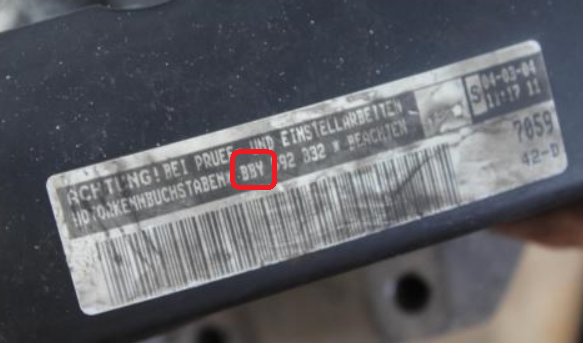
Engine code please. Look at the sticker on your upper cambelt cover. Three letters in front of the engine number. Example below.
-
Chimney fire is a good description of an active regen, I would think. One that is deliberately initiated, monitored and controlled though. Control oxygen availability and you have a fire that you have a good chance of extinguishing if temperatures get a little wild.
-
Looks a bit like it's been cracked during a clumsy previous removal, then someone's tried to melt it with a soldering iron tip to re-fuse the cracked plastic.
-
I doubt they think there is any need, but there's money to be had, and upselling to do once they have the car in their hands. "We noticed that your brake discs/pads/fluid; aircon; blinker fluid...."
-
I did some logging just now, will look at and share results tomorrow. I will need to do some more, longer duration logging/driving I think, I was in a hurry and didn't log all the best channels.
-
Ideally you'd charge the battery fully before trying to fault-find the alternator and its cabling. Is there a better battery you could borrow and put in temporarily?
-
Diesel or petrol 1.4? If petrol, MPI or 16 valve?
-
Measure the voltage right at the alternator to check. Positive meter probe carefully on output cable crimp terminal if you can get to it without risk of shorting your probe to other things, negative probe on a scraped clean bit of alternator's metal casing. If the voltage here is nearer 14.4/14.5 (with cold engine, idling), then the alternator is probably not at fault. Tarnishing/corrosion of the connections of the main positive and earth cables are the things to look for if the alternator is blameless. Unbolting, cleaning and reconnecting each end of each cable may fix this. Battery negative terminal off before anything else, for safety.
-
Doubtful, that just speeds up the natural discharging of capacitors, which probably takes very little time after first terminal comes off battery anyway.
-
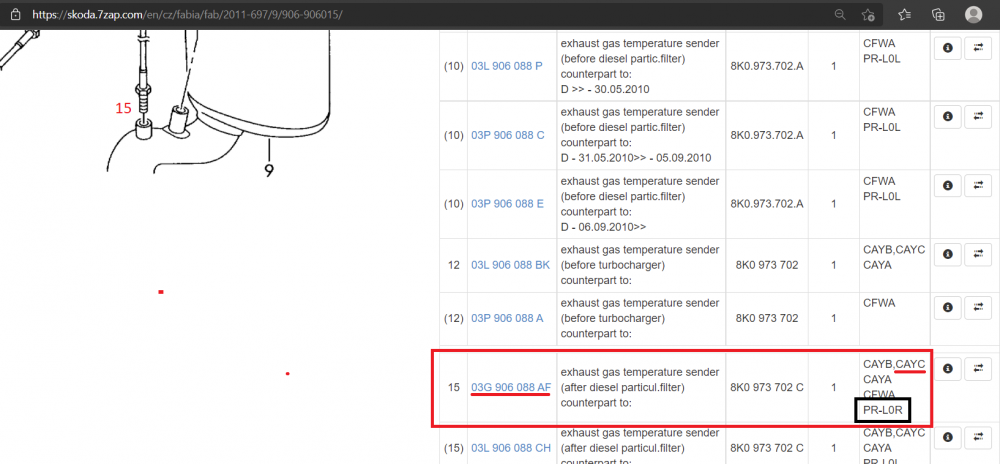
I expect they all have different part numbers, personally. Difference may only be connector colour or cable length etc. though. For RHD CAYC I'm seeing it as this one:
-
Either way the sentence makes no sense. Paraphrasing: "This is really, really important to us so we're communicating poorly about it"
-
Upmost vs. utmost When you need an adjective meaning (1) of the highest or greatest degree or (2) most extreme, the word is utmost. When you need an adjective meaning situated at the top, highest, or most upward position, the word you’re looking for is upmost. The latter is an old, almost archaic word that now mostly appears where writers obviously mean utmost.
-
Paint code is 8E8E, which according to googlage is equivalent to 9156 in just numbers 8e8e paint code - Google Search
-
SB3 is only one of several permanent power feeds to the BCM, so may not be sufficient to achieve anything reset-like. Which engine does your car have?
-
Are there any witness marks anywhere of where stickers possibly used to be? Those may have been cleaned away by whoever de-stickered it though, I guess.
-
I thought the converse was true; that EGR flow was reduced to zero during active regens? Traditionally, EGR use was said to reduce peak combustion temperatures? Edit: more importantly switching off EGR flow must increase available oxygen in the exhaust flow. Maybe the ECU software is detecting no lambda change or upward change in exhaust temperatures when it commands this, so it gets itself justifiably confused and defaults to some longer, less efficient regen process? Interesting read here, where functioning EGR system is said to be required later, post regen, in order to extinguish out-of-control fires in the exhaust system associated with regens: VAG EA189 Engine - EGR & Remap | Car Mechanics (proboards.com) Not something I'd ever thought of. User 'valhalla' seems to know his stuff: "An EGR emulator will not work, and could potentially be dangerous during a failed regen if it did; The signals used to determine the EGR valve performance are at several levels - electrical feedback signal from the valve motor/positioner itself (the bit that the emulator tries to fool), then the mass airflow feedback from the MAF to determine the closed-loop performance of the valve (most significant diagnostic mechanism), plus then the plausibility of manifold absolute pressure (MAP) versus MAF to further verify the "intake model". The only way an emulator would work is to simulate all three (and any other assorted "models"), at which point you might as well just use an engine, running properly, to do the job! The EGR performance must be spot-on for regens, but mostly from the perspective of thermal runaway in the exhaust system (under the front of the car). It is the only viable method to starve a fire in the exhaust system, by depletion of oxygen, and bring the temperature of the DPF outlet temperature back down to safe levels again - hence it is a prerequisite for DPF regens." This has got me thinking about a few seemingly common faults with the EA189s, DPF pressure sensor meltdowns and Exhaust gas temperature sensor 3 fault indications. Wondering if both, but particularly the former, may be the result of this 'control of fire' function going awry due to EGR command/performance mismatch in older/high mileage engines? i.e. the engine ECU tries to put the fire out by winding up the EGR flow (thus starving the fire of intake oxygen) - or trying to - fails because the flow isn't sufficient and the resulting runaway event kills the pressure sensor and either damages or causes out-of-range readings from the temp sensor??
-
I doubt the government give much of a rat's anus about older cars or their owners.
-
Post a photo of the label.