
Breezy_Pete
Sponsor
-
Joined
-
Last visited
Everything posted by Breezy_Pete
-
Having looked at wiring info and parts info, it does look like your car is equipped with two dual-speed fans, wired in parallel. They should both start up in low speed after a short time once A/C is enabled. Is it the Climatronic system or manual A/C? I suspect the former? To confirm low speed function/disfunction you can unplug the loom connector from the radiator thermoswitch, and link pins 1 and 2, red/white to red wires. As long as the relevant fuse is intact (giving 12V on pin 2), then both fans should start up at low speed.
-
Almost certainly not the ABS sensor/connector, I think. If you have a multimeter that has dc current ranges, I've done a guide on a method of getting a true reading of the quiescent current of the car when fully off. It sounds like you might need to use a high range, amps rather than milliamps. Quick and dirty parasitic current measurement - Handy Topics & Guides - BRISKODA This needs urgent fixing, obviously, as batteries will be permanently damaged by such deep discharges.
-
Both fans will be dual speed I think, and they are usually wired in parallel, so both should do the same thing (low or full speed) at the same time. I'll check wiring diagram tomorrow to be sure of what's what. It may be that the smaller of the two is single speed, telltale sign of that is there will only be two wires coming out of the motor housing rather than three. Coolant temperature or refrigerant pressure can trigger the action, which is why switching on A/C is a convenient check, as the pressure builds fairly quickly in warm ambient temperatures. Talk to you tomorrow.
-
Unless it runs 'vigorously'/loudly as that might be the full speed mode. One or two rad fans?
-
Then the fans should come on at low speed soon after switching it on and demanding cold air, if it's working and ambient temperatures are warm.
-
Does the car have aircon?
-
Check that your radiator fan(s) work on both speeds. Low speed failure is very common, resulting in higher temps and more pressure.
-
Glad I could be useful. Looking back at one of your pictures just up there a bit ^; the battery posts and battery clamps look like they would benefit from a clean-up, if you haven't already done that. Any contact resistance there is most unwelcome.
-
If there's an electrical connector on the fan that you can get sufficient access to unplug, inspect it for signs of water ingress and/or corrosion of the contacts inside. There's a permanent 12V supply which may be getting shorted to other pins that are causing the fans to spuriously burst into life. Whilst there, check for wiring damage adjacent to the connector too.
-
CO2 isn't the problem in urban emissions toxicity. And it's a fallacy to imagine that lowering CO2 emissions from engines automatically reduces the toxic pollutants from them. CO2 = climate change problem NOx, HCs, CO, particulates = urban air quality problem So few people seem to comprehend this.
-
No, they are different. The pre-cat one has 5 or 6 wires, the post-cat only 4. the connectors are obviously different, as is the technology in the sensor itself. Here are the part numbers assuming your car is engine code AZQ:
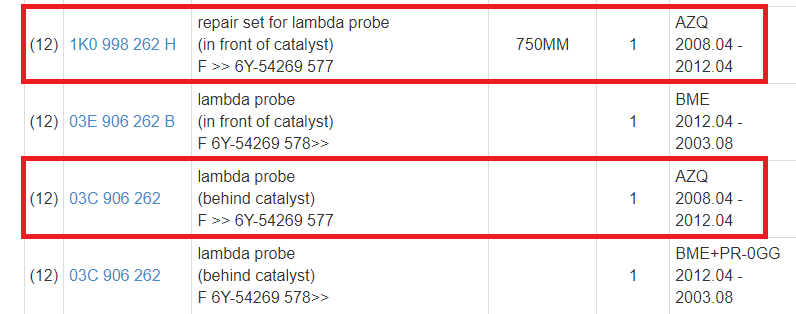
-
4B0 905 849 From here, item 5 ignition/starter switch; steering lock - Fabia(FAB) [EUROPA 2007 year] (7zap.com)
-
Although my comment wasn't specifically addressed to the OP, it was mainly intended in his direction, since he said: Giving me the impression he thought it was standalone. Charging batteries off the car isn't a great idea for cars with battery monitoring systems, as the car will be 'blind' to the added charge.
-
I think that unit is being a little mis-sold if anyone is looking at those photos and thinking to themselves that it's a standalone thing that doesn't need to be plugged into the mains?
-
Yes, a Skoda dealership parts department.
-
I'd be re-flowing all the connector pin joints on the board, knowing how they like to crack. Green and black connectors.
-
Tell me that the ethanol isn't made by fermentation with carbon dioxide fizzing away all the time...
-
The OP's 1.2/12v has a wideband pre-cat sensor which are quite pricey unfortunately.
-
Please let us know if the cleaner does improve things. Can your OBD reader look at what the engine coolant temperature sensor is reading while the engine is running?
-
You can. I'd be quite surprised if the 'catalyst cleaner' does anything useful though. Are you trying to address an emissions problem?
-
This lot has a couple, but in Latvia and quite a long lead time: Genuine VW AUDI SEAT SKODA Bora 1 Set Of Vacuum Pipes 06A145675D | eBay Can you put up a photo of the damaged bit?
-
Not sure you'd want a new one even if you could buy one, RRP over £115 ! VW, Audi, Seat, Skoda 06A145675D VACUUMPIPE (allcarpartsfast.co.uk) I'd think you'll get the same story if you call that lot. I'm not recommending them either, just a site I use to get RRP info. Mend what you've got, as already suggested.
-
Confused by the fact they are described as vacuum pipes, yet you're talking about coolant leakage.
-
Might be amongst these: plugs for floor - Superb(SUP) [EUROPA 2010 year] (7zap.com) Don't really know where I'm looking, hopefully you do. Item 5 seems like the closest match to the hole dims.
-
I'd be quite wary of fitting an AGM battery without modifying the charging system. Cars with those batteries tend to have charging management systems that deliberately keep them at a state of charge about 20% below maximum. Many people on here will tell you that this is to leave capacity space for 'micro-hybrid' boost charging on cars with variable voltage alternators, but I suspect it's at least equally because of possible problems with overcharging. See BU-201a: Absorbent Glass Mat (AGM) - Battery UniversityBU-201a: Absorbent Glass Mat (AGM) - Battery University Also they are not keen on getting warm. Here's a quote from that page: As with all gelled and sealed units, AGM batteries are sensitive to overcharging. A charge to 2.40V/cell (and higher) is fine; however, the float charge should be reduced to between 2.25 and 2.30V/cell (summer temperatures may require lower voltages). Automotive charging systems for flooded lead acid often have a fixed float voltage setting of 14.40V (2.40V/cell); a direct replacement with a sealed unit could overcharge the battery on a long drive. (See BU-403: Charging Lead Acid.) AGM and other sealed batteries do not like heat and should be installed away from the engine compartment. Manufacturers recommend halting charge if the battery core reaches 49°C (120°F). Table 1 spells out the advantages and limitations of AGM.