
Breezy_Pete
Sponsor
-
Joined
-
Last visited
Everything posted by Breezy_Pete
-
Didn't notice OP's location, and not sure if bonnet release is accessible irrespective of which door is open on a LHD mk2 Fabia. Good spot.
-
Pin 1 doesn't go to ECU. It comes from pin 6 of the 14 way connector pair adjacent to the main battery earth to chassis stud. There's a good selection of workshop manuals including circuit diagrams here:
-
Made some progress today, thanks to a clever pal of mine who also owns a long ladder. We tried a few ground-level options first, without any improvement in the situation. Got the looong ladder up to it and we (I) tried bypassing the masthead amp while ground team tested to see if it worked without that involved. Nope. TV signal was noticeably worse, but box still wouldn't connect to internet via ethernet cable. Much headscratching later, Ed settled on the hypothesis that the TV rf was bleeding through to the ethernet port of the BT box somehow, which was then affecting the EE 4G router in some way. Testing appeared to support this. A laptop connected via WiFi running connection speed tests repeatedly, with BT TV box connected by ethernet reliably showed slower and more variable speeds when TV aerial was connected to BT box. Solution appears to be WiFi-based TV streaming things like Firestick. Thanks all. 🙂 PS, I didn't fall off the 7m ladder and die. Not even once. 😁
-
Does the rear wiper have more than one speed, or adjustable pauses when functioning intermittently? Fronts, yes, but rear?
-
You'd want to be very confident that you can unlock driver's door mechanically with the key so that you can get to the bonnet release when you get back and want to reconnect the battery. No other issues occur to me.
-
@ecr7 I don't think there is any such involvement with CAN. CAN wiring is always labelled as such on wiring diagrams, and none of these 4 wires are. It's also implausible that the only connections to the washer pump would be CAN wiring. I've proposed this before but will reiterate here in the hope that someone may confirm, but this is how I think it must work, given the connectivity. Ignition switched power and earth - power up the minimal electrics/electronics inside the rear motor assembly, ready for input controlled action. WW input taken to 12V while INT is at 0V = wash wipe cycle initiated (washer pump will run in appropriate direction for rear wash while these inputs are so polarised). INT input taken to 12V and simultaneously WW taken to 12V, intermittent wiping function initiated and continues until both are taken back to 0V. (Washer pump won't run because both connections to it are at 12V). I can't see how else it can work, but would be happy to be shown if someone knows different.
-
Magnets may well be there. Many recent (last 25 years approx) VW group cars use this system, with alternating magnetic poles in a ring integrated into the inner face of the wheel bearing assembly; Speed Sensors & Rings: A Complete Guide - ACTRONICS LTD
-
Pin 1 is earth, brown wire. Pin 4 is a switched 12V, black/violet wire. Pin 2 is labelled INT (intermittent operation?) on circuit diagrams, fed by a green/red wire. Pin 3 is labelled WW (wash/wipe?), a green white wire. These two wires originate from the BCM, and also connect to the terminals of the washer reservoir pump.
-
You win this thread!
-
Right front window regulator (without motor) is 5J4 837 462, £75.70 + VAT from Skoda, cheaper from almost anywhere else, I imagine.
-
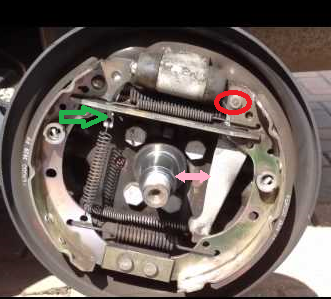
As above, the off-straight yoke is a giveaway that the lever pivot has seized. Rivet that is meant to allow rotation between shoe plate and handbrake lever shown in the red circle. Pink arrows show the free movement that should happen. Green arrow shows spring attachment point to the adjuster wedges.
-
Yeah, the aftermarket suppliers will clump together stuff to reduce the number of distinct items they need to make and stock.
-
Will check it out tomorrow.
-
Do you mean the motor module, or the mechanicals that it drives to move the glass? Either way, I can look up for you with VIN.
-
Comparing the house orientation on the map and my memory of which way the aerial points relative to house, I think it is aiming at the Oxford Transmitter. 👍
-
I have a four-way passive splitter from the old place that should be plug and play with the cables in the current, active one, I hope. Just got to get up to it.
-
Cheers, but Highworth seems well out of the coverage area of that Seagry thing? Top right corner of the coverage map shown.
-
Big time. Just hope is isn't too long before they get fibre out to us. Some bits of the town have it already, apparently.
-
Just ours The masthead amp is just out of reach of my longest ladder, borrowing a longer one on Saturday.
-
Thanks but I'm in Highworth next to Swindon now. Will update my profile.
-
Can't remember for certain if we tried that. Will do this evening to double-check, ta.
-
It all worked fine at the old place, with the major difference being the active aerial here versus passive there.
-
No, I don't think they are equipped to connect via anything but ethernet cable.
-
Moved into a new place, from one with FTTP (fibre to the premises), now have a 4G EE Smart hub thing instead. 🙁 But after blaming that for the first few days, we think we've decided that's not the weakest link. We have three of these BT YouView boxes, like this (maybe not exactly but visually): https://www.ebay.co.uk/itm/166844130551 The TV aerial here has an active masthead booster thing with an indoor 12V PSU for it that goes up to it on a Coax. If we plug the/a BT box into the 'TV' F-type output socket of this PSU we get an adequate TV signal that results in the BT box showing telly stuff to the telly itself via HDMI. If we stick an ethernet cable between EE hub thing and the BT box, the latter won't connect to internet. If we unplug the aerial connection, it will. So we can either have a telly that is connected to the internet but won't show any picture, or one that isn't, but will only show live TV. Help please! TV doesn't matter at all to me, but partner cares a lot, and streams a lot.
-
Unsurprisingly, what Skoda told you is correct. £98 plus VAT each for genuine from Skoda. Approx the same including the VAT if you go to LLL parts.