Breezy_Pete
Sponsor
-
Joined
-
Last visited
Everything posted by Breezy_Pete
-
This is what I have: VW Audi Seat Skoda USB Interface for VAG-COM 409.1 or VCDS Lite - most VAG 1996-2003 (gendan.co.uk) But you may want to ask other owners of early mk2 Fabias whether they have managed to use such a cable with VCDS Lite on their cars. I have speculated about it on here before, and looking at the wiring diagrams, there isn't an obvious difference between mk1 and early mk2 that would affect it, but that doesn't mean it will certainly work. You could be a pioneer, but it would be sad to spend the £20 (equivalent) for no data.
-
Item 20 here oil container and connection parts, hoses; ; no '... - Fabia(FAB) [EUROPA 2001 year] (7zap.com) G004000M2 or aftermarket equivalent which google can probably help you find.
-
Wrong. 6. Body, structure and attachments - MOT inspection manual: cars and passenger vehicles - Guidance - GOV.UK (www.gov.uk) Pretty unlikely to be in need of replacement though, with possible exception of 'dogbone' one if your car has that type between underside of gearbox and subframe.
-
Find out what your gearbox code is from the build sticker in the boot. Look up the relevant oil part number via one of the diagrams here gearbox Superb (SUP) [EUROPA 2015 year] (7zap.com) (first one is for transmission codes NBX and PRB, 2nd one as shown, KWB, MUJ and MYP). Cross-reference online to non-genuine equivalents if you don't like the price for genuine oil. Refilling needs to be done with car dead level both ways.
-
Head and block are aluminium alloy.
-
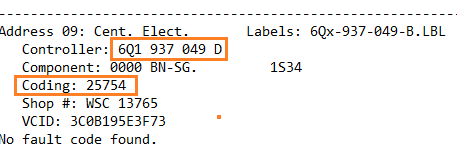
Fault codes, I guess, rather than 'configuration codes' which is what the e.g. 25754 is, and what you might need to apply to another module if you replaced rather than repaired.
-
Lapping the new valves in sounds like a good idea to me.
-
Have you got the locking tools for crank/cams? Can be found pretty cheaply these days.
-
There is a freeware version of VCDS, VCDS Lite, but I've not heard of anyone trying it on a mk2 even though I believe it may work on early ones. If it did, you'd only have to spend a small amount on a cable to connect OBD port to laptop (FTDI cable). Not sure what you mean by a debugger, but if it can output something that looks like the snippet from my autoscan, then that will do.
-
Check for excessive play in the valve guides, both exhaust and inlet; the former as a known wear weakness on earlier versions of this engine, the latter for damage due to recent trauma. My gut feeling/hope is that both will be OK, but worth checking while head is off. I'd chuck a new exhaust gasket at it for the sake of a few more £s. Consider hoovering out the exhaust manifold to try to remove any metallic debris that may be blocking the pre-cat to some degree.
-
Unfortunately not. If you know anyone that has VCDS near you, ask them to do an autoscan and then at least you'll have the module coding (and module part number). Five minute job. Example below of the relevant part of such a scan from our Mk1
-
Yes. Have you looked at your car yet to find it? Yes, if that is identified as the problem.
-
I'm out walking the dog, answers in half an hour.
-
A current drain that takes any battery to a very low voltage will rapidly cause permanent damage unfortunately, so it may not be the battery's fault. Read the how-to I've linked to for overall current drain (and I'll show you another as follow up if you do find a high overall reading). Newer cars with lots of electronic modules need different, more patient approaches than older simpler cars, to effectively pin down the real problem areas. Just pulling fuses can cause things which should be asleep to wake up due to communications interconnection, giving confusing results.
-
The belt manufacturer.
-
Keep trying to charge the newer battery, maybe after a lot of attempts it'll actually start charging normally, which it doesn't seem to be right now. The old battery certainly seems in better shape, as judged by readings and its ability to start the car. The alternator seems healthy so it does now look as though a battery drain is likely to be found when you get to that. Checking the voltage on the installed battery in the morning should tell a tale on its own. As you have reason to expect a higher-than-normal reading, it's probably prudent to set the meter to whatever its highest range of Amps DC is, in case it is a really high value that might blow the fuse of a lower (milliamps or hundreds of) range.
-
This doesn't make complete sense. Your engine produces as much power as you demand at any given moment, via the accelerator pedal. More air will go in only if you demand more power*. Only if your foot is flat to the floor will the amount of power output be beyond your control and very slightly dependent on air temperature etc. *Apologies, was only thinking of petrol engines there. Diesels will be a bit different in that respect, but still, in diesels the fuel input is controlling the power output, so same overall control in your hands/feet.
-
If your multimeter does current measurements you could check the overall quiescent current too: https://www.briskoda.net/forums/topic/495243-quick-and-dirty-parasitic-current-measurement/
-
There's something quite awesome about that!
-
No rush, long slow charges are best. The test I've just suggested is to establish if the alternator is actually generating, and it should also indicate if there are major voltage drops in the cabling/connections between alternator and battery. May as well check the voltage with one or two consumers switched on, while you're at it. Say headlights and cabin fan on max.
-
Nope. You've just ruled out one common charging system fault. Next thing to do (when you've finished charging the battery) is to measure the voltage across the battery terminals with engine running at idle, with no major current consumers switched on in the cabin.
-
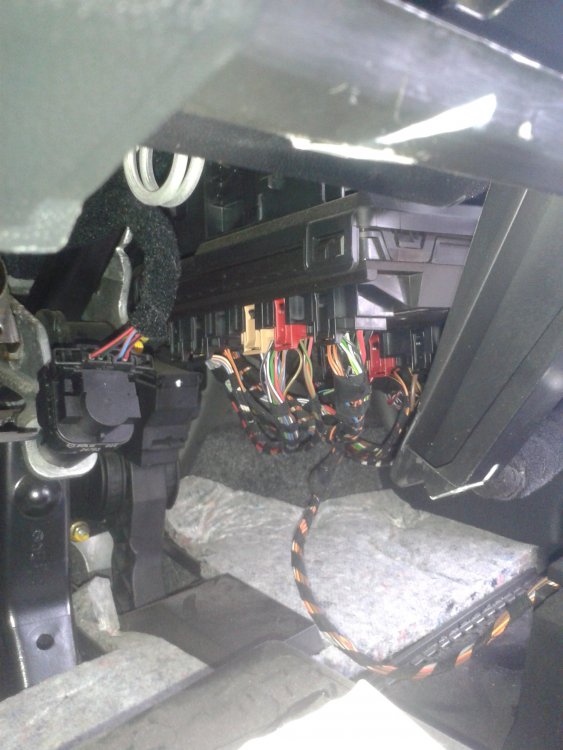
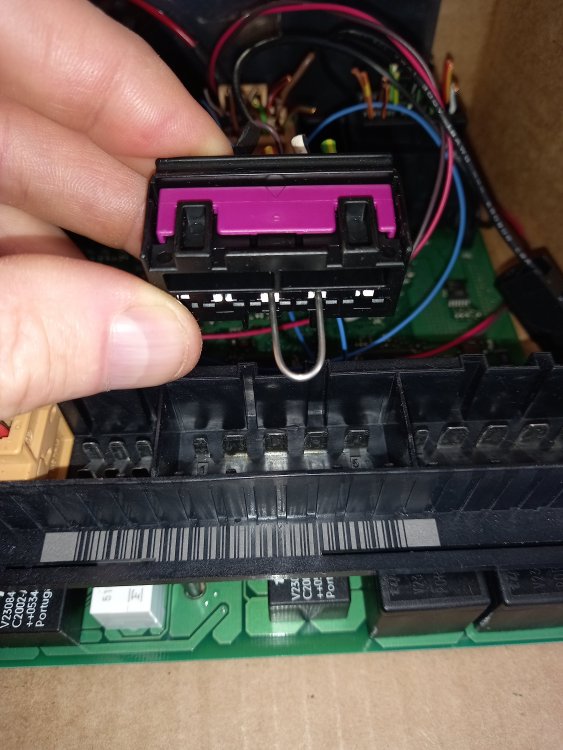
You may need the ignition on to allow the wiper function, can't remember, but if you put your head down close to the control unit you should hear it even if the engine is running, I think. If you can hear the relay clicking, try bypassing the relay as follows: Open the car but don't put the keys in the ignition, keep them in your pocket. Unplug the connector (black 5-way) that goes to the plug above the relay, it will be labelled XP4 on the control unit cover. Link pins 3 and 4 (red/grey wire to white/black wire on your car) as shown here. The wiper will start immediately at slow continuous speed, and only stop when you pull the link out again. Refit the connector. Just a warning to avoid surprises - when I did this exact test as described on my 9N Polo, which has very similar electrics, the wipers came on as expected. But the radio did also, which startled me a bit. Not sure if yours will do the same, but don't be surprised if it does! That connector includes the main earth connection to the control unit, which is why I suggest not having the keys in the ignition, and replacing the connector after the test before doing anything else, to avoid unnecessary errors being generated. I don't have a photo of the control unit in a LHD car, but imagine a mirror image of this, over on the left side above your clutch pedal, instead of the right side above the accelerator:
-
Skoda may not be completely correct. 😉 A bad relay contact can present as making the connection, but lack the ability to conduct enough current to start the wiper motor. I expect Skoda were thinking in terms of a relay that doesn't energise because of a coil fault. Bad contacts is a different fault. If you listen carefully when attempting to switch on the wipers you may hear the relay clicking as it does move its contacts? Will be most audible/obvious if you select intermittent and adjust it to short duration. The control unit containing that relay is just above the clutch pedal on a LHD car. Relay part number is visible in that thread I linked, but worth checking yours to see if it is the same: V2384-C2002A403. The necessary coding to change the whole control unit is quite quick and easy, if you have, or can borrow VCDS. Read coding of existing unit, remove from car, fit identical part number replacement (e.g. 2nd hand) then code new unit to match old one. If you have the skills to remove the old relay, and solder a new one in, that will be the cheapest solution.
-
Start with this free, easy check: https://www.briskoda.net/forums/topic/401778-battery-light-and-associated-problems/
-
Check both fuse 26 and 44, but I think it will be a badly burnt relay contact, probably: Wiper relay replacement - Skoda Fabia Guides - BRISKODA