Everything posted by Breezy_Pete
-
I would do this next, if I were you. I think your (excellent) measurement data suggest that the problem is that the alternator simply cannot generate sufficient current to keep up with demand when there are heavy consumers switched on. If the field coil current supplied through the slip rings is limited by poor connectivity, it will automatically limit the maximum output current from the alternator that is available at any given rpm. They look corroded/dirty in your photo I think.
-
Not sure what you mean by that. Photo?
-
Great guide; fantastic detail and presentation. I think to make the motor go in the opposite/correct direction, there is no need to re-wire anything on the rotor, you just need to rotate the metal motor housing round by 180°, as it contains permanent magnets. I only discovered this recently while watching a youtube video of someone repairing a window motor on some other brand of car. He said to mark the housing relative to the plastic parts so that it went back the same way as it came off 'or the motor would turn the wrong way'.
-
I just meant 'another'.
-
Swapping in A.N. Other onboard supply control unit would be pretty easy, and not expensive if you were happy to go secondhand. Would just need 2 minutes with VCDS on the old one to see the coding (unless you've already got a scan, which would tell you the info?), and 2 more to make the new one have the same coding, after installing it. Could just do it temporarily without any coding to see if it fixes the fault.
-
Hazard switch is just a pull-to-ground momentary signal input to the onboard supply control unit, I believe.
-
If you put the hazard lights on, do you get any flashing/clicking from the clocks?
-
My gut feeling is that it's not an instrument cluster fault, and I think that's a trickier swap anyway.
-
Hmm, thought that might be an easy explaantion of the fault, as the chip monitors its output current on each channel (left and right side of car). LEDs would be much lower current and probably fail to register as being on. I suspect the chip itself (BTS5240L on ones I've looked at from around 2005), or the circuit beyond it towards the 'brains', but swapping in a whole other onboard supply unit might be the pragmatic fix. Some swapping across of coding with VCDS might need doing though.
-
You haven't swapped the indicator bulbs out for LED equivalents, by any chance?
-
It is very strange, and also an MOT fail, I fear. My suspicion would be a fault within the onboard supply control unit above the accelerator pedal. I've not looked at how that monitors what the indicators are up to, but it must be a status output or two from the chip that drives the indicator bulbs, I guess. I'll have a look at one tomorrow if I get a chance.
-
Probably need a new brake light switch, item 1 here: socket; for models with towing facility; ========... - Roomster(RO) [EUROPA 2007 year] (7zap.com) 6Q0945511 genuine recommended, and not expensive from dealers. Not sure about 2, do you get the clicking noise from the cluster, but just no telltale LEDs? or neither?
-
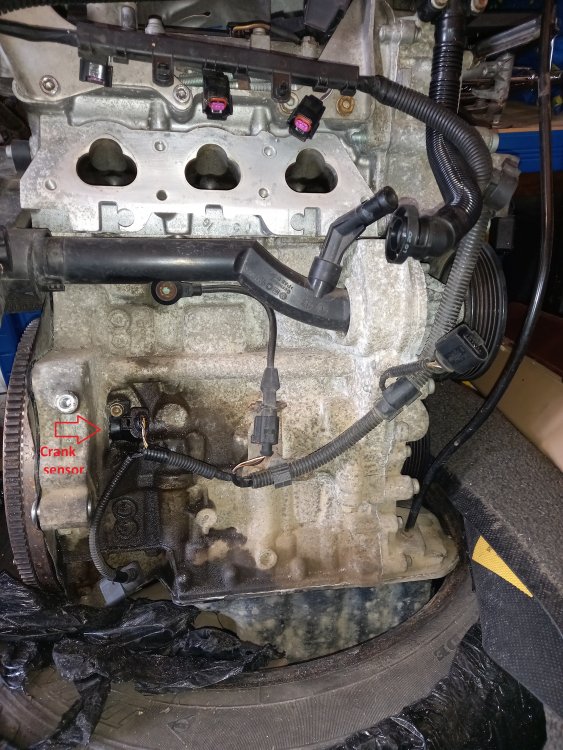
I think your engine code must be CGPA then. I would suggest that you check the chain timing before replacing anything else. This can be done by removing two covers from the battery end of the rocker cover, and checking the relative angles of the two slots in the ends of the cams. They should always be at the same angle relative to each other. When cylinder 1 is at top dead centre on either compression or exhaust stroke, they should be parallel to the head/block join. Crank sensor is in an awkward to access spot on the back of the engine block.
-
P0016 as in the title, or P1006 as in the text? What engine does your car have (engine code preferably)?
-
I can't imagine any in-situ 'snake oil' type treatments having any impact whatsoever if the problem is oil ash accumulation. I'm with @MarkyG82. First get the diagnosis done in case we're wrong (100k doesn't seem particularly high mileage but maybe wrong oil has been used at some points in history?); then if confirmed do it properly by removing, professional cleaning and refitting.
-
A numerous new family recently born in my bedroom, to a mysteriously 16-legged spider: The extra legs possibly shadows?, more obvious in macro mode:


-
Sounds very frequent. High mileage on the odometer? High loading of oil ash making it 'full' of soot as judged by the pressure sensing even though not much has actually arrived; probably.
-
The DPF light isn't a normal occurrence, it only appears if there is a fault related to the system.
-
Looking at ETKA, the 1.2 diesel started appearing in 2011 in Roomster, and always has DPF; still listed in 2015? 2011 page: exhaust pipe with catalyst and particulate filter... - Roomster(RO) [EUROPA 2011 year] (7zap.com) 2015 page: exhaust pipe with catalyst and particulate filter... - Roomster(RO) [EUROPA 2015 year] (7zap.com) Emissions fix increases EGR flow rates, which will tend to increase soot loading into the DPF, making regens more frequent.
-
If you look about three-quarters of the way down this page (use a computer/big screen not phone) you'll see that both the 'wiring set for engine' and 'wiring set for engine compartment' differ according to engine codes of the car in question. electrics Octavia (OCT) [EUROPA 2003 year] (7zap.com) No chance of either loom having 'just in case' spare connectivity, I think. Best to scavenge everything you possibly can from the donor car.
-
You probably needed to get rid of some of the rust to get it in the right place.
-
I've heard of sensor wear like that being caused by the dust seal on the driveshaft/CV that is meant to keep debris away from the sensor/magnetic ring. The CV 'cone' bit rusts and forces that plastic disc outward towards the sensor as rust takes up more room than the parent metal. Look at the fourth photo in this listing to see the thing I mean, just inboard of the splines: VW AUDI SEAT SKODA FABIA MK3 1.0 PETROL DRIVESHAFT OSF 6C0407272H POLO IBIZA | eBay
-
Telling us your engine code would help us know what we're dealing with. Look for it on your build sticker in the boot, or the letters in front of the engine number on the cambelt cover sticker.
-
Try it, but I should think it will be easy.
-
Can you maybe try cleaning up the slip rings with a small wire brush? I've replaced them on one or two alternators, so it can't be too difficult - if you can find them as spare parts to suit your model.