Everything posted by Breezy_Pete
-
Pick up pipe is item 4 here, referred to as 'suction line'. Must admit I've never seen one in the flesh. https://skoda.7zap.com/en/cz/fabia/fab/2001-225/1/115-115003/ Not quite as simple and cheap-looking as what I'd expected.
-
-
@JGrindel where did you get that part number from? I'd expect it to be 6Q0 423 445 instead; item 18A here: https://skoda.7zap.com/en/cz/fabia/fab/2008-608/4/423-423040/#18A
-
Nice to hear a good news story for a change. Has it been 'fixed' w.r.t. dieselgate, or left alone?
-
Direct emission of the oil mist/vapours into the atmosphere, probably. It's been illegal for engines to do that for a few decades now.
-
If you still get oil pressure warnings with new switch, get the sump off and clean out or replace the pick up pipe.
-
^ He's right. See it better here: https://www.ebay.co.uk/itm/VOLKSWAGEN-VW-GOLF-MK5-GT-170-03-09-2-0L-TDI-BMN-INLET-INTAKE-MANIFOLD-PD170/114292012060?hash=item1a9c55b41c:g:OwUAAOSwfGFfAH2T Is it maybe leaking out at the point where the actuator shaft connects 'through' into the bits inside the manifold?
-
Check the solder joints of the green cluster connector before spending any money. What year is it?
-
Which engine does your Fabia have?
-
Ignore list for you. You just can't stop digging your own hole.
-
You've spent a lot of time and words trying to justify your use of the term 'stainless steel' for fasteners that aren't. I just pointed out that stainless steel is not what you should be searching for. So just get your new bolts (of the correct part number and therefore right material and strength) fitted. Then you can stop worrying.
-
I give up. Use stainless steel everywhere you like.
-
Understanding of the failure mode, in order to avoid it? Most people working on cars know that stainless steel bolts if used anywhere tend to only be used for cosmetic, rather than structural functions. Well you'd be calling them by something other than their correct description. I'm honestly not trying to beat you up, just to avoid others thinking that buying stainless steel bolts for this use is a good plan.
-
It doesn't matter what I think they are made of, cos I'm not suggesting anyone replaces them with stainless steel. If you insist that I speculate, I'd say "Alloy steel"; as described in the link I posted. That covers a very large array of material compositions, probably, many of which may resemble stainless steel in appearance and properties, but aren't referred to as stainless steel. Point is, stainless steel bolts are generally weaker than high tensile ones.
-
Thing is, you've recommended that people try to source stainless steel replacements of some or other grade for these, yet you don't know that they are stainless to start with. Not a limb I'd like to be wandering out on.
-
Photo would be good. I don't understand why you're so keen on them being stainless.
-
In my experience, stainless fasteners usually have grades like A2-70, A4-80 see here for example: http://www.volksbolts.com/faq/basics.htm High tensile stuff, on the other hand, is marked with grades like 8.8 as seen in photos upthread.
-
How do you know? The first symptom may be the fatigue failure? What makes you think they are stainless steel?
-
Thanks @Lemto; unfortunately, there's not much visible of the end surfaces. Some similarities with images on page 3 here though: https://www.asminternational.org/documents/10192/20564188/amp17208p18.pdf Overtigthening would tend to cause necking of the threads near the failure point, as I understand it. Perhaps @Eric_DK can request the broken parts from the place mending his car. In this country it is your legal right to be given such parts, if you request them back. Not sure if same will be true in Denmark.
-
A bit of Loctite might be all that's required. Self-loosening due to vibration may be resulting in fatigue failure, once the parts become free to move relative to each other. An end-on view of both bits of @Lemto's broken bolt might shed more light on this, if still available.
-
The hard plastic loop of the PCV pipework is just a push-fit into the rubber couplers at each end, so will move in/out without huge effort. If it was loose enough to leak, I think you'd hear hissing when wiggling it about. Add a cable-tie or two to snug it down if it seems too loose? Brake servo hose is looking unusually intact!
-
-
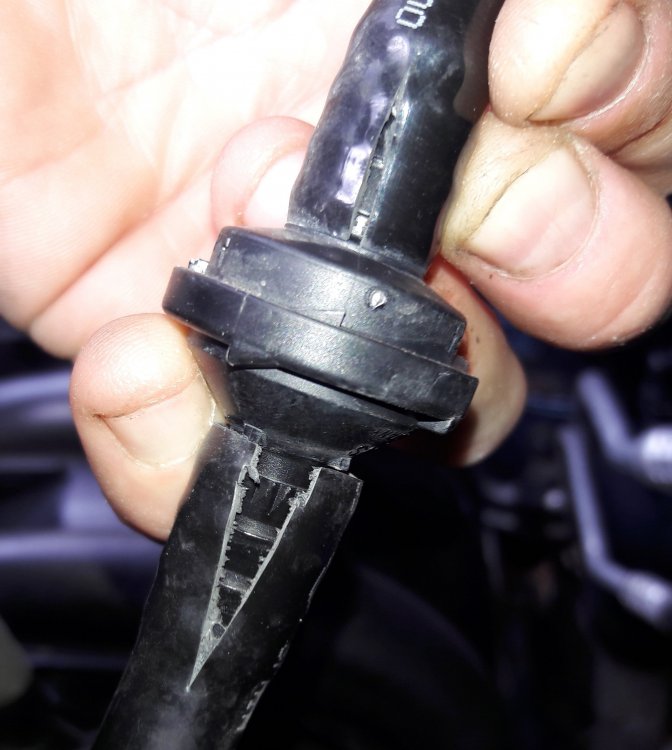
Can you post a photo or two of the non-return valve in the brake servo line, one from topside, one from underneath. You're looking for this kind of thing:
-
-