




nta16
FREEDOMLite
-
Joined
-
Last visited
Everything posted by nta16
-
Personally I would not worry about changing the belt before more years and tens of thousands of miles/kilometres, inspect it certainly and if for some reason it needs it replace it but hopefully that would not be the case. This is Europe not the UK where VWŠoda UK conned us to change the belt at 5 years / 50, 000 miles (the robbing b*st*rds). "The new advice is to use the intervals recommended in ElsaPro for all engines. For some variants, this means that there is no service interval at all, with 'fitted for life' items that can be considered as 15 years or '18O,000 miles. Because of the disparity in intervals, you must check the relevant literature for each case and advise the customer accordingly." CamBeltchangechange.pdf
-
Just as an alternative to the C-Tek - Lidl sell an appropriate charger for £15 and I know many buy this and find it fine, my neighbour has had his for many years now. And I put up Ring as I use the previous model for my wife 2015 Fabia, (ETA:) £30 or less depending where you buy from. - https://shop.ringautomotive.com/rsc904-4a-smart-battery-charger-maintainer.html 4 or 5 Amps is fine, I prefer 3 or even 2.
-
ETA: 1.2 TSI 90PS in my wife's car is fine but there are only the two of us at the most in the car normally. I do notice the difference when driving if we have two other passengers but the engine is still fully capable. Being a turbo and direct injection I think it is important to do timely and thorough (unlikely from a VW garage) engine oil and filter changes and I prefer to use a better oil than the garages or VWŠkoda recommend, it matters more the older or more use the engine gets. The cold weather Sweden would also encourage me to get a better quality oil that works better and protects more in the cold.
-
Do you not have Japanese marques available in Sweden? As put timely full and proper servicing and maintenance (well as much as you get from VW garages) for the whole car and not just the engine. The front dampers, and their Dealership replacements, were/are poor quality (failure and "misting") on my wife's 2015, I don't know if that is the same for 2016. Lots of owners report unfindable knock and creak from underside. Various noises from the engine bay at various times, nothing wrong just unrefined. The spark plugs should have been changed (twice) by now, sometimes important to prevent possible misfires. You want to make sure the 12v is in good state of charge and health to prevent the computer systems and programs getting upset and throwing up all sorts of unexpected warning lights, warnings, unseen error codes and issues, this is regardless of the headlights seeming bright enough and the engine starting. Obviously you want to check the condition of the brakes, I would have though the factory discs and pads had worn out and been replaced, brake fluid changes. In with brakes (and steering and suspension) is tyres, but being in Sweden you might be more careful about tyres than in the UK. As much as its history you buy the car on its current running condition, above cosmetics obviously. Personally when the car is 10 years old, if I still had it, I would change the VW "lifetime' coolant (vacuum pump possibly required) and change and improve the gearbox oil (this is a little extra farting about possibly than on other cars if it's the same as the 5-speed on my wife's car). Plenty of threads and posts on this forum of issues see if any relate to 2016 cars, only other thing that comes to my mind is possibly the flimsy electric wires that go from body to doors and rear lid, you could check for repairs or issues there though I am not sure I remember this for 2016 cars. HTH.
-
Hi, welcome. Quick answer - yes the interval service was correct for "flexible" "service" - is it sufficient, to who sold you the car, yes. Longer answer if you want it. - The problem is that a modern "service" isn't what you and I might recognise as a service. VW list a "maintenance" schedule of items which I would consider would be part of a service from yesteryear. I forget what is an "interval service" anyway? Most "services" now don't even fully service the engine let alone the car as a whole some of the missing bits are in the "maintenance" schedule. It's just marketing farting about to have these "flexible" and "fixed" parameters, and just a dash reminder setting anyway, the sky won't fall in if you have the work done later or better still often sooner, certainly for you if you stick to the "flexible" setting. Lower mileage and infrequent reasonable journey length generally makes it more not less important to have the engine oil changed annually (possibly sooner depending on use and environment, so you've done the right thing to switch to "fixed" servicing. At 4 years old or 40k-miles I'd expect to see the spark plugs changed, unless it's a diesel (not in your details), the air-con (including cabin filter) has been done, brake fluid has been changed once perhaps should have been twice at 50k-milkes, once might, you've not put what gearbox you have. Coming up will be the engine air filter and if diesel the fuel filter, you'd have to ask diesel owners about the value in that. Very important is the state of the tyres (not just tread depth left) and of course brakes (tyres being an important part in the braking, steering and suspension systems) these systems being a lot more important that the relatively unimportant engine. 22k-miles and 2 years is long time between oil changes and servicing given 15k-miles first year and 7k-miles in the next year, the 15k-miles.being less wearing on many items than the 7k-miles. If you've never had a VW product before (or German marque) you may find some of their carrying-ons a bit strange but that doesn't mean you always have to put up with them, there are two partiers to the contract of sales and work on the car and you have a choice of where you buy from and have work done (difficult with the often low quality English motor trade I know, only too well unfortunately). FYI the last car I owned for the previous 16 years as my one and only everyday car was a 1973 MG Midget so all the VW over-complex and intertwined computer systems and programs, even for changing the 12v battery came as a nasty surprise to me (and the 21st century "German engineering quality" despite having friends with Mercs and Beemers but hopefully 2021 Fabia Mk3 quality is better than 2015 (as you can tell I'm not a VW fanboy but the Fabia Mk3 isn't a bad car, just could be better).
-
If you were able to get someone to check the state of charge of the battery before you charge it you'd know how much is needed to help it, multimeter probes on the battery terminal posts is my preferred more direct readings (engine not run of course) and allowing a 0.2-3v drop from the car's systems being active. VW (figures) Charge level No-load voltage 1.28 g/cm3 100% 12.7 V 1.21 g/cm3 60% 12.3 V 1.18 g/cm3 40% 12.1 V 1.10 g/cm3 0% 11.7 V
-
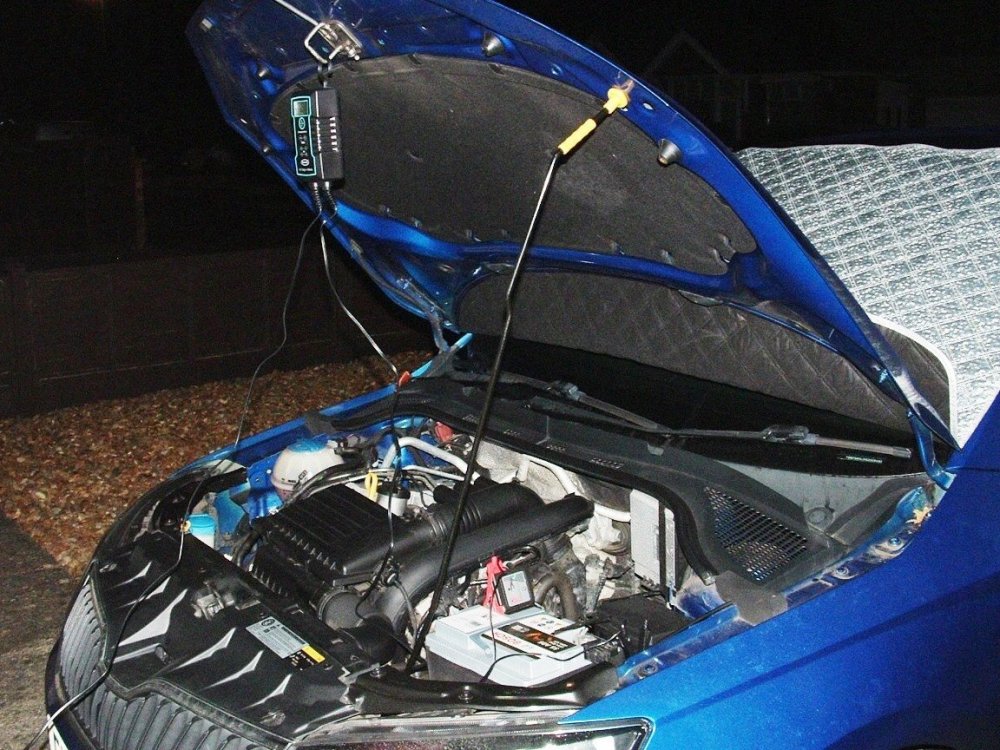
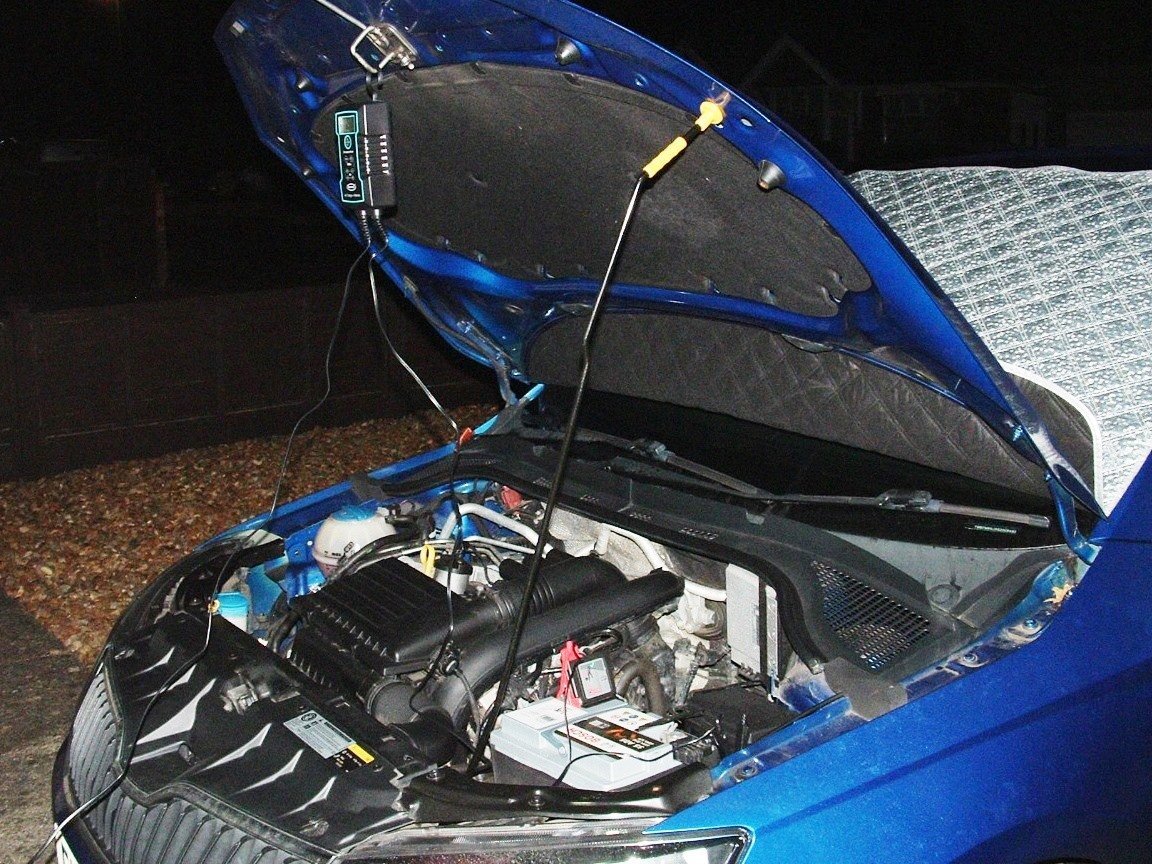
If it were me I'd run the car for about 2-5 minutes past the oil (not coolant) temperature was at as high as it's going above 90C. If the battery is very low you may need to briefly turn the headlights on to nudge charging into action shouldn't be needed but it won't hurt to do it even if battery isn't too low, remember only briefly If you want low usage items on like the radio to keep you entertained , say after the coolant temperature start to rise a bit or near 90c fine but bear in mind if the entertainment system is also doing TwatNav, running your phone etc. this is more electric usage drawing out when you want electric in. ETA: you could put the windows down, run the blower perhaps, if that makes it more comfortable to be in the car, I don't mean going to extremes to save nanos of electricity. If you do it today then once a week or to 14 days (depends how low the battery charge was/is) until you can drive the car again you should have things better. This only deals with the battery and engine, the tyres, brakes, transmission, etc., aren't getting any excise so you want to do your driver/owner maintenance checks before you drive the car next. Whatever age your car if you are keeping it more than a few years and don't frequently do reasonable length journeys and you prefer reliability and longer useful life of the expensive 12v battery in VW vehicles to paying for new replacement (and 'coding' in) then an appropriate battery charger maintainer and occasional preventative rechargers will probably be necessary. As I put these don't need to be elaborate or expensive (unless you prefer such stuff) the ones Lidl (and others) sell are fine, lower (amps) and slower recharging is generally better than high and fast. Just another example. - https://shop.ringautomotive.com/rsc904-4a-smart-battery-charger-maintainer.html My wife's 2015 Fabia on a preventative recharge on a very cold winter's night through to morning, 4-amp charger, 14 or 15 hours to get to fully recharged (in two sessions, car was need to drive 2 miles to work and 2 miles back that day). Whilst the charger was doing its job I was watching telly, listen to radio, sleeping - this is the only type of farting about with cars I don't mind. 😁
-
Great news. With more running of the car and some fine tuning you may find you get even a bit better fuel economy. And so good you find the car good to drive, unusual in someone your age but you are learning to actually drive rather partly at least relying on the car to do things for you and you will be learning about driver and owner maintenance of the car and vehicles generally, more so than many young qualified drivers. Just to let you know 2,000 rpm isn't high revs so you might be better driving in 4th gear at 50km/h and using a little less petrol, 3rd gear for approaching hazards of course. I lifted the following dash photo off the net of a 1991 Skoda 135 Rapid Coupe (135 RiC(?)) the 136 engine may vary slightly but it gives an indication of revs suited to the engine, note the green and red sections. Not that I would go much near or above 5,000 very often, other posters will know better than I where the 136 engine performs at its optimum, and I am only suggesting occasional pushes of the engine and car. Low revs can be good for fuel economy (after the engine has been fully warmed for a while) but good full economy also comes from some acceleration to nip through the gears to get into higher gears The engine, transmission and other components on the car benefit from being exercised to higher levels occasionally.
-
If you have a car made in 2024 or 2025 it won't be a good idea to leave the car parked up, locked up with alarm on for 4 weeks same for a 2022 made car but possibly less so. It also depends on how high or low instate of charge the battery is when you first parked it up as it will only get lower so a lower start point means a lower end point. The battery likes about 20C and starts to discharge itself more at higher temperatures. Plenty on threads on this site alone about flat batteries from cars being parked up and all the unexpected warning lights and messages, unseen error codes and issues from the battery being low but the headlights still seem bright enough and the engine starts. The computer systems and programs don't like the battery in too lower state for them (plenty of threads on the site exampling this). Best on to (get someone to) connect the battery to an appropriate charger maintainer following the instructions in the car's 'Owner's Manual' and for charger maintainer and to fully charge the battery and the maintainer will then keep it topped up. A good quality 4amp (that's all you need) example is available from Lidl for £15. Alternatively you (or someone else) could disconnect the battery following the instructions in the car's 'Owner's Manual', check what might (not all things they list are always effected) need resetting after reconnection, normally if you fully close all windows and sunroof, you only need to reset time-of-day clock, petrol/mileage, seats. Running the car will charge the battery but of course you need to have the electric consumption lower to get more charge back, air-con, heated anything, lights all off, don't turn steering wheel, start/stop off and then unless you leave the engine running long enough to get the oil (not coolant) temperature to 90C+ it won't be best for engine oil or engine. You may get away with leaving the battery 4 weeks, or a lot more perhaps (if not a 2024/5 car) but if the battery gets too low, even if the engine starts, the battery may not fully recover from this if it gets too low and shorten its reliable useful life. Not to turn up the misery but if the 4 weeks extends the need for recharging increases. As always each to their own. HTH.
-
VCDS isn't the only fruit available but you do need an appropriate level and to VW scan tool with the program for your model and year of car (or VIN). The scan tool needs to be up-to-date with that program and car 12v battery, and if appropriate scan tool battery, to be in reasonable state of charge, otherwise spurious readings and reports can be given. But of course it's just another diagnostic tool and not always the one to resolve issues but very useful and often necessary with modern cars with their complex intertwined computer systems and programs, yet the basics of diagnostics and repairs are still needed.
-
Might be a low-mileage irregularly used car and/or without a full and proper (by modern standards) timely service and maintenance (and repairs) history. Modern internal combustion engines aren't best suited to modern city/town driving use. Then again, so many variables, that will hopefully be ascertained on Kodiaq Mk1 forum.
-
Have you seen the results from following search and wirer's 2017 article (links at end of post, note I have no idea how good the article is but his other stuff seems to me as if it might be good. I don't think, but don't know, that a 2018 would be different. Note you will need an appropriate level scan tool for coding and turning off airbag light, with that you could also get loads of info on the BCM and other modules. Do not start messing with the VW (over) complex and intertwined computer programs and systems unless you feel confident that you're competent for the work involved as the old GIGO can be particularly cruel, back things up for safe return if required. No one is going to confirm and will be reluctant to deal with kits from sources they know nothing about. IIRC (always doubtful) there was a fairly recent threads or posts on this change, not sure if Fabia Mk3 or other model and I can't recall the details. HTH. Google search results - https://www.google.com/search?q=Fabia+Mk3+cruise+control+retrofit+site:www.briskoda.net&sca_esv=b703f1cd0674f892&rlz=1C1VDKB_en-GBGB1100GB1103&sxsrf=AHTn8zqyg_fQjmqiMiG-ahhEfTWotRQ8TA:1747062641763&udm=18&sa=X&ved=2ahUKEwibsabBm56NAxXnUUEAHdCaCL8QrQIoAnoECBcQAw&biw=1517&bih=665&dpr=0.9 wirer's 2017 article - https://wirer.sk/f3_tempomat/Hi welcome. You've posted in the wrong site forum for (model) problems, have a look at or ask in the 'Škoda Kodiaq' forum. - https://www.briskoda.net/forums/forum/340-%C5%A1koda-kodiaq/ Being very close to the exhaust it sounds louder and a bit rough but it depends on soe many things, especially as it's a 7-8 year old car its history. On the forum for the Mk1 Kodiaq will be experienced owners that will be able to give you info and advice. HTH. Good luck.Sorry thinking about it, now you've put it I do now remember something like that from the start of the thread (I think IIRC, I think). 🙃 Just be grateful with VW that you don't have to program new coils! 😁 I'm not a Tosch fan just for the sake of the name, always prefer Japanese brand for electrics/electronics. I've seen the VW labelled box spark plugs are NGK so I would feel more reassured about that if I ever got them instead of NGK. 😄 Let's hope you've got shot of the car and VWs many years before you die. 👍ETA: In my limited dealings with (twin) carbs (single carb was too long ago for my memory) despite what the book says I have never been able to noticed sound difference at 50rpm and for idle speed(s) usually you take the book figure as a starting point guide as the running might be better above this, it is no good having a good idle if the rest of the on the road running is not good. This is why you always do real world road driving to test and/or confirm your settings (even if the car is set up on a rolling road "dyno"). There are so many differences from when the car was new and left the factory to now, not least the aging, wear, tear, use and abuse of the car but also in the UK at least changes in the petrol coming out of the petrol station pumps. Somethings like oils have improved other things like some parts quality have not - buit that is the same for new cars too. Cars are all about engineering and mechanical compromises, you can only hope to keep these compromises as small as reasonably practical.Oil leaks usually with gravity so to be sure of leak/weep origin I'd clean all around the area before doing anything to check where the leak/weep is and that, hopefully unlikely but, there's not another leak contributing - never assume if you find or solve one issue that there isn't another or more issue(s). If leaks are difficult to pinpoint you can add a florescent type dye to the fluid and then sometimes with glasses and torch look for where it starts to leak/weep from. Also never underestimate the potential laziness and sloppiness of some professionals (and DIYers) work previously done, on cars (and homes). Good luck and let us know how you get/got on.Well done and thanks for reporting back fully. Perhaps you would like to put up your guides as threads/posts on the 'Classic Skoda Guides' forum. - https://www.briskoda.net/forums/forum/178-classic-skoda-guides/ It doesn't matter but I misunderstood your 5 and +/- 2, I was hoping the strobe light you bought had rpm too but didn't mention anything as you had already bought it and was having a hard enough time as it was without suggesting you might have need a different strobe light. Some valve clearances being slightly different to when you lasted check will always happen with an old used engine as long as not too too many are to far out. The thing is just to be consistent with how you set all of them, different people have different ways and 'feel' to this, on these old engine design and builds it was never that critical or could be that sustainably accurate, the next time you run the engine there would be differences from when you set them. But they do need to be (about) right and consistent as they affect the set up and running. Fair enough have the new parts in your boot until you have confidence in the running of the engine but don't be like the old-farts with old ("classic") cars that carry a car load of parts for breakdowns and "just in case" and because a certain part once let them down (usually because it wasn't fited right or replaced before it wore so badly - or was a p1ss-poor, crap made modern part). I ran "classics" (old over-priced and over-valued) cars for 30+ years for daily use and I knew of others owners that carried all sort of parts, you would need a trailer to carry all the possible parts. Prevention is better than cure, fit good quality parts correctly, use the car regularly (better still frequently) fully and properly service, maintain and repair as required the WHOLE car (not just the relatively unimportant engine. I used to change things like gearbox/transmission oil(s), (power steering for your car(?) despite "experts" (and engineers) saying not to bother. Brake fluid change, flush, clean. Initially (very) thorough clean, flushes and coolant change to cooling heating system. Obviously absolute priority is given to the braking system being in good order and function, a very important component of this is the tyres (which are also important to the steering, suspension and handling, road holding, ride quality and noise of the car) this is not just how much tread depth is left on them but how old and hard they have got affecting their performance. Also more important on an old car (and now more recent newer cars) is the 12v and its state of charge and health, for starting the car and running all the electrics but also for fault finding and repairs, particular engine starting and electric/electronic faults. So best to use the car regularly to keep the battery topped up (and for the sake of other (mechanical and other) systems on the car) - or if you really can't drive the car regularly over reasonable distances 30-50+ kms then get a battery charger maintainer. The little (low speed) drive you done on the video is fine after the engine has been fully warmed (at normal coolant temperature for a good number of minutes or 90+c engine oil temperature) as a test drive but no/very little good for the engine otherwise. Once you have things sorted just routine servicing and maintenance may only be needed if you use the car enough to keep it from reverting back and it should get better running and more reliable. Of course there will be things that might go wrong but with regularly driving the car you will learn how the car is normally so hopefully tell when things start to go off normal, plus you will learn how the car could or should actually go, it should not fell like a museum piece. You will be a better driver in this than in a more modern car. Good luck.Having a couple of decades experience of p1ss-poor rubber rubber parts or on parts (and other parts) I would be very careful about some of the suppliers' parts to Autodoc and other such car parts suppliers. If you have a Dealership nearby I would contact them and with my charm, good looks and modesty, chap with the parts department guy and see what cost they have them for, you might be surprised, and ask if there are alternative numbers for the (exact) same part as they may be at lower cost. I've no idea how good the following is but I've seen they can offer good prices (check the part is actually in stock and not on back order), if you've not already checked them. - https://skodapartsdirect.co.uk/ Again if you've not already checked them, there's also these people, again I've not dealt with them. - https://tps.trade/products (postage costs?) https://www.skoda-parts.com/online-store.html https://www.lllparts.co.uk/catalogs/skoda/CZ/FAB?currency=GBP&language=en I was a bit confused and now even more confused - I thought you had destroyed the 'rubber' "plug connectors" so coil packs can't be fitted until you get replacement 'rubber' "plug connectors" this time - but it doesn't matter if you're already sorted.Well done, and thanks for reporting back. The 'rubber' "plug connector" (1) looks like it's separate part from the drawing below, also note the fitment alignment ventilation duct (2). The pick initially separating the getting the connector from the plug is the start of breaking the seal between and lining up the ventilation duct as shown would also allow air movement rather then getting a vacuum like seal which can make the plug connector harder to remove, the coils being bolted down would compound this seal. Up to you of course but for future (cleaning and) lubrication where you'd normally use WD-40 Multi-Use I would recommend you use GT85 as it's a better and longer lasting lubricant than the Wd-40 Multi Use and is also a penetrating/releasing fluid, has PTFE, and smells nice. Give the WD-40 Multi-Use away (to someone you care not too much for). I know exactly what you mean about aching after bending into an engine bay for hours, always best avoided if possible (as with all farting about on cars) so to avoid this next time take your time and do the job properly - two things many professional technicians/mechanics/auto-electricians don't do or aren't allowed to do, as you've discovered. Absolute PITA, and elsewhere, working on cars but sometimes you have to do it yourself as others can't be trusted to do a decent job let alone good job. Good luck keep us informed of developments.Have you plugged in a VW appropriate scan tool to see what info that might give.Didi you synchronised both keys? You could try swapping batteries over in the remotes to see if issue also swaps, plus refitting a battery (fully, properly if not as such previously) might sort this if it's battery fitting related. Perhaps resetting or recoding the keys to the car. This sounds more central locking or remote issue(s) than alarm. Best is not to have a spare key as such bout to use both keys/remotes in any rotation/alternating you want, this means the batteries, remotes and metal keyblade get more even wear, you know how the batteries in each are and that they work and where to easily find the key not currently being used. With these proximity things you want the key not in use kept out of range of the car, in a tin box if required. I'd be trying anything cheap (free), easy and quick before going to Dealership/garage/mechanic/auto-electrician/locksmith and getting too involved in VW computer systems and programs. There are threads and posts that have one remote key doing different to the other but I can't remember what outcomes were given, any. As you have found "no faults showing" doesn't mean there aren't faults, tho' to be fair if the issue is intermittent it can be a lot more difficult to pin down when it's not playing up.montecarlo 33 minutes ago "Isn’t it interesting that so many new automatic gearboxes are designed to adapt to the owner’s driving style but Skoda have chosen to go the other way and expect drivers to adapt to their car’s quirky behaviour. We also have a Fabia Mk2 automatic which is an absolute pleasure to drive in comparison, very smooth and predictable, so much for progress! So, if anyone knows a way to stop the gears disengaging at stand still while the car is being held on the footbrake, please let me know. Many thanks"To just clarify I don't mean hold the car back with the handbrake when it's in gear, I mean not holding the car on the foot brake when the handbrake should be used. I had the (non-VW) manual gearbox, with start-stop, e-brake have the engine cut out when going off from a roundabout on a busy dual-carriageway as I prepared to stop when I thought a car was going to cross in front of me but he then took the exit without indicating and changing road position so I thought I could just drive on as I normally would in a slow down for possible give-way that wasn't required. You just have to adjust to the car. These systems are like having an inexperienced over-nervous driver in the front passenger seat that can also take over the controls of the car from you, front "assist" can be very nervous, and inaccurate, so can lane "assist". No doubt they could be very god safety devices but at this point in their development they're far too intermittent in their actions or lack of action. Then there's that road sign recognition . . .I would have thought there might be some information here on setting the carb. You do need to give up more information, you have the car everyone else only has it in their imagination of the engine bay and its contents, you may have put up photos before in other threads but they are forgotten by me at least. Is the carb a factory fitted standard carb (make, model), are you on just petrol or LPG too. For later, I too, for one, need reminding of your ignition set up, as it is now, my memory is you have got electronic ignition, cheap replacement dissy, new (undeclared make) HT leads, new (undeclared make and model) spark plugs. There are photos and or videos of carbs here, one or some might be from you for all I know. Generally the engine running sounds smoother when the mixture is set richer so whilst you want to hear a smooth steady idle you need some instrument to confirm mixture for economical running at least.



Important Information
Welcome to BRISKODA. Please note the following important links Terms of Use. We have a comprehensive Privacy Policy. We have placed cookies on your device to help make this website better. You can adjust your cookie settings, otherwise we'll assume you're okay to continue.