aubrey
Members
-
Joined
-
Last visited
Everything posted by aubrey
-
But is it hard high up ? As if so it would be similar to what my Roomster did when I got air in the ABS Unit. I had to bleed the ABS using VCDS, normal bleeding won't do it and I didn't find a garage that could do that. They all thought I was talking nonsense when I was asking not for a standard brake bleed but it had to be done using the OBD port and a diagnostic machine to bleed the ABS. So I had to do it myself. Immediately after that procedure the brake pedal was back to normal again. Back to the brake pedal activating the brakes high up when driving. I know I got air in the ABS due to my carelessness on a standard brake bleed, I let the reservoir run dry. Is there any chance air could of got in your ABS unit ?
-
With the engine off and handbrake on, if you push the pedal then a couple of times is it hard high up at the top with no creep ? Then start the engine, is that when it sinks too low ?
-
My father on law has this heated windscreen issue with his TomTom satnav on his Landrover. Only works in a bottom corner. So I know heated windscreens can be an issue with GPS reception.
-
The cambelt on the left hand side of the engine gets changed every 5 years. The independent VW specialist I use recommended that the water pump & its belt, on the right hand side, get replaced every other cambelt change to mitigate failure i.e. every 10 years. There is an aux belt that also drives the alternator and A/C Pump - That I guess is just inspect and replace if needed. So we are talking about 3 belts on the TSI Engine. It actually has 2 water pumps too, the one on the right side of the engine driven by that small toothed belt and an electric water pump. There is no second cambelt, it is a twin cam engine and both cams are driven by the single cambelt under the plastic cover on the left hand side of the engine.
-
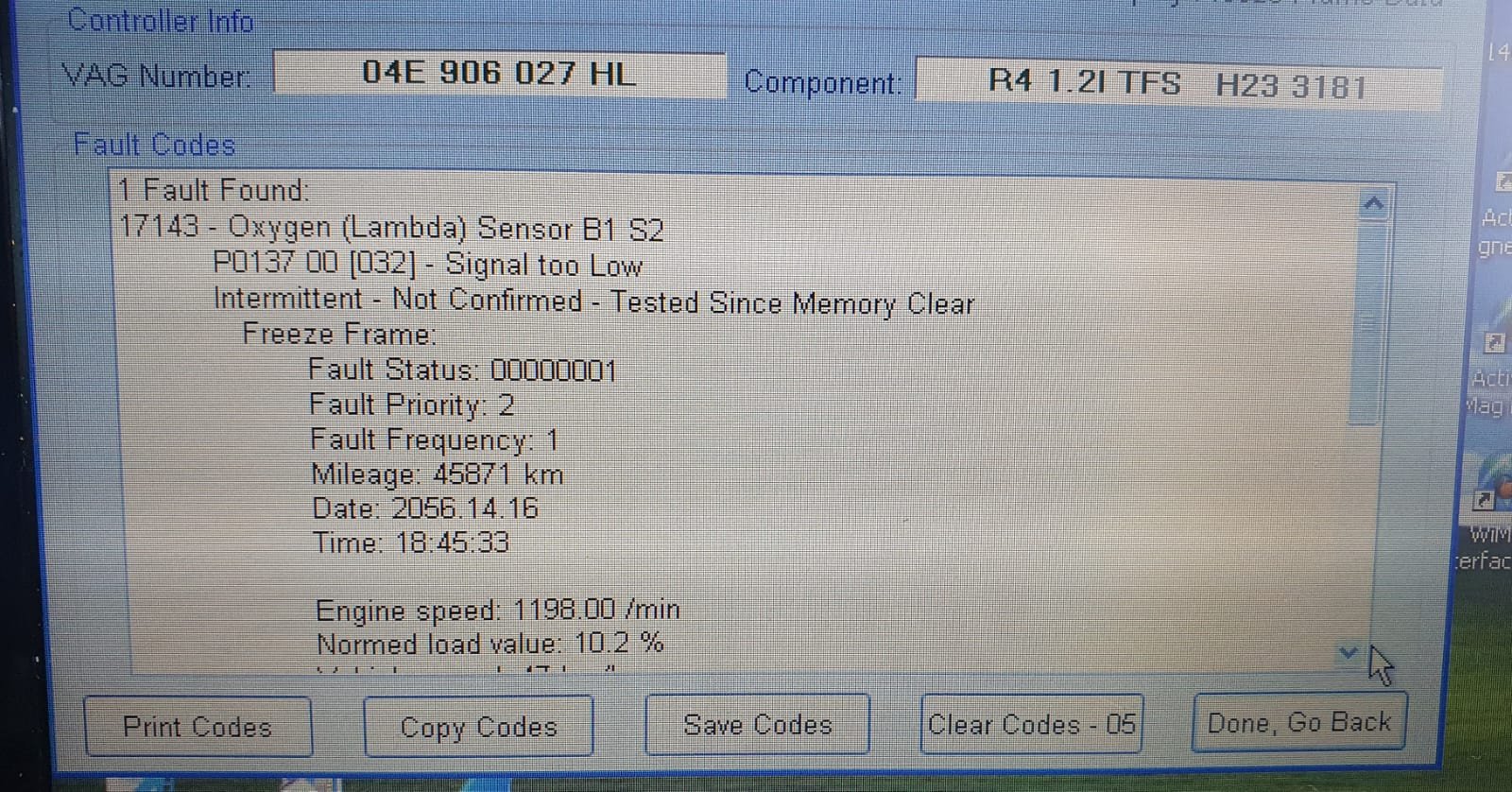
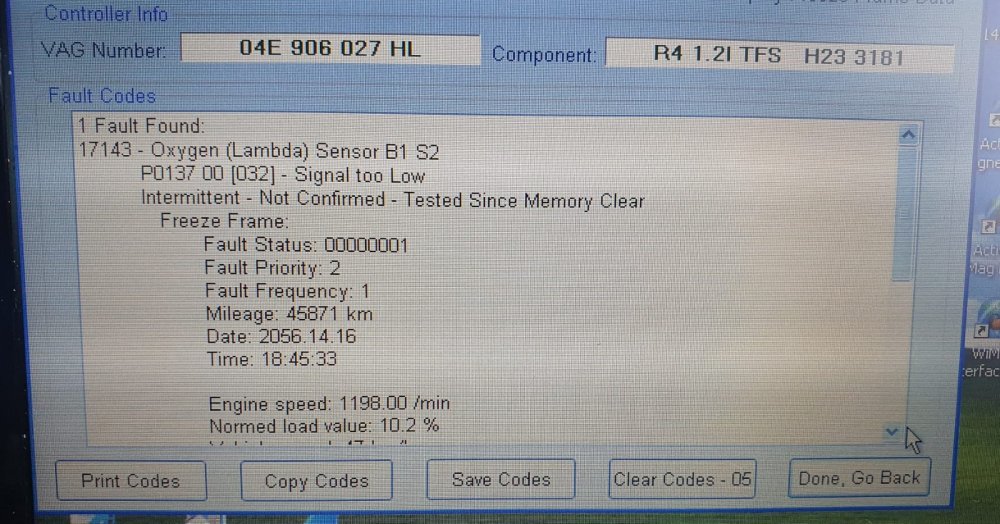
As I wrote earlier I had that exact error code come on my Yeti. I used one of those box spanners with a slot cut for the cable, made for those sensors. Also sprayed it with penetrating oil, it came out quite easily tbh. I agree with your thoughts on non OE parts, I've had issues before with reversing sensors. That's why I replaced with a VW part from TPS. With the new sensor fitted, the fault code cleared and that's been a year so far with no issues.
-
The 2nd Lambda (Oxygen) sensor. Bank is the manifold number, so something like a V8 would have 2 exhaust manifolds Sensor 1 and sensor 2, is from the engine before and after the catalyst. So B1 S2, is the O2 Sensor just after the exhaust catalyst. I had to change that on my Yeti after the engine management light came up, IIRC about £140 from TPS to buy one
-
From experience I've never had any issues with interference, I've run cat 5e all round my house, even gone though the same joist holes that already existed for the mains wiring. I agree with you avoiding Cat7, I run that once thinking it was a good idea but as you say it is a pain to terminate and takes up so much more room when multiple runs run together. I didn't even bother with earthing the shield on that cat7 as I read it's only needed in industrial environments. Wired network is much more reliable than wireless. Although I did install Cat5e runs to a ceiling POE AP on each floor as well, but they are just for mobile devices. You may want to think about adding an AP or two to your setup. I still say you would find it easier running all the cables downstairs in one go, a larger chase, but once under the floorboards it would be all empty to just fan out to each location. Overall it would be less work than having to chase and fill every room corner. You won't have any building reg issues with network cabling, that is all extra low voltage (ELV). Still run it in approved BS7671 zones as that is safer for future drilling, assuming the driller knows about zones. There are also regs on drilling joists, mostly practical issues like making big holes close to the sides and weakening the joist. You'll be able to look them up on the web but for small holes for threading a network cable through you would be very unlikely to hit problems there but look them up nether the less. As mentioned earlier I used holes already in the joists where I could even when run with the LV wiring too. I use a long 8mm SDS bit (450mm long) and I find I can drill from above the skirting down behind and then push the cable down that. I've put loads of wiring to back boxes in that way. A multitool is good for cutting in the actual boxes too. Network cabling is ELV (<50v AC), LV is the mains wiring - Low Voltage is <1000V AC. Not that I'd call your 240v House Wiring Low Voltage but officially LV is the term for it. That 5cm rule depth and protection is for LV (240v) cabling. In practise it is not achievable, so that is why RCBOs, RCDs etc are now added to all circuits including lighting circuits from the 18th edition wiring regs. These would not apply to your ELV Network wiring anyway.
-
You need to confirm that 75%, 35k is not that much for rear discs. I can understand the front but not the rear needing replacement at 35K. You can normally feel the ridge on the outside of the disc to see how much wear, that's checkable with the wheels on with many alloys . My bet is they are 25% worn and still have 75% service left. If that is the case then they would not need replacing now. I've had garages badly overestimate wear, not sure if they are trying to get work. But I've been told pads need changing when there was loads of material left. Hence best to always check yourself.
-
Permitted zones are 15cm in the corners and horizontal/vertical to an accessory outlet (socket/light switch etc). These are the standard wiring regs. So In general you would come up straight into a network port back box, so that comes under the normal horizontal/vertical to an outlet rule. There is no need to earth conduit. I would recommend the use of plastic oval conduit as it makes running the cable in and more so pushing excess down as the front plate is screwed on easier, but there are no rules there, you can just plaster in the cable as is if you want. But as said I would always recommend oval pvc conduit. According to BS7671 Wiring regs low voltage wiring should be run separately to your LV Mains cabling, in practice that means don't run both in the same conduit or strap together. You need to think where you network switch will be located, and run all the cables to/from that point. The normal network connection in this country is 568-B. So you would krone both ends to 568B. Normally to a patch panel at the network switch location. I used a 9U 19" Network cabinet in my side room for my network switch, but that cabinet also contains a network NAS drive, media server and ADSL Router. Don't forget the network run to your router or the ADSL BT run to the master socket depending on where you plan the router position. You state about coming down walls, considering the outlets would be nearer the bottom it is far simpler to come up from under the floor. My 1930's house had a top to bottom gap in the side of the chimney breasts, I think designed for central heating pipes. But it meant I could bundle all my network cables together with tie wraps and run down that channel. Or make a new bigger channel floor to ceiling in the corner to bring all the cables down in one go. You will then find going up into each room from the floor easier that coming down to each separate outlet. You say an old house so I'm assuming floor boards and not a solid concrete floor. Coming all the way down to almost floor level, although allowed by regs is not good practice as if the cable run was not considered in the future it could be drilled though. Switch drops to light switches normally come downwards but socket outlet run upwards. Your network outlets I would imagine would also be low and hence run upwards would be better. I would not consider running outside and in, that is messy, would look bad and be open to the environment/corrosion. (I do have C&G 2382 and 2391 so am aware of BS7671)
-
Just re-read your message. I replaced the door side. Are you writing about the main car side ? Sorry I have not done that side but it would not surprise me once you start exposing things you will find a part number written on what you currently have.
-
I would say they supplied the wrong door loom then. There are many options. I have done this. The best way to order the correct door loom is to use the number on the white label on your current door loom, that is the VW Part Number. To get to that you remove the elbow rest (screws), click off the door card, remove the plastic door liner (I just pulled mine back as much as I needed to access), drill the rivets off the speaker to remove that. Then it is pretty obvious and as said the part number will be on your current loom. I remember I was driving round for a couple of weeks with all that removed, using a pair of mole grips on the cable to open the door, while I waited for the replacement loom to turn up. You need 4 large pop-rivets when replacing the speaker.
-
That's not the Speedo reading, close but not exactly the same number
-
Works fine on mine: Saturday,29,May,2021,12:12:33:45213 VCDS -- Windows Based VAG/VAS Emulator Running on Windows XP x86 VCDS Version: 20.4.1.0 Data version: 20200331 DS317.0 www.Ross-Tech.com Mileage: 46030km-28601mi Repair Order
-
I did and found the Aircon had no pressure. Would I of checked the Aircon otherwise ? As expected it didn't work. Post purchase interestingly a regas lasted a few years no problems before the car was sold on anyway It's also handy for checking the ECU Mileage is close to the dashboard reading, so no clocking red flags
-
Its Stop Start batteries that often need coding, does the car have that ? Ahh just read read - it doesn't, that's why then
-
If you ever decide to change your battery then Tayna do good AGM replacements. AGM is better than EFB and don't cost that much more. You would need to code your new battery to the car but I can help you with that as I have VCDS. I see you state Enfield as your address, well I'm only in Newbury Park, Ilford so not far away.
-
The manual says P21W if not the led type. The led type it says that the brake and parking lights are integrated into the housing and not individually replaceable,
-
I put one of those Android units in when I had my Roomster. That gave me DAB and SatNav. I had to swap the rear roof antenna for a DAB antenna but that worked fine for me. When I sold it I gave the removed Swing unit too, just incase the new owner wanted to put it back to original. It did the Parking sensor display fine, picked up the data from the CanBus.
-
Hot made no difference, but putting the car level did. My front only has a slight slope, down on the battery side, but that made 300ml difference. So I vacuumed a bit out and now it's sitting towards the top of the hash area, with say a mm spare, when hot, level and rested for 5 mins. I won't make that mistake again. So it seems 3.9L is correct.
-
Yes, it was cold. I've never done an oil change and had to measure hot. In that case maybe I should vacuum some out.
-
Did my first oil + filter swap on my Yeti yesterday. Reading up beforehand loads of tables had 3.9L, so I thought my 4L purchase would be fine. But after a drain plug drain, I poured all 4L in and it only just showed on the lower end of the hash area on the dipstick. Got another 4L the next day and it probably took another 100-200ml to settle at the top of the hashed area. So that's around 4.1 to 4.2 litres. Am I missing something here ? It doesn't matter too much and I'll know in future but why do the tables say 3.9L ?
-
Out of interest I just looked at the Yeti service manual and it states to prebleed the ABS you open both nipples together and OBD do Basic Settings once done. The instructions say : A pre-pressure of 0.2 MPa (2 bar) is required to bleed the brake system. – Unscrew cap -1- from the brake fluid reservoir – Connect the thread plug -1- of the brake filling and bleeding device e.g. -VAS 5234- to the brake fluid reservoir. – Provide a suitable catch pan for used brake fluid. 1. Bleed the front left and front right brake calipers at the same time. 2. Bleed the rear left and rear right brake calipers/cylinders at the same time. – Allow brake fluid to drain until even the smallest air bubbles have escaped. – Initiate basic setting ⇒ Vehicle diagnostic tester. – Then perform normal bleeding
-
I've had similar issues on a Roomster. So some tests: 1) With the engine off if you push the brake down once hard and release, then repush hard - it should be hard with the pedal stuck high up and no creep downwards with sustained hard pressure. 2) Keeping the pressure on the pedal then start the engine. The pedal should drop down a little and then still remain firm. My Roomster on test 2) the pedal almost went to the floor. It was due to air in the ABS and I had to do the ABS bleed procedure with VCDS. After bleeding the ABS all was perfect, note a normal brake bleed would not of cleared the ABS of air on that model. I'm unsure if the Yeti ABS unit has a similar procedure or it will air bleed using a normal pressure bleeder.
-
I'll be interested if it's still working 6 months later. As I wrote earlier I had lots of issues with non VW (expensive) parts. Yes they always worked, but failed again a few months later. I was getting tired, although very skilled, at taking the rear bumper off and on. So post an update to confirm they carry on working.
-
That's a word I haven't heard in years, a bit like people always called the capacitor on points a condenser. Is there a difference between a rheostat and a potentiometer or variable resistor ? Anyway dimming is done by Pulse Width Modulation, PWM, now as it is more efficient and does not waste energy in heat on a resistance. So it makes sense that any replacement led lamps have to be as they mark them dimmable.