




Breezy_Pete
Sponsor
-
Joined
-
Last visited
Everything posted by Breezy_Pete
-
Alarm horn on your car appears to be fused from Fuse 54, 15 Amp value. It has only LIN 1-wire comms to the BCM, not CAN connected. See if there is evidence of a drain via that fuse? (Not mentioned in your original post, so I guess not?) Would be good to get a VCDS scan of the BCM (module 09) to see if it is registering a fault with the alarm horn (probably). That may, I suppose be causing things to not shut down fully. Not sure.
-
-
-
-
-
-
Wheel cover or centre cap off should reveal it, I think, no need to take wheel off?
-
May also be worth measuring the diameter of the space around the nut, and making sure that the socket you buy isn't too big on its overall diameter. Vaguely remember that on a Fabia mk1 the OD of the socket mustn't be bigger than about 49mm. My memory may not be correct though, and your model may have more (or possibly even less) room. Best to check.
-
The switch won't be causing the fuse to blow, it is wired with thin wires that carry tiny signal currents only.
-
The thick red/white wires come from the fuse that's blowing to each front door module. The most likely place for that to be broken or damaged is in the rubber bellows between the car body and each front door, in the hinge area. Since the driver's door is usually opened and closed most, look at that one first. The rubber can usually be detached at the car body end and pulled back towards the door to allow inspection of the wires inside. Would someone with a similar age mk2 Octy please tell this person how to gain access, please? I don't have personal experience on this platform.
-
I think you may find a short between the main 12V feed coming from that fuse, and something else, possibly the main brown earth. I can't see much else causing a 30 or 35 Amp fuse to blow instantly.
-
Go straight to checking the wiring in the rubber bellows between door and A-pillar.
-
Well done, always nice to hear of a good secondhand part solving a problem. 👍
-
Hope you meant 505 01 for the 1.9?
-
I would leave that. Maybe keep some paper or cardboard under there (fixed to undertray somehow) to absorb the drips, so they don't go onto the road, or your driveway/garage. It could be worth checking the positive crankcase ventilation (PCV) system is working correctly. This helps eliminate, or at least reduce any gas pressure in the crankcase/sump/head which makes leaks less probable. I don't know exactly how this system operates on your engine, so I can't suggest a method for checking it, but sometimes just loosening the oil filler cap while engine is idling, and observing whether it tends to be blown upward or sucked back down can give a useful indication.
-
Breezy_Pete replied to RalfRannet's topic in Skoda Favorit, Skoda Felicia, Skoda Fun and Skoda FormanThe thing I was trying to describe is nothing to do with the carburettor itself, certainly nothing to do with the accelerator pump.
-
Breezy_Pete replied to RalfRannet's topic in Skoda Favorit, Skoda Felicia, Skoda Fun and Skoda FormanAh OK, completely different arrangement with a wax thermostat acting directly on the flap? Or manual moving of the flap according to season? Maybe try to find a way to heat the carb body also.
-
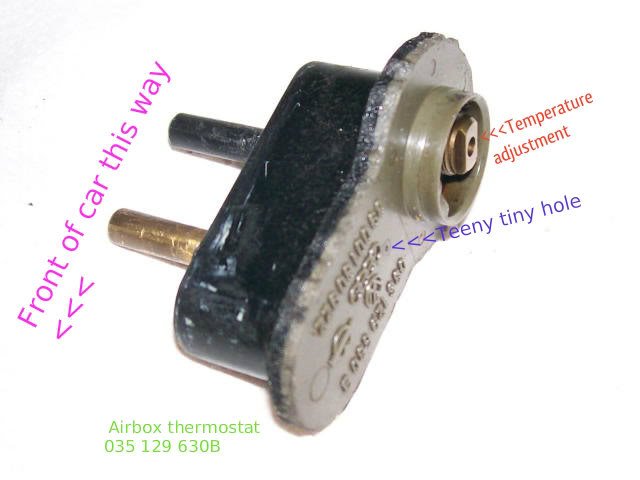
Breezy_Pete replied to RalfRannet's topic in Skoda Favorit, Skoda Felicia, Skoda Fun and Skoda FormanIn a mk2 Golf I used to own, there was a thermostatic vacuum valve in the hose that went to the diaphragm which moved the flap. That contained a bimetallic strip which was supposed to respond to the intake temperature to create a closed loop system. The little thermostat valve needed cleaning out before mine worked correctly. The 'teeny tiny hole' was blocked, so not allowing sampling of the passing air, or something, I seem to remember. (This was at least 20 years ago, so the memory is vague). Not sure if Felicia has same thing?
-
Perhaps a reason to be a bit more hesitant before ridiculing stuff that 'sounds wrong'?
-
If it is not leaking from somewhere higher up (above gearbox) and running down to there, then it seems likely that you would have to remove the gearbox to find the source of the oil. May be better to just keep cleaning it and making sure you are not losing much oil by checking the level regularly. If it is leaking enough to make a mess on your driveway, then it would be kind to other road users if you fix it before it gets much worse. It would be helpful if @Blue8793841 could maybe show us the technical service bulletin he mentions. Or at least tell us which brand, model and engine(s) it applied to.
-
Surprised me too @J.R., but make yourself a cup of tea and then try googling "oil leaking from flywheel bolts". Quite a bit of reading matter pops up.
-
I'll encourage someone else to flesh out that statement. Never owned a vehicle with a DPF myself.
-
More likely to be fuel contamination into the oil, unfortunately, due to interrupted/incomplete regens.
-
Ignore my mention of the precat bit. Whilst the ETKA illustration depicts one, real photos of genuine sections suggest it's not present on your part number. Makes life a bit easier.





Important Information
Welcome to BRISKODA. Please note the following important links Terms of Use. We have a comprehensive Privacy Policy. We have placed cookies on your device to help make this website better. You can adjust your cookie settings, otherwise we'll assume you're okay to continue.