SuperbTWM
Resident Member
-
Joined
-
Last visited
Everything posted by SuperbTWM
-
My gut tells me this might be normal as higher intake temperatures than expected would probably be picked up by the ECU and probably put the car in limp mode or at least store some codes???? Just done some more digging and i think you are looking at the intake temperature which is before the charge cooler, I think there should be 2 sensors, 1 before, 1 after, obviously if you are looking at the before temps they are going to be high
-
If you're not changing the pump it doesn't get touched when changing the belt
-
Do these have a vacuum operated FPR that could be faulty?
-
Having the dashcam sapping power is probably one of the reasons why your tired battery is causing issues, have you tried disabling the feature where it continues to run on or disconnecting it to see if your battery starts coping better? Would be interesting to know what voltage your camera cuts out at, i'm willing to bet its probably a lot lower than is ideal. For reference I had to replace an AGM battery on our Ford at 5 years old. It was starting the car fine but it wasn't letting us power up the front heated windscreen
-
Nobody with even half an understanding of how a DPF works would suggest doing that
-
looks to me like the top is the limiter as it looks like LIM on the little dial symbol, the bottom seems to have the standard cruise symbol. Either way, press them and find out!!!!!!!
-
I always thought it was a seperate system but if you look at the components it goes turbo>Nox catalyst>Adblue injector>DPF. The adblue and DPF go hand in hand really as the function of the DPF regeneration actually creates a lot more nox than the car otherwise would without a DPF. On the Euro 6 VAG engines there is a nox catalyst straight after the turbo (but before the adblue injector) which stores the nox at low exhaust temperatures, when the car goes into a DPF regen and cylinder and exhaust temps increase and this then gets converted into nitrogen. During said regen the nox goes throught the roof due to the increased exhaust and combustion tempratures that are helping regen the DPF and this is where the adblue injection comes in to convert the rest of the Nox to nitrogen and water which happens inside the DPF (must be some hybrid catalyst/DPF in cars that have SCR) Source: youtube (so it must be true 😂)
-
If the turbo has failed catastrophically then the VNT mechanism and the turbo housing can get pretty chewed up so I would remove and assess before chancing a core.
-
Could just be that the car needs a good thrashing after having been shunted around the forecourt for god knows how long. I have SCR and it doesn't smell any different to normal, it only injects a misoscule amount and it doesn't inject all the time
-
Have you tried looking at the raw value of the DPF pressure sensor with the engine off to verify its zero calibration and that the sensor is good?
-
Sounds to me like you've bought somebody elses problem, can you take it back? It doesn't seem to add up that the last regen was 11658m, which is presume is meters? I would try and see if you can view the live data or even better, log the data from the DPF temprature sensors and pressure also. When you buy a car that already has issues they could of of done something stupid such as remove the DPF without mapping it out, or let the DPF fill up to near breaking point.
-
Pleasure to be of some use at long last 😂 It mays still pay to take the fuel sender out of the car though if you are having fuel problems, if its designed similar to that of cars with a lift pump, the body of the sender will hold a resovoir of fuel which is topped up by the return. If it is not holding fuel then the suction line from the mechanical pump may pull air in when the tank is low on fuel or facing uphill/downhill.
-
You sure it has a fuel pump? I would expect to see 4 connections on that plug, 2 for the pump and 2 for the fuel level sender. Unless the sender is somewhere else? That may explain the 4V, that will be from the ECU for the fuel gauge?
-
It could explain the lack of heat as the silica beads can block up the heater matrix and the egr cooler. Also, there has been some other posts on here from other users in the past that have experienced a blocked or partially blocked egr cooler that has led to the coolant boiling when the car regenerates which can cause coolant loss through the pressure relief on the header tank cap. The latest coolant revision is G12 EVO this is backwards compatible with most modern coolants
-
Sounds to me like symptoms of the silica bag rupturing
-
Have you monitored the voltage while these strange things are happenning?
-
I assume that gunk is just emulsified oil from the turbo and CCV mixed with the coolant on its way out of wherever its leaking. Would be interested to see where it has failed Do you have access to a bandsaw, would be cool to see a cross section also, that would tell you if there is any corrosion, more likely maybe is failure due to vibration, a failed weld??
-
The EGR cooler can be a possibility but I wouldn't want to change it without knowing for certain.
-
I suppose with the introduction of the exhaust flap and other complexities it does need that other sensor for control. So far i'm lucky enough not to have to deal with the emissions side on mine yet. *touches wood*
-
So you have 2 differential pressure sensors? if one if across the DPF what does the other one measure?
-
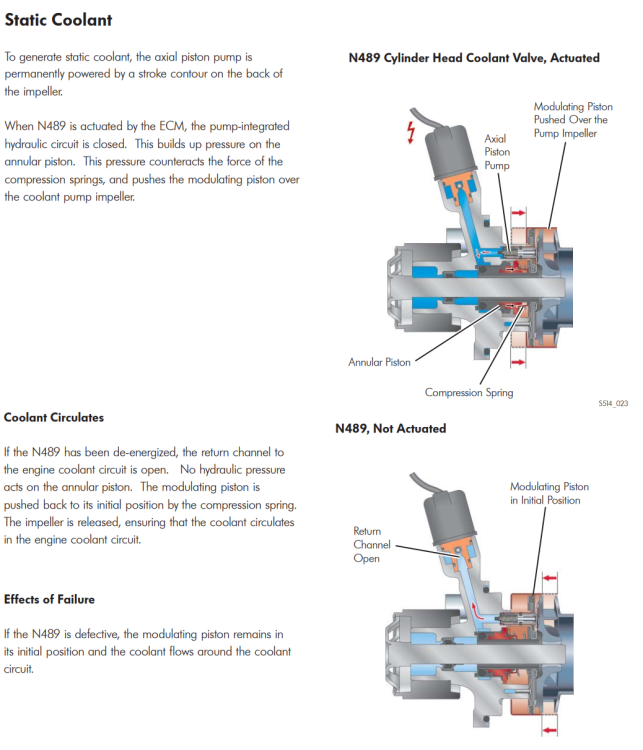
IMO this is probably one of the best and worst water pumps ever made. The effect it has on making the cabin warm in winter compared to the older engines is incredible (coupled with the rest of the complicated cooling system), You can fit water pumps without the sleeve but I think its worth the risk in having the sleeve and going OEM with the possibility of being less reliable
-
It won't move because the water pressure is what moves the sleeve. The solenoid is only a pilot valve. EDIT: Just read your latest post, looks like you had fun finding out for yourself 😂
-
Hi, the car has a high pressure EGR system which comes straight from the exhaust manifold, through a cooler and into the clean side of the turbo, the low pressure system is the bit you have replaced which takes exhaust gasses after the turbo/nox catalyst/dpf etc. also via a cooler and back into the intake. If you think about it, the EGR valve you have changed is going to be quite clean because its after the DPF therefore its not going to get blocked up in my opinion. From reading the literature on these engines the engine favours the low pressure EGR more because it is cooler (with the exception of right after a DPF regen) cleaner and doesn't effect the efficiency of the turbo. Have a read of this, it may give you some further ideas https://pics.tdiclub.com/data/517/820433_EA288.pdf
-
wouldn't you need 2x 6 point sockets for a 12 point head? 😂 It is a bit dissapointing that somebody who works on cars for a living hasn't got a man enough impact wrench to get a bolt out.
-
If you are 100% sure on your diagnosis it should. Worst case scenario is you have a good spare to sell on