Breezy_Pete
Sponsor
-
Joined
-
Last visited
-
Currently
Viewing Topic: Wanted: wiring diagram for blower motor
Everything posted by Breezy_Pete
-
Someone may have messed with the window motor module too. If the metal casing round the motor part is mis-fitted by 180 degrees it swaps rotation.
-
One reason for misfires on the HTPs, though mostly the single-cam 6-valve ones, is exhaust valve damage. This might show up as a lower compression value on that cylinder compared with the other two.
-
Don't suppose you own a compression tester or know anyone that does?
-
Can you repair the servo pipe better to temporarily ensure that it's not leaking at the cracked sections? Self-amalgamating tape reinforced by a few cable ties is probably better than anything else bodge-wise, and what I've done on my Polo recently as a stop-gap until I replace it. I keep meaning to see if the one on my other Polo is the same and in a better state, as that car's off the road.
-
Let's hope so.
-
Best thing to do with a post that doesn't interest you is not reply, obviously. If that's the general consensus, it's soon going to drop out of view. 🙂
-
GSF appear to do slave cylinders for about half what that ECP one costs, e.g. this comes from an ebay search of the genuine part number: Seat Cordoba 6L2 2002-2009 Clutch Slave Cylinder Hydraulic Replacement Part | eBay
-
Pretty sure it's the 6QE721261 number you need, or aftermarket equivalent. PR=0EM means MQ200 box. That code isn't on the sticker of our very similar car, but is in the full car data of it.
-
@VanhireBoys Have you been seeing oddness from the electric window on the side with the broken clip? I've been tackling ours today (driver's side) which had - as suspected - some up/down waggle at the rear of the glass when half open. This has indeed turned out to be the same as what you've suffered, broken runner. Good info from @sepulchrave earlier in the thread. Reason I ask about the electric window is that our driver's side one has been 'mischievous' lately, and I suspect this has been down to the broken runner making life harder for the window motor. What it's done quite often is that if you have the window down a bit, say one-quarter open, and then you go to close it again, the window goes up a tiny bit and then comes back down. Pretty sure this is the 'anti-pinch' function getting false-triggered by the extra resistance of window glass that's only being moved unevenly by just the front runner. Never seen it go up when commanded down. I was hoping to get to the point of testing it with new regulator panel today to see if that's gone away, but had a few issues fitting my replacement lock unit that I wanted to do at the same time, and now it's too dark.
-
erWin isn't really the place for part numbers, but there's always something ETKA-like free online to get parts info once you have the PR codes. My favourite just now is this one, which includes very recent stuff: LLLParts
-
Oh, apologies then, they must've "improved it worse".
-
Can you not go to Vehicle specific information then vehicle identification, then enter VIN to get to 'car data'? Used to be that way.
-
Not sure how much this page helps, but it's the only one out of three pages on rear discs that has unvented. https://www.lllparts.co.uk/en/catalogs/skoda/CZ/SUP/851/6/615/615050
-
You could ask a friendly dealership parts counter person for the full 'car data' pdf. Failing that you could pay for that same info at erWin Skoda (7 euro plus vat).
-
Got it. I'll leave you in the capable hands of the other guys here then.
-
Sorry; then I misunderstood your other post, I thought you were saying you'd just got a Roomster? 2013 cars will all be CAN: Don't think any of 08 Octy, Touran or Passat will be non-CAN, but not sure. Never heard of VCDS Free, but it sounds like it might be the old name for VCDS Lite.
-
Sure, but an option for the one specific car if it is pre March 2010. Is it @Enfys-Tan?
-
Big array of VCDS options here: Audi, VW, Seat, Skoda tools :: Gendan Automotive Products Includes super-cheap option of KKL cable which I think will work with the freeware VCDS Lite if your Roomster (mentioned in other post) happens to be an early one.
-
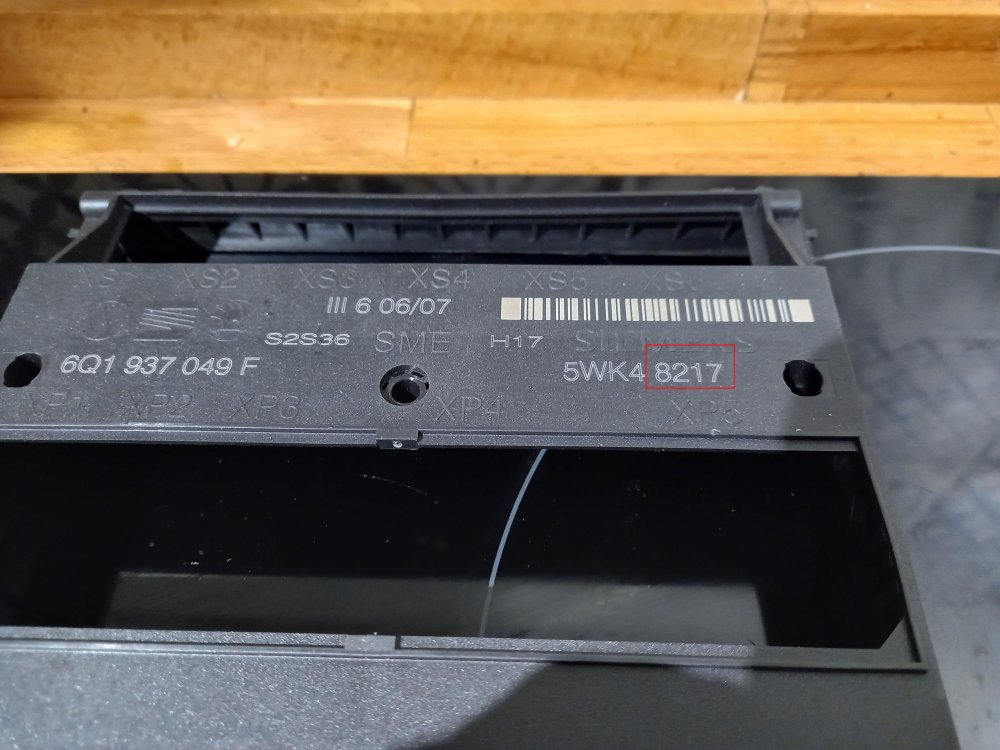
There's probably an original software version printed on the case. I wonder if @rum4mo knows what his originally was and what version they updated to? There must be hundreds of thousands of these units out in the wild so it must be specific to a particular software version number, I'd think. I speculate that the number in the red rectangle is the SW version this unit was born with:
-
How are the tyres?
-
Check when hot, may be fine. VW group may well specify capacity to midway between min and max, or even lower in these days where emissions regs and targets govern so much above good sense.
-
What's the level now with the engine at operating temperature? Sounds like you were checking it cold?
-
-
Power to window motor module, I think. I'd say this means it's the lock unit that's playing up.
-
They usually switch from open (not conducting) to closed (conducting) when pressure is above the threshold they work at. Not near computer now to help further, but that does ring a bell as the right wiring colours for the other one.