Breezy_Pete
Sponsor
-
Joined
-
Last visited
Everything posted by Breezy_Pete
-
Wait until it fails an MOT, or starts to sound horribly loud. They can look terrible but still be operationally fine. Aftermarket units will be rather tin foil-like in comparison, I'd expect. New genuine back box appears to be around £250 inc VAT, but would need VIN to confirm. If it ain't broke...
-
Please do report back with anything that might assist others in future, especially if you find an aftermarket supplier of correct, RHD parts. I suspect a lot of mk1 owners are in the even worse position of not even genuine replacements being available any more.
-
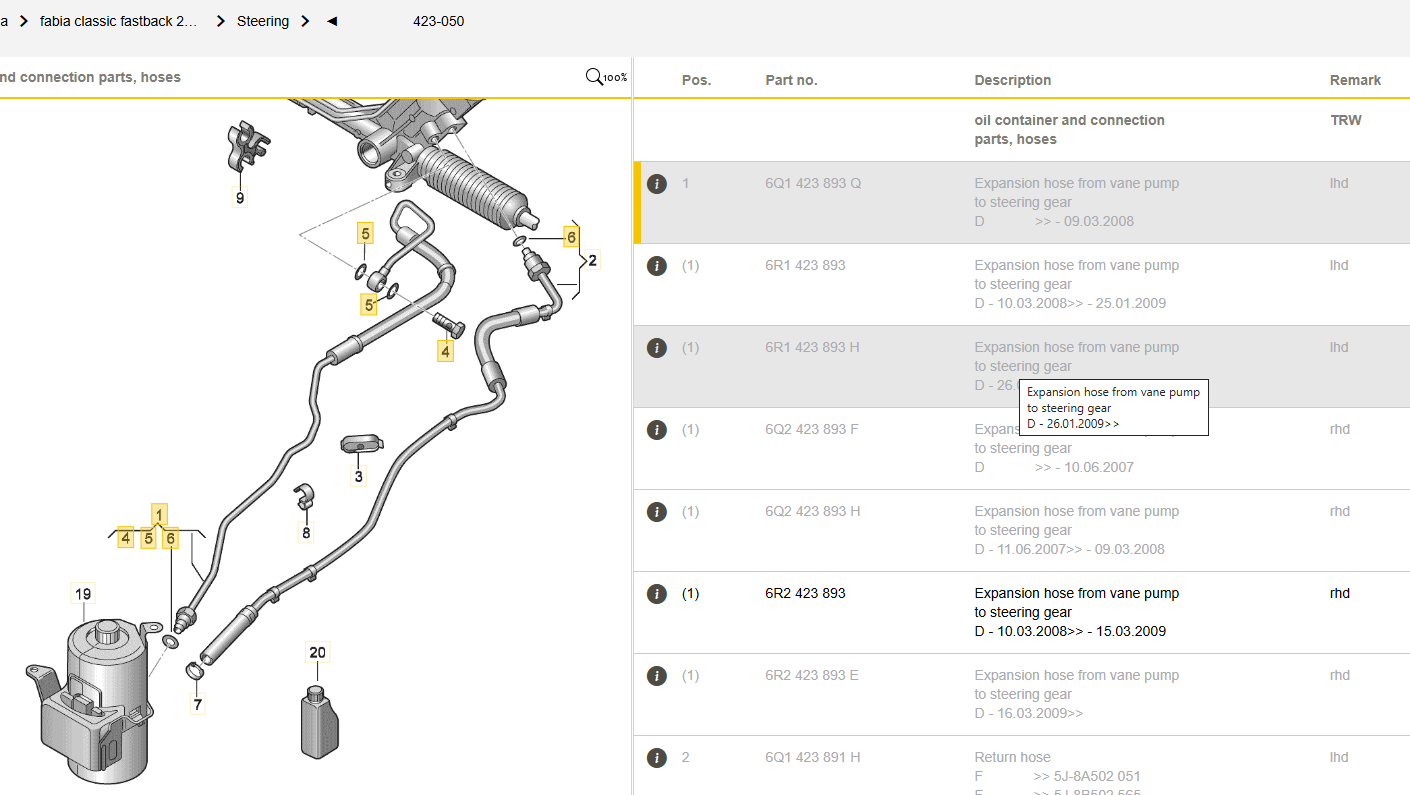
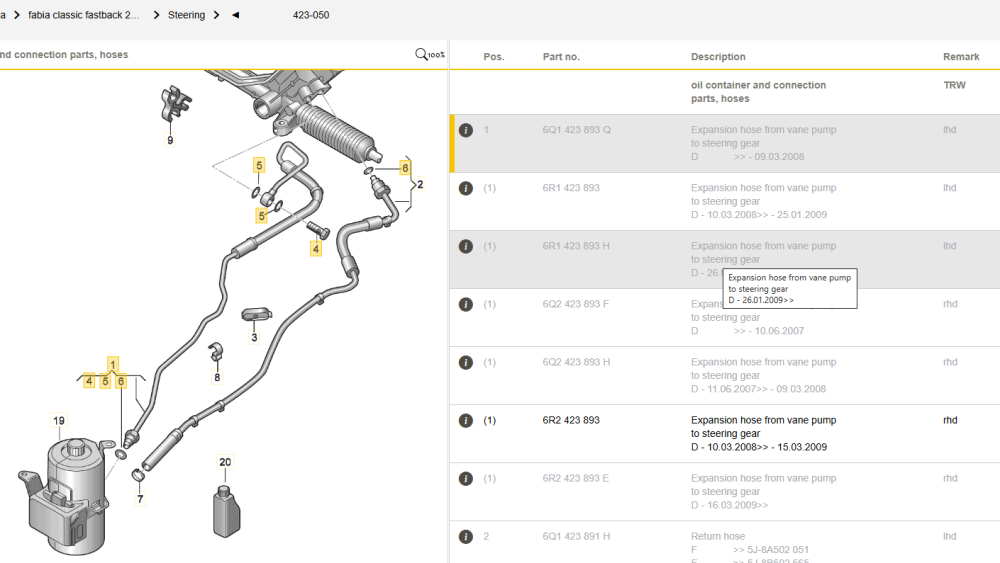
I doubt this image will help much for two reasons; it'll depict a LHD system, so you'd have to mentally mirror the rack to get an idea, and the hose images won't match RHD reality, too short for a start, I'd think. These diagrams tend to be a bit generic too, so even a LHD hose of the respective part number (will start 6R1 instead of 6R2, N.B.) may not resemble the sketch exactly. Most aftermarket stuff is likely to be made for the majority LHD market, and so will match 6R1 parts, not 6R2.
-
No idea about aftermarket, sorry. Autodoc can be a useful research tool in that respect. Find your nearest scrapyard.
-
"Expansion hose" for that VIN was 6R2 423 893, but superseded by 6R2 423 893E (RRP currently £295 + VAT) "Return hose " was 6R2 423 891D, now superseded by 6R2 423 891E (£89.50 + VAT) So that's £460-ish for parts alone, including VAT, for both genuine. I guess you'll try to find better condition secondhand? I wouldn't bother changing the return hose until it gives trouble, to be honest.
-
Partslink24 doesn't seem to recognise that VIN, is that your VIN? If not, what is yours?
-
Your car probably has an ABS module without that functionality.
-
Reg or VIN would get me to the best info efficiently.
-
"The dogmobile". 😀
-
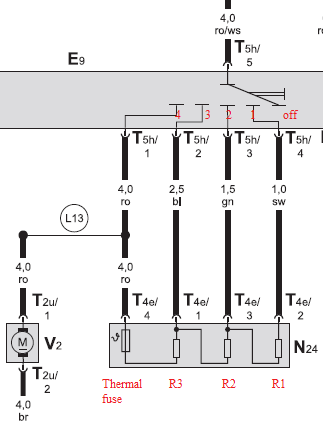
This is mk1 Fabia version, but I doubt they've changed. N24 is the resistor pack, switch above it, V2 the fan motor: Three resistors plus a thermal fuse, all in series (actually just 'tappings' off a continuous winding of resistive wire). R1 section is often the first to fail cos it gets most use, but any of those four bits can fail. If R3 or the thermal fuse fail, only speed 4 will work, cos that's permanently connected even in the absence of N24.
-
Skoda dealership parts counter?
-
I see that sometimes, I just click confirm. Not sure how things may or may not be different with a limited time subscription though.
-
Ignition switched feed from fuse 19 in cabin goes to pin 8 Permanent feed from engine fuse 4 goes to pin 1 Permanent feed from engine fuse 25 goes to pin 32. Pin 47 is earth. CANH (Powertrain) bus connection on pin 12, CANL on pin 13.
-
Not sure regarding MOT. 70 Ohms sounds high for the earth connection, but if shorting the pins makes different warnings happen it must be getting sensed OK. Perhaps one of the pads you replaced should have a wear sensor? Presumably you'd have noticed unplugging the old one though. Can you post a photo of the warning light?
-
OK, so there might be a problem with one of the wires going to that connector. Test that the brown/black wire from contact 2 of that connector has continuity to earth/battery negative, and measure volts on the other contact when ignition is switched on, and check that you see a voltage, relative to battery negative.
-
Try shorting the contacts of the loom plug instead, or connect pin 1 (the brown/purple wire) to earth. It might be that when fluid level is correct, the circuit is made (shorting pin 1 to pin 2, which should be earthed), rather than broken. This would then register a fault for bad/broken connection, as well as low fluid, so a fail safer arrangement.
-
-
-
-
Perfect. I've used ASM several times and have no reason to distrust their info on anything I've bought. Good find! You may be able to shave off a few quid if you can find same item on their website instead of going through ebay.
-
An even cheaper one here: https://www.ebay.co.uk/itm/127224423560
-
Sounds like the relay within the motor module is doing the clicking, which should result in rotation, so I think it's falsely (or accurately) sensing an overload/overcurrent condition. The black rubber radial seal around the white cog sometimes gets extremely stiff, so it could just about be that, but I suspect it's more likely the result of contact burnout on that relay within the motor. Probably most economic to try a cheap secondhand replacement like this: https://www.ebay.co.uk/itm/316982998532 I could inspect the original for you and replace that relay and anything else that looks suspect, if you wish. I'll start a private chat with you, because you lack sufficient posts (20) to start a conversation, I think.
-
Unscrew the motor from the door panel and check what happens with it trying to operate without driving the mechanicals. You'll have to reconnect the switchpack 'hanging' from the door loom, and will probably need ignition switched on to check.
-
I see. Well personally I'd go for the genuine one on ebay that's only done 50k, over any new aftermarket product. The latter tend to be cheap for a reason. Or keep your eyes/search engine open for another, perhaps tidier-looking one with similarly low mileage.
-
What's wrong with your original drive shafts?