
Breezy_Pete
Sponsor
-
Joined
-
Last visited
Everything posted by Breezy_Pete
-
It looks to me from haris's photograph as if the negative clamp has just not been pushed far enough down the battery post (which is slightly conical) before being tightened. If it was a Skoda-supplied battery, I'm pretty sure it would have a VW-group part number somewhere on the top label, @Axle_of_weasels Or is that in fact one just to the right of D52 on the second line? Ending 901 068? Can't make out the first three characters. Doesn't seem to be; those last 6 characters don't fit with any I'm seeing in parts catalogue. (And axle's link's title tells us that is the varta part number, not vw-group; now that I've gone there)
-
Maybe why he said this?
-
One reason perhaps, but another may be that making things seem more difficult for non-VW group companies/individuals' DIY can be very lucrative... As soon as they get your car in, they can start upselling all those 'we found this, that and the other that need work' things. I understand that @BigEjit works in this field, so he's probably the closest we'll get to specific reliable inside info.
-
If there was a significant fault, you'd have a code for it, and probably a warning light on? It's not clear to me whether the readings you're seeing are coming from the pedal sensors, or the TB sensing. Either way, don't go on assumptions, hope that someone rises to the challenge suggested above by @Golf-Fiend and measures what goes on in another similar vehicle. I think you're jumping to conclusions with insufficient info. Tends to be expensive.
-
Hold up! I don't think you've in any way established that there's any fault here!
-
Modern diesels do have throttle bodies, but they're not used for the same purpose as on petrol engines; so there will be a very different relationship between throttle pedal position and throttle plate than there would on a petrol car (which isn't 1:1 anyway). Must admit, I didn't notice we were talking about a diesel when I posted.
-
There are both, sensors in pedal and throttle body.
-
Tyre balance weights haven't used lead for some time, I think.
-
ASZ, no?
-
1 -Brn/Blu 2 - Blu/Yel 3 - Purple/red 4 - Blk/Yel
-
Fuse 10 is the 's' contact fuse, live whenever key is in the ignition switch. That probably caused the radio to wake up internally, even though off. This may have persisted for long enough to cause the situation you're seeing.
-
Was the key in the ignition when you were measuring the 140mA?
-
The guide pins on FSIII brake calipers are an M9 thread, oddly enough. Came up in a recent thread where someone knackered the thread these go into on the bearing housing, and unfortunately helicoiled M10 thinking that's what they were.... Even more off-topic, I looked carefully at one of these bearing housings the other day, and those M9 threads look to be part of pressed-in bushes, rather than tapped into the general surroundings. Might suggest they could be pressed out again and replaced, like for like. Another option to maybe explore is cutting back (or removing carefully depending on your love for the car) some carpet in the neighbourhood of these captive nuts, to see how they get in there, and how replaceable they seem.
-
Another quick point on this topic, as I'm in the midst of refitting a seat myself. The screwthread on these bolts is M8, not M10, although the head fits an M10 XZN tool. There is such a thing as an M9 thread, so that's one re-tapping option, but you may be quite limited about what head types you can buy M9 bolts with, and what will fit in the available space. M10 will give more choice, but of course bigger heads again.
-
Might be an idea to take it to someone less impatient for some help on this one. Wouldn't normally suggest resorting to non-DIY, but this is quite a significant safety thing. Is it a rear one, or a front one? Seatbelt plus airbag does the work restraining you in a forwards direction*, but the seat needs to stop you going the other way, so I'd've thought the front fasteners were most critical in that respect. Edit: * but seatbelt clip is attached to seat, so that argument is flawed...
-
Battery management system 'believers' will tell you "Yes, definitely, if you don't tell the car it has a new battery, the charge management system will get itself terribly confused and treat your new battery (in some unspecified way) as if it were the old one still." Personally, I think this is flawed logic, based on the belief that the charging system is cleverer than it really is. I find it hard to believe that the system charges the battery in different ways depending on how old or degraded it 'thinks' the battery is. Trouble is, few people outside a relevant engineering team at VW group probably know the whole truth. Not really in VW group's interests to publicise the details, nor to say "ah yeah, it's a very robust system, it'll work it out within a short time" even though that's probably true.
-
Haha, I only read a preview of your post without seeing your photo. I just edited one of mine to this:
-
I see about 0.3 bar at idle. It's not clear from what you've written what you did with the PCV hose? Ideally, to eliminate it from your enquiries, you should disconnect it from the inlet manifold and block the hose stub it goes onto. Maybe you did do that?, it sounds as though you are quite methodical. Auto or manual gearbox?
-
Unplug the loom connector from the radiator thermoswitch and test for 12V at the connection fed by the red wire, that comes from a 30amp fuse on the battery. If that's there, you can test both speeds of fan operation by linking that connection to each of the others. If you link to the red-white connection, it should come on at low speed, move it to link red to red/black and full speed should happen. Mind hands/fingers and expect a spark when you link the pins. The above should be able to trigger both speeds even if the relay mentioned above isn't doing anything. That relay lives in location 13 of the cabin relay holder, if my understanding of the wiring diagram is correct. Edit, relay only fitted to AHF engine code apparently, I think yours is AGR?
-
Continuity test the wiring in that case.
-
Welcome back! Looks like a good choice.
-
20 years in Fabia.
-
Which temperature sensor? Give us the exact info that VCDS has generated please. Assuming this is a Climatronic system, there seem to be temperature sensors L/R in at least two sets of vents, G150/151, plus G261/262 in footwell vents. The first two are driven from pins 13 (purple/blk) and 14 (purple/wht) - respectively - of a 20-way connector at the control unit. But they're not just 'positive feeds' that you can substitute any old 12V supply into, they are the sensing current source, so must be wired as intended, or the control unit won't measure anything. Earth returns of both G150 and G151 (and the sunlight sensors) go back to pin 17 of same 20-way. Are you sure it's not the sensor itself that's broken?
-
You're welcome. If you have reason to suspect that the car has been neglected with respect to oil servicing, check for oil leaks first. If you find any, it may be evidence of that system becoming blocked up by degraded oil. Unlikely on a car of this relatively young age, I hope.
-
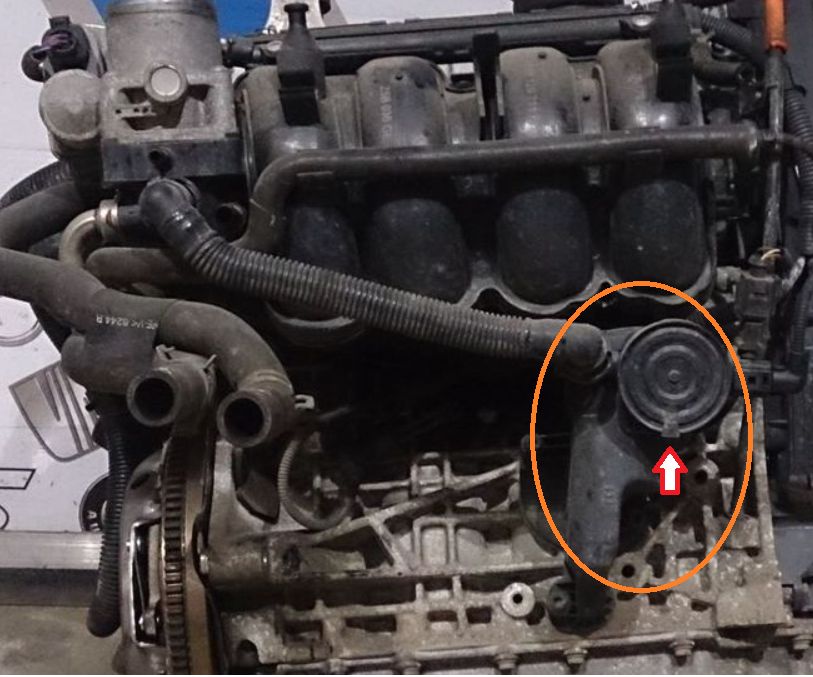
Probably not a worthwhile exercise as there is already such a device on the back of your engine block. Item 19 here: https://skoda.7zap.com/en/cz/fabia/fab/2011-697/1/103-103010/ Oil mist goes into the big hole by o-ring 17, gets centrifuged inside, oil drips out of the liquid outlet by o-ring 18, back into the sump. The de-misted vapour comes out via hose 28 to the inlet manifold just under the throttle body. A PCV diaphragm valve controls the flow rate so there isn't excessive flow at light throttle operation or idle. Items 28 and 29 here supply a little fresh air into the system to help flush through any flammable vapours https://skoda.7zap.com/en/cz/fabia/fab/2011-697/1/103-103045/